
ASC 740 Quarterly Update Q1 2026: Key Tax Accounting Changes
The first quarter of 2026 delivered a wave of developments affecting how companies account for income taxes under ASC 740 quarterly update 2026 frameworks. From Treasury guidance on bonus depreciation elections to Supreme Court tariff rulings with immediate balance sheet implications, tax accounting teams face a complex environment requiring rapid response.
At SW Accounting & Consulting Corp, we advise public and private company clients through quarterly ASC 740 computations. This update synthesizes the highest-impact Q1 2026 developments based on Deloitte’s April 2026 Accounting for Income Taxes newsletter and our own analysis.
What Does Rev. Proc. 2026-17 Mean for Bonus Depreciation Elections? 🏗️
Rev. Proc. 2026-17 provides late election and revocation relief for taxpayers who want to make or change their IRC § 163(j) and § 168(k)(7) elections — allowing corrections that affect deferred tax assets and depreciation timing differences.
The 100% bonus depreciation phase-down has been one of the most consequential tax law changes of the past several years for capital-intensive businesses. With 100% bonus depreciation restored for qualified production property (QPP) — a specific category of property used in manufacturing activities — there are now new election choices to navigate:
- IRC § 168(k)(7) election: Opt out of bonus depreciation for a class of property. Some taxpayers want to preserve regular depreciation deductions in future years when rates may be higher.
- IRC § 163(j) election: Elect out of the business interest expense limitation for certain real property trades or businesses, with the trade-off of using ADS depreciation for nonresidential real property and residential rental property.
- Rev. Proc. 2026-17 relief: Taxpayers who made these elections on prior returns — or failed to make them — can use this new procedure to make corrections for open tax years, subject to specified conditions.
From an ASC 740 perspective, changes to these elections directly affect deferred tax assets and liabilities. A switch from ADS to MACRS depreciation (or vice versa) creates temporary differences that must be reassessed in the quarter the election change is made. Companies with significant fixed asset bases should model the deferred tax impact before making election changes under Rev. Proc. 2026-17.
In our practice, we have seen manufacturers rush to claim 100% bonus depreciation for QPP without modeling the ASC 740 impact. While the immediate tax savings are real, the full reversal of bonus depreciation DTLs must be tracked. If a valuation allowance is in place, the additional DTL from bonus depreciation may actually reduce the allowance — a counterintuitive but important ASC 740 interaction to document for auditors.
How Does New CAMT Guidance Affect ASC 740 in 2026? 💼
The IRS issued further CAMT (Corporate Alternative Minimum Tax) guidance in Q1 2026 addressing adjusted financial statement income (AFSI) adjustments for specific transaction types, affecting the deferred CAMT liability that large corporations must track under ASC 740.
The CAMT — a 15% minimum tax on AFSI for corporations with average annual AFSI exceeding $1 billion over three years — has created a new layer of ASC 740 complexity since its introduction. Corporations subject to CAMT must track CAMT credits (unused CAMT paid in excess of regular tax) as deferred tax assets.
Q1 2026 guidance addressed several AFSI adjustment questions:
- Partnership income inclusion: AFSI adjustments for income from partnerships where the corporation has a significant ownership interest
- Insurance company specific rules: Treatment of policyholder surplus accounts and insurance reserves in AFSI computation
- Section 45Z clean fuel production credit: Whether clean fuel credits reduce AFSI or create CAMT credit offsets — Treasury confirmed section 45Z credits do NOT reduce AFSI but do generate an eligible credit to offset CAMT liability
Large corporations should review their Q1 2026 CAMT credit position in light of the section 45Z clean fuel guidance. Companies with significant renewable fuel production activities may be generating CAMT credits faster than anticipated. These credits are deferred tax assets under ASC 740 and require recoverability assessment — particularly if a valuation allowance is already in place.
How Should Tariff Changes Under IEEPA Be Reflected in ASC 740? 🌎
The Supreme Court’s Q1 2026 ruling on executive authority under IEEPA (International Emergency Economic Powers Act) to impose tariffs created immediate accounting implications — higher import costs affect deferred tax calculations through inventory valuation and cost basis adjustments.
Tariffs imposed under IEEPA are treated as costs of imported goods, increasing inventory values. For ASC 740 purposes, this creates several considerations:
- Inventory temporary differences: LIFO and lower of cost or net realizable value (LCNRV) adjustments triggered by tariff-driven cost increases create new DTAs or DTLs
- Book/tax inventory method differences: LIFO is available for tax but not IFRS; under US GAAP, LIFO elections interact with tariff cost flow assumptions
- Economic substance doctrine: Treasury issued guidance in Q1 2026 on the economic substance doctrine in the context of supply chain restructuring responses to tariffs — sham transactions designed to avoid tariff costs may be recharacterized, affecting both customs and income tax positions
Companies rapidly restructuring supply chains in response to IEEPA tariffs should document the business purpose carefully. Both customs authorities and the IRS are examining cross-border arrangements entered into after tariff imposition for economic substance.
What Do the Section 987 Final Regulations Mean for ASC 740? 🔄
The finalized section 987 foreign currency regulations — which govern how US companies calculate FX gains and losses on foreign branch operations — create significant deferred tax entries for multinationals that have been deferring recognition under prior guidance.
Section 987 addresses how to compute income or loss from foreign qualified business units (QBUs) — essentially foreign branch operations. Under the longstanding transition relief (which had been extended repeatedly since 2010), many taxpayers deferred compliance. The final regulations end that deferral for most taxpayers beginning in 2026.
Key ASC 740 impacts include:
- Historic FX book/tax differences: Companies with branches must calculate cumulative FX differences since branch inception under the new regs. These create deferred tax assets or liabilities depending on whether the functional currency appreciated or depreciated.
- Transition elections: Taxpayers may elect various transition methods, each with different deferred tax profiles. The choice must be documented in the period the election is made.
- Uncertain tax position (UTP) considerations: Where the section 987 regulations’ validity is uncertain (several provisions were challenged in litigation), ASC 740-10 uncertain tax position reserves may be required.
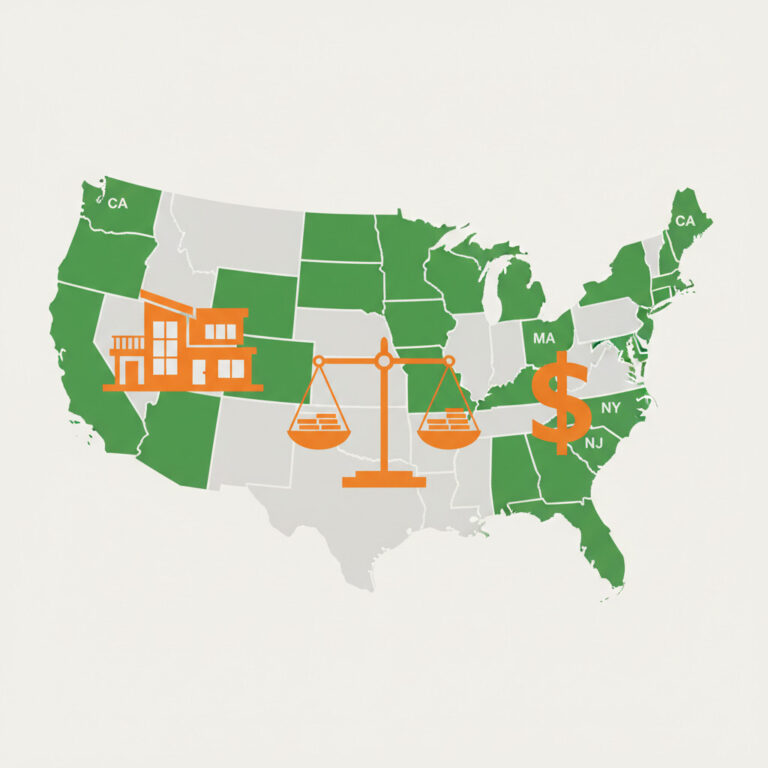
Which States Had Major Tax Changes Affecting ASC 740 in Q1 2026? 🗺️
Twenty-eight states enacted or proposed significant income tax changes in Q1 2026, ranging from conformity updates to new apportionment formula modifications — each requiring deferred tax reassessment for affected taxpayers.
The multistate environment remains one of the most dynamic areas of tax accounting. Q1 2026 highlights include:
- Federal conformity updates: Multiple states enacted or considered conformity to the TCJA bonus depreciation restoration and other federal changes — affecting state DTAs and DTLs separately from federal
- Market-based sourcing expansions: Several states extended market-based sourcing rules to service revenue, changing the apportionment formula for companies with multistate service activities
- Combined reporting changes: States continuing to move toward mandatory combined filing for related party groups, which affects how companies compute state taxable income and state effective tax rates
- SALT deduction cap responses: Pass-through entity (PTE) tax legislation in additional states allows partnerships and S corporations to elect entity-level state tax payments as a workaround to the federal SALT deduction cap
For ASC 740 purposes, state rate changes enacted during Q1 2026 must be reflected in deferred tax balances as of the enactment date, not the effective date. Companies with significant deferred tax balances in affected states should re-run their state deferred tax calculations promptly after legislative enactment. For more detail on these topics, see the Deloitte April 2026 Accounting for Income Taxes Newsletter.
As of Q1 2026, over 140 countries have enacted or are implementing Pillar Two global minimum tax rules. The US has not enacted domestic Pillar Two legislation, but US multinationals face exposure through the UTPR (Undertaxed Profits Rule) in jurisdictions that have enacted it. Under ASC 740, the IAS 12 Pillar Two exception does not apply — US GAAP companies must recognize current and deferred tax effects of Pillar Two under existing ASC 740 guidance.
Frequently Asked Questions ❓
Key Takeaways: ASC 740 Q1 2026
- Rev. Proc. 2026-17 allows late bonus depreciation election changes — model deferred tax impact before acting
- Section 45Z clean fuel credits offset CAMT but do not reduce AFSI — update CAMT DTA calculations
- Section 987 final regs end transition relief — reassess cumulative FX deferred taxes for foreign branches
- 28 states with Q1 2026 tax changes require immediate deferred tax remeasurement at enactment date