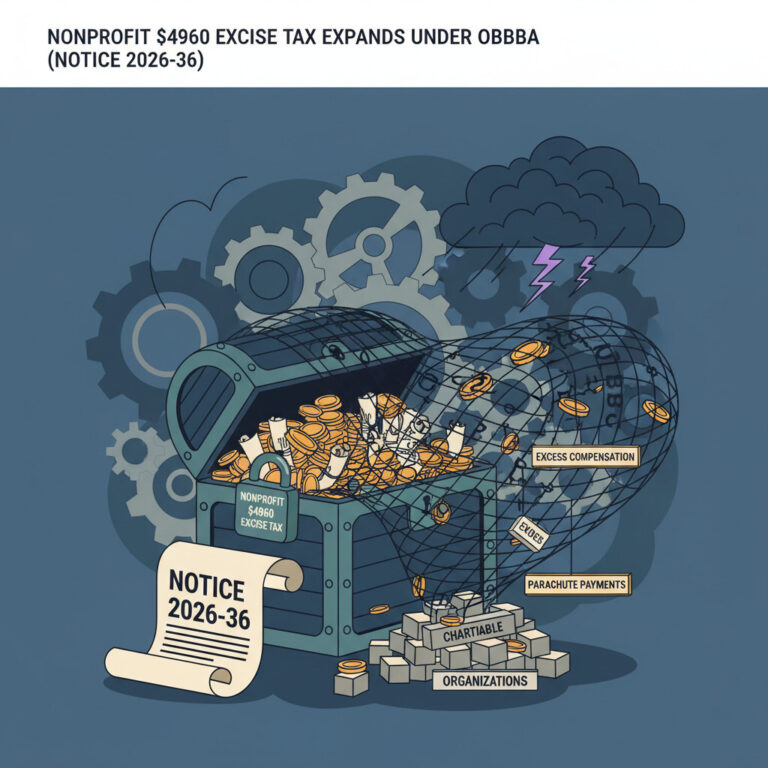

Illustration of the expanded IRC section 4960 21% excise tax on nonprofit executive compensation over $1 million under OBBBA and IRS Notice 2026-36
|

Nonprofit §4960 Excise Tax Expands Under OBBBA (Notice 2026-36)

How did OBBBA expand the §4960 excise tax on nonprofit executive compensation? Internal Revenue Code §4960 imposes a 21% excise tax on a tax-exempt organization’s “excess remuneration” — compensation over $1 million paid to a covered employee — plus certain excess parachute (separation) payments. Under the One, Big, Beautiful Bill Act, beginning with tax years…

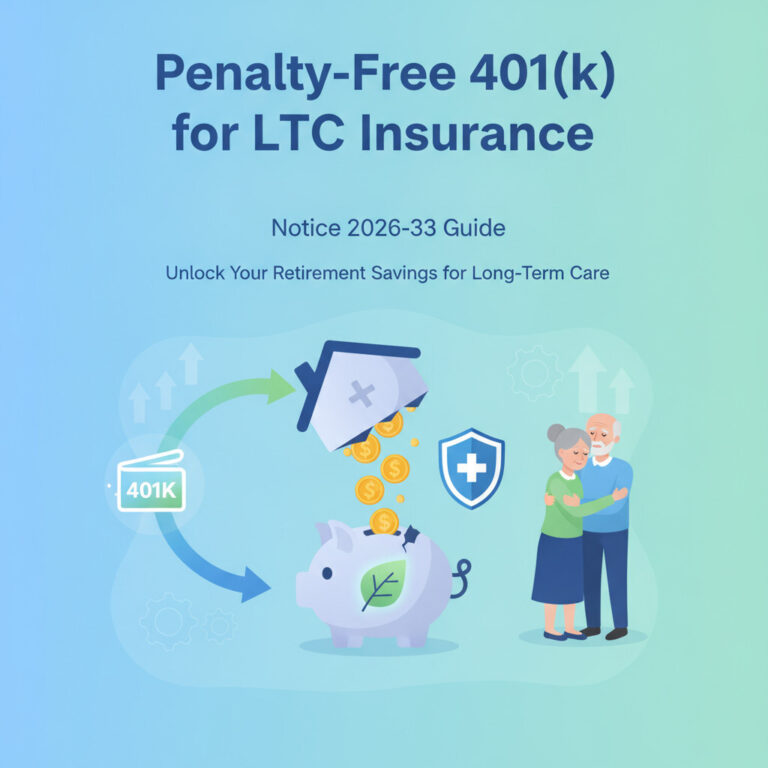
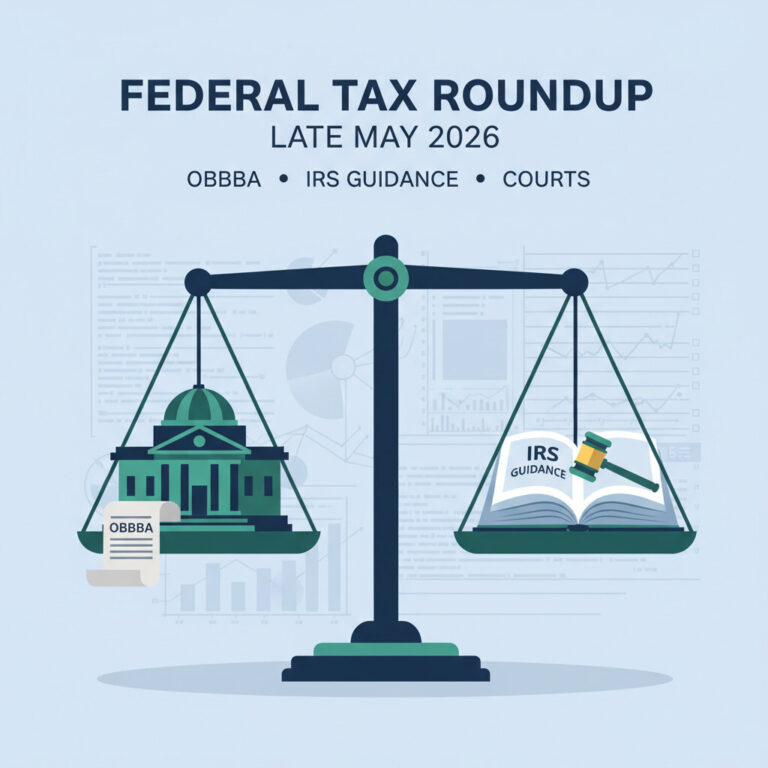
Illustration of late May 2026 federal tax roundup — JCT OBBBA report, Treasury IRS guidance T.D. 10048 and Notice 2026-33, House tax bills, and Tax Court section 6038(b) rulings
|

Federal Tax Roundup Late May 2026: OBBBA, IRS Guidance, Courts

What are the most important federal tax developments from late May 2026? Four stand out. (1) The Joint Committee on Taxation released a 341-page provision-by-provision report on the One, Big, Beautiful Bill Act (OBBBA, P.L. 119-21) and flagged 10 provisions that may need technical correction. (2) Treasury and the IRS issued new guidance — final…

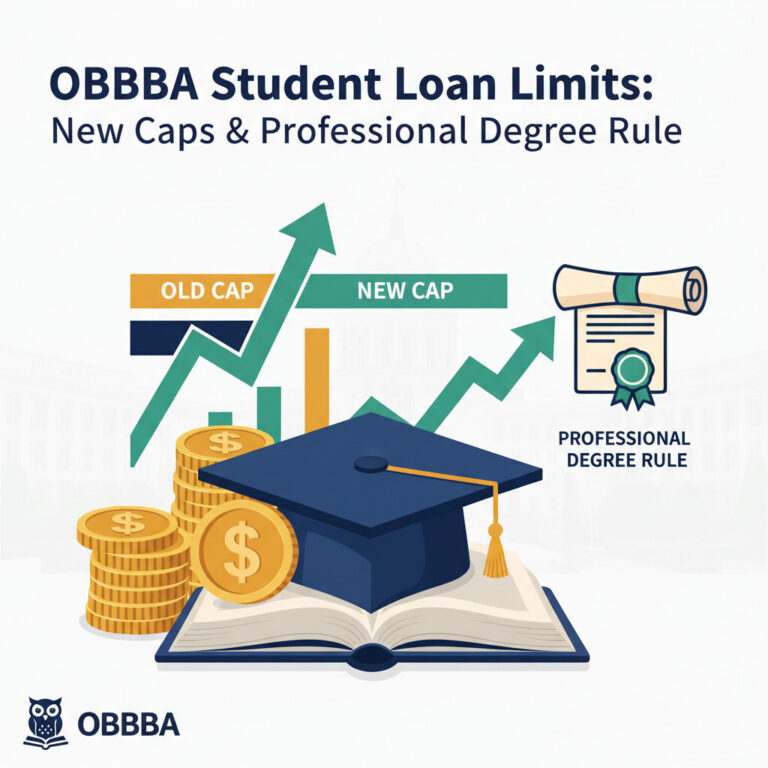
Illustration of OBBBA federal student loan limits and the Department of Education professional degree rule — $200K professional vs $100K other graduate caps, accounting excluded
|

OBBBA Student Loan Limits: New Caps & Professional Degree Rule

How did OBBBA change federal student loans for graduate and professional students? The One, Big, Beautiful Bill Act (OBBBA, Pub. L. No. 119-21) placed new caps on federal student loans and directed the U.S. Department of Education (DOE) to define which “professional degree” programs qualify for higher borrowing limits. Under the DOE’s final rule, only…

Illustration of 2026 homeowner tax deductions — the new $40,000 SALT cap on real estate taxes, mortgage interest limits, and non-deductible home costs on IRS Schedule A
|

Homeowner Tax Deductions 2026: New $40,000 SALT Cap Guide

What home expenses can you actually deduct in 2026 — and what’s the new SALT cap? To deduct homeownership expenses you must ITEMIZE. The two main deductible items are (1) state and local real estate taxes — now subject to a $40,000 limit ($20,000 if married filing separately) under the increased SALT deduction cap —…

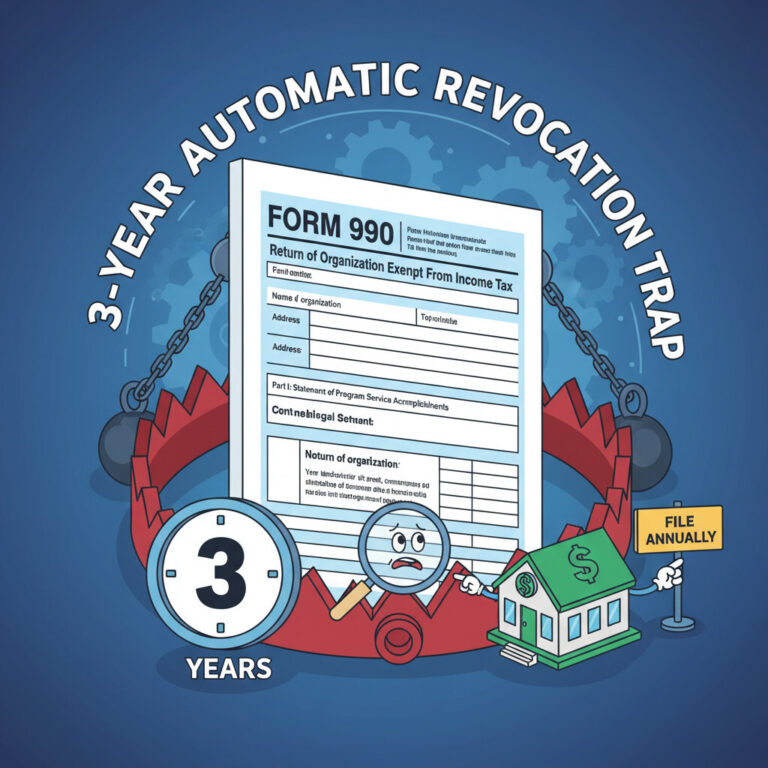
Illustration of Form 990 filing requirements and the IRC section 6033(j) three-year automatic revocation trap for tax-exempt nonprofit organizations
|

Form 990 Filing & the 3-Year Automatic Revocation Trap

Which Form 990 must your nonprofit file, and what happens if you miss it? Most tax-exempt organizations must file an annual return in the Form 990 series, due by the 15th day of the 5th month after the organization’s accounting period ends (May 15 for calendar-year filers). Which form you file — 990-N, 990-EZ, 990,…

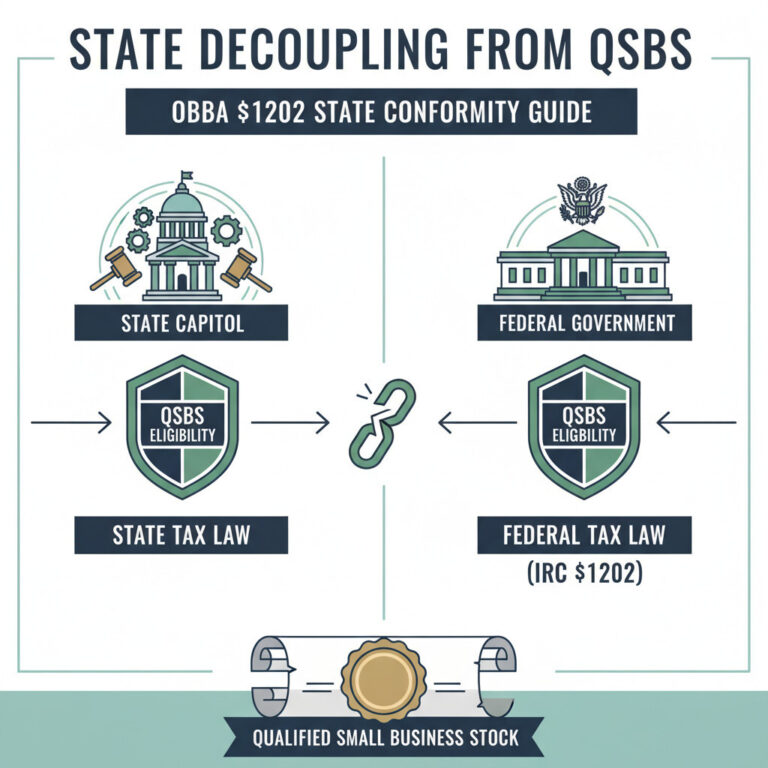
Illustration of state decoupling from federal QSBS section 1202 exclusion under OBBBA — Maine and Oregon decoupled, California taxes QSBS gains, state conformity risk for founders
|

State Decoupling from QSBS: OBBBA §1202 State Conformity Guide

Do states follow the federal QSBS exclusion under OBBBA — and why does state conformity matter? Not automatically. The One Big Beautiful Bill Act (OBBBA, Pub. L. No. 119-21) expanded the federal Qualified Small Business Stock (QSBS) exclusion under IRC §1202 — but states set their own conformity. Maine and Oregon have enacted legislation DECOUPLING…

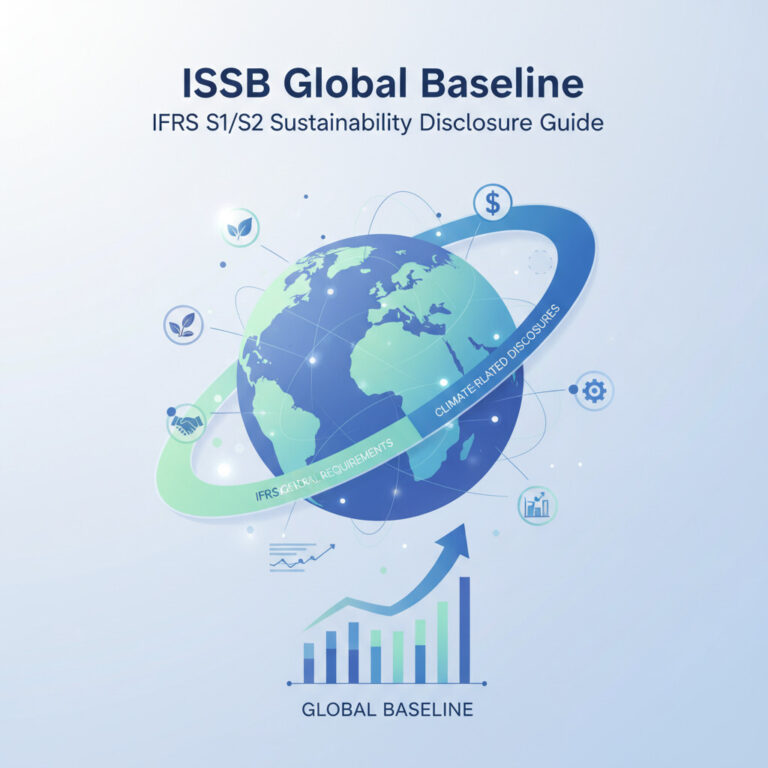
Illustration of the ISSB global baseline for sustainability disclosure — IFRS S1 and IFRS S2 four-pillar framework converging across China CSDS, EU CSRD, and US California SB 253/261
|

ISSB Global Baseline: IFRS S1/S2 Sustainability Disclosure Guide

What is the ISSB global baseline for sustainability disclosure, and why does it matter in 2026? The International Sustainability Standards Board (ISSB) — established by the IFRS Foundation — issued IFRS S1 (general sustainability-related financial disclosures) and IFRS S2 (climate-related disclosures) as a global baseline for how companies report sustainability information to investors. By 2026,…

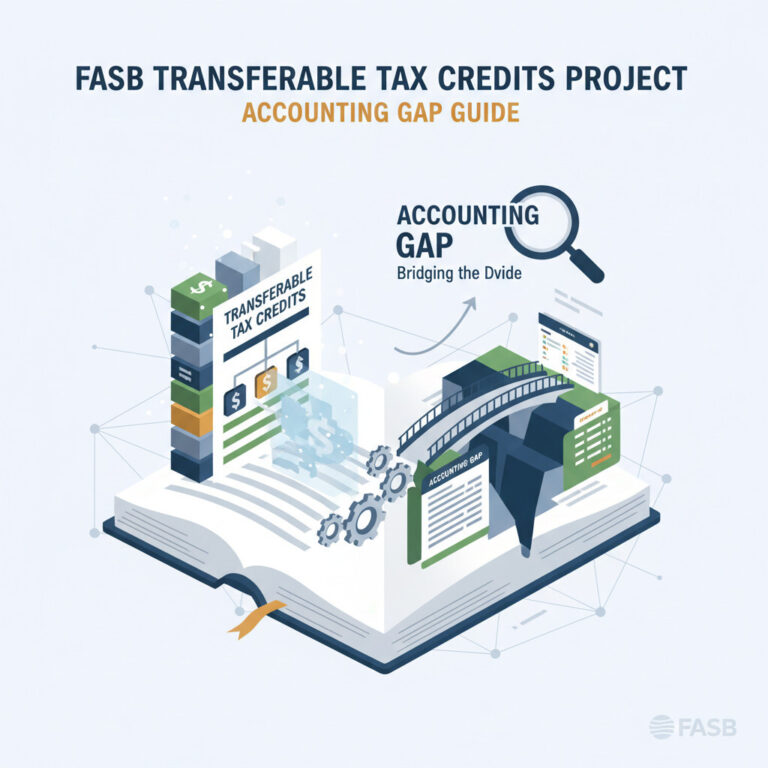
Illustration of FASB transferable tax credits accounting project — IRA, CHIPS, and OBBBA credit accounting gap, ASC 740 vs ASC 832 analogies, recognition triggers
|

FASB Transferable Tax Credits Project: Accounting Gap Guide

How should companies account for transferable tax credits under U.S. GAAP? The Financial Accounting Standards Board (FASB) voted in May 2026 to advance a project on the accounting treatment of nonrefundable transferable tax credits — including the Inflation Reduction Act (IRA) clean energy credits under IRC §6418, CHIPS and Science Act semiconductor credits, and One…

Illustration of Social Security imposter scam red flags — SSA OIG warning about doctored badge photos, gift card demands, and federal fraud reporting channels
|

Social Security Imposter Scam: SSA OIG Red Flags + Reporting

How can you tell a Social Security imposter scam from a real government contact? The Social Security Administration Office of the Inspector General (SSA OIG) issued a fresh warning in 2026 about a rising imposter scam: criminals impersonate real federal employees by harvesting names from social media and sending doctored badge photos to “verify” their…

Illustration of IRS Offer in Compromise process — Form 656-B application, Reasonable Collection Potential calculation, and 2026 Dirty Dozen OIC mills warning
|

IRS Offer in Compromise: Form 656-B + 2026 OIC Mills Warning

How does the IRS Offer in Compromise work, and how do you avoid OIC mills? An IRS Offer in Compromise (OIC) is a legally-binding agreement between a taxpayer and the IRS to settle outstanding tax debt for less than the full amount owed. You apply with Form 656-B (Offer in Compromise Booklet) plus a $205…

Illustration of IRS No Tax on Tips final regulations under the One Big Beautiful Bill — Treasury Tipped Occupation Code list and qualified tips definition
|

No Tax on Tips Final Regulations: 70+ Occupations, Qualified Tips Guide

Who qualifies for the No Tax on Tips deduction under the final regulations? The Treasury and IRS issued final regulations on April 10, 2026 (IR-2026-49) implementing the “No Tax on Tips” deduction under the One, Big, Beautiful Bill Act (OBBBA). Workers in 70+ occupations on the Treasury Tipped Occupation Code (TTOC) list can deduct qualified…

Illustration of ASU 2023-05 joint venture formations accounting — fair value measurement at formation date under Subtopic 805-60
|

ASU 2023-05 Joint Venture Formations: Fair Value Accounting Guide

What does ASU 2023-05 require for joint venture formation accounting? Under FASB Accounting Standards Update 2023-05, joint ventures must record assets received and liabilities assumed at fair value at the formation date — adopting a new basis of accounting on day one. The guidance is in new Subtopic 805-60 and is effective prospectively for any…

Illustration of FASB equity method targeted improvements 2026 — significant influence threshold and GP partnership investment treatment
|

FASB Equity Method Targeted Improvements: 2026 Tentative Board Decisions

What did the FASB decide on equity method targeted improvements at the May 13, 2026 Board meeting? The FASB tentatively decided to apply a single “significant influence” threshold for the equity method regardless of entity type, remove the 20% presumption, broaden the board-of-directors indicator to functionally-equivalent governing bodies, and require general-partner significant-influence treatment for noncontrolling…

Sec semiannual reporting form 10 s proposed rules featured
|

SEC Semiannual Reporting Framework: Form 10-S Proposed Rules

What is the SEC’s proposed semiannual reporting framework? On May 5, 2026 the SEC proposed rules allowing public companies to opt into semiannual reporting via a new Form 10-S — replacing three Form 10-Q filings per year with one mid-year report. Quarterly remains the default; semiannual is an annual opt-in election made on the cover…

Asu 2023 09 income tax disclosures fortune 500 first year featured
|

ASU 2023-09 Income Tax Disclosures: Fortune 500 First-Year Adoption

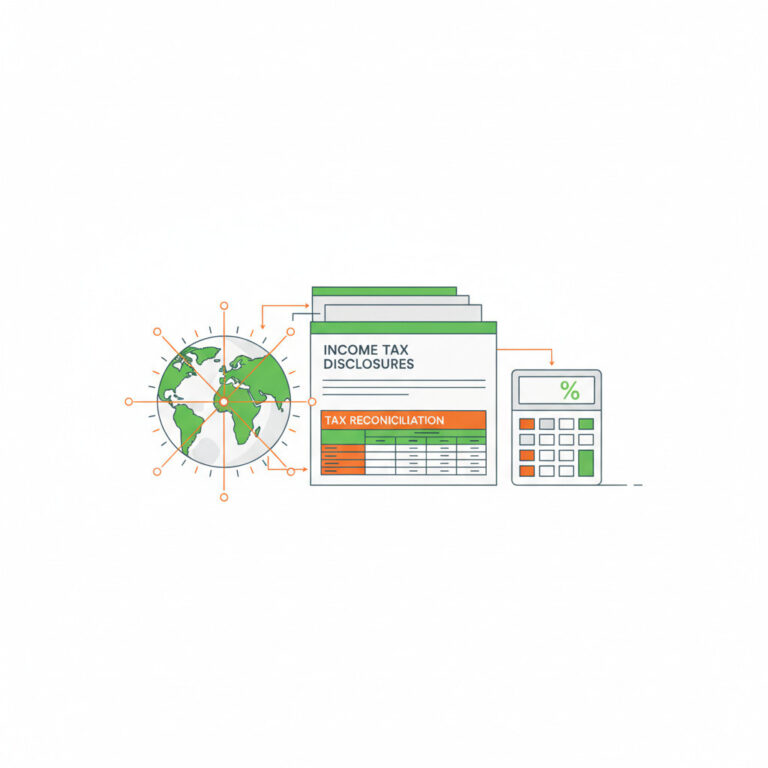
What is ASU 2023-09 and how are companies handling the new income tax disclosures in their first year? ASU 2023-09 requires public business entities to disclose an eight-category income tax rate reconciliation in both percentages and dollar amounts, plus jurisdictional disaggregation by state and country — and Fortune 500 first-year adoption shows California and Canada…

Ai disclosures 10k fortune 500 2025 sec focus featured
|

AI Disclosures 10-K: Fortune 500 2025 Trends and SEC Focus

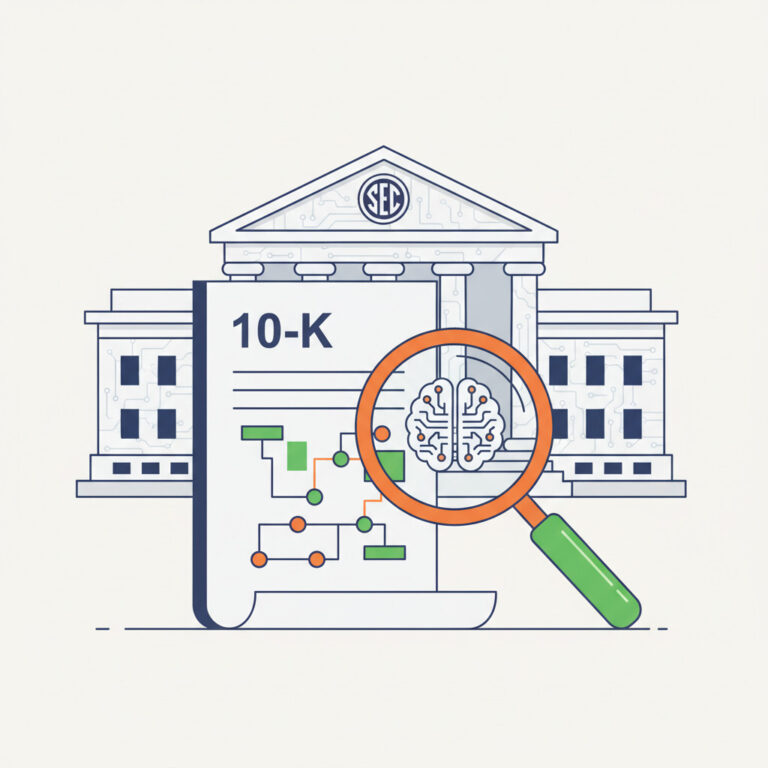
What are the latest AI disclosures 10-K trends among Fortune 500 companies? 95% of Fortune 500 registrants now disclose AI-related matters in their 10-Ks (up from 84%), with Risk Factors leading at 95% — and the SEC is signaling a shift in focus toward AI governance, explainability, and emerging fraud risks. If you’re drafting your…

Government grants accounting us gaap featured
|

Government Grants Accounting: US GAAP Treatment and Disclosures

How should businesses account for government grants under US GAAP? US GAAP has no comprehensive standard for business government grants, so entities apply an accounting policy by analogy — typically IAS 20 (deferred income or net asset reduction), ASC 958-605 contribution model, or revenue recognition — and now must comply with ASU 2024-04’s enhanced disclosure…

Pik dividends measurement asu 2026 01 featured
|

PIK Dividends Measurement: ASU 2026-01 New FASB Guidance

What is the new PIK dividends measurement rule under ASU 2026-01? Issuers must measure paid-in-kind dividends on equity-classified preferred stock by multiplying the stated PIK dividend rate by the liquidation preference of the shares — eliminating the prior diversity in practice between discretionary and nondiscretionary approaches. On April 23, 2026 the FASB issued ASU 2026-01,…

Ferc gaap accounting differences 2026 featured
|

FERC GAAP Accounting Differences: 2026 Update for Utilities

What are the key FERC GAAP accounting differences for power and utility companies? FERC uses equity-method accounting for all subsidiaries regardless of ownership, classifies certain non-utility activities “below the line,” includes accumulated cost of removal in accumulated depreciation, and lacks the current/long-term distinction common in US GAAP — creating systematic reconciliation work for every regulated…

Internal use software capitalization asu 2025 06 featured
|

Internal Use Software Capitalization: ASU 2025-06 Explained

What changed for internal use software capitalization under ASU 2025-06? The FASB eliminated the old project-stage gating and replaced it with a single “probable-to-complete” threshold — finally aligning US GAAP with how agile software development actually works in 2026. If you’ve ever tried to apply the 1998 internal-use software rules to a modern agile sprint,…

Sec tokenized securities statement 2026 featured
|

SEC Tokenized Securities: 2026 Joint Statement Explained

Do securities laws apply to blockchain tokens? The SEC tokenized securities statement of January 28, 2026 confirms existing federal securities laws apply to blockchain-based tokens. No new rules, no safe harbor — just a clear reaffirmation that tokenization is a technical change, not a legal one. On January 28, 2026, three SEC divisions made something…

Asc 740 quarterly update 2026 featured
|

ASC 740 Quarterly Update Q1 2026: Key Tax Accounting Changes

What are the most important ASC 740 developments in Q1 2026? The ASC 740 quarterly update 2026 covers five major areas: Rev. Proc. 2026-17 election relief for bonus depreciation, new CAMT AFSI guidance, tariff accounting under IEEPA, section 987 FX final regulations, and significant multistate legislative activity across 28 states. The first quarter of 2026…

Ifrs 18 agenda decisions 2026 featured

IFRS 18 Agenda Decisions Q1 2026: 5 Key Changes Explained

What did the IFRIC decide in Q1 2026 regarding IFRS 18? The IFRIC finalized five binding IFRS 18 agenda decisions in its March 2026 update, addressing FX differences on intragroup loans, classification of non-income taxes, expense-by-nature disaggregation scope, parent entity main business activity, and FX derivative classification — all critical for entities preparing to adopt…

Ifrs 2026 updates featured
|

IFRS 2026 Updates: IFRS 18, IFRS 9 Amendments & What Changes This Year

What are the key IFRS 2026 updates? The most important IFRS 2026 updates include IFRS 9 amendments for financial instrument classification and nature-dependent electricity contracts effective January 1, 2026, the upcoming IFRS 18 replacing IAS 1 effective January 2027, and the March 2026 IASB decisions on IFRS 10 Consolidated Financial Statements — changes that require…

Fasb hedge accounting updates 2026 featured

FASB Hedge Accounting Updates 2026: What Every CPA Must Know

What are the new FASB hedge accounting changes for 2026? The FASB approved targeted improvements in February 2026 that allow hedging of interest rate risk for held-to-maturity (HTM) debt securities, remove the OIS parameter from the SOFR benchmark rate, and expand net investment hedging for float-to-float cross-currency swaps. These changes apply to all entities and…

Ifrs 18 financial statement featured
|

IFRS 18 Explained: The New Financial Statement Presentation Standard Replacing IAS 1

What is IFRS 18 and when does it take effect? IFRS 18, the new standard that replaces IAS 1, fundamentally redesigns how companies present financial statements. It is mandatory for annual periods beginning on or after January 1, 2027 — but with the 2026 comparative period already underway, companies using IFRS must begin planning their…

Gasb 103 government reporting featured
|

GASB 103 Explained: Key Changes to Government Financial Reporting You Need to Know

What is GASB 103 and how does it change government financial reporting? GASB 103 is a major update to the government financial reporting model, effective for fiscal years beginning after June 15, 2025, that redefines operating vs. nonoperating revenues, introduces subsidy reporting, and strengthens MD&A requirements for state and local governments. If you work in…