How does OBBBA change the charitable deduction in 2026?
Every November, a client calls our Los Angeles office with a familiar question: how much of the check I write to my church, my alma mater, or the food bank is actually going to come back to me at tax time? The honest answer for years has been “all of it, up to the AGI ceilings.” Starting with tax year 2026, that answer has to change. The One Big Beautiful Bill Act of 2025 introduced two new limits that shrink the charitable deduction for almost every itemizer and a third rule that opens a new deduction for people who do not itemize. This post walks through what the statute actually says, who feels the hit, and the planning levers that still work under the primary-source rules in IRC §170 and IRC §68.
What does OBBBA actually change about the charitable deduction? 📜
OBBBA adds a 0.5%-of-AGI floor on itemized charitable contributions, a 2/37ths reduction on itemized deductions for top-bracket taxpayers, and a new above-the-line charitable deduction for non-itemizers of up to $2,000. All three take effect for tax year 2026.
The One Big Beautiful Bill Act was enacted in July 2025 as H.R.1 of the 119th Congress (OBBBA). It amended IRC §170 to add paragraph (p), which creates the 0.5%-of-AGI floor on an individual’s itemized charitable contributions. It also amended IRC §68 to replace the old (and long-dormant) Pease limitation with a 2/37ths reduction aimed at taxpayers in the top federal bracket. And it created a new above-the-line deduction of up to $1,000 (single) or $2,000 (joint) for cash gifts to public charities by taxpayers who claim the standard deduction. The IRS page on charitable contribution deductions walks through the general rules; the OBBBA-specific overlays are what change the math for 2026 returns.
Taken together, these pieces do three things. For most itemizers, the charitable deduction is a little smaller than it used to be at the same donation level. For the highest earners, each dollar of itemized deduction is worth 35 cents of tax saved rather than 37. And for roughly nine-in-ten filers who take the standard deduction, there is finally a real, if modest, tax reward for giving again — the first permanent above-the-line charitable deduction for non-itemizers since the pandemic-era rules expired.
How does the 0.5% AGI floor on the charitable deduction work? 📏
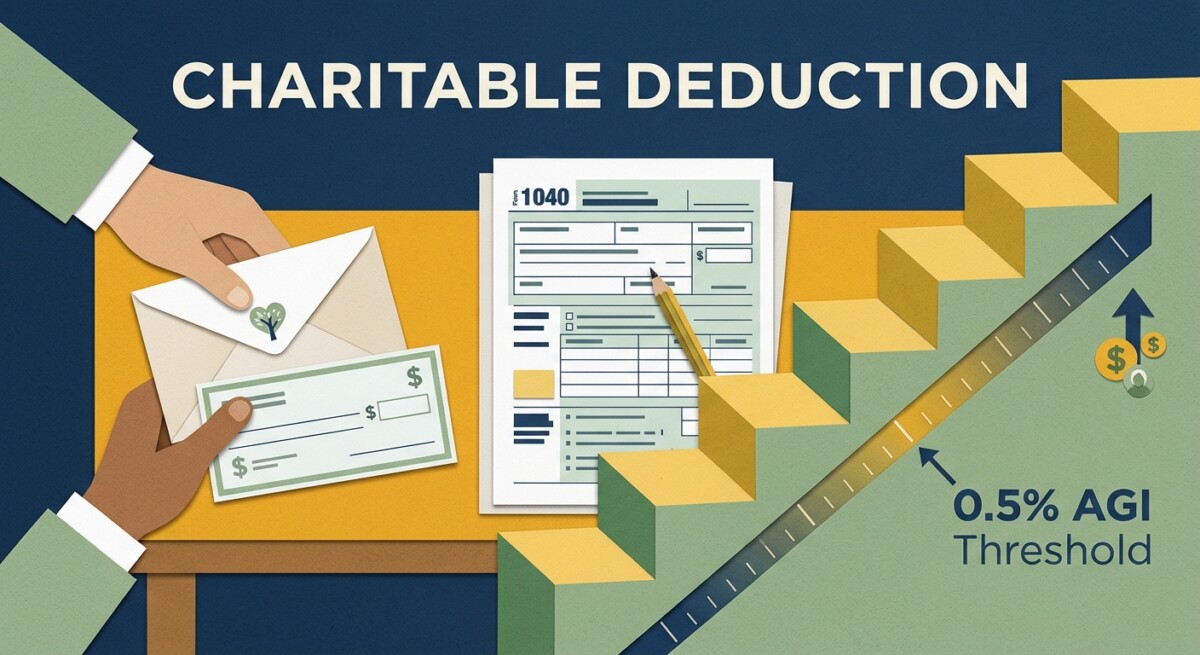
Your Schedule A charitable deduction is reduced by 0.5% of your adjusted gross income. If your total charitable contributions for the year are less than that floor, the deduction is reduced to zero.
The mechanics are blunt. Take total charitable contributions that would otherwise be deductible on Schedule A, subtract 0.5% of your AGI, and the remainder is what carries into the regular percentage-of-AGI limits (60%, 50%, 30%, or 20% depending on the asset and the donee) that already live in IRC §170(b). In practice this creates a small hurdle every year:
| AGI | 0.5% floor | If you give $1,000 | If you give $5,000 | If you give $25,000 |
|---|---|---|---|---|
| $100,000 | $500 | $500 deductible | $4,500 deductible | $24,500 deductible |
| $200,000 | $1,000 | $0 deductible | $4,000 deductible | $24,000 deductible |
| $500,000 | $2,500 | $0 deductible | $2,500 deductible | $22,500 deductible |
| $1,000,000 | $5,000 | $0 deductible | $0 deductible | $20,000 deductible |
The floor is a one-way reduction: it never adds a benefit, it only subtracts. For a household in the 24% federal bracket, a $1,000 floor costs about $240 of federal tax, plus state tax where the state conforms. For higher-AGI households, the hard-dollar hit grows linearly with income — $5,000 of floor at $1 million of AGI, $25,000 of floor at $5 million. The deduction of amounts above the floor is unchanged, and unused amounts still carry forward for five years under the existing IRC §170(d)(1) rules.
One quirk: because the floor is applied before the regular 60%/50%/30%/20% ceilings, a very large single-year gift still has to clear both tests. The floor is subtracted first; the remainder is then limited to the applicable percentage of AGI; anything left over carries forward.
Who actually gets hit by the 2/37ths itemized deduction cap? 🧮
Only taxpayers whose taxable income (before itemized deductions) crosses into the 37% federal bracket. For 2026 that is roughly $640,000 of taxable income for single filers and about $768,000 for joint filers; the IRS publishes the final 2026 thresholds in its annual inflation adjustments.
The 2/37ths reduction in IRC §68 is best understood as a 35% cap on the tax value of each dollar of itemized deduction that sits inside the 37% bracket. You add every itemized deduction — mortgage interest, state and local taxes within the SALT cap, charitable gifts, and the rest — back to taxable income. Any portion of that re-grossed income above the 37% bracket threshold is subject to a 2/37ths haircut. The result: a deduction that would otherwise save 37 cents on the dollar saves 35 cents instead.
For a top-bracket household with $100,000 of itemized deductions, the 2/37ths rule costs roughly $5,400 of federal tax. It is real money, but it is also narrow: it applies only to the slice of income (and deductions) above the 37% threshold, so most itemizers never see it. Taxpayers in the 32% bracket or below are unaffected, which is why the OBBBA charitable rules feel very different depending on where you sit on the income curve.
The 2/37ths cut applies after the 0.5% floor
Order of operations matters. On a top-bracket return, the 0.5%-of-AGI floor reduces the charitable deduction first; what remains is then part of total itemized deductions, which is where the 2/37ths cap bites. A single $10,000 cash gift at $2 million of AGI thus runs the gauntlet twice: $10,000 of gifts less a $10,000 floor equals a $0 charitable deduction before the 2/37ths cap is even considered. The IRS will publish the final applied formula in revised Schedule A instructions and in IRS Publication 526.
What stays the same, and where did the big exceptions survive? 🔎
The 60%/50%/30%/20%-of-AGI ceilings, the five-year carryover, qualified charitable distributions from IRAs, and the fair-market-value rules for long-term appreciated publicly traded stock are all unchanged. The new above-the-line deduction for non-itemizers is a genuine win.
- Percentage ceilings still apply. Cash gifts to public charities remain deductible up to 60% of AGI; appreciated long-term capital-gain property to public charities remains deductible up to 30% of AGI; gifts to most private non-operating foundations are capped at 30% (cash) or 20% (property). The 0.5% floor sits below these ceilings; it does not replace them.
- Carryovers continue. Amounts above the applicable ceiling carry forward for five years under IRC §170(d), as before. Carryover amounts generated under the new rules follow the same five-year clock.
- Appreciated-stock gifts are still powerful. A gift of long-term appreciated publicly traded stock to a public charity still avoids the capital gains tax on the appreciation and generally produces a fair-market-value deduction under IRC §170(e). The 0.5% floor and the 2/37ths cap both apply to the deduction side, but the untaxed appreciation is not a deduction and is not clipped.
- Qualified charitable distributions still work. An IRA owner age 70½ or older can direct cash from the IRA to a qualifying public charity under IRC §408(d)(8). The amount is excluded from gross income rather than deducted, so neither the 0.5% floor nor the 2/37ths cap applies. The indexed annual cap and the required-charity list are described in IRS Publication 590-B.
- The new $2,000 above-the-line deduction. OBBBA adds a permanent deduction for cash gifts to public charities for taxpayers who claim the standard deduction, capped at $1,000 (single) or $2,000 (joint). It is not subject to the 0.5% floor or the 2/37ths cap. Donor-advised funds and private non-operating foundations are excluded.
What should donors and advisors actually do before year-end? ✅
Clear the floor on purpose, use a donor-advised fund to bunch, run the QCD numbers for anyone 70½ or older, and model the hit for top-bracket clients so the surprise arrives in October planning, not in April filing.
- Decide whether to clear the floor or skip it. If a client’s planned giving sits near 0.5% of AGI, pulling additional gifts into 2026 or deferring them into a bunching year can be the difference between a full deduction and zero.
- Use a donor-advised fund to bunch. Front-loading three or five years of giving into 2026 exposes only one year’s AGI to the 0.5% floor and leaves future years below the standard-deduction line. The DAF then grants to charities on the donor’s normal schedule.
- Run the QCD math for anyone 70½ or older. A QCD under IRC §408(d)(8) sidesteps both OBBBA limits and can satisfy part of the required minimum distribution for clients 73 or older. The indexed annual cap is published yearly in IRS Publication 590-B.
- Model the 2/37ths cut on top-bracket returns. For clients likely to clear the top-bracket threshold on taxable income before itemized deductions, add a 2/37ths haircut line to the itemized-deduction schedule in your planning tool so the number is on the page in October, not in April.
- Capture the $2,000 for standard-deduction clients. Make sure any client who takes the standard deduction keeps a 2026 record of cash gifts (acknowledgment letters, bank statements) so the new above-the-line deduction actually lands on the return.
From our practice: 0.5% is small per return, big across a book
In our Los Angeles practice, the 0.5% floor is rarely the number that changes a client’s giving plan on its own. It is small enough that philanthropic donors treat it as rounding. What it does change is the planner’s work: once a client has twenty bank-account-level cash gifts of $100 each over the year, the floor quietly erases most of them. A single annual gift of the same total amount gets the same tax result with far less paperwork. The lesson is operational more than strategic — consolidate the giving, keep the acknowledgment letters, and the new rules barely touch the donor who was going to give anyway.
Summary: OBBBA charitable deduction in 2026
- A new 0.5%-of-AGI floor reduces every itemized charitable deduction and zeroes out gifts below the floor.
- A 2/37ths cap on itemized deductions in the 37% bracket shrinks the per-dollar value of each deduction to 35 cents on the top-bracket slice.
- A new above-the-line deduction of up to $1,000 (single) or $2,000 (joint) is available for non-itemizers; donor-advised funds and private non-operating foundations are excluded.
- QCDs under IRC §408(d)(8) and gifts of long-term appreciated stock remain the strongest ways to give without feeding either new limit.
- The percentage-of-AGI ceilings (60%/50%/30%/20%) and the five-year carryover under IRC §170 are unchanged.
Frequently asked questions about the charitable deduction under OBBBA ❓
Q. Does the new 0.5% AGI floor really wipe out small donations?
In many cases, yes. If your total charitable contributions for the year are less than 0.5% of your adjusted gross income, the floor reduces the deduction to zero. For a household with $200,000 of AGI, that threshold is $1,000. Donations above the floor are deductible, but only to the extent they exceed it. The floor is applied before the regular percentage-of-AGI contribution limits in IRC §170.
Q. How does the 2/37ths reduction interact with the 0.5% AGI floor?
They stack. The 0.5% floor from the 2025 OBBBA amendments to IRC §170 is applied first to the charitable deduction itself. The 2/37ths reduction from new IRC §68 then applies on top, but only to the portion of itemized deductions that falls inside the 37% bracket. In effect, a top-bracket taxpayer who clears the floor still sees the benefit on each extra dollar capped at 35%, not 37%.
Q. Does the $2,000 non-itemizer charitable deduction count against the floor?
No. OBBBA adds a separate above-the-line charitable deduction for non-itemizers of up to $1,000 for single filers and $2,000 for joint filers. It sits outside IRC §170(b) and is not reduced by the 0.5% AGI floor or by the 2/37ths cut. It only covers cash gifts to public charities, not gifts to donor-advised funds or private non-operating foundations.
Q. Can IRA owners avoid the floor by using a qualified charitable distribution?
Yes, within limits. IRC §408(d)(8) lets IRA owners 70½ or older direct up to the indexed annual cap (reported each year by the IRS) directly from the IRA to an eligible charity. The transfer is excluded from gross income instead of being deducted, so the 0.5% floor and the 2/37ths cut never touch it. A QCD can also count toward the required minimum distribution for the year.
Q. Does bunching donations into one year really help under OBBBA?
Often, yes. Because the 0.5% floor applies every year, spreading $5,000 of giving across five years can lose part of it to five separate floors. Front-loading five years of giving into one year — frequently through a donor-advised fund so the grants to charities still go out annually — exposes only one year’s AGI to the floor and leaves four years below the standard-deduction line.
Q. Are donations of appreciated stock still worth more than cash under the new rules?
Usually, yes. A gift of long-term appreciated publicly traded stock to a public charity still avoids capital gains on the appreciation and generally qualifies for a fair-market-value deduction under IRC §170(e). The 0.5% floor and the 2/37ths cut apply to the deduction, but the untaxed appreciation is not a deduction and is unaffected.
Q. Does the OBBBA charitable deduction change apply to C corporations?
C corporations have a separate 1% taxable-income floor under the 2025 amendments to IRC §170(b)(2), modeled on the individual rule, with a corresponding deduction above the floor subject to the existing 10% ceiling. The individual-side details discussed here — the 0.5% AGI floor and the 2/37ths cap — are specific to IRC §170(b)(1) and IRC §68.
This article is general information, not tax or legal advice for your situation. Charitable planning depends on your facts, your state’s conformity, and the IRS’s final 2026 inflation adjustments. For a confidential review, contact SW Accounting & Consulting Corp.