Are IRS partnership audits really down in 2026?
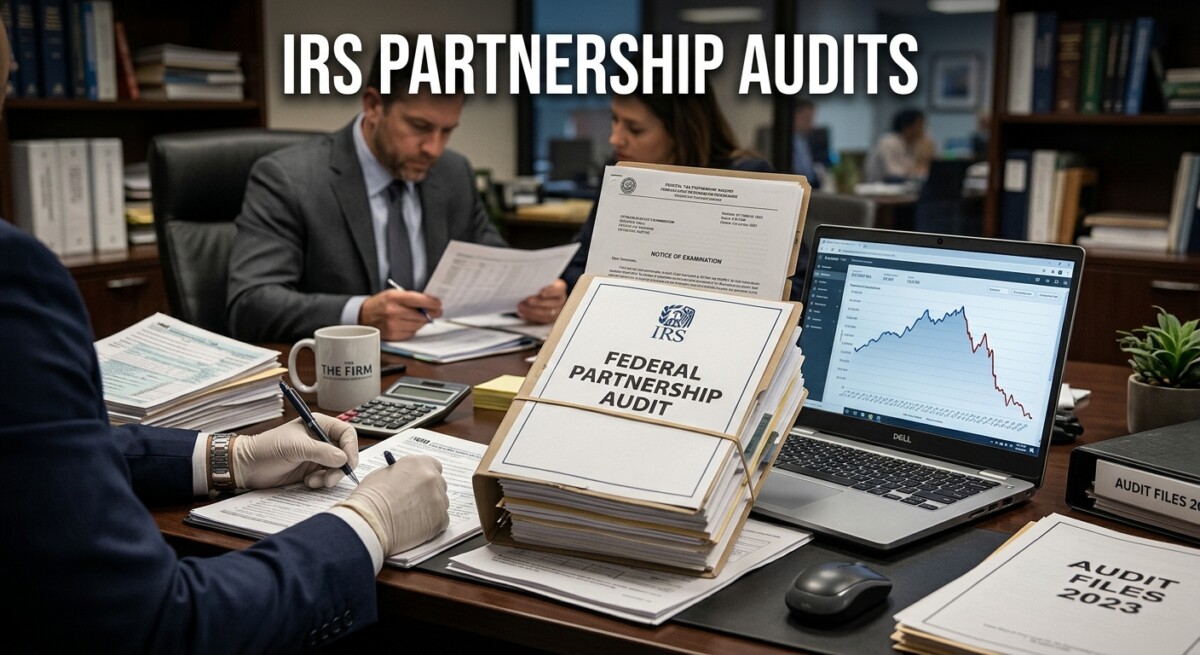
A client calls after reading a headline that the IRS is retreating from partnership enforcement. The question is always the same: do they still need to worry about an exam? The honest answer is more nuanced than the headline. Government oversight reports show the pace of IRS partnership audits has slowed sharply since fiscal year 2023, but the regime that decides who pays when a partnership adjustment lands has not changed, and the biggest partnerships are still being picked. The number of audits is down. The cost of being the one that is selected is not.
What did TIGTA report about IRS partnership audit activity? 📉
The Treasury Inspector General for Tax Administration (TIGTA) reported that partnership examination starts rose from 4,106 in fiscal year 2020 to 6,709 in fiscal year 2023, then fell to 2,285 in fiscal year 2024 and 1,589 in fiscal year 2025 — a decline of roughly 76% from the FY 2023 peak.
The upward phase of the data appears in TIGTA Report 2025-308-030 (August 2025), which reviewed pass-through examination coverage through fiscal year 2023 and documented a 63% increase in partnership examination starts over the FY 2020 baseline. The share of individual examinations TIGTA analyzed that involved returns reporting more than $400,000 climbed from 5.2% to 8.8% during the same period.
The reversal is documented in TIGTA Report 2026-3S-0045 (August 2026), which reports Treasury’s fiscal year 2025 performance data. Partnership examination starts dropped to 2,285 in FY 2024 and 1,589 in FY 2025. High-income individual examination starts fell from 4,326 in FY 2023 to 3,692 in FY 2025. Large-corporation examination starts moved in the other direction, from 1,400 to 1,483 over the same window. TIGTA reported that the IRS Pass-Through Entities program lost more than 20% of its staff during 2025 and concluded that the agency would need to reassess its large-partnership examination coverage goals.
| Metric | FY 2020 | FY 2023 | FY 2024 | FY 2025 |
|---|---|---|---|---|
| Partnership examination starts | 4,106 | 6,709 | 2,285 | 1,589 |
| High-income individual exam starts (reported) | — | 4,326 | — | 3,692 |
| Large-corporation exam starts | — | 1,400 | — | 1,483 |
Our read of the data
In our practice, the useful question is not whether the headline audit rate rose or fell this year. It is what happens if the IRS picks your return — and TIGTA’s figures show the agency is still running meaningful numbers of partnership examinations, including on the very largest partnerships, with fewer people to run them. Fewer starts, concentrated on bigger targets, means the exams that do open tend to be the complex ones.
Why are IRS partnership audits different from an individual exam? 🔍
A high-income return rarely stands alone. The IRS can follow the return through pass-through entities, closely held businesses, trusts, and related entities, so one disputed partnership issue can change several years of individual returns at the same time.
Current IRS high-income and high-wealth examination procedures expressly recognize that these taxpayers often operate through interconnected business entities and investments. A partnership adjustment can change an individual partner’s taxable income. A change to a partner’s outside basis can determine whether partnership losses were deductible. The sale of a partnership interest can involve both capital and ordinary-income components, and self-employment tax can turn on whether a partner qualifies for the limited-partner exception.
The IRS Large Business & International compliance campaigns page lists active issue-based campaigns that reach directly into partnership returns: partnership losses in excess of a partner’s basis, sales of partnership interests, and self-employment tax positions involving limited partners, among others. A partnership that lands inside one of those campaigns is not being audited at random — it is being audited for a position the IRS has already decided to pursue.
One adjustment, many returns
A single partnership-level change can cascade into multiple partner returns and multiple tax years. The factual record built during the first examination tends to decide how far the adjustment travels. Waiting until the Revenue Agent asks follow-up questions to think about that record is usually too late.
How did the BBA change who pays after an IRS partnership audit? 💸
Under the Bipartisan Budget Act of 2015, partnership-related adjustments are generally determined at the partnership level, and the resulting imputed underpayment is assessed and collected from the partnership itself in the adjustment year — not from the reviewed-year partners who originally benefited from the position.
The Bipartisan Budget Act of 2015 created the centralized partnership audit regime, generally applicable to partnership taxable years beginning after December 31, 2017. Unless an eligible partnership properly elects out, partnership-related adjustments are determined at the entity level. Any resulting imputed underpayment generally is assessed and collected from the partnership itself in the adjustment year, together with applicable penalties, additions to tax, and interest. That is a sharp departure from the traditional idea that partnerships pass items through to their partners instead of paying federal income tax at the entity level.
The practical problem is straightforward: when the partnership receives the tax bill, somebody has to fund it. Depending on the partnership agreement and the partnership’s cash position, the entity may use operating cash, borrow, suspend distributions, or make a capital call. The situation becomes contentious when ownership has changed between the reviewed year and the adjustment year — the IRS adjustment may concern partners who owned the business during the audited year, while the resulting tax becomes payable years later, when different partners own the partnership.
From our practice: write the audit clauses before the audit
Partnership agreements that pre-date BBA often say nothing specific about who bears the cost of a prior-year examination. When the IRS adjustment lands years later, the silent agreement defaults to the current partners. In our practice, the fairest results come from agreements that explicitly allocate audit-related liabilities to the reviewed-year partners, require indemnities from departing partners, and spell out when the partnership representative must consult the full partner group before binding them.
Can a partnership push the IRS adjustment out to reviewed-year partners? 🚀
Yes, if the partnership representative makes a valid and timely election under Internal Revenue Code Section 6226. The 45-day period after the Final Partnership Adjustment cannot be extended, and the election shifts the adjustment to each reviewed-year partner’s own return.
The push-out election is the main escape valve inside the BBA regime. If the partnership representative makes a valid Section 6226 election within 45 days of the Final Partnership Adjustment, the partnership does not pay the imputed underpayment to which the election applies. Instead, the relevant adjustments flow out to the reviewed-year partners, who account for their shares on their own returns under the statutory rules, with interest at a rate two percentage points higher than the standard underpayment rate.
Before the push-out window opens, the partnership also has the right to request modification of the proposed imputed underpayment after the IRS issues a Notice of Proposed Partnership Adjustment. The partnership representative generally has 270 days from the NOPPA to submit modifications. Depending on the facts, modification can substantially reduce the ultimate imputed underpayment — for example, where tax-exempt partners, lower-rate partners, or amended returns from partners can bring the number down before any push-out decision is made.
Both procedures sit inside Internal Revenue Manual Part 4.31.9, which sets out how examiners run BBA cases in the field. The deadlines in the IRM are not negotiable: the 45-day push-out election period in particular is a statutory wall, not a target.
What should your partnership do before the next IRS examination notice? 🛡️
Confirm BBA status for each open year, lock in the partnership representative, align the partnership agreement with the regime, and build the documentation now that a BBA exam will eventually ask for.
- Confirm BBA or elected-out status for each open tax year. The election to opt out of the regime is made year by year on a timely filed Form 1065. If your partnership has a non-eligible partner (another partnership, a trust, a disregarded entity, certain foreign partners), it is in the BBA regime by default — no amount of planning after a notice arrives changes that.
- Treat the partnership representative role as a governance decision. The representative has sole authority to bind the partnership and its partners on settlements, modifications, extensions of the statute of limitations, and the push-out election. Partners other than the representative generally have no independent statutory right to participate. Choose the person, document the scope, and consider requiring consultation before certain actions.
- Update the partnership agreement. Add explicit allocation of audit-related liabilities to reviewed-year partners, indemnity language for departing partners, and procedural rules for the representative. Agreements written before BBA often default the economic cost to whoever happens to own the partnership when the IRS finally issues its adjustment.
- Build the record early. Basis workpapers, allocation calculations, documentation of self-employment positions, and support for any item sitting inside a published LB&I campaign are the exhibits the Revenue Agent will ask for first. Reconstructing them under a 30-day Information Document Request is far more expensive than keeping them current.
- Plan the push-out before you need it. If the partnership’s cash and partner mix make a push-out election the right default, run through the Section 6226 mechanics now — not during the 45-day window after the Final Partnership Adjustment arrives.
Summary: IRS partnership audits in 2026
- TIGTA’s latest data show partnership examination starts fell about 76% from fiscal year 2023 to fiscal year 2025, but 82 of the largest partnerships were selected and 43 of those exams remain open.
- The BBA audit regime still bills the partnership itself for the imputed underpayment in the adjustment year — current partners can bear the cost of a prior-year position.
- Section 6226 lets the partnership representative push the adjustment out to reviewed-year partners, but the election must be made within 45 days of the Final Partnership Adjustment.
- LB&I campaigns target specific partnership issues (losses in excess of basis, interest sales, limited-partner self-employment); a partnership inside a campaign is being audited for a reason.
- Before the notice arrives: confirm BBA or elected-out status, document the representative’s authority, update the partnership agreement, and keep basis and allocation workpapers current.
Frequently asked questions about IRS partnership audits ❓
Q. Did IRS partnership examinations actually fall in 2025?
Yes. The Treasury Inspector General for Tax Administration (TIGTA) reported that partnership examination starts fell from 6,709 in fiscal year 2023 to 2,285 in FY 2024, and then to 1,589 in FY 2025 — roughly a 76% decline from the FY 2023 peak. High-income individual examination starts also fell, from 4,326 in FY 2023 to 3,692 in FY 2025. Large-corporation starts moved in the opposite direction, rising from 1,400 to 1,483 over the same period.
Q. If audit rates are down, do IRS partnership audits still matter?
Yes. TIGTA reported that 82 of the largest U.S. partnerships were selected for examination, with 43 of those examinations still open. The IRS continues to run specialized high-income and high-wealth procedures and active LB&I compliance campaigns targeting partnership losses in excess of basis, sales of partnership interests, and limited-partner self-employment tax positions. The number of audits has fallen; the stakes of being picked have not.
Q. What does the BBA audit regime change about who pays the tax?
Under the Bipartisan Budget Act of 2015, partnership-related adjustments are generally determined at the partnership level. If a partnership does not properly elect out or push the adjustment out to its partners, the resulting imputed underpayment is assessed and collected from the partnership itself in the year the IRS finalizes the adjustment — not from the partners who owned the partnership in the reviewed year. That default rule can push the economic cost of a prior-year tax position onto current partners.
Q. Can a partnership push an IRS adjustment back to the reviewed-year partners?
In many cases, yes. Internal Revenue Code Section 6226 lets the partnership representative make a push-out election within 45 days of the Final Partnership Adjustment. If the election is valid and timely, the partnership does not pay the imputed underpayment; instead, each reviewed-year partner reports and pays its share of the adjustment on its own return, with interest at a higher rate. The 45-day period cannot be extended.
Q. Which partnerships can elect out of the BBA audit regime entirely?
An eligible partnership with 100 or fewer partners for the taxable year, where every partner is an eligible partner — generally individuals, C corporations, eligible foreign corporations, S corporations, and estates of deceased partners — can elect out on a timely filed Form 1065. Partnerships with another partnership, a trust, or a disregarded entity as a partner are not eligible. The election is made year by year and cannot be made retroactively after an exam notice arrives.
Q. How should a partnership prepare before an IRS examination notice arrives?
Three steps carry most of the weight. First, confirm whether the partnership is BBA or elected-out for each open year and whether a push-out election is realistic given the partner mix. Second, treat the partnership representative role as a governance decision — the representative binds the partnership and its partners on settlements, modifications, and the push-out election. Third, make sure the partnership agreement allocates responsibility for taxes arising from prior-year examinations, especially when ownership has changed between the reviewed year and the adjustment year.
This article is general information, not tax or legal advice for your situation. Partnership examinations turn on their specific facts, deadlines, and agreement language. If your partnership has received an Information Document Request, a Notice of Proposed Partnership Adjustment, or a Final Partnership Adjustment, contact SW Accounting & Consulting Corp for a confidential review.