Are ICE Endex futures Section 1256 contracts? (2026)
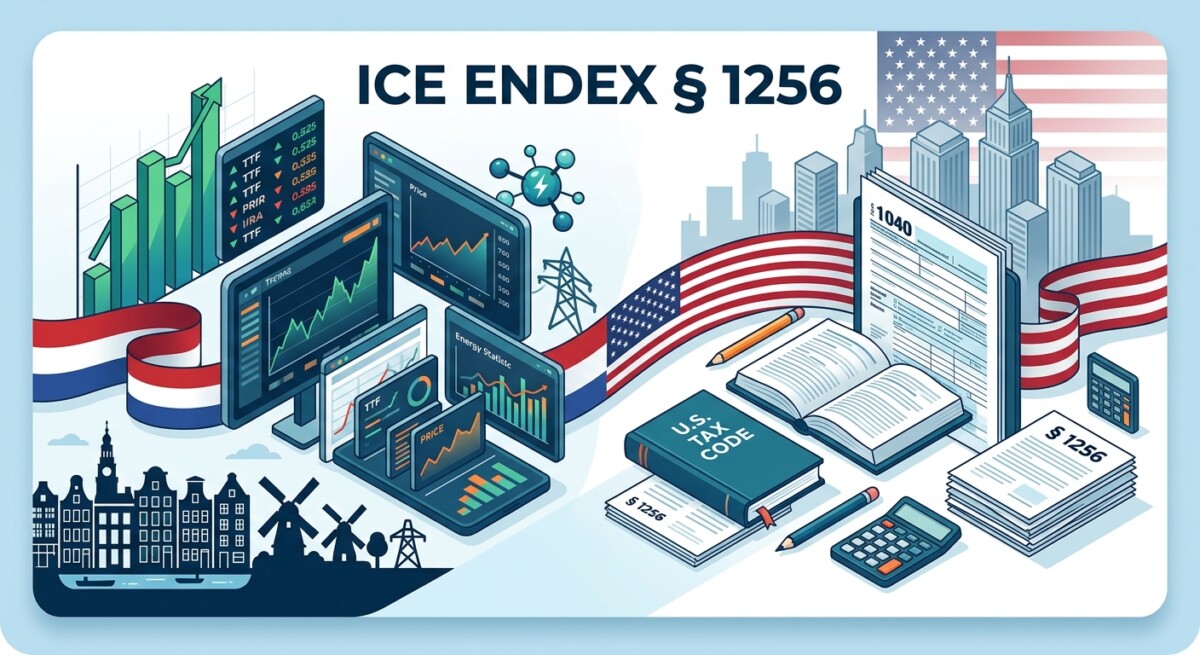
For most of the last decade, U.S. traders who ran positions on the Dutch TTF gas market or on European power futures through ICE Endex sat in an uncomfortable place at year-end. The exchange was regulated in the Netherlands, held a CFTC Order of Registration under the foreign-boards-of-trade system, and looked operationally like the U.S. futures venues that automatically get § 1256 treatment — but the IRS had never said so. That gap has now closed. ICE Endex has been added to the short list of foreign exchanges the IRS has explicitly designated as “qualified” for § 1256 purposes, effective for contracts entered into on or after September 1, 2026. This post walks through what the ruling changes, how the mark-to-market and 60/40 rules apply, and what U.S. traders and their CPAs should do before year-end.
What did the IRS actually decide about ICE Endex? 📄
The IRS held that ICE Endex is a qualified board or exchange within the meaning of § 1256(g)(7)(C), on the condition that ICE Endex holds a valid Order of Registration under the CFTC’s foreign-boards-of-trade registration system.
The determination sits in Rev. Rul. 2026-16, published in the Internal Revenue Bulletin. The facts the IRS recited are straightforward. ICE Endex is a regulated exchange of the Netherlands. On December 23, 2011, the CFTC published its CFTC final FBOT registration rule (76 FR 80674) in the Federal Register, codified at 17 CFR Part 48. The final rules generally took effect on February 21, 2012 and let the CFTC issue an Order of Registration to a foreign board of trade, permitting direct access to its electronic trading and matching system from the United States. On January 10, 2017, the CFTC granted such an Order to ICE Endex.
Once the CFTC had cleared the exchange for direct U.S. access, the § 1256 question became a housekeeping matter. Internal Revenue Code § 1256 defines a “qualified board or exchange” in three prongs — a national securities exchange registered with the SEC, a domestic contract market designated by the CFTC, or, in the catch-all at § 1256(g)(7)(C), “any other exchange, board of trade, or other market” the Treasury Secretary or a delegate determines has rules adequate to carry out § 1256’s purposes. That third prong is how foreign venues enter the § 1256 world, and it is the prong the IRS relied on here.
The holding is narrower than a general blessing of European energy futures. The IRS did not sweep in over-the-counter Dutch derivatives, ICE’s non-Endex platforms, or contracts on other Netherlands venues. It designated one exchange, tied to one CFTC registration, on prospective facts. If any of those elements changes — a new corporate structure, a new registration order, a different platform — the ruling does not travel with it.
How does Section 1256 mark-to-market and the 60/40 rule work? 📊
A § 1256 contract is treated as sold for its fair market value on the last business day of the taxable year. The resulting gain or loss is then split 60% long-term and 40% short-term, regardless of actual holding period.
Mark-to-market is the piece traders feel first. Under § 1256(a), an open § 1256 contract is deemed sold on the last business day of the year at fair market value. The recognized gain or loss is folded into the year-end result and closes the position for tax purposes; a fresh basis carries forward into the next year. There is no waiting for the trade to settle, and there is no way to defer a paper gain by simply leaving the position open through December 31.
The 60/40 rule is the piece traders remember. Once mark-to-market fixes the gain or loss, § 1256(a)(3) characterizes 60% of it as long-term capital gain or loss and 40% as short-term, with no regard for how long the contract was held. For a trader whose futures book turns over inside a year — the typical case in European gas and power — that character split is what makes § 1256 status economically meaningful. Ordinary short-term treatment at the highest marginal rate becomes a blended rate that materially lowers the tax on net gains.
| § 1256 mechanic | What happens | Where it lives in the Code |
|---|---|---|
| Mark-to-market | Open positions deemed sold at fair market value on the last business day of the taxable year; gain/loss recognized annually. | § 1256(a)(1) |
| 60/40 character split | Recognized gain or loss is 60% long-term and 40% short-term, regardless of actual holding period. | § 1256(a)(3) |
| Loss carryback election | Net § 1256 losses can be carried back three years against § 1256 gains, at the taxpayer’s election. | § 1212(c) |
| Straddle limitations | Losses on offsetting positions in a § 1092 straddle remain subject to the straddle rules; § 1256 does not override them. | §§ 1092, 1256(a)(4) |
Losses are treated symmetrically, and that matters. Because the character split is mechanical, a bad year on ICE Endex produces 60% long-term capital loss and 40% short-term capital loss, both of which offset capital gains from other sources on the same return. Under § 1212(c), a trader can elect to carry a net § 1256 loss back three years against prior § 1256 gains — a piece of relief that is easy to miss if you have never dealt with a § 1256 position before.
When does the ICE Endex ruling take effect, and what does “cut-off basis” mean? ⏳
The ruling applies to ICE Endex Contracts entered into on or after September 1, 2026. Older positions keep their prior treatment; there is no catch-up § 481 adjustment when the new method starts.
The IRS invoked its authority under § 7805(b)(8) to make Rev. Rul. 2026-16 prospective. Two dates matter for planning. First, September 1, 2026 is the trigger — any ICE Endex Contract entered into on or after that date falls under the ruling. Second, the ruling defines “ICE Endex Contracts” as futures contracts and futures-contract options that are traded on or subject to ICE Endex rules, that are described in § 1256(g)(1)(A), and that are not covered by the § 1256(b)(2) exception.
A change from ordinary futures treatment to § 1256 mark-to-market is a change in method of accounting within the meaning of §§ 446 and 481. Rather than force taxpayers through the usual Form 3115 process, the ruling grants the Commissioner’s consent automatically for the year in which the taxpayer first holds an ICE Endex Contract that entered into on or after September 1, 2026, and waives the Form 3115 filing requirement. The change is made on a cut-off basis — the new method is applied only to contracts opened on or after the effective date, and older positions are not disturbed.
Because the change is cut-off, there is no potential omission or duplication of income or deductions, and no § 481(a) adjustment is permitted or required. In practical terms: a trader who was already using the correct pre-ruling treatment for open positions does not have to unwind them, and the tax on positions opened before September 1, 2026 continues to be computed the way it always was.
Do not touch positions that opened before September 1, 2026
The cut-off is one-way. Applying § 1256 mark-to-market retroactively to a position that was opened on August 30, 2026 would be a method change the IRS did not authorize in this ruling and would need its own Form 3115 filing under the general procedures. The safe path is to segregate trades by open date and start the new treatment cleanly on September 1, 2026.
How is the accounting method change actually made on the return? 📝
You start using § 1256 mark-to-market for ICE Endex Contracts entered into on or after September 1, 2026 in the first taxable year in which you hold such a contract, and you report the resulting gain or loss on Form 6781. No Form 3115 is required and no § 481 adjustment is computed.
The mechanics fall out of the ruling text. The Commissioner grants consent for the change; you take the change in the first taxable year during which you hold an ICE Endex Contract entered into on or after September 1, 2026. Form 3115, Application for Change in Accounting Method, is waived. The cut-off basis means no § 481(a) computation is required and no adjustment is spread over four years.
On the return itself, the reporting flows through Form 6781, Gains and Losses From Section 1256 Contracts and Straddles. Each open ICE Endex Contract that entered into on or after September 1, 2026 is marked to fair market value on the last business day of the year and included in the year-end result. The 60/40 character split is applied on Form 6781 and the net figures then flow to Schedule D. Traders who elect the § 1212(c) loss carryback do so on that same Form 6781.
Documentation is worth setting up at the account level, not the trade level, before year-end. Broker reporting on foreign futures has historically been thin — 1099-Bs sometimes miss § 1256 boxes on non-U.S. products, and reconciling to statements is easier if you have a running record of open positions with trade date, settlement date, and daily marks separated by pre- and post-September 1 open dates. In our practice, that separation is the difference between a clean Form 6781 and a return that gets a correspondence notice.
What should U.S. traders and their CPAs do before September 1, 2026? 🚦
Confirm whether your positions are ICE Endex Contracts, put a September 1 segregation in place, coordinate with the broker on 1099 coding, and revisit the straddle and wash-sale interactions before the first post-cutover trade.
- Confirm the exchange and product. Not every ICE-branded European futures market is ICE Endex — check the contract specifications and confirm the venue against the CFTC’s registered FBOT list. The CFTC’s registered FBOT list is the authoritative source.
- Verify the CFTC Order of Registration is still valid. The § 1256(g)(7)(C) status in the ruling is conditional. If the Order is withdrawn, suspended, or replaced before your trade date, the ruling does not carry you.
- Segregate open positions by trade date. Positions opened before September 1, 2026 keep their old treatment; positions opened on or after September 1 get § 1256 treatment. Your books and your broker statements should show that split cleanly.
- Talk to your broker about 1099 coding. Broker reporting on § 1256 contracts uses specific 1099-B boxes; not every non-U.S. futures broker maps ICE Endex Contracts to those boxes by default. Ask before the first post-cutover trade prints, not in February.
- Model the year-end mark. For a trader whose ICE Endex book is closed and offsetting, the mark-to-market is neutral. For a directional book, it accelerates income or losses by up to a year and reshuffles the character. Both matter for estimated-tax deposits.
- Revisit straddles and § 988 interactions. § 1256 does not override the straddle rules in § 1092 or the foreign-currency-gain rules in § 988. A euro-denominated ICE Endex position with a matched hedge on another platform can still trigger loss deferral under § 1092.
From our practice: the ruling is quiet, the accounting is not
Revenue rulings that add a foreign exchange to § 1256 read like housekeeping and get almost no press. The tax consequences are anything but quiet. In our practice, the first year a trader crosses into § 1256 is usually the year the estimated-tax picture blows up — mark-to-market pulls forward gains that would have deferred, and 60/40 rearranges what the trader expected to be short-term. The trades that make this manageable are the ones done in September and October, before the first ICE Endex Contract entered into after September 1, 2026 shows up as an open position on December 31.
Summary: what Rev. Rul. 2026-16 means for ICE Endex traders
- ICE Endex is now a qualified board or exchange under § 1256(g)(7)(C), provided its CFTC FBOT Order of Registration remains valid.
- The determination is prospective: it applies only to ICE Endex Contracts entered into on or after September 1, 2026.
- Mark-to-market and the 60/40 capital-gain split apply on those contracts, reported on Form 6781.
- The change in method is automatic — Form 3115 is waived, the change is made on a cut-off basis, and no § 481 adjustment is permitted or required.
- Positions opened before September 1, 2026 keep their prior treatment.
Frequently asked questions about ICE Endex and § 1256 ❓
Q. What did Rev. Rul. 2026-16 actually decide about ICE Endex?
The IRS determined that ICE Endex, a regulated exchange in the Netherlands, is a qualified board or exchange within the meaning of § 1256(g)(7)(C) so long as ICE Endex holds a valid Order of Registration under the CFTC’s foreign-boards-of-trade registration system. The determination is prospective and applies to ICE Endex Contracts entered into on or after September 1, 2026.
Q. Why does § 1256 status matter for a U.S. trader?
Section 1256 contracts are marked to market at year-end, so unrealized gains and losses are recognized annually whether or not the position is closed. The resulting gain or loss is then split under the 60/40 rule — 60% treated as long-term capital gain or loss and 40% as short-term — regardless of how long the contract was held. That treatment is different from ordinary futures or forward contracts on unlisted foreign exchanges.
Q. Which ICE Endex products does the ruling reach?
It reaches futures contracts and futures-contract options that are traded on or subject to the rules of ICE Endex, that are described in § 1256(g)(1)(A), and that are not covered by the exception in § 1256(b)(2). In practice that is the exchange’s regulated Dutch TTF and other European natural-gas, power, and related energy futures — not over-the-counter positions and not the specific instruments carved out by § 1256(b)(2).
Q. Do I have to file Form 3115 to switch to § 1256 mark-to-market?
No. The Commissioner grants consent to change the method of accounting for ICE Endex Contracts entered into on or after September 1, 2026, and the requirement to file Form 3115 is waived. The change is made on a cut-off basis, so there is no § 481 adjustment for positions opened before the effective date.
Q. When does the new treatment start, and does it touch older positions?
The ruling is effective for ICE Endex Contracts entered into on or after September 1, 2026. Contracts entered into before that date are not affected — the cut-off basis means old open positions keep their prior treatment and there is no catch-up adjustment when the new method starts.
Q. What if ICE Endex loses or changes its CFTC registration?
The § 1256(g)(7)(C) determination is conditioned on ICE Endex holding a valid Order of Registration under the CFTC’s foreign-boards-of-trade system. If that Order is withdrawn, suspended, or replaced, the qualified-board-or-exchange status turns off with it. Traders should verify the exchange’s current status on the CFTC’s public registry before relying on § 1256 for new positions.
This article is general information, not tax advice for your positions. Section 1256 planning turns on the specific contracts, the broker’s reporting, and your other capital positions. If you trade ICE Endex products through a U.S. account, contact SW Accounting & Consulting Corp for a position-by-position review before September 1, 2026.