IRS Opportunity Zone Transition Rules 2026: Notice 2026-40
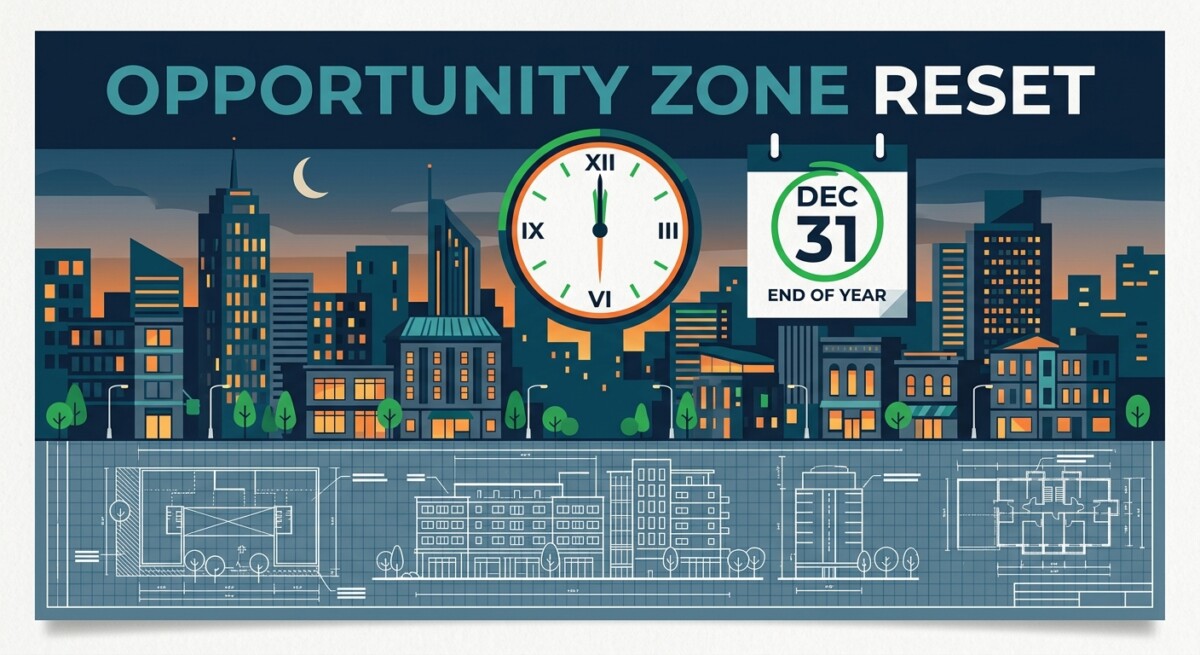
The IRS has finally drawn a clear line around what happens next for Opportunity Zone investments — and the result is closer to a reset than an extension. The IRS Opportunity Zone transition rules in Notice 2026-40 focus on how existing deals move from the 2017 framework into the revised regime enacted last year. For sponsors and investors with live OZ deals, the real question is whether those structures line up closely enough with the new rules to carry forward.
At SW Accounting & Consulting Corp, we advise Los Angeles real estate sponsors, fund managers, and closely-held businesses whose 10-year OZ timelines run right through the transition window. This is exactly the kind of statutory reset that can quietly rewrite a fund’s economics without anyone amending a document. Here is what actually changed, why it matters for existing QOFs, and what to check before December 31, 2026.
What did the IRS actually change in Notice 2026-40? 📅
The December 31, 2026 deferred-gain inclusion date is unchanged, but the flexibility around it — reinvestments, holding periods, and working-capital deployment — has been substantially rewritten.
Under IRC §1400Z-2, investors who deferred an eligible gain into a Qualified Opportunity Fund (QOF) must recognize that deferred gain by December 31, 2026, unless an earlier inclusion event occurs. Notice 2026-40 does not move that date. What it does is address how existing QOFs continue to operate after the statute was rewritten in 2025.
The IRS confirmed that a gain triggered at the QOF level by a sale or similar event can be deferred again if that gain is reinvested into a QOF within 180 days. That framework sounds similar to the market’s prior expectation, but the mechanics are different. The reinvested gain is treated as a new investment rather than a continuation of the original QOF investment. The 10-year holding period for excluding post-acquisition appreciation starts over.
That creates a real tradeoff for funds evaluating 2026 liquidity events: investors can preserve deferral on the triggered gain, but doing so resets the timeline that drives the program’s headline benefit. Separately, the deemed inclusion of deferred gain on December 31, 2026 cannot be reinvested into a new deferral — the original election remains in place for that gain.
How do the working-capital safe harbor rules work now? 🏗️
Ongoing or phased development can continue in previously designated zones after 2026 only if a written working-capital plan is in place by year-end 2026 and specific contribution and expenditure thresholds are met.
Without administrative relief, the statutory changes would have effectively cut off the ability for projects in previously designated zones to continue development past 2026. The IRS avoided that outcome — but only within a narrow set of conditions. The path forward depends on:
- A written working-capital plan in place by year-end 2026.
- Meeting specific thresholds for capital contributions before that date.
- Meeting specific expenditure thresholds before that date.
If those requirements are satisfied, property acquired after 2026 can still qualify as Opportunity Zone business property, even in a zone designated under the prior rules. Miss them, and the project will generally fall outside the regime going forward.
Which projects survive the reset — and which fall out? 🧾
Routine capital work on existing property generally continues to qualify; new buildings and later phases that were not locked in before 2027 generally do not.
The IRS framework puts real pressure on phased development. Here’s how the distinction plays out:
- Still qualifies: unit renovations, mechanical and electrical system replacements, and modernization of existing space that keeps a project operating.
- Generally will not qualify: adding a new building, expanding into adjacent property, or moving forward with a later phase that was not locked in before 2027.
For many real estate deals, that distinction determines whether Phase II or Phase III remains inside the OZ structure. Timing and documentation matter in a way they did not in the early years of the program: the business plan, capital structure, and deployment of funds all need to support that the next phase of development was already in motion before year-end.
How does the new designation cycle change future OZ investing? 🌎
Newly designated zones will operate on their own 10-year timelines tied to the date of designation, rather than the fixed expiration dates that governed the original program.
The statute creates a split system. Legacy investments continue under transition rules while new capital is deployed under the revised framework. For investors, that means the OZ market is no longer a single-cohort program with one expiring window — it becomes a rolling series of designation cycles, each with its own clock.
Practically, this changes how sponsors should think about fund vintages and how investors should think about capital commitments. A dollar deployed into a legacy zone now behaves very differently from a dollar deployed into a newly designated zone, both in terms of timeline and in terms of the property-eligibility rules that surround it.
What should QOF sponsors and OZ investors do right now? ✅
Inventory every live QOF position, decide the 2026 disposition path for each, and lock down working-capital documentation before December 31.
Concrete steps for the balance of 2026:
- Model the deemed inclusion. Confirm the deferred gain that will be recognized on December 31, 2026 for each investor and coordinate cash for the associated tax.
- Decide reinvestment posture. For QOF-level gains this year, evaluate whether the deferral is worth restarting the 10-year clock — and communicate that tradeoff to LPs before year-end.
- Finalize a written working-capital plan for any ongoing or phased project, with dated capital contribution and expenditure thresholds documented before December 31, 2026.
- Segregate legacy versus new-designation capital. Track designations and holding periods separately as new zones come online on rolling 10-year cycles.
Notice 2026-40 at a glance 📊
| Topic | Rule under Notice 2026-40 | Practical impact |
|---|---|---|
| Deferred-gain inclusion date | Unchanged — December 31, 2026 | Plan investor cash for the associated tax |
| QOF-level gain reinvestment | Deferrable if reinvested into a QOF within 180 days | Treated as a new investment; 10-year clock restarts |
| Ongoing / phased development | Requires written working-capital plan by year-end 2026 + threshold compliance | Phase II/III may qualify; miss thresholds = out of OZ regime |
| Routine capital work | Continues to qualify | Renovations, system replacements, modernization |
| New designations | Own 10-year timeline tied to designation date | Rolling cycles rather than a single expiration |
📌 Key Takeaways
- The December 31, 2026 deferred-gain inclusion date is unchanged and cannot be re-deferred.
- Reinvesting a QOF-level gain preserves deferral but restarts the 10-year holding period.
- Phased projects need a written working-capital plan and threshold compliance by year-end 2026 to continue.
- Newly designated zones follow their own rolling 10-year timelines, not a single fixed expiration.
Frequently Asked Questions ❓
Q. What is the IRS Opportunity Zone transition rule?
It’s the framework in Notice 2026-40 that governs how existing Qualified Opportunity Fund deals move from the 2017 statutory regime to the revised Opportunity Zone rules enacted in 2025. It keeps the December 31, 2026 deferred-gain date and clarifies reinvestment, working-capital, and phased-development requirements.
Q. Can I still defer my 2026 deemed inclusion by reinvesting into a QOF?
No. The deemed inclusion of deferred gain on December 31, 2026 cannot be reinvested into a new deferral — the original election stays in place. Only QOF-level gains triggered by a sale or similar event can be re-deferred if reinvested within 180 days.
Q. Does reinvesting a QOF gain preserve my 10-year holding period?
No. The IRS treats the reinvested amount as a new investment. The 10-year clock for excluding post-acquisition appreciation starts over from the reinvestment date.
Q. What does the working-capital safe harbor require for ongoing projects?
A written working-capital plan in place by year-end 2026, together with specific capital contribution and expenditure thresholds satisfied before that date. If met, property acquired after 2026 can still qualify as Opportunity Zone business property in a previously designated zone.
Q. Which types of construction still qualify after 2026?
Routine capital work — unit renovations, system replacements, and modernization of existing space — continues to qualify. New buildings, expansion into adjacent property, or later phases not locked in before 2027 generally fall outside the OZ regime.
Q. How are newly designated Opportunity Zones treated?
Newly designated zones run on their own 10-year timelines tied to the designation date, rather than the fixed expiration dates that governed the original program. The market becomes a rolling series of cycles rather than one closing window.
The Opportunity Zone regime is now a two-track program: legacy funds under transition rules and new capital under a revised framework. If you would like a review of your QOF’s 2026 disposition path, working-capital documentation, or reinvestment strategy, contact SW Accounting & Consulting Corp. Primary sources: IRS Notice 2026-40 and IRC §1400Z-2.