Hiring Seasonal Employees: 2026 Payroll Tax Guide
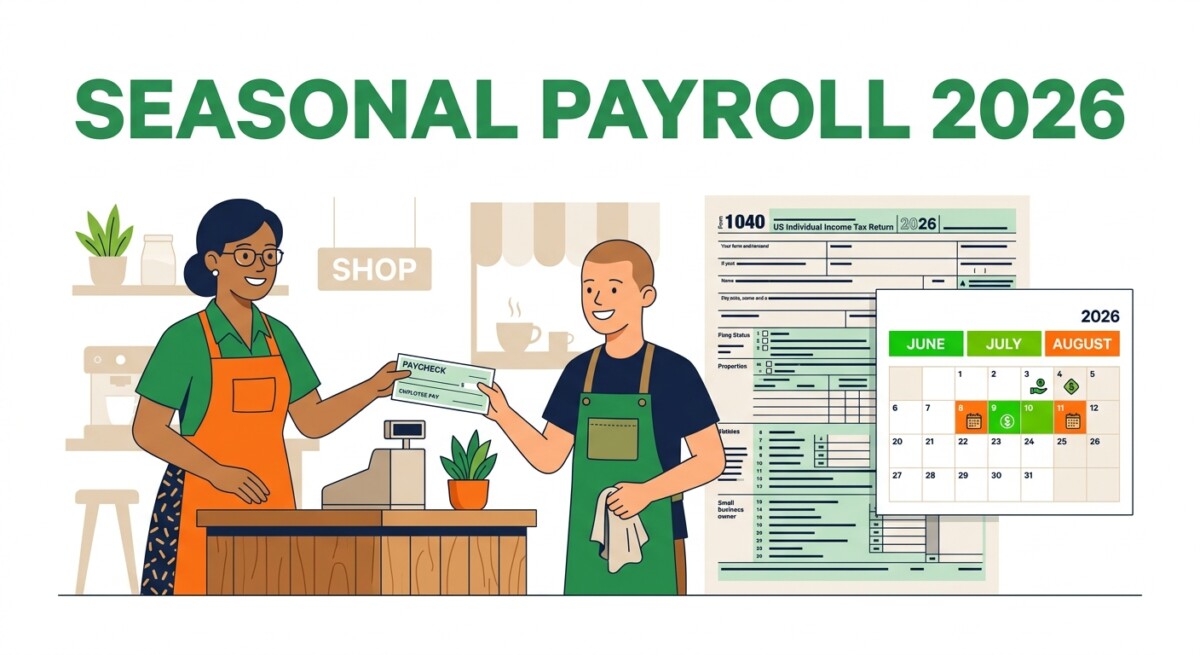
The summer months bring a rush of hiring for many Los Angeles small businesses — restaurants staffing up for tourist season, retail stores gearing up for back-to-school, camps, landscaping crews, and event vendors. If you are hiring seasonal employees or part-time help this summer, it is easy to assume the payroll rules are somehow lighter. They are not. The IRS treats seasonal wages the same as any other wages, and one missed deposit or one un-checked box on Form 941 can turn a short-term hire into a long-term penalty problem.
At SW Accounting & Consulting Corp, we walk small-business clients through this every summer. This guide pulls together the federal payroll rules that apply — straight from IRS Tax Tips, Form 941 instructions, and Publication 15 — so you can hire, pay, and file without surprises.
Are seasonal and part-time employees treated differently for federal payroll taxes? 🧾
No — the IRS applies the same federal income tax withholding, Social Security, and Medicare tax rules to seasonal and part-time workers as to any other employee.
This is the single most common misconception we see. A short season, a limited number of hours, a college student “just helping out for the summer” — none of that changes the federal payroll classification. If the worker is an employee (not an independent contractor under the common-law test), the employer must withhold federal income tax based on the employee’s Form W-4, withhold the employee share of Social Security and Medicare (FICA), pay the employer share of FICA, and deposit and report those taxes on time.
Federal unemployment tax (FUTA) can also apply. Whether it does depends on the wages paid and the type of work, but seasonal status by itself is not an exemption. Employers should also confirm each new hire’s work authorization on Form I-9 and consider state-level rules — in California, that includes state income tax withholding, EDD registration, and state disability insurance (SDI) that follow their own thresholds.
What is the “seasonal employer” box on Form 941, and should I check it? ✅
Seasonal employers who do not pay wages in every quarter can check the “seasonal employer” box in Part 3 of Form 941, which lets the IRS know a return may not be filed for certain quarters.
Form 941, Employer’s Quarterly Federal Tax Return, is normally required every quarter — even a quarter with zero wages triggers a filing obligation unless the IRS knows otherwise. Seasonal employers get a specific relief valve. If your business genuinely has no tax liability for a quarter because no wages were paid, you can:
- Check the “seasonal employer” box in Part 3 of every Form 941 you file.
- File at least one taxable return during the year. If the box is checked and at least one taxable return is filed, the IRS generally will not follow up on quarters with no filing.
Publication 15, Section 12, has the details. Two common mistakes: (1) forgetting to check the box on every Form 941, not just one, and (2) leaving the box checked in a year where you have wages every quarter — that inconsistency invites IRS correspondence.
What about farm workers — Form 941 or Form 943? 🌾
Agricultural employers file Form 943 annually instead of Form 941 quarterly, and they follow the rules in Publication 51 (Circular A).
If your business employs farm workers — whether year-round or seasonal — do not report those wages on Form 941. Farm-employer wages go on Form 943, Employer’s Annual Federal Tax Return for Agricultural Employees, filed once a year. Publication 51 (Circular A), the Agricultural Employer’s Tax Guide, is the operational manual: it covers who counts as a farm worker, when withholding applies, FICA and FUTA rules for farm labor, and record-keeping. Non-farm seasonal wages — a produce-stand cashier who never sets foot in the field, for example — still go on the regular Form 941 track.
How should a small business set up payroll before hiring seasonal employees? 📋
Before the first day of work, complete new-hire paperwork, register with federal and state agencies, and confirm the deposit and reporting cadence that will apply.
A workable checklist for a small employer bringing on summer help:
- Verify identity and work authorization on Form I-9 within three business days of hire.
- Collect Form W-4 from each employee to determine federal income tax withholding.
- Report new hires to the state new-hire reporting registry within the state’s window (California: 20 days).
- Set up federal deposits through EFTPS and schedule them monthly or semiweekly based on your lookback amount.
- Confirm state registrations — in California, EDD registration for state income tax and SDI; check local minimum-wage and paid-sick-leave rules.
- Decide the Form 941 posture — regular quarterly filer, or seasonal employer with the Part 3 box checked in every filed return.
Seasonal payroll — quick reference table 📊
| Situation | Federal form / rule | Watch item |
|---|---|---|
| Non-farm seasonal or part-time wages | Form 941 quarterly | Same withholding as full-time employees |
| Quarters with no wages paid | Form 941, Part 3 seasonal-employer box | Check on every filed 941; file 1+ taxable return |
| Agricultural / farm workers | Form 943 annually + Publication 51 | Do not put farm wages on Form 941 |
| All employees (rules reference) | Publication 15, Employer’s Tax Guide | Section 12 covers seasonal employer specifics |
📌 Key Takeaways
- Seasonal and part-time wages follow the same federal payroll rules as full-time wages.
- Check the “seasonal employer” box in Part 3 of every Form 941 if you will not pay wages in some quarters.
- Farm workers go on Form 943, not Form 941 — Publication 51 has the rules.
- Complete I-9, W-4, EFTPS enrollment, and state new-hire reporting before the first paycheck.
- Misclassifying employees as 1099 contractors or missing deposits are the most expensive mistakes.
Frequently Asked Questions ❓
Q. Do I have to withhold federal income tax from a summer intern’s paycheck?
If the intern is your employee, yes — federal income tax withholding is based on the Form W-4 they submit, and Social Security and Medicare taxes also apply. The withholding rules do not change because the job is temporary.
Q. Can I just pay seasonal workers as 1099 contractors to keep it simple?
Usually no. The IRS common-law test looks at behavioral control, financial control, and the relationship of the parties. A summer cashier, host, lifeguard, or camp counselor supervised by the employer and paid an hourly wage is almost always an employee, not a contractor. Misclassification exposes the business to back taxes, penalties, and interest.
Q. What is the difference between Form 941 and Form 943 for seasonal hires?
Form 941 is the quarterly federal payroll return for most employers. Form 943 is the annual return specifically for agricultural employers. If your seasonal hires do farm work, use Form 943 and follow Publication 51; otherwise, use Form 941.
Q. Do I need to file Form 941 for a quarter when I paid no seasonal wages?
Generally you must file, but seasonal employers who check the “seasonal employer” box in Part 3 of Form 941 and file at least one taxable return during the year usually avoid IRS follow-up for the zero-wage quarters. Check the box consistently on every filed 941.
Q. Where can I find the IRS rules for hiring seasonal employees?
Publication 15, the Employer’s Tax Guide, is the main reference — Section 12 addresses the seasonal-employer designation. Publication 51 covers agricultural employers. The IRS Small Business and Self-Employed portal also has practical checklists on hiring and employment taxes.
Q. Are there special California rules on top of the federal ones?
Yes. California employers register with EDD and follow state income tax withholding, state disability insurance (SDI), and state unemployment insurance (UI) rules. Local minimum-wage ordinances (including Los Angeles City and County) and California’s paid-sick-leave rules also apply. Confirm state and local obligations alongside the federal ones before the first paycheck.
Summer hiring should not become a payroll-penalty story. If you would like a payroll-compliance review before your seasonal ramp-up, contact SW Accounting & Consulting Corp. Primary sources: IRS Newsroom / Tax Tips, Form 941, Publication 15 (Employer’s Tax Guide), Publication 51 (Agricultural Employer’s Tax Guide), and IRS employment taxes portal.