NYC Junk Fees Rule: Does It Apply to My Business? (2026)
New York City is moving further than any other U.S. municipality on consumer pricing and subscription rules. Under Mayor Zohran Mamdani’s Executive Orders 9 and 10, the NYC Department of Consumer and Worker Protection (DCWP) has issued a proposed NYC junk fees rule requiring all-in pricing and a final Click-to-Cancel rule that takes effect October 1, 2026. Both apply to a wide sweep of businesses that transact with New York City consumers, not just companies headquartered in the five boroughs.
At SW Accounting & Consulting Corp, we advise small business owners and multi-location operators on how state and city rules like these translate into checkout systems, marketing copy, and refund policies. Here is what the two rules actually do, who is covered, when the deadlines hit, and what to change now to avoid $525-per-violation penalties.
What is the NYC junk fees rule? 🧾
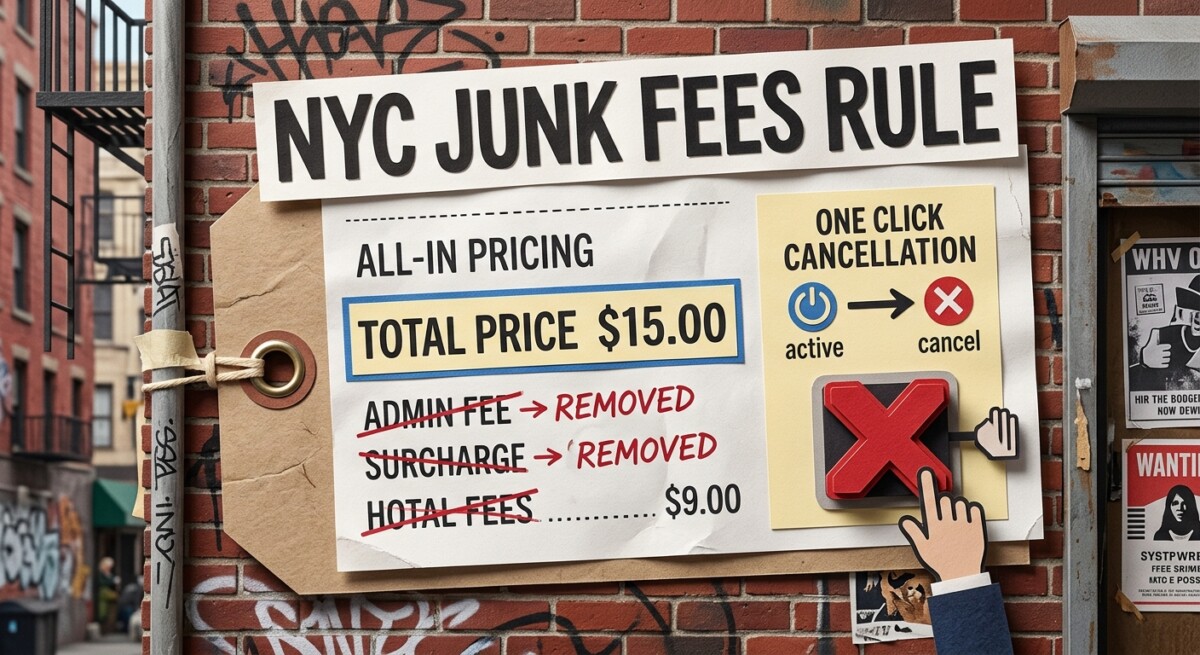
The proposed NYC junk fees rule requires businesses to advertise the full “all-in” price of a good or service upfront, including every mandatory fee, and bans surprise mandatory charges at checkout.
The proposal implements Executive Order 9, which directed DCWP to crack down on “junk fees” — mandatory charges that appear late in the purchasing process, often after the consumer has already committed to buy. The rule was published on July 8, 2026, followed by a public comment period and a public hearing on August 7, 2026. Once finalized, it will require:
- All-in advertised price: the price shown to consumers must include every mandatory charge or fee.
- No misrepresentation: businesses cannot misstate the purpose, amount, or refundability of any fee.
- Fee documentation: “service charges,” “processing fees,” or similar mandatory charges must be included in the advertised price and documented as to what they actually cover.
- Penalties: restitution to harmed consumers plus civil penalties beginning at $525 per violation.
The rule targets industries where junk fees have become widespread — third-party delivery apps, hotels, ticketing platforms — but it is written broadly enough to reach almost any consumer-facing business with mandatory add-on charges. Details of Executive Order 9 are published by the NYC Mayor’s Office.
What does the Click-to-Cancel rule require? 🔄
The final Click-to-Cancel rule requires businesses that sell auto-renewing or continuous-service subscriptions to New Yorkers to disclose subscription terms clearly and provide a cancellation method as simple as sign-up.
The rule implements Executive Order 10 and takes effect on October 1, 2026, making New York City the first U.S. municipality to require simple, one-step subscription cancellation. In plain terms, if a customer can sign up online in one click, the business must let them cancel online in one click — no phone-only cancellation channels, no long-form retention gauntlets, no burying the cancel button.
Specifically, the Click-to-Cancel rule:
- Applies to auto-renewal and continuous-service subscriptions — streaming, SaaS, gyms, meal kits, memberships, “free trials” that convert to paid.
- Requires clear disclosure of subscription terms at the point of sign-up (price, renewal frequency, and how to cancel).
- Requires an easy, direct cancellation path that mirrors the sign-up mechanism.
- Prohibits confusing or drawn-out cancellation processes designed to discourage customers from leaving.
- Penalties: restitution to harmed consumers plus civil penalties beginning at $525 per violation.
NYC has published a plain-language landing page for consumers and business operators at the Click-to-Cancel resource page, and the underlying authority is set out in Executive Order 10.
Who is covered by the NYC junk fees rule and Click-to-Cancel? 🏢
The rules are keyed to the transaction, not the business’s address — any company selling to a New York City consumer is exposed, including out-of-state and online-only sellers.
Because DCWP’s authority runs to consumer transactions occurring in New York City, an out-of-state SaaS company with New York City subscribers is not automatically off the hook. The most exposed business types are:
- Subscription boxes and streaming services — the classic Click-to-Cancel targets.
- Gyms, studios, memberships with automatic renewal and phone-only cancellation.
- Ticketing and event platforms that add “processing fees” only at checkout.
- Third-party food delivery apps layering service, delivery, and small-order fees.
- Hotels and short-term rentals — NYC previously banned hidden hotel fees; the all-in pricing rule extends the same logic across industries.
- SaaS and B2C software selling to NYC consumers with auto-renewing plans.
What are the deadlines and penalties under the NYC junk fees rule? 📅
The Click-to-Cancel rule takes effect October 1, 2026; the junk fees rule is proposed with a public hearing held August 7, 2026, and will be finalized after DCWP considers comments.
Both rules carry the same civil penalty structure: $525 per violation, plus restitution to any harmed consumer. Because each transaction can be its own violation, exposure scales quickly for high-volume sellers. Save yourself the math and treat the effective dates as hard deadlines to reconfigure checkout, subscription, and cancellation flows.
How should my business prepare for the NYC junk fees rule? ✅
Audit your checkout, subscription sign-up, and cancellation flows now — the fixes are engineering and copy changes, not legal defense costs.
Concrete steps for a business that touches New York City consumers:
- Roll every mandatory fee into the advertised price. If a “service fee,” “processing fee,” or similar charge is not truly optional, it belongs in the top-line number the customer sees first — not on the last checkout screen.
- Document what each remaining fee covers. Keep an internal record of the actual cost or service behind any “service charge” so you can defend both its purpose and its amount.
- Rewrite subscription sign-up copy. Show price, renewal frequency, and cancellation method plainly at sign-up — not buried in the terms of service.
- Build a self-serve cancellation button. If a customer signed up online, they must be able to cancel online without a phone call, retention chat, or multi-step form.
- Refund and dispute policy alignment. Update refund and dispute policies so that misrepresenting the refundability of a fee is not baked into your standard operating procedure.
- Train your customer service team. A single scripted retention step that delays a cancel can generate a $525 violation per subscriber.
NYC junk fees rule vs. Click-to-Cancel at a glance 📊
| Item | Junk fees rule (proposed) | Click-to-Cancel rule (final) |
|---|---|---|
| Authority | Executive Order 9 → DCWP | Executive Order 10 → DCWP |
| Effective date | TBD after public comment (hearing Aug 7, 2026) | October 1, 2026 |
| Who is covered | Any business advertising a price to NYC consumers | Any business selling auto-renewing subscriptions to NYC consumers |
| Core requirement | All mandatory fees included in advertised price | Cancellation as easy as sign-up |
| Civil penalty | Starts at $525 per violation + restitution | Starts at $525 per violation + restitution |
📌 Key Takeaways
- The NYC junk fees rule requires all mandatory fees to be included in the advertised price.
- The final Click-to-Cancel rule takes effect October 1, 2026 — first in the nation.
- Both rules carry civil penalties starting at $525 per violation plus restitution.
- Coverage is keyed to the NYC transaction, so out-of-state and online-only sellers are exposed too.
Frequently Asked Questions ❓
Q. Does the NYC junk fees rule apply to my out-of-state business?
If you advertise or sell to consumers in New York City, yes — DCWP’s authority runs to the consumer transaction. Being headquartered elsewhere does not exempt you when your customer is a New Yorker.
Q. When does the Click-to-Cancel rule take effect?
October 1, 2026. As of that date, any business selling auto-renewing subscriptions to NYC consumers must offer a cancellation method as easy as its sign-up path.
Q. Are optional add-ons like tips or gratuities covered by the junk fees rule?
The rule targets mandatory charges. A genuinely optional customer-facing tip that the consumer can decline is not the same as a mandatory service charge — but a fee that is not truly optional must be rolled into the advertised price and documented for what it actually covers.
Q. What are the penalties for violating either rule?
Both rules provide for restitution to harmed consumers and civil penalties starting at $525 per violation. Because each transaction can be a separate violation, exposure scales quickly for high-volume sellers.
Q. How is this different from the federal FTC “click-to-cancel” push?
Federal consumer-cancellation efforts have moved in fits and starts. NYC has now enacted a municipal Click-to-Cancel rule with a firm October 1, 2026 effective date, backed by DCWP enforcement — the first U.S. city to do so — regardless of the federal timeline.
Q. What should a small business do first to comply with the NYC junk fees rule?
Audit your top three consumer-facing prices for hidden mandatory fees, rewrite the advertised price to include them, and confirm you can document what any remaining “service” or “processing” fee actually covers. Then, if you sell subscriptions, replace phone-only cancellation with a self-serve online cancel path.
Q. Do these NYC rules preempt state consumer protection laws?
No. New York State consumer protection statutes still apply, and businesses must comply with both. The NYC rules are additional municipal requirements enforced by DCWP.
Consumer rules like these look like marketing tweaks until an enforcement notice arrives with hundreds of $525-per-violation counts. If you would like a compliance review of your checkout, subscription, and cancellation flows before the NYC deadlines land, contact SW Accounting & Consulting Corp. Primary sources: NYC Mayor’s Office, Executive Order 9, Executive Order 10, and the NYC DCWP Click-to-Cancel resource.