
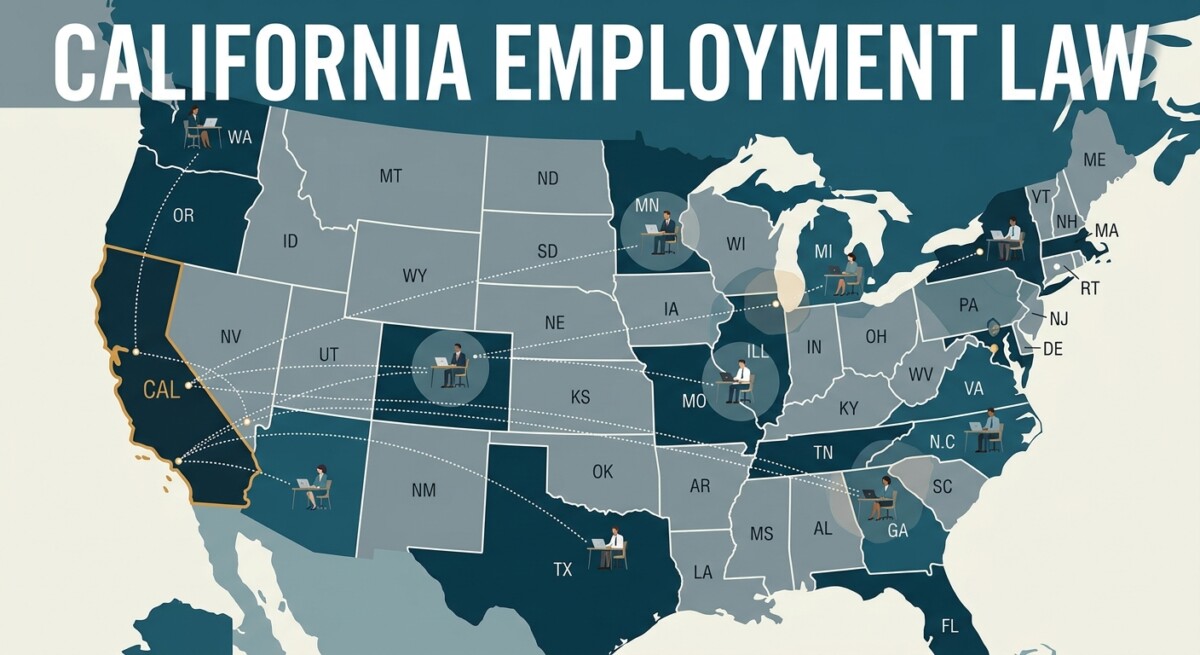
Does California employment law reach remote workers?
Every quarter, an employer client of our Los Angeles office asks a version of the same question. The company is headquartered in California, but the workforce is scattered across a dozen states, and half the engineers have never set foot in a California office. If we terminate a remote worker in Utah, are we exposed to California wage, leave, and anti-discrimination claims? A recent decision of the California Court of Appeal, California employment law practitioners will want to read carefully, gives that question its most direct answer in years — and clarifies where the safe assumptions really lie.
The decision is Saberin v. Alation, Inc., No. A174549 (Cal. Ct. App., 1st Dist., Div. 5, July 30, 2026). It arises out of a wrongful-termination dispute, but the underlying holding is squarely about the geographic reach of California employment statutes when the workforce is distributed. This post walks through what the court decided, what it deliberately left open, and the practical steps a California-headquartered employer should be taking now.
When does California employment law follow a remote worker out of state? 🗺️
It does not follow automatically. There is no single connection — not the employer’s headquarters, not a choice-of-law clause, not tangential involvement by a California employee — that on its own extends California employment statutes to a worker performing services entirely outside the state.
Under the California Supreme Court’s earlier decision in Ward v. United Airlines, Inc., the geographic reach of a California employment statute must be analyzed statute by statute. Courts look at the text, purpose, and legislative history of the specific statute to determine what connections to California are sufficient to invoke it. There is no single, portable test that applies across the code. The Court of Appeal in Saberin reaffirmed this approach and applied it to a fact pattern that has become common: a California-headquartered employer, an out-of-state remote worker, and a termination decision made by executives who were themselves out of state at the time they acted.
The employee in Saberin resided in Utah and worked remotely for Alation, Inc., a data analytics company headquartered in California. He was arrested while traveling outside California, and Alation later terminated his employment. The termination decision was made by two Alation executives while they were physically located in Illinois. A California-based HR business partner provided background information and relayed the outcome, and one of the two executives ordinarily worked remotely from California but was in Illinois when the decision was rendered. The Court of Appeal, affirming the trial court, held that these connections were insufficient to invoke California’s employment statutes on the claims at issue.
How does the physical location of the decisionmaker matter under California employment law? 📍
It matters a great deal. The Court of Appeal looked to where the executives who made the substantive termination decision were physically present at the time they acted. Both were in Illinois, and that was dispositive — even though one of them ordinarily worked from California.
This is one of the practical takeaways employers should absorb. The court did not accept the argument that a decisionmaker’s usual place of work in California, or the employer’s California headquarters, could substitute for the physical location of the decisionmaker at the moment the substantive decision was made. The court treated the where-was-the-person-when-they-decided question as central. That has direct implications for how employers document significant personnel decisions.
In our practice: document location, not just decision
For California-headquartered employers with multi-state workforces, we now advise the same standard for any material personnel decision affecting a remote worker: contemporaneously record who made the decision, where each decisionmaker was physically located when the decision was made, the employee’s state of residence and place of work, and the specific role of any California-based employee who touched the file. Reconstructing these facts months later, from a paper trail that was not built to answer that question, is a much weaker record than one created at the time.
Is a California choice-of-law clause enough to extend California employment law to a remote worker? 📜
No. The Court of Appeal held that a California choice-of-law clause incorporates all of California law, including its presumption against extraterritorial application. A choice-of-law clause therefore does not, standing alone, resolve the extraterritoriality question in the employee’s favor.
The employee argued that his arbitration agreement’s California choice-of-law clause meant that California employment statutes governed the dispute. The court rejected the framing. Choosing California law means choosing all of it, including the rules California courts apply to determine whether a given California statute reaches conduct outside the state. Because those rules led the arbitrator to conclude that the statutes at issue did not apply on these facts, the arbitration award was upheld.
For employers, the point is not that choice-of-law clauses are useless. They still resolve real questions when a dispute has a genuine California connection. The point is that drafting a California choice-of-law clause into an offer letter for a Utah-based engineer does not manufacture a California connection where none otherwise exists. If the plan is to bind out-of-state remote workers to California employment standards, the clause has to be paired with a real, documented California nexus, and the standards themselves may need to be built into the employment agreement as contract terms rather than left to statutory operation.
What did Saberin v. Alation leave open under California employment law? ❓
The most important open question: whether the same result would follow for an employee who lives in California and works entirely remotely for an employer with no California office. The court expressly declined to decide it.
The Court of Appeal was deliberate about the limits of its holding. Several scenarios were flagged as unresolved or expressly outside the reasoning:
- A California-resident remote worker. The court expressly declined to address whether California employment law would apply to a worker who resides in California but performs services entirely remotely for an out-of-state employer with no California office. Employers should not treat Saberin as protection in that scenario.
- Strategic relocation of decisionmakers. The court noted, but did not decide, whether an employer that relocates decisionmakers outside California for the purpose of avoiding California law might itself thereby establish a sufficient California connection. Personnel decisions should be made on ordinary business grounds, not staged to game the analysis.
- Substantive California participation. The court found that mere “input” from a California-based HR partner — background information, relaying the decision — did not establish the necessary nexus. Substantive participation in, or ratification of, the underlying decision by a California-based employee is a different matter and may support a different result.
- A statute-by-statute inquiry. A favorable outcome on one category of claim does not extend to other California employment statutes. Wage-and-hour, anti-discrimination, leave, and pay-transparency provisions each carry their own extraterritoriality analysis.
Do not read this as a blanket California safe harbor
Saberin turned on a specific fact pattern: an out-of-state employee, an out-of-state work location, and out-of-state decisionmakers at the moment of decision. Change any of those facts materially and the analysis changes. In particular, a California-resident remote worker, or a decision made or ratified by a California-based executive, could produce a different result. Employers should not adopt a general rule that “we’re not exposed to California law for anyone outside California” — the holding is narrower than that.
What should California-headquartered employers do now under California employment law? 🧭
Six things: document decisionmaker location; separate input from decision-making authority; treat California-resident remote workers as covered; run the analysis statute by statute; revisit choice-of-law and arbitration clauses with realistic expectations; and avoid reshuffling decisionmakers as a workaround.
- Document decisionmaker location contemporaneously. For any material personnel decision affecting an out-of-state remote worker — termination, discipline, adverse pay actions — record who made the substantive decision, where each of them was physically located when the decision was made, and the underlying business rationale. Save this contemporaneously, not after a demand letter arrives.
- Distinguish input from decision-making authority. Where a California-based employee is involved with a personnel decision affecting an out-of-state worker, the record should reflect whether that involvement was administrative (relaying information, updating a system) or substantive (weighing evidence, choosing an outcome, approving the action). Saberin treated mere input as insufficient; substantive participation could change that.
- Treat California-resident remote employees as covered. Saberin did not decide the California-resident scenario. Absent controlling authority, the safer assumption is that California employment law reaches employees who reside and work in California, even if the employer has no California office. Wage, leave, and anti-discrimination compliance should be built to that baseline.
- Run the extraterritoriality analysis statute by statute. Ward and Saberin both make clear that each California employment statute has its own reach. Do not extrapolate from a favorable outcome on one claim to another. If the statute in question is silent on geographic reach, the analysis has to be done from the ground up.
- Revisit choice-of-law and arbitration clauses with realistic expectations. A California choice-of-law clause is not a mechanism to extend California employment protections to out-of-state workers, and it is not a defense that avoids the extraterritoriality question either. It incorporates all of California law, including its presumption against extraterritoriality. Draft accordingly, and address specific standards contractually where those are the real goal.
- Do not stage decisionmaker locations to game the analysis. The Court of Appeal left open whether strategic relocation of decisionmakers outside California could itself establish a California connection. Personnel decisions should follow ordinary business considerations, and the location record should be the byproduct of real business practice, not choreography.
How does the analysis connect back to Ward v. United Airlines? 🏛️
Saberin applies the statute-by-statute framework that the California Supreme Court set out in Ward v. United Airlines, Inc. Under that framework, the reach of each California employment statute is determined by that statute’s own text, purpose, and legislative history — not by a single across-the-board rule.
Ward involved wage-statement claims by airline pilots and flight attendants whose work was performed largely outside California. The California Supreme Court held that whether the wage-statement statute applied turned on the specific statutory scheme’s connection to California — a question of statutory interpretation, not of common-law choice-of-law. Saberin applies the same posture to the statutes at issue in that case: what does each statute say about geographic reach, and what connections to California are needed to invoke it? Employers analyzing exposure to a different statute — say, a leave provision, a pay-transparency requirement, or a specific anti-discrimination provision — should approach that statute the same way, rather than treating Saberin as a general rule.
For overview of California appellate opinions and the primary-source landscape practitioners rely on, see California Courts, where published decisions in this line — including Saberin and Ward — are made available.
| Fact pattern | California connection | Likely result under Saberin |
|---|---|---|
| Employee resides in Utah; works in Utah; California HQ; decision made by executives physically in Illinois | Employer HQ only; “input” from California HR | California employment statutes at issue not invoked (holding of Saberin) |
| Employee resides in California; works remotely from California; employer has no California office; decision made from outside California | Employee lives and works in California | Open question — Saberin expressly declined to decide; safer to assume California law applies |
| Employee resides in California; works from California; California-based executive substantively approves the decision | Multiple substantive California ties | California employment statutes likely apply |
| Employee resides outside California; works outside California; California-based executive substantively made or ratified the decision | Substantive California participation in the decision | Different from Saberin; California law may reach the decision |
| Employer relocates decisionmakers outside California specifically to avoid California law | Strategic relocation | Open question; court flagged but did not decide |
Summary: California employment law and remote workers
- A California headquarters alone does not extend California employment statutes to a worker who lives, works, and is terminated outside the state (Saberin v. Alation, July 30, 2026).
- The physical location of the actual decisionmakers at the time of the decision was central to the holding — both were in Illinois, and that was dispositive.
- A California choice-of-law clause incorporates all of California law, including its presumption against extraterritorial application; it does not, standing alone, extend California employment protections to out-of-state workers.
- The court expressly did not decide the California-resident remote-worker scenario; the safer assumption is that California employment law applies to those employees.
- Each California employment statute has its own extraterritoriality analysis (Ward v. United Airlines) — do not generalize the Saberin outcome across the code.
Frequently asked questions about California employment law and remote workers ❓
Q. Does California employment law automatically apply because a company is headquartered in California?
No. In Saberin v. Alation, decided July 30, 2026, the California Court of Appeal held that the employer’s California headquarters, standing alone, was not enough to invoke California’s employment statutes for a worker who lived and worked in Utah and whose termination was decided by executives physically located in Illinois. Each statute has its own extraterritoriality analysis; corporate residency alone does not resolve it.
Q. Does a California choice-of-law clause in an offer letter cover remote workers outside the state?
Not on its own. The Court of Appeal held that a California choice-of-law clause incorporates all of California law, including its presumption against extraterritorial application. The clause therefore does not, standing alone, extend California employment protections to a worker who has no personal or work-based connection to the state.
Q. If a California-based HR partner “provided input” on the termination, does California law apply?
Not necessarily. The court found that mere “input” — background information and relaying the decision — from a California-based employee was too tenuous a connection to invoke California employment law where the substantive decisionmakers were physically located elsewhere. Substantive participation or ratification is a different matter and could change the analysis.
Q. What happens if the remote employee actually lives in California but the employer has no California office?
That question was expressly left open. The Court of Appeal declined to resolve whether the outcome would differ for a California-resident employee working remotely for an out-of-state employer. Employers should not treat Saberin as protection in that scenario; the safer assumption is that California employment law may reach that worker.
Q. Do we have to run this analysis statute by statute?
Yes. Following Ward v. United Airlines, Inc., California courts examine the text, purpose, and legislative history of each statute individually to determine what connections to California are sufficient. A favorable outcome on one statute — say, a wage claim — does not automatically extend to another, such as an anti-discrimination or leave statute.
Q. What documentation should employers keep to support an extraterritoriality position?
A contemporaneous record of who made the substantive employment decision, where each decisionmaker was physically located when the decision was made, the employee’s state of residence and place of work, and the specific role of any California-based personnel involved. These are the facts the Court of Appeal treated as decisive; reconstructing them after a dispute is far weaker evidence.
This article is general information, not legal or employment-law advice for your situation. Extraterritoriality outcomes turn on the specific statute at issue and the specific facts. If your company has a California headquarters and a multi-state workforce, contact SW Accounting & Consulting Corp for a review of your documentation and standards.