Family caregiver tax: employee or self-employed?
A client in Los Angeles calls to ask how to pay the daughter who moved home to care for an aging parent. Another client is the daughter — she already started receiving checks from an insurance policy or a state agency and wants to know whether she is supposed to send any of it to the IRS. Both calls are about the same small set of rules, and both go sideways when the family assumes the payments are “just family money” and nothing needs to be reported. The family caregiver tax guidance the IRS publishes for small businesses and the self-employed is the right starting point for almost every case we see, because it draws two lines that decide the whole return: employee versus not, and trade or business versus not. This post walks through both lines using the primary IRS sources, the Social Security Administration guide for household workers, and the forms actually used to file.
Is a paid family caregiver an employee or self-employed? 👨👩👧
By default, the family caregiver is a household employee of the person being cared for. That makes the care recipient the employer, and the employer may owe federal employment taxes on the wages paid.
A caregiver, in the IRS sense, is someone who performs in-home services for an elderly or disabled person. The IRS page on family caregivers and self-employment tax treats that caregiver as the care recipient’s employee in most arrangements, because the care recipient (or the family member who hired on the recipient’s behalf) controls what is done, when, and how. That control test is the same one that distinguishes employees from independent contractors across the rest of federal tax law. The caregiver is almost never selling services to the public, setting their own schedule, carrying their own supplies, or accepting other clients while working in the home, so the default lands on employee.
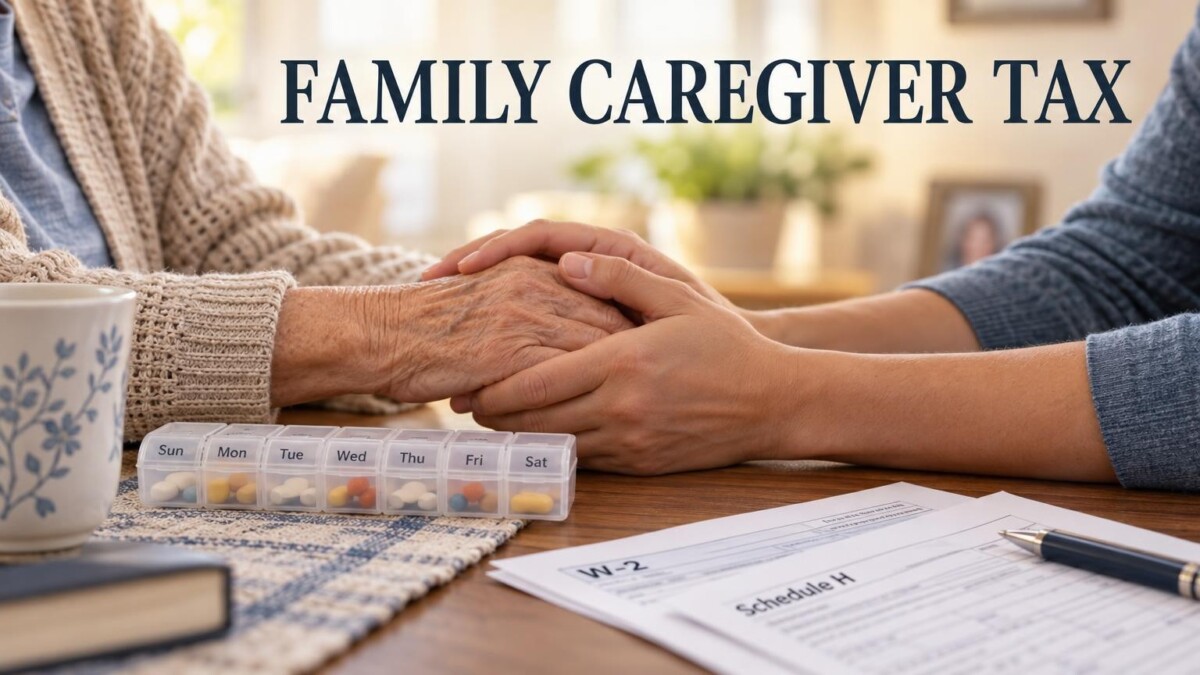
That default matters because household employment comes with its own set of taxes: Social Security, Medicare, federal unemployment (FUTA), and, in some cases, federal income tax withholding. IRS Publication 926, Household Employer’s Tax Guide, is the controlling document for the family, and Schedule H (Form 1040) is the return that pulls those taxes onto the family’s own Form 1040 at year-end. The family does not file a separate employer return for a single household employee; Schedule H does the work.
The caregiver’s side of the picture is simpler but easy to miss. Even when every exception removes the family’s employment-tax obligation, the family still issues Form W-2 to the caregiver. That W-2 flows to the caregiver’s own return as wages. Treating the payments as untaxed family transfers is where many of these cases go wrong, and it is the one mistake that still surfaces when the caregiver later applies for Social Security or a mortgage and nobody can document the income.
Which family relationships remove employment taxes? 🤝
Four relationships generally take the family out of federal household employment taxes: a spouse, a child under age 21, a parent (with narrow exceptions), and any employee under age 18 (also with exceptions). The source for all four is Publication 926, Table 1.
The exceptions sit in IRS Publication 926, Household Employer’s Tax Guide under the heading that asks whether the family needs to pay employment taxes. Each exception is narrow and turns on the relationship between the employer and the caregiver, not on the dollar amount paid. The relationships that remove federal Social Security, Medicare, and FUTA taxes are:
| Caregiver is the employer’s… | Employment taxes? | Form W-2 still required? |
|---|---|---|
| Spouse | Not owed | Yes |
| Child under age 21 | Not owed | Yes |
| Parent | Not owed, unless a narrow exception applies | Yes |
| Employee under age 18 | Generally not owed, with exceptions | Yes |
| Sibling, aunt/uncle, in-law, adult child, or unrelated caregiver | Owed if wages reach the Publication 926 thresholds | Yes |
The parent exception has a small but important wrinkle. Even when the caregiver is a parent of the employer, Publication 926 pulls them back into Social Security and Medicare taxes in certain family situations — for example, where the employer has a child living in the home who is under age 18 or has a physical or mental condition requiring the care of an adult for at least four continuous weeks, and the employer is divorced and not remarried, widowed, or living with a spouse whose own condition prevents care. Do not skip Table 1. Reading the exact wording of the exception is the only way to know whether the parent sits inside it.
Two things the exceptions do not do. They do not change the federal income tax that the caregiver owes on the wages — that follows the caregiver’s own filing status and bracket. And they do not eliminate the Form W-2 filing. The family still issues a W-2 for the wages so that the caregiver has documented earned income, the Social Security Administration has the record (see the Social Security Administration household worker guide for household-worker reporting), and the IRS can match wage reports to the caregiver’s return.
When does a family caregiver owe self-employment tax instead? 💼
Self-employment tax applies when the caregiver is engaged in a trade or business of providing care services. One family member on one case, paid by a state agency or insurance company, is usually not that. A sole proprietor with multiple clients is.
The IRS gives two clean examples on its family caregiver page. In one, a family member is paid by an insurance company to care for their spouse. The caregiver reports the payment as income but does not owe self-employment tax, because the activity is not a trade or business — it is one person caring for one spouse. In the other, a family member receives income from a state agency to care for their grandchildren so the parent can work. Again, the income is reported but no self-employment tax is due; the arrangement is family care, not a care business.
The line moves when the caregiver is holding themselves out as a service to the public. The IRS example of self-employment tax applying is a caregiver who operates a sole proprietorship adult day-care business out of the home, with multiple clients, one of whom happens to be their grandmother. The state agency pays the caregiver to care for the grandmother. Because the caregiver is already in the trade or business of adult day care, the state payment flows onto Schedule C along with everything else the business earned, and Schedule SE calculates SE tax on the net profit.
Two facts drive that outcome, and either one can flip the answer on a borderline case. The first is continuity and regularity: a one-off arrangement with a relative is not a trade or business. The second is whether the caregiver has other paying clients for the same service. A caregiver with advertising, a client intake process, business insurance, and a second client is operating a business no matter what the state agency calls the arrangement. A caregiver with one relative and nothing else is almost certainly not.
How should a family actually pay a caregiver? ✅
Decide whether the family qualifies for an exception, obtain an EIN if any employment tax will be owed, run payroll correctly, issue Form W-2 at year-end, and attach Schedule H to Form 1040 when taxes are due. Do not route the payments as personal gifts.
- Identify the employer. The person being cared for is the employer unless a family member formally takes on that role. The employer’s name, SSN or EIN, and address control the W-2 and the Schedule H.
- Apply Publication 926, Table 1. If the caregiver is a spouse, child under 21, parent (within the exception), or an employee under 18 (within the exception), no household employment taxes are owed, and Schedule H is unnecessary for that caregiver. If not, continue.
- Get an EIN. Any employer that owes household employment taxes needs an Employer Identification Number before issuing Form W-2. Applying is free and takes minutes online.
- Withhold and match where required. If the caregiver’s cash wages cross the Social Security and Medicare threshold for the year, the family withholds the employee share and matches with the employer share. FUTA has its own threshold. Publication 926 publishes both.
- Issue Form W-2 and file with the SSA. Form W-2 is due to the caregiver and to the Social Security Administration after year-end. The due date applies even when no employment tax was owed.
- Attach Schedule H to Form 1040. Schedule H (Form 1040) reports the employment taxes and any federal income tax withheld. The total rolls into Other Taxes on the family’s own return, and the family pays it with the personal tax balance.
From our practice: fix the paperwork before the dependency conversation
The family caregiver tax questions rarely arrive alone. They usually arrive attached to a dependency claim (“Can I claim mom?”), a medical-expense deduction on Schedule A, or a state-level in-home supportive services payment. In our practice, the return is cleaner when the household employment paperwork is settled first. Once the W-2 exists, the caregiver’s income is a known number, the dependency gross-income test can be run honestly, and the caregiver’s share of household expenses stops moving. Trying to do those three at once from a shoebox in April is the slowest possible path.
What about Medicaid waiver payments to a live-in caregiver? 💡
Payments received by a live-in individual care provider under a state Medicaid Home and Community-Based Services waiver may be excluded from gross income as difficulty-of-care payments under IRS Notice 2014-7, subject to the notice’s conditions.
Notice 2014-7 is the reason some caregivers see a W-2 with wages in Box 1 and others see Box 1 at zero. The IRS guidance on Notice 2014-7 explains that qualified Medicaid waiver payments to a care provider who lives in the same home as the care recipient are treated as difficulty-of-care payments excludable from gross income under Internal Revenue Code section 131. Where the exclusion applies, the caregiver still receives documentation of the payments, but the amount is not includible in taxable income.
Exclusion has limits
The Notice 2014-7 exclusion is specific: it applies to a care provider who lives in the same home as the person receiving care, under a qualified state Medicaid Home and Community-Based Services waiver. Payments for care in someone else’s home, payments to a non-live-in caregiver, and payments outside a qualifying waiver program are not covered. And even where the exclusion applies, the caregiver may still elect to treat the payments as earned income for purposes of the Earned Income Tax Credit and the Additional Child Tax Credit — a choice that depends on the rest of the return. Do not treat these payments as excluded without reading the notice and confirming the facts.
Summary: family caregiver tax
- A paid in-home family caregiver is a household employee of the care recipient by default, not a contractor and not an unpaid family helper.
- Publication 926, Table 1, exempts a spouse, child under 21, parent (with narrow exceptions), and employee under 18 (with exceptions) from federal employment taxes — but Form W-2 is still required.
- If the caregiver is not in any of those categories, the family may owe Social Security, Medicare, and FUTA, reported on Schedule H attached to Form 1040.
- A caregiver who operates a care business with multiple clients reports payments on Schedule C and pays self-employment tax on Schedule SE — even when one of the clients is a relative.
- Qualified live-in Medicaid waiver payments may be excluded from gross income under Notice 2014-7, subject to the notice’s conditions.
Frequently asked questions about family caregiver tax ❓
Q. If I pay my adult sister to care for our mother in the home, is she an employee or self-employed?
Generally she is a household employee of the person being cared for (your mother, or whoever directs the care). Under the family caregiver tax rules on the IRS website, an in-home caregiver is normally an employee of the care recipient, and the employer may owe federal employment taxes. The adult sister is not a child under 21 of the care recipient, so no automatic family exemption applies. The family should still check Publication 926, Table 1 to confirm whether employment taxes are owed based on wages paid, but either way Form W-2 is required.
Q. Can a spouse be paid as a household employee without triggering employment taxes?
Yes. Publication 926 specifically excepts a caregiver who is the employer’s spouse, child under age 21, or parent (with narrow exceptions), and an employee under age 18 (also with exceptions), from federal employment taxes such as Social Security, Medicare, and FUTA. The wages still have to be reported on Form W-2, and ordinary income tax may still apply at the caregiver’s level.
Q. Do I owe self-employment tax if a state agency paid me to care for my own grandchildren?
Usually no. The IRS family caregiver guidance uses this exact fact pattern as an example of income that is reported on Form 1040 or 1040-SR but is not subject to self-employment tax. The payments are compensation for caring for your own family member rather than net earnings from a trade or business, so Schedule SE is not required. You still report the income.
Q. What if the caregiver is my child who is under 21?
Household employment taxes generally do not apply to a child under age 21 who works for a parent, and that exception carries over to the caregiver context when the care recipient is the parent. The child still has to report earned income on their own Form 1040 if it meets filing thresholds, and Form W-2 is still issued if the caregiver meets the definition of an employee.
Q. Must I file Schedule H if I owe no household employment taxes?
Not necessarily. Schedule H is the return that household employers use to report Social Security, Medicare, FUTA, and any income tax withheld. If an exception in Publication 926, Table 1 removes those taxes entirely, there is nothing to report on Schedule H for that caregiver. Form W-2, however, still reports wages. If you have other household employees who are not exempt, you file Schedule H for them.
Q. Do Medicaid waiver payments count as taxable income for a family caregiver?
Not always. Under IRS Notice 2014-7, payments received by an individual care provider under a state Medicaid Home and Community-Based Services waiver program for providing care to an eligible person who lives in the provider’s home are treated as difficulty-of-care payments excludable from gross income under Internal Revenue Code section 131. The exclusion has specific requirements and does not cover every state payment, so verify the facts before treating payments as excluded.
Q. When does a family caregiver cross into self-employment and owe SE tax?
When the caregiver is engaged in a trade or business of providing care services, not just helping one relative. The IRS example is a sole proprietor adult day-care operator who cares for multiple clients, one of whom happens to be their grandmother and whose care is paid for by a state agency. Because the activity is a trade or business, the payments are reported on Schedule C and are subject to SE tax on Schedule SE.
This article is general information, not tax or legal advice for your situation. Family caregiver arrangements turn on their facts, including who directs the care, who pays, and whether the caregiver has other clients. If your family is setting up or unwinding a paid caregiver arrangement, contact SW Accounting & Consulting Corp for a confidential review.