How do I open a US business bank account from Korea?
How do I open a US business bank account from Korea without an SSN or ITIN?
After an EIN comes in, a US business bank account is the first real spending tool for the entity, and in 2026 a non-resident founder can realistically open one online in one to three weeks with the right documents and address evidence.
You registered the LLC or C-Corp, you filed Form SS-4, and the IRS called back with an EIN. The next week always comes as a surprise: the US business bank account application needs more than a tax ID. Every Korean founder we help past this step runs into the same questions in the same order — which EIN letter does the bank accept, does a registered-agent address count, who counts as a 25% owner, and why did an online application close without an email. This post walks the roadmap from the EIN confirmation letter to a funded operating account, using only US federal and state primary sources that your bank will actually point to if you ask.
What does a US bank need before it will open my business account? 🧾
Every US bank, fintech included, must verify the entity, every ≥25% beneficial owner, and one control person before any funds move. That obligation is a federal rule, not a bank preference.
The anchor rule for the bank side is the Customer Identification Program under 31 CFR 1020.220, implementing Section 326 of the USA PATRIOT Act. It forces every US bank to collect, at minimum, the legal name, formation address, date of formation, and tax identification number for the entity, plus name, date of birth, address, and an identification number for the people behind it. For a Korean founder with no SSN or ITIN, a passport number plus country of issuance substitutes under 1020.220(a)(2)(i)(A)(4)(ii).
The second layer is the beneficial-ownership rule at 31 CFR 1010.230. The bank must identify every individual who owns 25% or more of the entity and one person who exercises significant control (typically the CEO or managing member). This is separate from any FinCEN Beneficial Ownership Information filing you may or may not owe; it applies at the moment of account opening, every time.
Why do most Korean founders start with a fintech rather than a traditional US bank? 💻
Traditional US branches usually ask for in-person identification and a US residence; non-resident founders bypass that friction by opening with a BSA-covered fintech that runs the whole workflow online.
The fintechs you have heard of — Mercury, Relay, Brex, Wise Business, Novo — are not themselves chartered banks in most cases. They partner with FDIC-insured US sponsor banks and pass that insurance through to the deposited funds, up to the FDIC limit, so long as the funds sit at the sponsor. The same CIP and beneficial ownership rules apply to the sponsor, which is why the fintech asks for the same documents a bank branch would, just through a web form.
The practical trade-off is that these providers rarely accept cash deposits, offer thinner lending products, and reserve the right to close an account quickly if the ownership story stops matching reality. For an early-stage company that mostly receives wires and ACH payments, that is almost always acceptable. For a business that will handle cash from a US storefront, pair the fintech with a traditional branch account once a US-resident officer is in place.
In our practice
The single most common delay we see is not the EIN itself — the IRS international line at 267-941-1099 usually hands out the number on the call. The delay is the CP 575 letter traveling to a Korean mailing address. Clients who ask the IRS for a 147C replacement letter by fax at the same time as the live call usually have proof in hand within a week, and the fintech application never stalls at the “upload your EIN confirmation” step. See the IRS summary of the 147C request process at IRS.gov.
Which documents should I gather before I click Apply? 📂
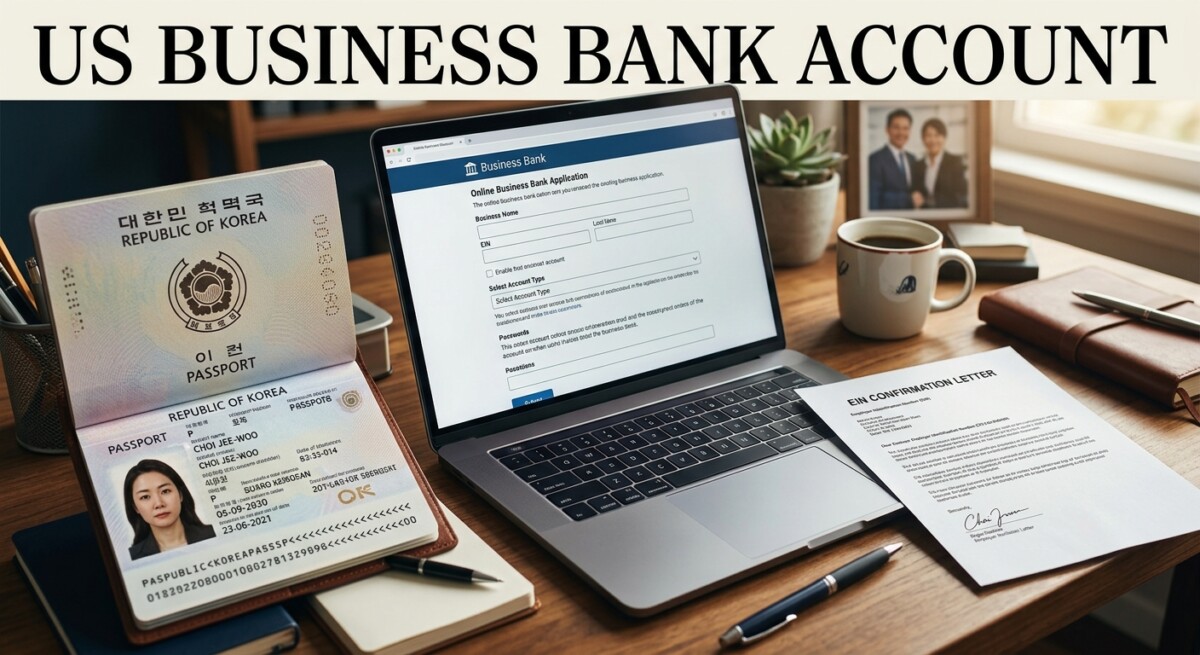
Six documents cover almost every US business bank account application for a foreign founder: an EIN letter, state formation certificate, operating agreement or bylaws, passport scans for every ≥25% owner, a street address, and a specific business description.
| Document | What it proves | Where to get it |
|---|---|---|
| CP 575 or 147C letter | Entity has an active EIN | IRS EIN (mail) or IRS 800-829-4933 (fax) |
| Certificate of Formation / Articles of Incorporation | Entity is validly formed under state law | Secretary of State of the formation state |
| Operating Agreement / Bylaws (signed) | Who the control person is; ownership split | Internal document (prepare before applying) |
| Passport scan for each ≥25% owner | Beneficial-ownership identity (31 CFR 1010.230) | Valid machine-readable passport, no expired page |
| US street address for the business | Operational US presence; CIP address | Office lease, virtual office with mail service, co-working desk |
| Business description & website | Nature of the US activity for AML risk scoring | Draft before applying; one specific sentence beats three generic ones |
On the address line: a PO Box is not acceptable under 31 CFR 1020.220(a)(2)(i)(A)(3), which asks for a residential or business street address. A registered agent address alone, with no mail-forwarding or physical presence attached, is treated similarly during review — the bank reads it as the agent’s office, not yours, and will either downgrade or decline.
⚠️ Common deadline trap: FinCEN BOI reporting
Separately from the bank’s CIP, a foreign reporting company that registers to do business in a US state must file Beneficial Ownership Information with FinCEN within 30 days of registration under the current rule. Domestic entities (the US LLC or C-Corp you just formed in a US state) are not currently subject to BOI reporting after the March 2025 interim final rule, but confirm the live status at fincen.gov/boi before relying on this — the rule has been through litigation and may shift again.
What should I do if the first US business bank account application is declined? 🔁
A decline from one fintech does not shut the door; it almost always points to one of three fixable facts, and reapplying at a different sponsor bank or a different fintech resolves the account for most founders within a week.
The three facts that drive most declines are: a business description that reads generic (a one-line “consulting services” is weaker than a three-line description of the specific service, pricing, and customer type); an address that resolves to a registered-agent office with no operational tie; or a country of residence currently on a US sanctions screening list, in which case the bank cannot proceed regardless of documentation. The first two are rewrites. The third is a true blocker and your options are to add a US-resident officer or set up a non-US multi-currency account designed for cross-border receivables.
In practice, applicants cycle through two or three providers to land a workable account. Each application creates a new CIP file at a new sponsor bank — the previous decline does not carry across — but duplicate applications under the same ownership and the same vague description will reach the same conclusion. Rewrite the description before you reapply, not after.
Where does a US business bank account fit in the broader launch roadmap? 🗺️
Treat the EIN, the account, and the first federal tax calendar entries as one continuous workflow: the entity cannot bill customers, pay payroll providers, or hold investor funds until the account is live, and the account cannot open until the EIN confirmation letter is in hand.
A realistic sequence for a Korean founder, assuming the US entity is already formed under state law:
- File Form SS-4 by international phone (immediate issuance) or fax (4–7 business days). The IRS international line and the SS-4 instructions are on the IRS Form SS-4 page.
- Request a 147C letter the same day if the CP 575 mailing destination is overseas; the bank will accept either letter.
- Draft a signed operating agreement or bylaws listing every ≥25% owner, the control person, and the US business address.
- Apply at one BSA-covered fintech. Expect a decision in 2–10 business days.
- If declined, rewrite the business description and address, then apply at a second provider.
- Once funded, set up payroll, state tax registrations, and the first federal filing calendar (typically Form 1120 or 1065 and any state franchise or minimum tax).
Total elapsed time from state formation to a live account for a prepared applicant is one to three weeks. Months-long timelines usually trace back to the CP 575 letter being mailed to Korea with no 147C backup, or to the applicant trying the IRS online EIN tool, which is only available to applicants whose principal business is in the United States.
Key takeaways
- A US business bank account application needs the CP 575 or 147C EIN letter, state formation documents, a signed operating agreement, and a passport scan for every ≥25% owner.
- The Customer Identification Program at 31 CFR 1020.220 and the beneficial-ownership rule at 31 CFR 1010.230 drive every bank’s document list — fintechs follow the same rules through their sponsor bank.
- A PO Box or a registered-agent-only address is almost always declined; prepare a US street address with mail forwarding before applying.
- Expect one to three weeks from EIN issuance to a funded account if the paperwork is in order; a decline on the first application is normal and fixable.
Frequently asked questions ❓
Q1. Can I open a US business bank account without an SSN or ITIN?
Yes. Under 31 CFR 1020.220(a)(2)(i)(A)(4)(ii) a non-US person can satisfy the Customer Identification Program with a passport number and country of issuance in place of a US taxpayer identification number. The entity still needs an EIN, but the individual owner does not need an SSN or ITIN to be identified.
Q2. Does a fintech like Mercury or Relay count as a real US bank?
The fintech itself is usually a technology provider sitting on top of an FDIC-insured US sponsor bank. Deposits held at the sponsor are FDIC-insured up to the standard limit under the sponsor’s charter. For most operating-cash purposes the economic answer is the same as a traditional bank; for cash deposits, international wires on obscure corridors, or complex lending the traditional branch is still the simpler fit.
Q3. What is a 147C letter and when should I request one?
The 147C letter is an IRS-reissued EIN verification that banks accept in the same way they accept the original CP 575. Request it by calling 800-829-4933 and asking for the business & specialty tax line; the IRS will fax it to a number you provide. Request it immediately if the CP 575 is being mailed overseas or if the original letter has gone missing.
Q4. Do I need to fly to the United States to open my business account?
Not for BSA-covered fintechs — they verify identity online using passport images, selfie liveness checks, and the beneficial-ownership rule under 31 CFR 1010.230. Traditional branch accounts usually still require in-person identification by at least one authorized signer; a US-resident co-founder or officer can satisfy that in-person step so the non-resident founder does not need to travel.
Q5. Does opening the account trigger a FinCEN Beneficial Ownership Information filing?
The two beneficial-ownership regimes are separate. The bank’s beneficial-ownership rule at 31 CFR 1010.230 applies at account opening. FinCEN’s Corporate Transparency Act Beneficial Ownership Information reporting at 31 CFR 1010.380 applies to the entity itself and, under the interim final rule effective March 2025, currently reaches only foreign reporting companies — US domestic LLCs and corporations are not subject to BOI reporting as of this writing. Confirm the current status at fincen.gov/boi before relying on it, because the rule has been through litigation.
Q6. Can my Korean parent company be the 100% owner of the US entity, and does that change the bank’s documentation?
Yes, a Korean entity can own the US entity outright. The bank still runs 31 CFR 1010.230 by looking through the Korean parent to the individual humans who own ≥25% of the parent and treating them as the beneficial owners of the US customer. Expect to supply the Korean parent’s business registration, its articles of incorporation, and passport scans for the Korean-side ≥25% owners.