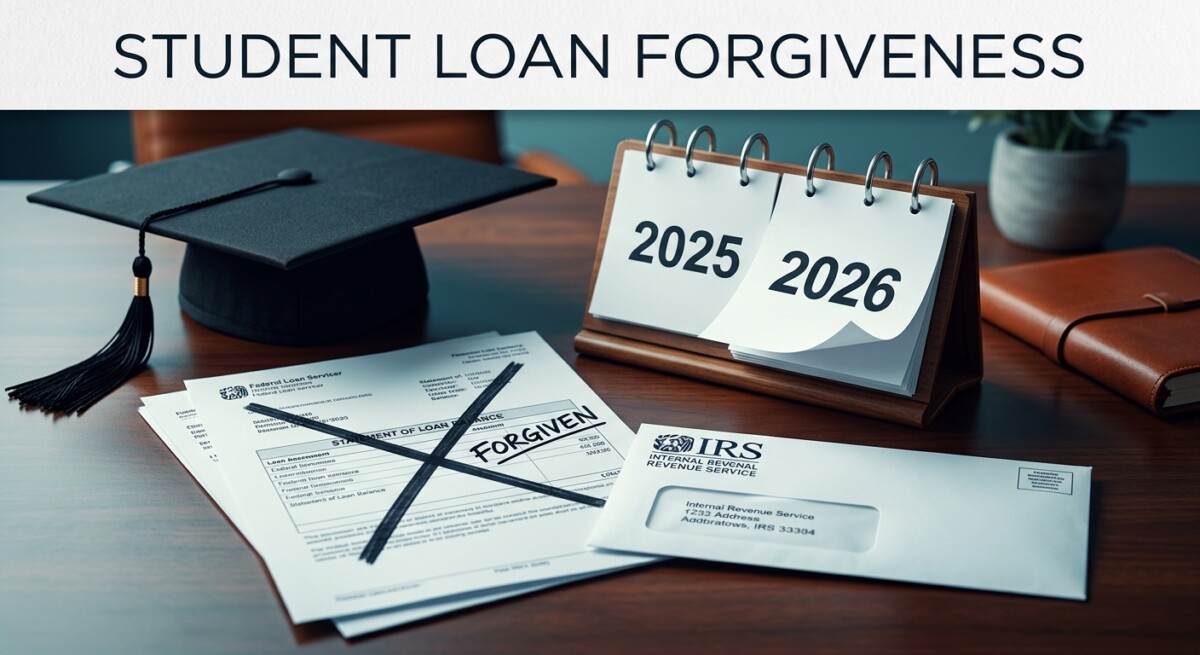
Is student loan forgiveness taxable in 2026?
For four years, a quiet provision of the American Rescue Plan Act kept canceled federal student debt off the tax return. That window closed on December 31, 2025. Starting with discharges in 2026, student loan forgiveness is back to being taxable under the default rule of Internal Revenue Code §61 and §108, and borrowers crossing the finish line on income-driven repayment are the first ones to feel it. In our Los Angeles practice, we are already seeing clients receive their first Form 1099-C in roughly a decade, often for amounts that double or triple a year’s federal tax bill. This post walks through what the law actually says in 2026, which forgiveness programs are still excluded, how to use the insolvency rule when it fits, and what to do in the months before the 1099-C arrives.
Why is student loan forgiveness taxable in 2026? 📅
Because the exclusion added by the American Rescue Plan Act was temporary. The default rule in Internal Revenue Code §61 treats canceled debt as gross income, and §108 only exempts narrow categories. Between 2021 and 2025, Congress widened one of those categories — then let the widening expire.
The federal rule on canceled debt is older than any particular forgiveness program. Under 26 U.S.C. §108, gross income includes discharged indebtedness unless an exception listed in §108 applies. For student loans, the usable exceptions sit in §108(f). Historically, §108(f) excluded only loans forgiven in exchange for working in a particular profession or geographic area, such as public service or underserved healthcare, plus discharges on account of the borrower’s death or disability.
Then came the pandemic. Public Law 117-2 (American Rescue Plan Act) §9675 added subparagraph (B) to §108(f)(5), excluding from gross income any discharge of a wide class of student loan debt occurring in a taxable year beginning after December 31, 2020, and before January 1, 2026. For borrowers whose income-driven repayment plans finally reached cancellation during those years, the discharged balance was simply not reported as income. The provision sunset by its own terms on December 31, 2025. Congress did not extend it.
The result is that borrowers whose IDR cancellation lands in 2026 are back under the pre-2021 regime. The loan holder files Form 1099-C for the amount discharged, the IRS receives the same form, and the borrower reports the amount as ordinary income on Schedule 1 of Form 1040 — unless a surviving exclusion in §108(f), §108(a), or elsewhere applies. The mechanics are summarized in IRS Publication 4681 and IRS Topic No. 431.
Which student loan forgiveness programs are still tax-free? 🛡️
Public Service Loan Forgiveness, discharges for death and total and permanent disability, and repayments under the National Health Service Corps and qualifying state loan repayment programs for health professionals. These exclusions are permanent and did not expire with the American Rescue Plan Act provision.
Not every forgiveness program became taxable at the stroke of midnight. The permanent architecture of §108(f) still carves out several categories, and IRS Publication 970 (chapter 5) is the clearest IRS summary of which program fits where.
| Program / event | Statutory basis | 2026 federal income tax treatment |
|---|---|---|
| Public Service Loan Forgiveness (PSLF) after 120 qualifying payments | §108(f)(1) | Excluded from gross income. Permanent — not affected by the ARPA sunset. |
| Discharge on borrower’s death | §108(f)(5) (permanent part) | Excluded from gross income. |
| Discharge for total and permanent disability | §108(f)(5) (permanent part) | Excluded from gross income. |
| National Health Service Corps and qualifying state loan repayment programs for health professionals | §108(f)(4) | Excluded from gross income. |
| Income-driven repayment (IDR) forgiveness after 20 or 25 years | No specific §108(f) exclusion after 12/31/2025 | Generally taxable in 2026 unless insolvency, bankruptcy, or another §108(a) exclusion applies. |
| Teacher Loan Forgiveness (up to $17,500 for qualifying teachers) | §108(f)(1) | Excluded from gross income — tied to the service-based exclusion. |
| Borrower Defense to Repayment and Closed School Discharge | §108(f)(1) / Treasury guidance | Treated as service-based or Treasury-recognized exclusions — generally not taxable; verify the specific discharge. |
Two patterns are worth drawing out. First, every surviving exclusion is tied to a defined event — a service requirement, a death, a disability, or a specific statutory program. There is no general exclusion for “loan was eventually canceled.” Second, the exclusion applies at the federal level. A handful of states conform selectively; California, for example, has historically conformed to the §108(f) exclusions through its own code sections, but state treatment should always be confirmed on the state return separately.
How does the insolvency exclusion work for student loan forgiveness? 📉
Under §108(a)(1)(B), you exclude canceled debt to the extent you were insolvent immediately before the discharge. Insolvency is a factual snapshot: total liabilities minus the fair market value of all assets, taken the day before the discharge event.
For a borrower whose IDR forgiveness lands in 2026 with no surviving §108(f) exclusion, the insolvency rule in §108(a) is often the next line of defense. The analysis is mechanical, but it is fact-intensive and poorly understood. IRS Publication 4681 includes the IRS’s own worksheet; the key steps are the same every time:
- Pick the measurement date. Insolvency is tested immediately before the discharge, not at year end. For an IDR cancellation effective June 1, 2026, the test is run as of the end of May 31, 2026.
- Tally all liabilities, including the student loan being discharged, mortgages, credit cards, medical debt, auto loans, business guarantees, and tax balances owed. Contingent liabilities count only to the extent of a more-likely-than-not obligation.
- Tally the fair market value of all assets, including retirement accounts, cash value life insurance, home equity, vehicles, business interests, and household goods. Use fair market value, not basis.
- Compute the insolvency amount: liabilities minus assets, if positive.
- Exclude up to that amount from the canceled debt income on Form 982, Part I, box 1b. Any excess is still taxable.
- Reduce tax attributes under §108(b): net operating losses, general business credits, capital losses, basis in property, passive activity carryovers, and foreign tax credits, in the order Form 982 prescribes.
Two subtleties trip up most borrowers. First, retirement accounts count as assets — a borrower with a healthy 401(k) is often not insolvent on paper even when cash flow is tight. Second, the discharged loan counts as a liability for purposes of the test, so a borrower whose only significant debt is the student loan being forgiven is frequently insolvent by that amount, which can wipe out the income entirely. In our practice we build the insolvency balance sheet in the fall of the discharge year, while statements are still fresh, rather than in April with a shoebox of year-end account printouts.
Bankruptcy discharge is a separate path
Student loans discharged in a Title 11 bankruptcy proceeding are excluded under §108(a)(1)(A) and reported on Form 982, Part I, box 1a. The exclusion applies only if the discharge actually occurs under the Bankruptcy Code, including the undue hardship adversary proceeding that student loans require. Simply filing bankruptcy with student loans listed is not enough.
How do I report canceled student debt on my 2026 tax return? 📝
Start with the Form 1099-C from your loan holder. Report the amount from Box 2 as other income on Schedule 1, Form 1040, unless an exclusion applies. If an exclusion applies, attach Form 982 and report the excluded amount on the appropriate line.
The 2026 filing season will be the first in five years in which most IDR cancellations land on a tax return as income. The paperwork chain is deterministic:
- Form 1099-C arrives in January 2027. Box 2 shows the amount discharged in 2026, Box 1 the date of the identifiable event, and Box 6 the event code (code G is typically used for a decision to discontinue collection). The loan holder sends the same copy to the IRS.
- Compare the 1099-C to your records. Payment history on your servicer’s portal should match. Dispute any discrepancy with the loan holder, not with the IRS, and before you file.
- Apply any surviving §108(f) exclusion first. PSLF, death, disability, NHSC, and qualifying state LRP discharges are reported on Form 982 under the specific category.
- If no §108(f) exclusion applies, run the §108(a) tests. Bankruptcy discharge first, then insolvency, then the other §108(a) categories. Each exclusion reduces tax attributes under §108(b).
- Report any taxable remainder on Schedule 1, Form 1040, as other income. The amount flows into Adjusted Gross Income and can phase out credits you otherwise qualified for.
- Keep the worksheet. Retain the insolvency computation, loan statements, and supporting valuations for at least three years from the return’s due date, longer if any attribute reduction carries forward.
From our practice: the credits are the hidden cost
The headline is the income tax on the forgiven balance, but the quieter damage is the loss of credits that phase out with Adjusted Gross Income. The Earned Income Tax Credit, the Child Tax Credit, the Premium Tax Credit for marketplace health coverage, and the Saver’s Credit all collapse at higher AGI. For a family in the $40,000 to $80,000 range, a $30,000 to $60,000 IDR cancellation can disqualify them from credits worth more than the income tax itself. The §108(a) insolvency exclusion, where available, protects not only the headline tax but the credits beneath it.
What should borrowers do before the 1099-C arrives? ⏳
Confirm which exclusion, if any, applies to your discharge; build the insolvency balance sheet the week of the discharge; set aside estimated tax, if needed, to cover the shortfall; and coordinate with a CPA before year-end so Form 982 and any attribute reductions move together.
- Verify your program. PSLF, NHSC, teacher, and disability discharges remain excluded; IDR forgiveness in 2026 generally does not. Confirm the exact program and the identifiable event with your servicer.
- Document assets and liabilities on the discharge date. Save bank, retirement, and property statements as of the day before the discharge. Reconstructing an insolvency position six months later is far harder than printing one at the time.
- Project the federal and California tax impact. Run a projection with and without the forgiven amount so the credit phase-outs and bracket shifts are visible before the return is prepared.
- Make estimated payments if the balance due will be material. Underpayment penalties can be avoided by increasing withholding or making a fourth-quarter estimated payment under §6654.
- Keep tax-free alternatives on the table. Employer student loan assistance under §127 (through 2025 as currently legislated and periodically extended), state LRPs, and the National Health Service Corps Loan Repayment Program all remain available where their eligibility rules fit.
- If the balance due is unaffordable, plan an IRS payment plans conversation before April 15 — a short-term installment agreement is usually cheaper than a long one.
Summary: student loan forgiveness and taxes in 2026
- The American Rescue Plan Act §9675 exclusion for canceled student debt sunset on December 31, 2025. IDR cancellations in 2026 are generally taxable under §61 and §108.
- Permanent §108(f) exclusions survive: PSLF, death, total and permanent disability, NHSC, teacher loan forgiveness, and qualifying state loan repayment programs.
- The §108(a) insolvency exclusion is the main backstop — exclude up to the amount you were insolvent immediately before the discharge, on Form 982, with tax-attribute reduction under §108(b).
- Form 1099-C from the loan holder triggers reporting; the IRS receives the same form, so matching is automatic.
- The credit phase-outs — EITC, CTC, Premium Tax Credit, Saver’s Credit — are often a larger cost than the income tax itself. Plan the exclusion and the return together.
Frequently asked questions about student loan forgiveness ❓
Q. Is student loan forgiveness taxable in 2026?
For most federal borrowers, yes. The temporary exclusion in Internal Revenue Code §108(f)(5)(B), added by §9675 of the American Rescue Plan Act, expired on December 31, 2025. Starting with discharges in 2026, canceled federal student debt — including balances canceled under income-driven repayment plans — is generally includible in gross income under §61 and §108, unless a separate exclusion applies.
Q. Which student loan forgiveness programs are still tax-free in 2026?
Public Service Loan Forgiveness under §108(f)(1) remains excluded from income, as do discharges on account of the borrower’s death or total and permanent disability under the permanent part of §108(f)(5). Repayments received under the National Health Service Corps Loan Repayment Program and certain state loan repayment programs for health professionals are excluded under §108(f)(4). Insolvency and bankruptcy discharges under §108(a) are also excluded.
Q. How is canceled student debt reported to me and to the IRS?
Your loan holder (or the Department of Education’s servicer) issues Form 1099-C, Cancellation of Debt, listing the amount discharged in Box 2 and the identifiable event code in Box 6. The IRS receives the same form. If an exclusion applies, you still receive the 1099-C, but you report the excluded amount on Form 982 and attach it to your return.
Q. Will I owe the 10% additional tax on the forgiven amount?
No. The 10% additional tax under §72(t) applies to early distributions from qualified retirement plans, not to cancellation of debt income. Canceled student loan balances are ordinary income only — but ordinary income is enough to push a middle-income household into a higher bracket and strip them of credits that phase out with AGI.
Q. Can I use the insolvency exclusion to avoid tax on forgiven student loans?
Sometimes. Under §108(a)(1)(B), you exclude discharged debt to the extent you were insolvent — your liabilities exceeded the fair market value of your assets — immediately before the discharge. The excluded amount reduces tax attributes under §108(b) on Form 982. Insolvency is a factual test taken on the day before the discharge, and student loans themselves count as a liability in that calculation.
Q. What if I can’t pay the tax when the 1099-C arrives?
The forgiven amount is taxed in the year of discharge, so plan ahead. If the balance due at filing is unaffordable, request an installment agreement or, in hardship, an offer in compromise. Interest and late-payment penalties accrue until paid, so a short-term installment plan is usually cheaper than a long one. Coordinate the request with your CPA before the April filing deadline.
This article is general information, not tax or legal advice for your situation. Cancellation of debt cases turn on facts and timing. If you or a family member expects a student loan discharge in 2026, contact SW Accounting & Consulting Corp for a confidential review.