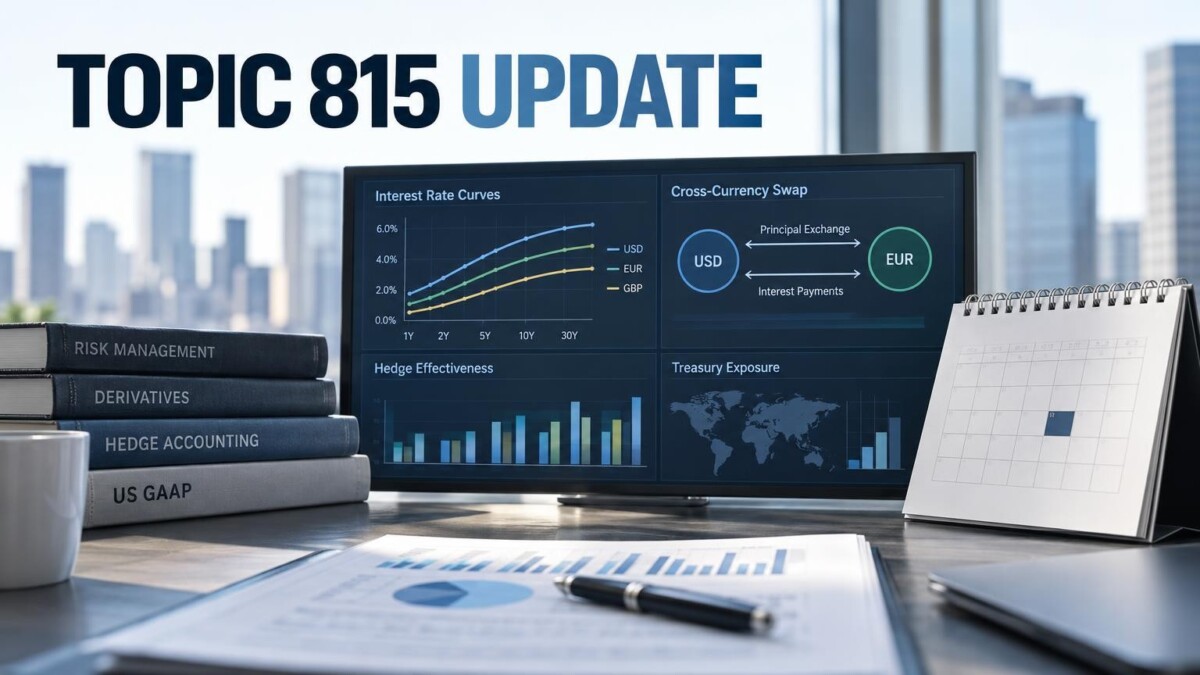
FASB hedging update: Topic 815 decisions (2026)
Hedge accounting under ASC Topic 815, Derivatives and Hedging has sat uncomfortably with the way treasury teams actually manage interest-rate and currency risk for several years. Companies holding large held-to-maturity debt portfolios have been boxed out of fair value hedging for the components that matter most to them, SOFR fair value hedges have carried an OIS-flavored benchmark description that drifted from current market practice, and cross-currency hedges of net investments in foreign operations have failed the mechanics of Topic 815 for reasons unrelated to economics. The FASB hedging update the Board affirmed on October 21, 2026 addresses all three and sets out a transition path that lets early adopters move as soon as the final Accounting Standards Update is issued.
This post walks through what the FASB Board actually decided, what each decision changes in Topic 815, how transition is expected to work, and what finance and accounting policy teams should line up before the final ASU drops. The FASB current technical agenda shows the project continuing to move toward ballot, so the window to prepare is limited.
What did the Board affirm about the FASB hedging update to Topic 815? 📘
At its October 21, 2026 meeting the Board affirmed three substantive decisions on Topic 815 and directed staff to draft a final Accounting Standards Update for written-ballot vote: HTM debt securities are freed from their special risk restrictions, the OIS parameter is removed from the existing SOFR benchmark description, and float-to-float cross-currency swaps with different reset dates can qualify as net investment hedging instruments.
The amendments were originally issued for public comment earlier in 2026 as a proposed ASU titled Derivatives and Hedging (Topic 815): Targeted Improvements to Accounting for Interest Rate Risk Hedging and Net Investment Hedging. After weighing comment-letter feedback, the Board affirmed its key decisions and, importantly, affirmed scope: the amendments apply to all entities. Public business entities, private companies, and not-for-profits that use hedge accounting under Topic 815 will all be subject to the same rules.
The Board also made two decisions worth noting about what did not change. It decided not to amend ASC Topic 320, Investments—Debt Securities to clarify the use of the terms amortized cost basis and amortized cost that appear across the debt-securities guidance, and it decided not to remove the requirement in paragraph 815-35-35-9 that the two interest rate curves in a float-to-float cross-currency swap be comparable. In both cases the Board concluded that the targeted improvement did not justify opening adjacent guidance.
How does the FASB hedging update change HTM debt securities? 🏦
The Board decided to remove the limitations specific to eligible risks that may be hedged for held-to-maturity debt securities. HTM securities will be subject to the same general guidance applicable to hedging financial assets, which means the full interest-rate-risk toolkit opens up.
Under current Topic 815, the risks that could be hedged for HTM debt securities were constrained in a way that did not apply to the same securities classified as available-for-sale. Treasury teams that moved a security into HTM to signal intent and lock in amortized-cost measurement effectively surrendered access to the broader hedge-designation set. The targeted improvement removes that distortion.
The transition decision for this piece is specific. The Board affirmed that entities apply the HTM amendments prospectively, with no transition elections available. That means a new hedge-designation decision on an HTM security after the effective date is where the benefit shows up; there is no retroactive change for hedges that failed under old Topic 815.
In our practice: inventory the HTM book before the ASU drops
In our practice, the biggest planning win here is operational, not conceptual. Clients with HTM positions above a few hundred million dollars are already asking which lots they would designate first. We help them build a prioritized list keyed to coupon reset dates, modified duration, and natural offsets with their liability book, so the designation paperwork is ready the week the final ASU is issued. Early adoption is permitted, and in a rate environment where fair-value swings can swamp earnings, getting a documented hedge in place one quarter sooner is a material P&L outcome.
What does removing the OIS parameter from the SOFR benchmark rate mean? 📈
The Board affirmed removing the overnight index swap (OIS) parameter from the existing SOFR benchmark rate description in Topic 815. SOFR as traded in the current market will qualify as the benchmark interest rate for hedge accounting without the historical OIS gloss.
When SOFR was added to Topic 815 as a permissible benchmark interest rate, the Board described it with an OIS parameter that reflected the way SOFR-indexed derivatives were quoted at the time of transition from LIBOR. Market convention has moved on. Preparers and auditors have had to argue each quarter whether their designated hedged risk continued to match the Codification description. Removing the parameter aligns the benchmark description with how SOFR is now used.
Transition for this piece is the richest of the three. The Board decided that entities with existing fair value hedges where SOFR is the designated benchmark interest rate may adopt the amendments on either a prospective or a modified retrospective basis. Under the modified retrospective approach, an entity is permitted to modify its hedge documentation to change its hedged risk designation and effectiveness assessment method without requiring hedge dedesignation. That matters: dedesignation would release accumulated other comprehensive income into earnings and reset the hedge clock.
Modified retrospective adopted in an interim period requires annual-period alignment
The Board decided that if an entity elects the modified retrospective transition for the SOFR OIS removal in an interim period, the entity must adopt the amendments as of the beginning of the annual reporting period that includes that interim period. The practical effect: the comparative quarters inside the fiscal year all share one basis of accounting. Plan the elect-and-adopt sequence with your controller and your auditor before you touch hedge documentation.
How does the FASB hedging update treat cross-currency swaps in net investment hedges? 🌍
The Board affirmed that float-to-float cross-currency swaps with different reset dates qualify as hedging instruments in net investment hedges, provided the intervals on each leg occur every six months or more frequently.
Hedging a net investment in a foreign operation with a float-to-float cross-currency swap has historically run into a mechanical problem under Topic 815: the reset dates on the two legs rarely line up perfectly in market-standard swaps. Topic 815 had treated non-identical reset dates as a disqualifier for perfect effectiveness. The affirmed amendments explicitly permit this structure, subject to the six-month-or-more-frequent reset rule, bringing the accounting into line with how treasury teams actually hedge translation risk.
The Board also decided not to amend paragraph 815-35-35-9 to remove the requirement that the two interest rate curves be comparable, and not to extend the perfect-effectiveness assumption to any float-to-float cross-currency swap with reset intervals every six months or more frequent. In other words, the eligibility rule is being relaxed; the method-of-assessment framework is not. Transition for this piece is prospective, consistent with the HTM transition approach.
When does the FASB hedging update take effect, and what should finance teams do now? 🗓️
The amendments are effective for annual reporting periods beginning after December 15, 2027, and interim periods within those annual periods, with early adoption permitted on or after the final ASU’s issuance date. For a calendar-year filer, that is first-quarter 2028 at the latest.
Early adoption is likely to be more common on this ASU than most, because each of the three decisions removes an existing hedge-accounting friction without introducing a new disclosure burden. The transition disclosures required are a short list: the nature of and reason for the change in accounting principle, the method of applying the change, and, for the SOFR OIS modified retrospective option, a description of any retrospectively adjusted prior-period information and the cumulative effect on retained earnings or other appropriate equity components. Interim issuers provide the disclosures in both the interim and annual statements for the year of change.
The practical checklist for the next two quarters:
- Scope your HTM population. Identify securities most likely to benefit from fair value interest-rate-risk hedging after the ASU is final, and pre-draft the hedge documentation.
- Inventory your SOFR fair value hedges. Decide which population moves prospectively and which uses the modified retrospective transition. The decision drives hedge-documentation remediation.
- Review treasury playbooks for cross-currency net investment hedges. If a float-to-float structure was passed over because of reset-date mechanics, model it with the new rule.
- Align with your auditor on timing. Early adoption midyear is permitted, but a modified retrospective SOFR election in an interim period triggers annual-period alignment. Coordinate before, not after, the adoption journal entry.
- Update accounting-policy memos and SOX narratives. The population of eligible hedges will expand; the controls that govern designation and effectiveness testing need to describe the new scope cleanly.
Watch the FASB current technical agenda and the FASB Accounting Standards Updates index for the final ASU; the Board directed the staff to draft it for written-ballot vote at the October 21, 2026 meeting.
| Topic 815 issue | Board decision (October 21, 2026) | Transition |
|---|---|---|
| Hedging interest rate risk on HTM debt securities | Remove the special-risk limitations; apply the general financial-asset guidance | Prospective, no transition elections |
| “OIS” parameter in the existing SOFR benchmark rate | Remove the OIS parameter | Prospective or modified retrospective; interim-period election triggers annual-period alignment |
| Float-to-float cross-currency swaps with different reset dates in net investment hedges | Permit as hedging instruments if each leg resets every six months or more frequently; comparability of the two interest rate curves is retained | Prospective |
| Entities in scope | All entities (public, private, not-for-profit) | — |
| Effective date | Annual reporting periods beginning after December 15, 2027; interim periods within those annual periods | Early adoption permitted on or after the final ASU’s issuance date |
Summary: the FASB hedging update at a glance
- The Board affirmed targeted Topic 815 improvements on October 21, 2026 and directed a final ASU for ballot.
- HTM debt securities will be subject to general interest-rate-risk hedging guidance (prospective).
- The OIS parameter is removed from the SOFR benchmark rate; adopters choose prospective or modified retrospective (no dedesignation required).
- Float-to-float cross-currency swaps with different reset dates can be net investment hedging instruments if each leg resets every six months or more frequently (prospective).
- Effective for annual periods beginning after December 15, 2027; early adoption permitted on or after the final ASU’s issuance date.
Frequently asked questions about the FASB hedging update ❓
Q. When does the FASB hedging update to Topic 815 take effect?
The Board decided the amendments are effective for annual reporting periods beginning after December 15, 2027, and for interim periods within those annual periods. Early adoption is permitted on or after the issuance date of the final Accounting Standards Update. For a calendar-year filer, that means mandatory adoption in the first-quarter 2028 financial statements, with the ability to adopt earlier once the final ASU is issued.
Q. Can HTM debt securities now be designated in a fair value hedge of interest rate risk?
Yes. The Board decided to remove the limitations specific to eligible risks that may be hedged for held-to-maturity debt securities. Once the final ASU is effective, HTM securities will be subject to the same general interest rate risk hedging guidance that applies to other hedged financial assets. The Board also decided not to amend Topic 320 to change the use of the terms amortized cost basis and amortized cost.
Q. What does removing the OIS parameter from the SOFR benchmark rate change?
Today the SOFR benchmark rate as described in Topic 815 includes an overnight index swap (OIS) parameter. The Board affirmed its decision to remove that parameter so that SOFR itself, as currently used in the market, qualifies as the benchmark interest rate for hedge accounting. Entities with existing SOFR fair value hedges can adopt either prospectively or on a modified retrospective basis, with a hedge-documentation remediation path.
Q. Do float-to-float cross-currency swaps qualify as net investment hedging instruments?
Yes, subject to a reset-frequency rule. The Board affirmed that float-to-float cross-currency swaps with different reset dates can be hedging instruments in net investment hedges, provided the intervals on each leg occur every six months or more frequently. The Board did not remove the comparability requirement for the two interest rate curves.
Q. What transition disclosures will the final ASU require?
At a minimum, entities will disclose the nature of and reason for the change in accounting principle and the method of applying the change. Entities issuing interim financial statements must provide the disclosures in both the interim financial statements of the period of change and the annual financial statements. Entities electing the modified retrospective transition for removing the OIS parameter from SOFR must additionally describe any prior-period information retrospectively adjusted and the cumulative effect of the change on retained earnings or other appropriate equity components.
Q. Does this FASB hedging update affect how we account for crypto assets?
No. In the same October 21, 2026 meeting, the Board separately discussed feedback on tokenized real-world assets, holdings of an issuer’s own crypto assets, cash-flow-statement classification of crypto activity, additional disclosures, and rewards and slashing, and decided not to add any of these as projects to its technical agenda at this time. Crypto remains outside the scope of the Topic 815 hedging amendments.
Q. How should finance teams prepare before the final ASU is issued?
Inventory existing fair value hedges where SOFR is the designated benchmark and where HTM securities are hedged. Decide, with your auditors, whether a prospective or modified retrospective transition is more useful for each population. Review hedge documentation templates so new designations after issuance can take advantage of the simplifications. Confirm that controls over hedge effectiveness testing contemplate the revised SOFR benchmark description and the expanded HTM population.
This article is general information, not accounting or tax advice for your situation. Hedge accounting decisions depend on hedged items, instruments, documentation, and effectiveness methodology. If your organization is weighing an early adoption of the final Topic 815 ASU, contact SW Accounting & Consulting Corp for a scoping conversation.