
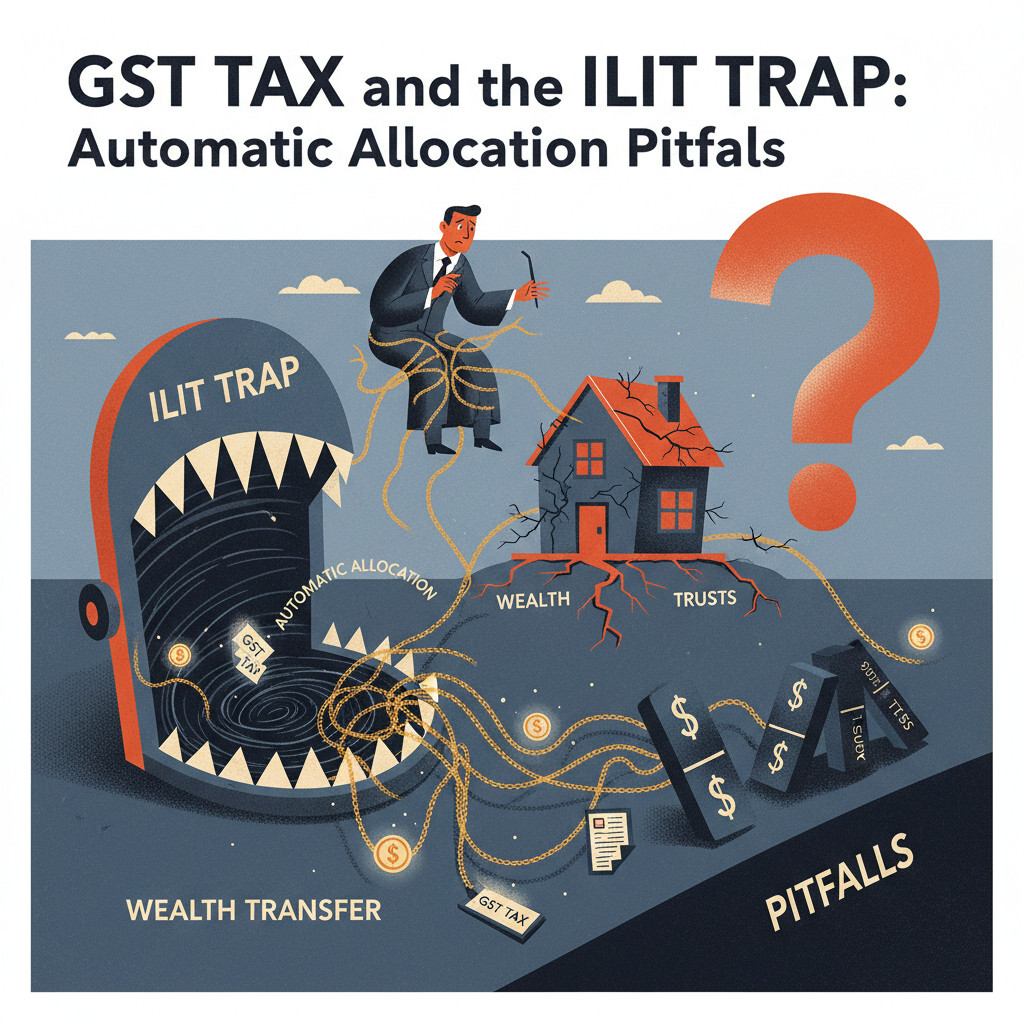
GST Tax and the ILIT Trap: Automatic Allocation Pitfalls
For families building multi-generational wealth, the generation-skipping transfer tax is the silent third tax — layered on top of gift and estate tax at a flat 40% — and the GST exemption is the tool that neutralizes it. But the exemption only works if it’s tracked and allocated correctly, and the most common place that breaks down is the irrevocable life insurance trust (ILIT).
At SW Accounting & Consulting Corp, we work with Los Angeles area families and their estate-planning attorneys on gift, estate, and GST tax compliance. Below: what the GST tax is, how the exemption and automatic-allocation rules work, the ILIT pitfalls we see most often, and how to fix a trust whose GST status went sideways.
What is the GST tax? 🏛
The GST tax (IRC Chapter 13) is a flat 40% tax on transfers to a “skip person” — generally someone two or more generations below the transferor (grandchildren, or a trust for their benefit). It exists to prevent families from avoiding a layer of estate tax by transferring wealth directly to grandchildren, skipping the children’s generation.
Three types of taxable events trigger GST tax:
- Direct skip — an outright transfer to a skip person (e.g., a gift directly to a grandchild).
- Taxable distribution — a distribution from a trust to a skip person.
- Taxable termination — a trust interest terminates such that only skip persons remain as beneficiaries.
The GST tax is separate from, and in addition to, gift and estate tax. A transfer can be subject to both gift tax AND GST tax — which is why proper exemption allocation matters so much.
How does the GST exemption work? 🛡
Each individual has a GST exemption (tied to the unified estate and gift tax basic exclusion amount under IRC §2010(c)(3)) that can be allocated to transfers to shield them from GST tax. Under the One, Big, Beautiful Bill, the basic exclusion amount was set at a high, permanent, inflation-indexed level (approximately $15 million per individual for 2026 — confirm the current indexed figure).
Key mechanics:
- Allocation creates an “inclusion ratio” — allocating enough exemption to a trust gives it an inclusion ratio of zero, meaning it is fully GST-exempt; partial allocation leaves a fractional inclusion ratio and partial GST exposure.
- Allocation can be automatic or elected — IRC §2632 provides automatic allocation rules for certain transfers; you can also affirmatively opt in or out on a timely filed gift tax return.
- Exemption is a finite, lifetime resource — once used on one transfer, it’s not available for another. Using it inefficiently (or accidentally) is permanent.
The §2632 automatic-allocation rules are designed to protect taxpayers who forget to allocate — but they can also allocate exemption where you didn’t intend, or fail to allocate where you did. Relying on the defaults without an intentional election is how exemption gets wasted on the wrong trust, or how a trust meant to be GST-exempt ends up with a nonzero inclusion ratio.
Why do ILITs cause GST problems? 🧨
Irrevocable life insurance trusts are a cornerstone of estate planning — they keep life insurance proceeds out of the taxable estate and provide liquidity at death, funded by annual-exclusion gifts under IRC §2503(b). But the GST implications are frequently overlooked, and the structure creates four recurring traps.
| Common ILIT oversight | Why it bites later |
|---|---|
| Not tracking GST exemption use | Annual-exclusion gifts aren’t reported on a gift tax return, so exemption allocation goes unrecorded — no paper trail years later |
| Not electing in/out of automatic allocation | Defaults under Regs. §26.2632-1(b)(2) apply by inertia, often producing an unintended inclusion ratio |
| Ignoring “hanging” Crummey powers | Lapsing withdrawal rights under IRC §2632(c)(3)(B) change the trust’s GST status year by year (see Crummey, 397 F.2d 82 (9th Cir. 1968)) |
| Not analyzing historical gifts | Prior automatic allocations may have already consumed exemption before any new gift — stacking errors compound |
A client funds an ILIT with $40,000 a year for decades, all within the annual exclusion — so no gift tax returns were ever filed. The client believes the trust is fully GST-exempt for the grandchildren. But because exemption allocation was never tracked or elected, and a large earlier gift (e.g., an $11.58 million dynasty-trust gift) already consumed the client’s GST exemption, the ILIT may have a nonzero inclusion ratio — meaning future distributions to grandchildren face the 40% GST tax the client thought they had avoided. By the time it’s discovered, fixes are costly and limited.
How do you prevent (or fix) GST problems? 🔧
Prevention is dramatically cheaper than correction. The fixes below are easier the earlier they’re done — and some become unavailable once exemption is exhausted.
- File gift tax returns even when not required — reporting annual-exclusion gifts to an ILIT lets you affirmatively allocate (or not allocate) GST exemption and creates the paper trail.
- Make intentional §2632 elections — opt in or out of automatic allocation deliberately on a timely filed return, rather than relying on defaults.
- Track the inclusion ratio annually — especially for trusts with lapsing Crummey powers, the GST status can shift each year.
- Audit historical gifts before new ones — reconstruct prior allocations before recommending additional contributions, so you don’t stack errors.
- Consider corrective tools — late allocation, qualified severance of a trust, or other remedies may help, but they are fact-specific and time-sensitive; involve an estate-tax specialist promptly.
Frequently asked questions about the GST tax
A flat 40% — the highest estate and gift tax rate — imposed in addition to any gift or estate tax on the same transfer.
Generally a person two or more generations below the transferor — most commonly grandchildren — or a trust whose beneficiaries are all skip persons. Certain unrelated persons more than 37.5 years younger also count.
Not strictly required if the gifts stay within the annual exclusion — but filing anyway lets you make intentional GST allocation elections and builds the documentation that prevents expensive surprises later. For GST purposes, filing is often the smart choice.
Sometimes. Remedies like late allocation of exemption or a qualified severance may help, but they are fact-specific and time-sensitive, and may be limited if exemption is already exhausted. Have an estate-tax specialist review the trust’s full gift history promptly.
How can SW Accounting help? 💼
At SW Accounting & Consulting Corp, we work alongside your estate-planning attorney on the tax-compliance side of multi-generational planning — reconstructing GST exemption history, preparing gift tax returns with intentional §2632 allocation elections, tracking trust inclusion ratios, and coordinating corrective strategies when a trust’s GST status needs repair. We help make sure the trust you intended to be GST-exempt actually is.
📩 Schedule a GST & estate tax review
Disclaimer: This article is for informational purposes only and is not legal or tax advice. Always consult a qualified professional regarding your specific facts. Primary sources: Internal Revenue Code Chapter 13 (GST tax), §2503(b), §2010(c)(3), §2632; Treas. Reg. §26.2632-1; Crummey v. Commissioner, 397 F.2d 82 (9th Cir. 1968); AICPA Trust, Estate, and Gift Tax technical guidance; One, Big, Beautiful Bill (Pub. L. No. 119-21).