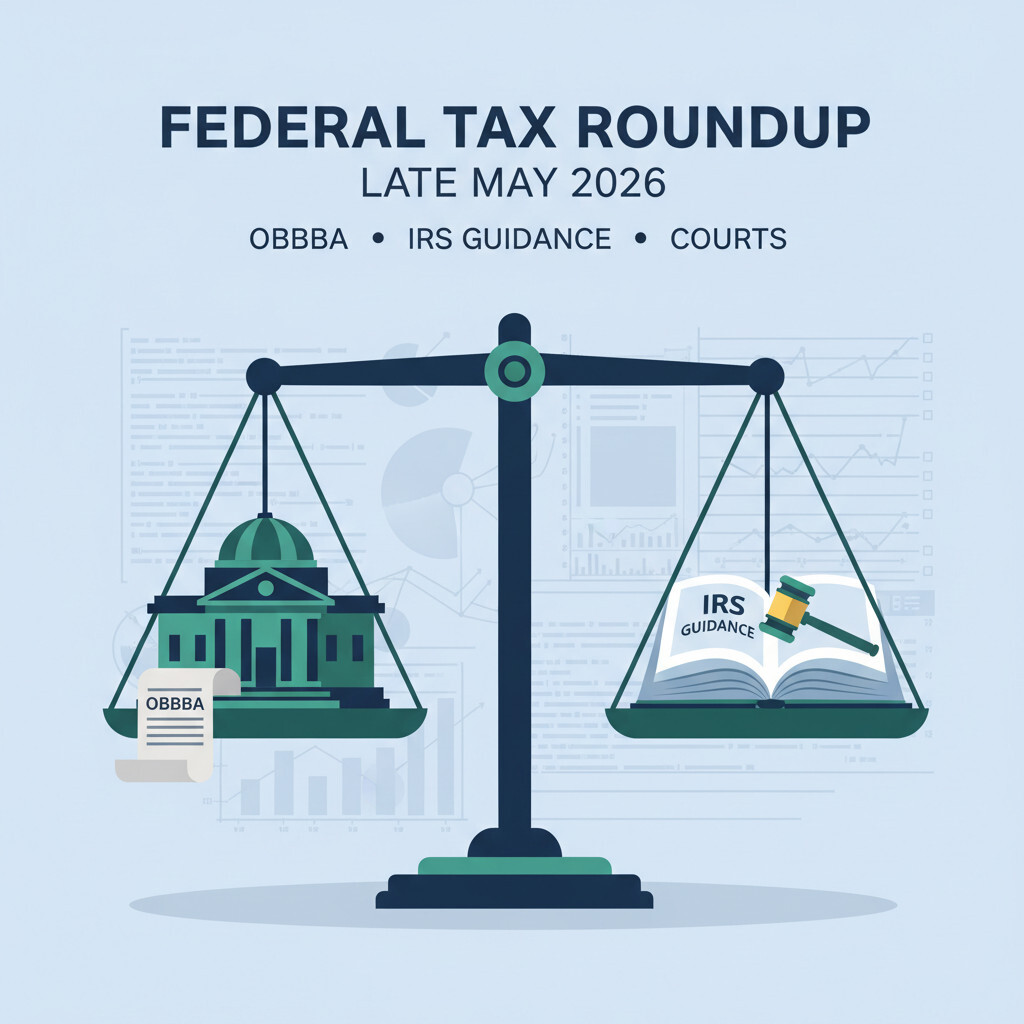
Federal Tax Roundup Late May 2026: OBBBA, IRS Guidance, Courts
Late May 2026 packed a lot of federal tax activity into a few weeks — legislative, regulatory, and judicial. This roundup pulls the developments that matter most for businesses and individuals, drawn from primary sources: the Joint Committee on Taxation, the House Ways and Means Committee, the Treasury Department and IRS, and the federal courts.
At SW Accounting & Consulting Corp, we track these developments so Los Angeles area clients don’t have to. Below: OBBBA implementation, new IRS guidance, tax bills moving on the Hill, and the latest court rulings.
1. OBBBA implementation watch 🏛
The Joint Committee on Taxation (JCT) issued a detailed, provision-by-provision report on the One, Big, Beautiful Bill Act (P.L. 119-21) — and Congress heard early data on how the law’s new deductions are landing in the 2026 filing season.
JCT’s OBBBA report (May 28). The 341-page document functions like a “Bluebook” limited to OBBBA: for each provision it describes prior law, explains the new provision, and gives the effective date. Importantly, JCT — working with House Ways and Means, Senate Finance, and Treasury’s Office of Tax Policy — identified 10 provisions affecting individual and business income taxes where the law may be unclear or may not have met drafters’ intent, footnoting recommendations for added clarity. Translation: technical corrections may be coming for those provisions, so watch them before taking aggressive positions.
OBBBA deductions in the 2026 filing season. At a May 20 House Ways and Means Tax Subcommittee hearing, lawmakers cited filing-season data showing more than 60 million taxpayers claimed at least one of OBBBA’s new deductions — each claimable WITHOUT itemizing:
| New OBBBA deduction | Taxpayers claiming | Average deduction |
|---|---|---|
| Tipped income | 7 million+ | > $7,000 |
| Overtime pay | ~28 million | ~ $3,100 |
| Seniors | 34 million+ | ~ $7,500 |
| Interest on certain auto loans | 1 million+ | > $1,800 |
When JCT flags a provision as unclear or as missing drafters’ intent, it signals where future technical corrections or IRS guidance are most likely. If a 2026 position depends on one of those 10 flagged provisions, document your reasoning and watch for follow-up guidance before filing season closes.
2. New Treasury & IRS guidance 📑
Two pieces of guidance landed: final regulations on partnership-interest sale reporting, and a notice implementing OBBBA’s qualified long-term care distribution rules.
- T.D. 10048 — partnership interest sale reporting. Treasury and the IRS finalized regulations modifying information-reporting obligations for sales or exchanges of certain partnership interests in partnerships owning inventory or unrealized receivables (so-called “hot assets”). The final rules adopt the proposed regulations (REG-108822-25) without change — no comments were received and no hearing was held.
- Notice 2026-33 — qualified long-term care distributions. This notice provides guidance for certified long-term care insurance issuers on the disclosure and reporting requirements under IRC §§401(a)(39) and 6050Z, and guidance under §§72(t)(2)(N) and 401(a)(39) for plan administrators and individuals making/receiving qualified long-term care distributions — including safe harbors for plan administrators. This implements an OBBBA provision letting eligible individuals tap retirement funds for qualified long-term care insurance without the usual early-distribution friction.
3. Tax bills moving on the Hill 🇺🇸
The House advanced several tax-relevant measures in mid-May, with bipartisan support on multiple fronts.
- Taxpayer Due Process Enhancement Act (H.R. 6506). Passed the House May 19. It would suspend the limitations period for filing a refund claim during collection proceedings, prohibit crediting overpayments against disputed liabilities during such proceedings, and expand the Tax Court’s jurisdiction.
- Housing bill limiting institutional investors. On May 20 the House voted 396-13 for bipartisan legislation (an amended version of the 21st Century ROAD to Housing Act) that would, among other things, restrict large institutional investors from purchasing single-family homes.
- Digital asset tax legislation. Bipartisan tax writers introduced long-awaited legislation addressing the tax treatment of digital asset transactions, referred to the House Ways and Means Committee — timing and final form still uncertain.
- Senate tax administration bill. Senate Finance leadership introduced a broad tax-administration package, continuing a run of bipartisan procedural reforms.
4. Courts & enforcement ⚖️
Several rulings reshaped the enforcement landscape — most notably on the §6038(b) foreign-information-return penalty, plus important Tax Court decisions on economic substance, partnership adjustments, and Collection Due Process.
| Ruling | Takeaway |
|---|---|
| §6038(b) penalty — Second Circuit (Safdieh) | The IRS CAN automatically assess the $10,000 Form 5471 penalty for late foreign-corporation information returns — overturning the Tax Court and aligning with the D.C. Circuit’s earlier reversal of Farhy. Two circuits now side with the IRS. |
| Economic substance — Otay Project LP | The Tax Court applied the common-law economic substance doctrine to disallow a large partnership basis adjustment, but rejected penalties on §6664(c) reasonable-cause grounds (reliance on three firms’ opinions). Practitioners advising on partnership transactions with significant basis adjustments should review it. |
| Partnership adjustment (FPA) | The Tax Court held that an administrative error did not invalidate a Final Partnership Adjustment — procedural slips don’t necessarily void the IRS’s action. |
| CDP — Diversified Group Inc. v. Commissioner | A taxpayer who declines an IRS Appeals conference is barred from challenging the underlying liability later in a Collection Due Process hearing (§6330(c)(2)(B)). Don’t skip Appeals. |
| TIGTA partnership compliance | The Treasury Inspector General for Tax Administration provided feedback on the IRS’s partnership compliance initiatives — a signal that partnership audits remain an enforcement priority. |
(1) International filers: with two circuits now backing automatic assessment of the §6038(b) penalty, late or missing Forms 5471 are higher-risk than ever — file on time. (2) Partnerships: between the economic substance ruling and TIGTA’s compliance feedback, basis-adjustment and partnership-structuring positions face intensifying scrutiny. Document business purpose contemporaneously.
Frequently asked questions
It’s a 341-page, provision-by-provision explanation of the One, Big, Beautiful Bill Act (P.L. 119-21) from the Joint Committee on Taxation. It also flags 10 provisions that may be unclear or miss drafters’ intent — a roadmap to where technical corrections and IRS guidance are likely next.
It provides guidance on qualified long-term care distributions under IRC §§401(a)(39), 6050Z, and 72(t)(2)(N) — reporting/disclosure for long-term care insurance issuers and safe harbors for plan administrators handling these distributions.
Per the Second Circuit (Safdieh) and the D.C. Circuit (which reversed Farhy), yes — the §6038(b) $10,000 penalty is automatically assessable. The trend strongly favors the IRS, so timely filing of foreign-information returns is critical.
Because, per Diversified Group, declining the Appeals opportunity can bar you from challenging the underlying liability later in a Collection Due Process hearing under §6330(c)(2)(B). Use the Appeals process when offered.
How can SW Accounting help? 💼
At SW Accounting & Consulting Corp, we translate fast-moving federal developments into action for LA-area businesses and individuals — assessing OBBBA positions against the JCT’s flagged provisions, applying new Treasury/IRS guidance (T.D. 10048, Notice 2026-33), and managing exam, Appeals, and CDP risk in light of the latest court rulings. If any of these touch your 2026 filings, let’s review before deadlines.
📩 Schedule a federal tax developments review
Disclaimer: This article is for informational purposes only and is not legal or tax advice. Always consult a qualified professional regarding your specific facts. Primary sources: Joint Committee on Taxation report on P.L. 119-21 (OBBBA); House Ways and Means Committee Tax Subcommittee hearing (May 20, 2026); Treasury/IRS T.D. 10048 (REG-108822-25) and Notice 2026-33; H.R. 6506; 21st Century ROAD to Housing Act; U.S. Court of Appeals for the Second Circuit (Safdieh) and D.C. Circuit (Farhy); U.S. Tax Court (Otay Project LP; Diversified Group Inc. v. Commissioner; cf. Patel v. Commissioner, 165 T.C. No. 10 (2025)); TIGTA; IRC §§6038(b), 6330(c)(2)(B), 6664(c), 7701(o), 401(a)(39), 6050Z, 72(t)(2)(N).