Nonprofit §4960 Excise Tax Expands Under OBBBA (Notice 2026-36)
For years, many nonprofits treated the §4960 excise tax on executive compensation as a narrow problem affecting only a handful of top earners. The One, Big, Beautiful Bill Act changed that. Effective for tax years beginning after December 31, 2025, the excise tax can apply to any employee earning more than $1 million — not just the five highest-paid — and Treasury and the IRS have now signaled (Notice 2026-36) that proposed regulations are coming.
At SW Accounting & Consulting Corp, we work with Los Angeles area nonprofits, foundations, hospitals, and universities on compensation and tax compliance. Below: what §4960 taxes, exactly what OBBBA changed, where hidden exposure arises, and what to do before year-end.
What does §4960 tax? 💸
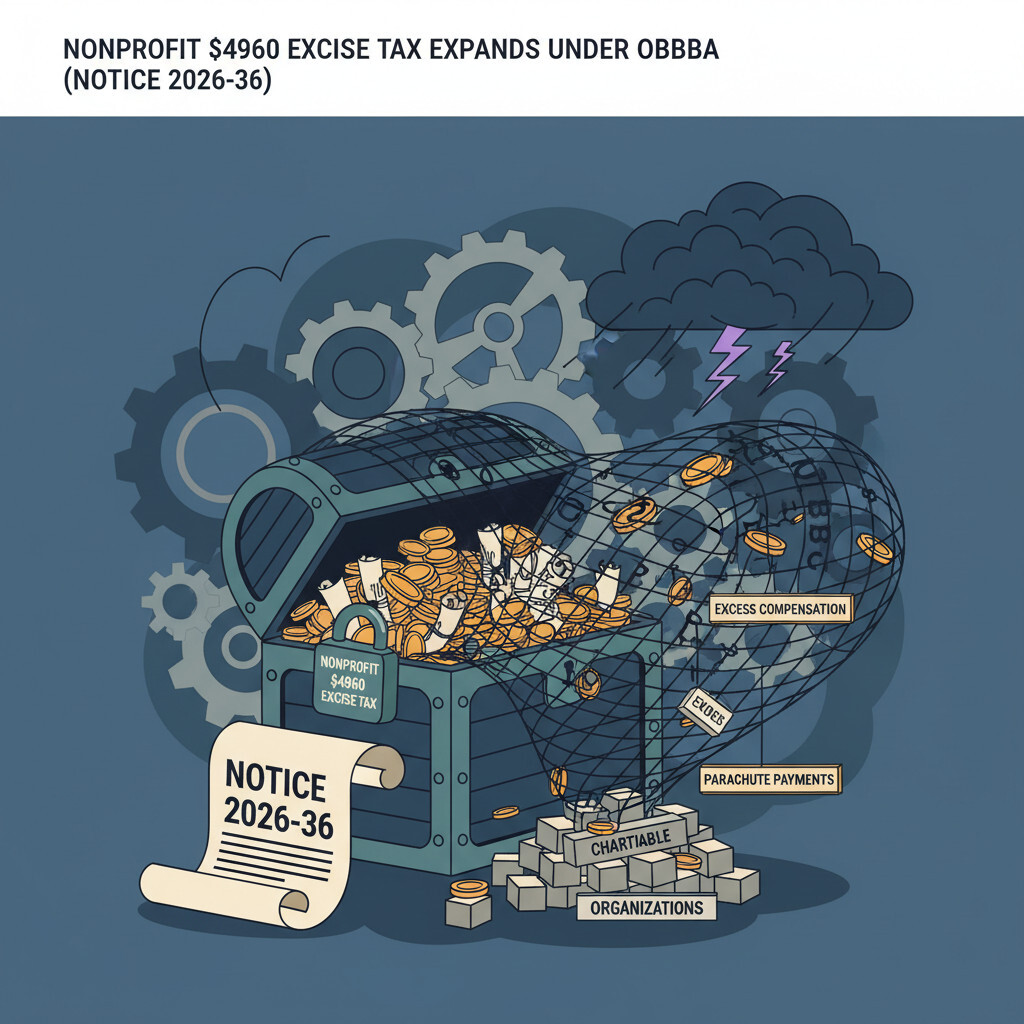
IRC §4960 imposes an excise tax — at the corporate rate of 21% — on an applicable tax-exempt organization for two things: (1) “excess remuneration,” meaning compensation over $1 million paid to a covered employee for the year, and (2) “excess parachute payments” tied to separation from service.
| Trigger | What’s taxed |
|---|---|
| Excess remuneration | The portion of a covered employee’s compensation that exceeds $1,000,000 in the tax year |
| Excess parachute payments | Separation-related payments that equal or exceed three times a base amount (the “excess” over the base is taxed) |
Critically, the 21% tax is owed by the ORGANIZATION, not the employee — so it’s a direct hit to the nonprofit’s budget, and it can arrive in a year when an executive’s pay spikes for reasons that have nothing to do with base salary.
What did OBBBA change? 📜
Before OBBBA, the tax generally focused on a defined group of “covered employees” — broadly, the organization’s five highest-compensated employees for the year (plus anyone who had been a covered employee in a prior year). Beginning with tax years after December 31, 2025, OBBBA broadens the reach so the $1 million test can apply to a much larger population of employees — not just the top five.
Why this matters:
- Bigger population in scope — large hospitals, universities, and health systems may have many employees (physicians, senior administrators, coaches, investment staff) over $1 million who were not previously “covered.”
- Budgeting concern, not just compliance — §4960 is shifting from a narrow filing issue to a real financial-planning line item for large nonprofits.
- Proposed regulations coming — Notice 2026-36 (IR-2026-73, June 5, 2026) announces Treasury and IRS intent to issue proposed regulations implementing the OBBBA changes; watch for the details.
A covered employee’s compensation for the $1 million test includes far more than salary. A normally-sub-$1M employee can cross the line in a single year because of a large deferred-compensation vesting event, a retention payout, or a severance package. Don’t assume “our base salaries are under $1M, so we’re fine.”
Where does hidden exposure arise? 🔍
One of the biggest challenges under §4960 is determining what compensation actually counts toward the $1 million threshold. Several arrangements create exposure that base-salary screening misses entirely.
- Deferred compensation — supplemental executive retirement plans (SERPs), long-term incentive plans, and retention arrangements can create large spikes in taxable remuneration in the year benefits vest.
- Severance and retention payouts — separation-related payments can both push annual remuneration over $1 million AND trigger the separate excess-parachute-payment tax.
- Taxable fringe benefits — certain taxable fringes count toward the threshold along with salary and bonus.
- Aggregation across related entities — compensation paid by related organizations, taxable subsidiaries, or affiliated entities may need to be combined when testing the threshold — exposure can hide in the org chart.
What should nonprofits do now? 🛠
With the expansion effective for tax years after December 31, 2025 and proposed regulations on the way, the time to reassess is before year-end — not at filing.
| Action | Detail |
|---|---|
| Re-scope covered employees | Move beyond the old “top 5” mindset; identify everyone who could clear $1M including via vesting/separation events |
| Model deferred-comp vesting | Project SERP / LTIP / retention vesting years to find spike-year exposure in advance |
| Map aggregation | Inventory related/affiliated entities and combine compensation where the rules require |
| Budget the 21% | Treat potential §4960 liability as a planning line item, not a surprise at return time |
| Watch the proposed regs | Monitor the regulations promised in Notice 2026-36 before locking in 2026 compensation structures |
Frequently asked questions about the §4960 excise tax
21% — the corporate income tax rate — applied to excess remuneration over $1 million and to excess parachute payments. The tax is owed by the tax-exempt organization, not the employee.
For tax years after December 31, 2025, the $1 million test can apply to a broader group of employees rather than being limited primarily to the five highest-paid. Notice 2026-36 (IR-2026-73, June 5, 2026) announces intent to issue proposed regulations implementing the change.
Not necessarily. Deferred-compensation vesting, retention payouts, severance, and certain taxable fringe benefits all count toward the threshold. An employee normally below $1M can cross it in a single spike year.
Possibly. The aggregation rules may require combining compensation paid by related organizations, taxable subsidiaries, or affiliated entities when testing the $1 million threshold. Map your structure before testing.
How can SW Accounting help? 💼
At SW Accounting & Consulting Corp, we help LA-area nonprofits, foundations, hospitals, and universities get ahead of the expanded §4960 excise tax — re-scoping covered employees, modeling deferred-compensation vesting and separation events, applying the aggregation rules across affiliated entities, and budgeting the 21% exposure before year-end. We track the Notice 2026-36 proposed regulations so your 2026 compensation decisions are made with the rules in view.
📩 Schedule a §4960 exposure review
Disclaimer: This article is for informational purposes only and is not legal or tax advice. Always consult a qualified professional regarding your specific facts. Primary sources: Internal Revenue Code §4960; One, Big, Beautiful Bill Act (Pub. L. No. 119-21); IRS News Release IR-2026-73 (June 5, 2026); IRS Notice 2026-36 (intent to issue proposed regulations on excess tax-exempt organization executive compensation and excess parachute payments).