Is my IRA 401(k) withdrawal taxable in Korea or the US?
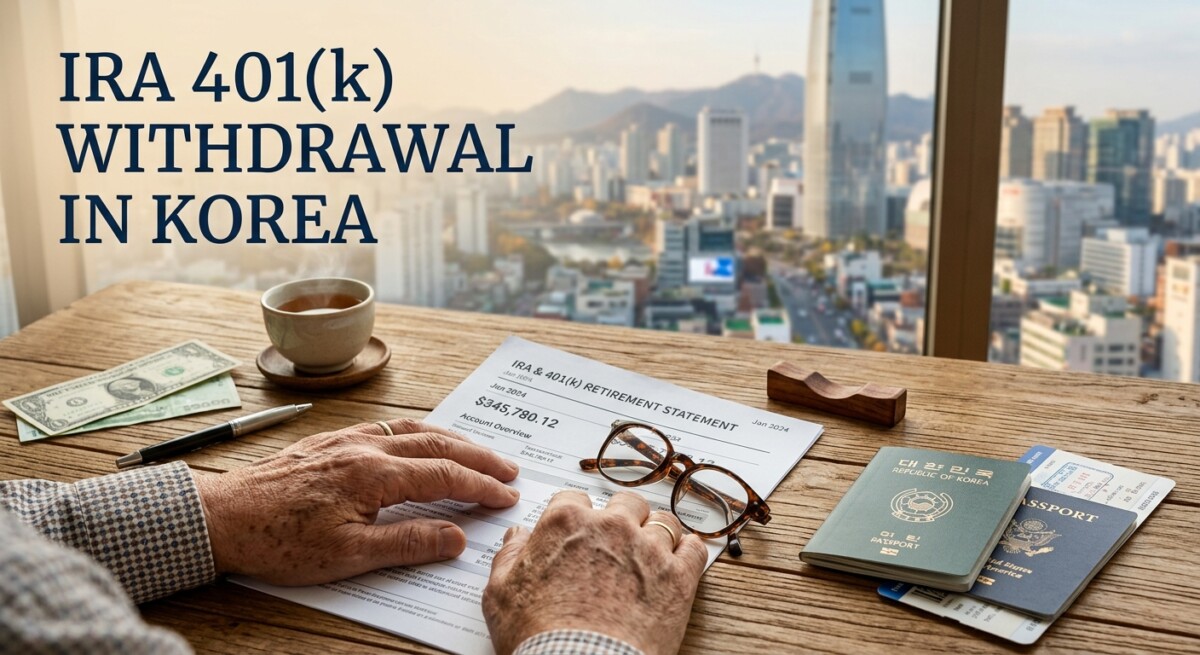
You spent 25 years at a company in Los Angeles, maxed out your 401(k), rolled it to a traditional IRA at Fidelity, and now you have moved back to Seoul to be closer to family. The custodian keeps asking whether you want to withhold 10%. Your Korean accountant says the income has to show up on your Korean return. And somewhere in the middle, you are wondering whether you are about to pay tax twice on the same dollar.
The short version — the one most US citizens living in Korea never hear from their US custodian — is that your IRA 401k Korea withdrawal stays fully reportable in the United States for as long as you hold your US citizenship. The treaty does not take you out of the US system. It only tells you which country gets to tax first, and how to claim a credit in the other.
This guide walks through what the IRS actually requires on your US return, what the US–Korea tax treaty does and does not do for retirement accounts, how early-withdrawal penalties and required minimum distributions apply from abroad, and the reporting forms (FBAR, Form 8938, Form 1116) you cannot skip.
Does the US still tax my IRA 401k Korea withdrawal if I live in Seoul? 🇺🇸
Yes. US citizens are taxed on worldwide income, including every dollar of taxable IRA and 401(k) distributions, regardless of residence.
The US system taxes based on citizenship, not residence. The IRS states this in Publication 54, Tax Guide for U.S. Citizens and Resident Aliens Abroad: if you are a US citizen or resident alien, your worldwide income is generally subject to US income tax, regardless of where you live. There is no exclusion that removes IRA or 401(k) distributions from this rule.
Traditional (pre-tax) IRA and 401(k) distributions are ordinary income on your Form 1040, Line 4b (IRA) and Line 5b (pensions/401(k)). Roth distributions are tax-free in the US if they are qualified under IRS Publication 590-B — the account has been open for at least five tax years and you are at least 59½, disabled, or taking it as a first-time homebuyer (up to the $10,000 lifetime cap) or after death.
If you are younger than 59½, the 10% additional tax under Internal Revenue Code §72(t) still applies to a US citizen in Korea. The statutory exceptions — substantially equal periodic payments, disability, certain medical expenses, and the SECURE 2.0 emergency-withdrawal rules — are listed in Pub 590-B. “I live overseas” is not one of them.
What does the US–Korea tax treaty actually do for my retirement account? 📜
For a US citizen, almost nothing on the US side — the saving clause lets the US tax your IRA 401k Korea withdrawal in full. On the Korea side, it allocates taxing rights and preserves credit relief.
The Convention Between the United States and the Republic of Korea for the Avoidance of Double Taxation, signed in 1979 and in force since 1979, is published by the Treasury on the Treasury International Tax Policy treaties page, with the IRS summary at Korea – Tax Treaty Documents. Two provisions matter here:
- Private pensions and annuities. The treaty generally allocates taxing rights over private pensions to the country of residence. In US practice, a traditional IRA or 401(k) withdrawal is treated as a pension-type payment.
- Government and social-security payments. US Social Security benefits paid to a resident of Korea follow the treaty’s social-security article. Benefits are not US-source for a non-US-resident recipient under the treaty’s allocation, but as a US citizen you remain taxable in the US on those benefits anyway because of the saving clause.
The saving clause is the critical piece. Every US tax treaty contains it, and the US–Korea treaty is no exception: the United States reserves the right to tax its citizens and residents as if the treaty had not come into effect. That means the treaty cannot be used by a US citizen to shelter their IRA 401k Korea withdrawal from US tax.
What the treaty still does for you is set up the mechanics on the Korean side (Korea generally honors a US tax credit for taxes paid first in the United States) and prevent double taxation through the Form 1116 Foreign Tax Credit on your US return when Korea has the first right to tax a particular payment.
Expert insight: order of taxation matters more than the treaty itself
In our practice, the clients who come in with the biggest surprise bills are the ones who assumed the treaty “exempts” their IRA on the US side. It does not. What we actually model for them is the sequencing: Korea taxes the distribution as part of resident worldwide income (there are specific Korean rules on how US retirement accounts are characterized and whether basis is recognized), the US taxes it under its own schedule, and the client claims a Form 1116 credit for Korean tax paid on the same income. Where the two tax systems disagree about the character or the year of recognition, that is where real double tax leaks in — and no amount of custodian paperwork fixes it after the fact.
How much will my US custodian withhold on an IRA 401k Korea withdrawal? 💵
For a US citizen, IRA distributions default to 10% federal withholding and 401(k) eligible-rollover distributions default to 20% mandatory withholding — your foreign address does not change that.
The withholding rules sit in two different places in the Code:
- Traditional IRA distributions are “designated distributions” under Internal Revenue Code §3405. The default is 10% federal income-tax withholding on a non-periodic distribution, which you can elect out of (or elect a higher rate) using IRS Form W-4R.
- 401(k) and other qualified-plan eligible rollover distributions that are paid to you (not directly rolled over) are subject to a mandatory 20% federal income-tax withholding under §3405(c). This cannot be waived.
Your Korean address does not convert you into a non-resident alien for US withholding purposes. You continue to file Form W-9 (not W-8BEN) with your custodian. Some US custodians nevertheless block or close accounts for clients with foreign residential addresses — the IRS does not require this, but each custodian has its own policy, and in our practice it is the single most common reason a client needs to re-route or consolidate before leaving the US.
On the Korean side, the US withholding appears on your Form 1099-R and is the amount you later claim as a Form 1116 foreign tax credit — wait, that is backwards. The Korean credit is the one you claim in the US only if Korea has primary taxing right and you paid Korean tax. We will tie this together in the next section.
What is my 2026 required minimum distribution if I live in Korea? 📅
The required beginning date for most IRAs and 401(k)s is April 1 of the year after you turn 73, and this applies to US citizens abroad exactly the same as US residents.
Required minimum distributions (RMDs) come from Internal Revenue Code §401(a)(9). SECURE 2.0, enacted in late 2022, raised the age for the required beginning date from 72 to 73 for individuals who reach age 72 in 2023 or later. The age rises again to 75 for individuals born in 1960 or later, starting in 2033. The IRS summarizes current RMD rules on its Retirement Plan and IRA Required Minimum Distributions FAQs page.
What this means in practice:
- If you turn 73 in 2026, your first RMD must be taken no later than April 1, 2027. Each subsequent RMD must be taken by December 31 of its year. Taking the first and second RMD in the same calendar year is a common and expensive timing mistake.
- Roth IRAs are not subject to RMDs during the owner’s lifetime. Roth 401(k)s became free of lifetime RMDs for plan years beginning after December 31, 2023, under SECURE 2.0.
- The excise tax for missing an RMD was reduced by SECURE 2.0 from 50% to 25% — and down to 10% if corrected within the correction window — but it is still a tax, not a notice.
If you have multiple traditional IRAs you may aggregate RMDs across them. Qualified plan RMDs (such as a 401(k) still at a former employer) must be taken separately from each plan.
⚠ Warning — reporting Korean bank accounts triggered by the distribution
Once your IRA proceeds land in a Korean bank account, the aggregate balance of all your Korean financial accounts almost certainly crosses the $10,000 threshold for the FBAR (FinCEN Form 114), which must be filed with FinCEN by April 15 of the following year (automatic extension to October 15). You may also need Form 8938 with your Form 1040 if you cross FATCA thresholds, which are higher for US citizens living abroad ($200,000 at year-end or $300,000 any time during the year for single filers). FBAR civil penalties for willful non-filing can run up to the greater of $100,000 or 50% of the account balance per violation. Do not treat this as housekeeping — treat it as part of the distribution plan.
How do I compare a lump-sum IRA 401k Korea withdrawal with a staged plan? 📊
Staging distributions across tax years almost always beats a lump sum because the US progressive brackets and the Korea–US foreign tax credit limit both reset annually.
The federal 2026 brackets are published on the IRS Publication 17 page. A single filer crosses from the 22% bracket into the 24% bracket near $103,000, and into 32% near $197,000 (2026 projected inflation-adjusted figures; confirm the final numbers against the IRS Revenue Procedure for 2026). A lump sum frequently pushes an otherwise mid-bracket retiree into 32% or 35% for one year.
The following stylized comparison shows the directional effect only — your own federal, state (if any), and Korean liabilities depend on your facts.
| Strategy | Illustrative US bracket exposure | FTC capacity reset | RMD interaction |
|---|---|---|---|
| Lump sum $500,000 in one year | Top portion in 32%–35% federal | One year of credit room; excess carries | RMD obligation extinguished early |
| Staged $100,000 × 5 years | Largely 22%–24% federal | Five annual credit limits | Natural overlap with RMD years |
| Roth conversions pre-move | Pay now at a known US rate | Future qualified distributions are US-tax-free | Reduces future RMD base |
| Leave in US, take only RMDs | Lowest annual US exposure | Modest annual credit room needed | RMD runs for life |
Three structural notes. First, Roth conversions executed before you become a Korean tax resident are much simpler than conversions after, because Korea’s treatment of a conversion is not symmetrical to the US treatment. Second, a Roth distribution that is qualified in the US is not automatically treated the same way in Korea; your Korean advisor must confirm classification. Third, the Form 1116 limitation is computed on a per-category basis — passive, general, treaty-resourced — and retirement distributions typically fall in the “general” category, not “passive.”
Which US forms do I file after an IRA 401k Korea withdrawal? 🧾
Expect at a minimum a Form 1040 (with your 1099-R), Form 1116 for the Korean tax credit, FBAR, and possibly Form 8938 and Form 8606.
- Form 1040 and Form 1099-R. Your US custodian issues the 1099-R. Enter the distribution on Line 4 (IRA) or Line 5 (pension/401(k)). Non-filing because “the tax was withheld” is still a filing failure.
- Form 8606. Required if any part of your distribution represents after-tax basis (nondeductible contributions). This is how you make sure you are not double-taxed on your own money.
- Form 1116, Foreign Tax Credit. Claim credit for Korean income tax actually paid on the same distribution. The IRS form page is linked above.
- FinCEN Form 114 (FBAR). Required if the aggregate balance of your foreign financial accounts exceeded $10,000 at any time in the year. Filed electronically with FinCEN, not with the IRS.
- Form 8938. Required at higher FATCA thresholds, which are higher for US citizens living abroad. Filed with Form 1040.
The automatic two-month extension for US citizens living abroad under IRS when-to-file rules moves your filing deadline from April 15 to June 15; the regular Form 4868 extension pushes it to October 15. Payment, however, is still due on April 15 — the extension is only for filing.
Finally, the US–Korea Totalization Agreement, administered by the Social Security Administration, affects how your Social Security contributions and benefits coordinate with Korean National Pension coverage. It does not change how your IRA or 401(k) distributions are taxed, but it is often the companion issue in the same client meeting.
The 60-second summary
- US citizens pay US tax on their worldwide IRA and 401(k) distributions; moving to Korea does not change that.
- The US–Korea tax treaty allocates taxing rights but the saving clause preserves the US’s right to tax its own citizens — no treaty “exemption” is available to you.
- Form 1116 (foreign tax credit), FBAR, and often Form 8938 become mandatory the year you take a distribution and move funds to Korean accounts.
- Staged distributions, Roth conversions before the move, and clean basis tracking on Form 8606 are the three levers that move the real tax bill.
Frequently asked questions ❓
1. If I renounce my US citizenship, does my 401(k) stop being taxable in the US?
Expatriation under Internal Revenue Code §877A can trigger an exit tax on your worldwide assets, and the post-expatriation treatment of retirement accounts depends on whether you are a “covered expatriate.” This is a separate planning exercise that should be done years in advance, not as a withdrawal strategy. The IRS summarizes expatriation reporting in the instructions for Form 8854.
2. My 401(k) is small — can I just cash it out and move the money to Korea?
You can, but under 59½ you add a 10% §72(t) early-withdrawal penalty on top of ordinary income tax, 20% mandatory withholding is removed from your check at the plan level, and the full amount still has to be reported on your Form 1040. “Small” is often not small after the compounded tax drag.
3. Will Korea tax the amount I already paid US tax on?
Potentially yes, because Korea taxes its residents on worldwide income. The mechanics for avoiding double tax are a Korean foreign tax credit for US tax paid (where the US has primary right under the treaty), or a US foreign tax credit for Korean tax paid (where Korea has primary right). Your Korean tax advisor and your US CPA need to coordinate on which country is “first” for each payment.
4. Do Roth IRA distributions avoid Korean tax too?
On the US side a qualified Roth distribution is tax-free under Pub 590-B. On the Korean side, there is no guarantee that Korea characterizes a Roth distribution the same way, and some positions treat the earnings portion as taxable. Confirm classification with your Korean advisor before relying on the US rule.
5. If my IRA custodian closed my account because of my Korean address, where do the funds go?
The custodian will typically distribute the balance to you, triggering the full ordinary-income-plus-penalty consequence. The better move is to transfer in a trustee-to-trustee rollover to a US custodian that explicitly accepts non-US-resident US citizens before you leave, or to leave a US mailing address and bank in place if that is accurate for your facts.
6. Does moving to Korea let me skip RMDs?
No. The §401(a)(9) required minimum distribution rules apply to the account holder regardless of residence, and the excise tax under SECURE 2.0 (25%, reduced to 10% if timely corrected) applies the same way to a US citizen abroad.