New IFRS Standards 2026: Effective at 30 June 2026
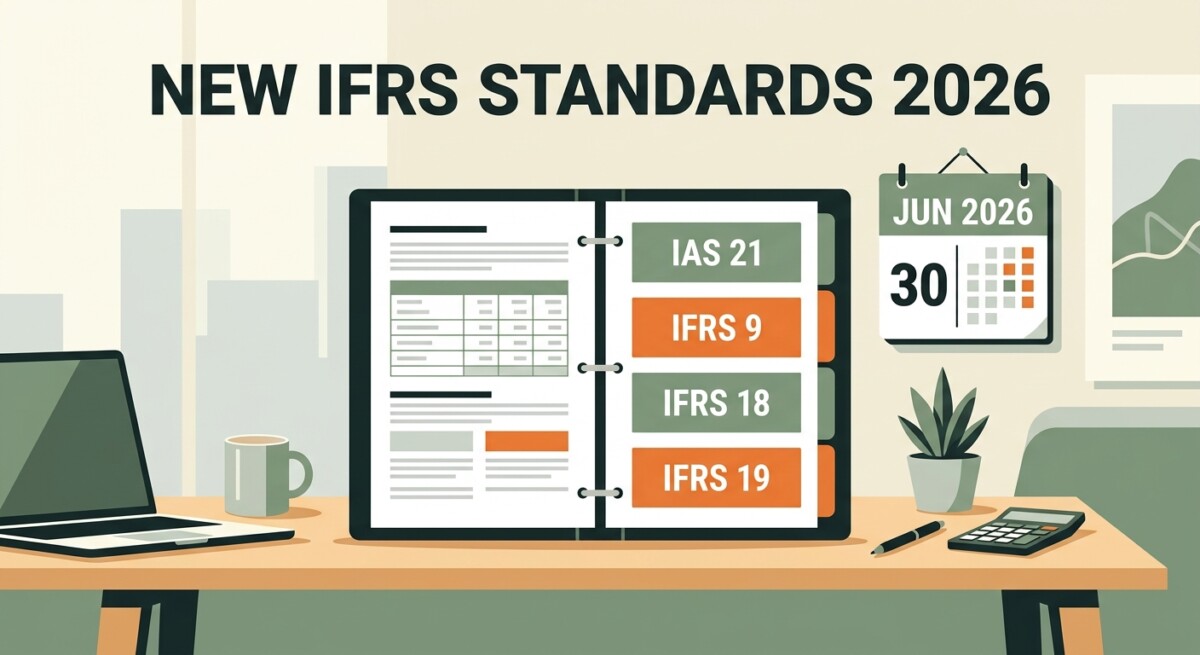
Every reporting close brings the same first question for the finance team: have we caught all the new pronouncements? For entities reporting under IFRS with periods ending 30 June 2026, the answer is more crowded than usual. The new IFRS standards 2026 package spans mandatory amendments to IAS 21, IFRS 9, and IFRS 7, Annual Improvements Volume 11, an updated third edition of IFRS for SMEs, and a sustainability tweak to IFRS S2 — with the much larger IFRS 18 and IFRS 19 waiting one more year.
At SW Accounting & Consulting Corp, our audit-support and financial-reporting teams help groups with IFRS-reporting subsidiaries or parent companies close every period on the current basis. This guide walks through what the IFRS Foundation (the IASB and ISSB) has actually issued, when each pronouncement is mandatory at a 30 June 2026 close, and the paragraph 30 of IAS 8 disclosure hooks that reviewers will look for.
Which new IFRS standards are mandatory at 30 June 2026? 🔎
Four items are effectively mandatory today — the IAS 21 lack-of-exchangeability amendments, the IFRS 9 and IFRS 7 amendments on classification and measurement, the IFRS 9 and IFRS 7 amendments on power purchase arrangements, and Annual Improvements to IFRS Accounting Standards Volume 11.
Whether a pronouncement is mandatory at your 30 June 2026 close depends on when your annual period began. Fourth-quarter filers began their year on 1 July 2025, third-quarter filers on 1 October 2025, second-quarter filers on 1 January 2026, and first-quarter filers on 1 April 2026. The IFRS Foundation publishes each amendment with an effective date expressed as “annual reporting periods beginning on or after” — so a 1 January 2026 effective date bites for first and second quarters at 30 June 2026 but is only optional early adoption for third and fourth quarters.
- IAS 21 amendment — Lack of Exchangeability (issued 15 August 2023; effective for periods beginning on or after 1 January 2025). Mandatory for 3rd- and 4th-quarter filers at 30 June 2026. Provides guidance on when a currency is exchangeable and how to estimate the exchange rate when it is not.
- Amendments to IFRS 9 and IFRS 7 — Classification and Measurement of Financial Instruments (issued 30 May 2024; effective for periods beginning on or after 1 January 2026). Mandatory for 1st- and 2nd-quarter filers at 30 June 2026; optional for later filers.
- Amendments to IFRS 9 and IFRS 7 — Power Purchase Arrangements (issued 18 December 2024; effective for periods beginning on or after 1 January 2026). Same timing pattern: mandatory for 1st- and 2nd-quarter filers, optional for others.
- Annual Improvements to IFRS Accounting Standards — Volume 11 (issued 18 July 2024; effective for periods beginning on or after 1 January 2026). Covers narrow-scope fixes to IFRS 1, IFRS 7, IFRS 9, IFRS 10, and IAS 7.
What actually changes under the IFRS 9 and IFRS 7 amendments? ⚡
Two separate amendment packages tighten how entities classify financial instruments and how they account for nature-dependent electricity contracts such as renewable power purchase arrangements.
The May 2024 classification and measurement amendments address issues raised in the IFRS 9 post-implementation review. They clarify the settlement date of financial assets and liabilities settled through an electronic payment system, refine the assessment of contractual cash flow characteristics for financial assets with ESG-linked or other contingent features (the “solely payments of principal and interest” test), and add new IFRS 7 disclosures about contractual terms that could change cash flow timing or amount. Entities with green loans, sustainability-linked debt, or non-recourse features should redo the SPPI analysis before the close.
The December 2024 power purchase amendments respond to the accounting distortions that arose as corporates signed long-dated PPAs to hedge exposure to renewable electricity. The amendments narrow the “own use” scope of IFRS 9 for certain PPAs, adjust the hedge accounting rules so that a variable-volume PPA can be designated in cash flow hedges, and add IFRS 7 disclosures so users can see the risks. These matter far outside the utilities sector — any group with a corporate PPA for wind, solar, or hydro electricity needs to reassess.
How do the IAS 21 lack-of-exchangeability rules apply in practice? 💱
When a currency cannot be freely converted at the measurement date, the entity estimates a spot exchange rate that would otherwise apply in an orderly transaction — and discloses how it did so.
The amendments to IAS 21 fill a long-standing gap. Before the change, IAS 21 assumed that a spot rate always existed but was silent on cases where a currency simply is not exchangeable — think capital controls or a collapsed parallel market. The new guidance sets out two questions: is the currency exchangeable into the other currency at the measurement date, and if not, what estimated rate reflects the rate at which the entity could exchange the currency in an orderly transaction. Entities that operate in jurisdictions with volatile or restricted currency markets must document the assessment for each affected date and disclose the nature and impact of the lack of exchangeability, the estimation technique used, and the risks the entity is exposed to.
What is coming next — IFRS 18, IFRS 19, and IFRS 20? 📅
Three large standards remain optional at 30 June 2026: IFRS 18 restructures the income statement, IFRS 19 lets eligible subsidiaries scale back disclosures, and IFRS 20 addresses regulatory assets and liabilities.
IFRS 18 Presentation and Disclosure in Financial Statements was issued on 9 April 2024 and applies to annual reporting periods beginning on or after 1 January 2027 (early application permitted). It replaces IAS 1 for entities applying IFRS Accounting Standards and introduces three defined categories of income and expense — operating, investing, and financing — along with mandatory management-defined performance measures (MPMs) disclosure. Adoption changes the top line of the statement of profit or loss and the analysis of expenses. Groups should plan the transition now; the disclosures do not fit into a two-week sprint.
IFRS 19 Subsidiaries without Public Accountability: Disclosures (issued 9 May 2024; effective for periods beginning on or after 1 January 2027) lets an eligible subsidiary use recognition and measurement from full IFRS Accounting Standards while applying a reduced-disclosure package. It is a significant relief for finance functions inside a group that already reports under full IFRS at consolidation.
IFRS 20 Regulatory Assets and Regulatory Liabilities (issued 27 May 2026; effective for periods beginning on or after 1 January 2029) applies to entities subject to regulated rate-setting. It requires recognition of regulatory assets and regulatory liabilities and matching regulatory income and expense — closing the mismatch that arises when the timing of the regulated recovery differs from the underlying costs. Regulated utilities should begin gap analysis now even though the effective date is four years out.
What about the IFRS for SMEs and the sustainability updates? 🌱
The third edition of IFRS for SMEs is optional but represents a significant modernization; the ISSB amendments to IFRS S2 reduce the compliance burden for greenhouse-gas disclosures.
The third edition of the IFRS for SMEs Accounting Standard was issued on 27 February 2025 for annual periods beginning on or after 1 January 2027. Major changes include revised concepts and pervasive principles, updated consolidation guidance in section 9, a rewritten financial instruments section with a new section 12 on fair value measurement, and updates to business combinations, goodwill, and revenue. Small and medium-sized entities that voluntarily apply IFRS for SMEs should read the transition provisions carefully — several sections require prospective adoption while others require full retrospective application.
On the sustainability side, the ISSB issued Amendments to Greenhouse Gas Emissions Disclosures (Amendments to IFRS S2) on 11 December 2025 for periods beginning on or after 1 January 2027. The amendments reduce duplication and complexity by allowing certain reliefs on Scope 3 emissions, jurisdictional GWP values, and the requirement to use the Global Industry Classification Standard. Preparers already applying IFRS S2 should welcome the relief but confirm their reporting boundary is documented in the transition year.
30 June 2026 IFRS reporting cheat sheet 📊
| Pronouncement | Effective from | Mandatory at 30 Jun 2026 |
|---|---|---|
| IAS 21 — Lack of Exchangeability | 1 Jan 2025 | Q3, Q4, full year |
| IFRS 9 & IFRS 7 — Classification & measurement | 1 Jan 2026 | Q1, Q2 |
| IFRS 9 & IFRS 7 — Power purchase arrangements | 1 Jan 2026 | Q1, Q2 |
| Annual Improvements Volume 11 | 1 Jan 2026 | Q1, Q2 |
| IFRS 18 — Presentation and Disclosure | 1 Jan 2027 | Optional (early) |
| IFRS 19 — Reduced disclosures for subsidiaries | 1 Jan 2027 | Optional (early) |
| IFRS 20 — Regulatory assets and liabilities | 1 Jan 2029 | Optional (early) |
| IFRS for SMEs — Third edition | 1 Jan 2027 | Optional (early) |
| IFRS S2 — Greenhouse Gas Emissions amendments | 1 Jan 2027 | Optional (early) |
📌 Key Takeaways
- The new IFRS standards 2026 package is mostly amendments — IAS 21, IFRS 9, IFRS 7, and Annual Improvements Volume 11.
- Whether an amendment is mandatory at 30 June 2026 depends on when your annual period began.
- IFRS 18, IFRS 19, and IFRS 20 are optional until 2027 (2029 for IFRS 20) — plan transition now.
- Disclose new IFRSs issued but not yet effective under IAS 8 paragraph 30.
Frequently Asked Questions ❓
Q. Are the new IFRS standards 2026 mandatory for every reporter?
Not automatically. Mandatory application at 30 June 2026 depends on when the entity’s annual reporting period began. A 1 January 2026 effective date is mandatory for reporters whose year began on or after 1 January 2026 (typically 1st- and 2nd-quarter filers at 30 June 2026); it is optional for entities on later cycles.
Q. When must we apply the IAS 21 lack-of-exchangeability amendments?
For annual reporting periods beginning on or after 1 January 2025. At a 30 June 2026 reporting date, application is mandatory for 3rd- and 4th-quarter filers (whose year began on or before 1 October 2025) and for full-year filers.
Q. Do the IFRS 9 amendments apply to a group without financial-sector operations?
Yes. Any entity that holds financial assets with ESG-linked, contingent, or non-recourse features must redo the SPPI (solely payments of principal and interest) assessment. Corporates with green loans, sustainability-linked bonds, or non-recourse financing are directly affected.
Q. Can we early-adopt IFRS 18?
Yes. IFRS 18 permits early application. Because IFRS 18 restructures the income statement into operating, investing, and financing categories and adds management-defined performance measures disclosure, early adoption is a significant project — not a last-minute election.
Q. What is the paragraph 30 of IAS 8 disclosure?
IAS 8 paragraph 30 requires an entity to disclose new IFRSs that have been issued but are not yet effective, together with known or reasonably estimable information relevant to assessing the possible impact on the financial statements when applied.
Q. Does the EU endorsement status matter for a 30 June 2026 close?
For EU-registered issuers, only endorsed pronouncements can be applied in IFRS financial statements filed with EU regulators. Several of the newer standards (IFRS 19, IFRS 20, and the third edition of IFRS for SMEs) are not yet endorsed for use in the EU as of the IFRS Foundation’s latest listing.
Bringing a group’s IFRS reporting current under this many moving pieces is where an experienced technical accounting team pays for itself. If you would like a reporting-close review of your new IFRS standards 2026 exposure — including IAS 8 paragraph 30 disclosures and a transition plan for IFRS 18 — contact SW Accounting & Consulting Corp. Primary sources: the IFRS Foundation IASB and ISSB standard-setter announcements, including the amendments to IAS 21, IFRS 9, IFRS 7, and the newly issued IFRS 18.