
OBBBA State Conformity 2026: Does Your State Follow?
The One Big Beautiful Bill Act (OBBBA, P.L. 119-21) rewrote several core business deductions in 2025 — immediate expensing of domestic research, permanent 100% bonus depreciation, and higher Section 179 limits among them. But those are federal changes. Whether they lower your state tax bill depends entirely on OBBBA state conformity, and in 2026 states are splitting in every direction.
At SW Accounting & Consulting Corp, we prepare returns for Los Angeles businesses that operate across state lines — restaurant groups, multi-location practices, and growing companies. This is exactly the kind of federal-versus-state gap that quietly creates underpayments and missed refunds. Here is what OBBBA changed, why states are diverging, and what multistate businesses should check now.
What is state tax conformity, and why does it matter? 🔗
Conformity is the degree to which a state’s tax law follows the federal Internal Revenue Code — and states choose how much of the OBBBA to adopt.
States fall into three broad camps. Rolling conformity states automatically track the current IRC, so federal changes flow through unless the state acts to decouple. Static (fixed-date) conformity states adopt the IRC as of a specific date and must pass legislation to move that date forward. And many states take a selective approach — conforming to some provisions while carving out others. Because the OBBBA landed mid-stream, nearly every state has had to legislate a response, and the results are inconsistent.
The practical result: the same purchase or expense can be fully deductible federally and only partly deductible — or not at all — at the state level in the same year.
Which OBBBA provisions are states fighting over? 🧾
The biggest conformity flashpoints are R&D expensing, bonus depreciation, Section 179, and the international GILTI/NCTI rules.
- Domestic R&D expensing (IRC §174A): the OBBBA restored immediate expensing of domestic research costs. Several states decouple and still require capitalization and amortization.
- Bonus depreciation (IRC §168(k)): the OBBBA made 100% bonus depreciation permanent. Many states have long refused to follow bonus depreciation and continue to.
- Section 179 expensing: the OBBBA raised the limits — but a state can cap the deduction at the old amount, disallowing the expansion.
- GILTI → NCTI (IRC §951A): the OBBBA renamed and reworked the international income rules, and states are updating (or disallowing) the related deduction.
How are specific states handling OBBBA state conformity? 🗺️
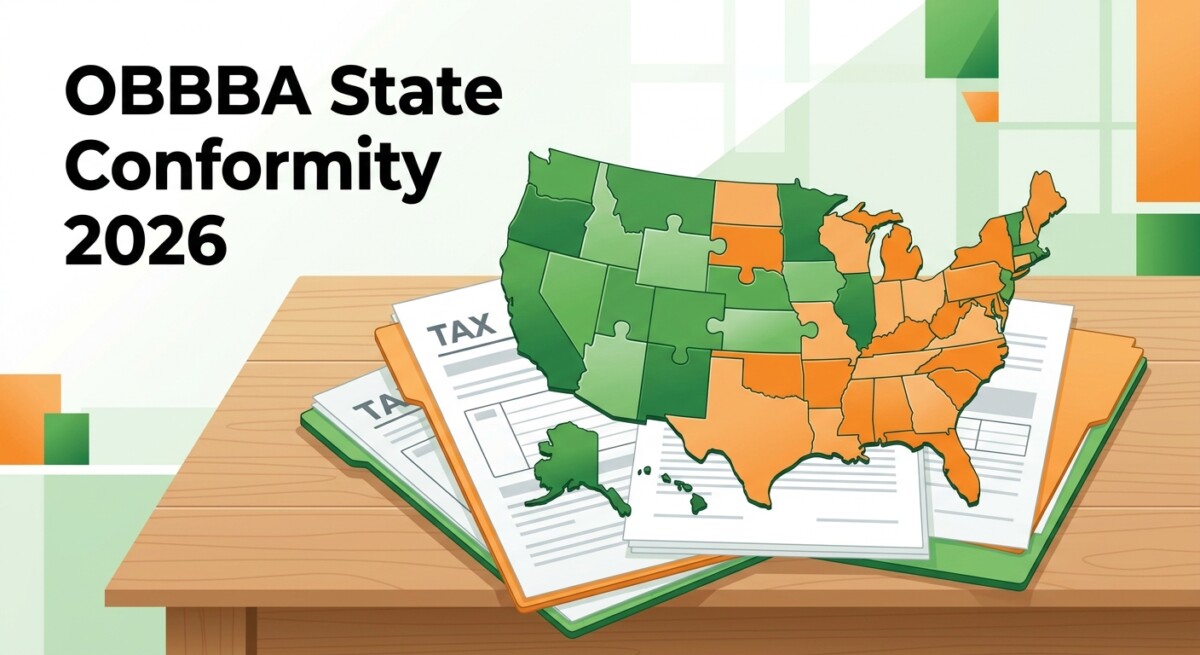
Recent 2026 legislation shows the split clearly — even neighboring approaches disagree on the same federal provision.
A few representative examples from laws enacted in June 2026:
- Arizona (H.B. 4168): updated conformity to the IRC as of January 1, 2026 and adopted many OBBBA provisions — but decoupled from the OBBBA’s special depreciation allowance for qualified production property, requiring an addback, and updated its international-income terminology from GILTI to IRC §951A income.
- Florida: updated corporate income-tax conformity but specifically decoupled from §174A domestic R&D expensing, keeping references to §§168(k), 174, 163(j), and 179 tied to an earlier Code.
- Massachusetts (H.B. 5470): took a selective approach — limiting conformity to certain §174A R&D changes, temporarily decoupling from business-interest, depreciation, and expensing provisions, narrowing Opportunity Zone treatment to Massachusetts zones, and disallowing the expanded §179 deduction for 2025–2026.
- New York & Rhode Island: both decoupled from OBBBA R&D expensing for state purposes; Rhode Island added specific §174/§174A addback rules and a high-income surtax.
- Iowa (DOR guidance): because Iowa fully excludes §951A (NCTI) income from its corporate base, corporations cannot take the federal 40% NCTI deduction under §250 for Iowa purposes.
What should a multistate business do right now? ✅
Map each state’s conformity position for the deductions you actually claim, and watch for retroactive changes and amended-return windows.
Concrete steps for the 2025 and 2026 filing seasons:
- Inventory your OBBBA-driven deductions — R&D expensing, bonus depreciation, Section 179, QBI, and any §951A items — and flag which states you file in.
- Compute state addbacks separately. Do not assume the federal deduction carries to the state return; several states require an addition to state income.
- Watch retroactive effective dates. Some 2026 laws apply to tax years beginning after December 31, 2024, so a return you already filed may need correcting.
- Use amended-return relief windows. Massachusetts, for example, allows taxpayers who already filed a non-conforming 2025 return to file an adjusted return within 90 days of the new law.
OBBBA conformity at a glance 📊
| State | 2026 approach | Watch item |
|---|---|---|
| Arizona | Conforms to much of OBBBA | Decouples from qualified-production-property depreciation |
| Florida | Updated conformity, selective | Decouples from §174A R&D expensing |
| Massachusetts | Partial / selective | Disallows expanded §179; QOZ limited to MA zones |
| New York / Rhode Island | Decouple on R&D | State R&D addbacks; RI high-income surtax |
| Iowa | Excludes NCTI from base | No 40% §250 NCTI deduction for Iowa |
📌 Key Takeaways
- OBBBA changed federal rules; states decide separately whether to follow.
- The big flashpoints: R&D expensing, bonus depreciation, Section 179, and GILTI/NCTI.
- A federal deduction can be added back on the state return — model it before filing.
- Watch retroactive dates and amended-return windows (e.g., Massachusetts’ 90-day window).
Frequently Asked Questions ❓
Q. What does OBBBA state conformity actually mean?
It refers to whether a state adopts the federal tax changes in the One Big Beautiful Bill Act. States can conform fully, decouple entirely, or take a selective approach — so the federal treatment does not automatically apply to your state return.
Q. If I expense R&D on my federal return, can my state disallow it?
Yes. Several states, including Florida, New York, and Rhode Island, have decoupled from the OBBBA’s §174A domestic R&D expensing, meaning you may still have to capitalize and amortize those costs for state purposes.
Q. Does every state follow federal bonus depreciation and Section 179?
No. Many states have never conformed to bonus depreciation, and some cap Section 179 below the federal limit. Massachusetts, for example, disallowed the OBBBA’s expanded §179 deduction for 2025 and 2026.
Q. What is the GILTI-to-NCTI change?
The OBBBA reworked the international income regime under IRC §951A, shifting the terminology from GILTI to net CFC tested income (NCTI). States such as Arizona and Iowa updated their rules; Iowa disallows the related 40% §250 deduction for state purposes.
Q. I already filed my 2025 state return. Do I need to amend it?
Possibly. Some 2026 conformity laws apply retroactively to tax years beginning after December 31, 2024. If your state changed its treatment after you filed, check whether an amended return is required and whether a relief window (such as Massachusetts’ 90-day period) applies.
Q. How does this affect a California business?
California has long maintained its own selective conformity and does not automatically follow federal changes, so many OBBBA provisions require California-specific adjustments. Multistate operators must run each state separately rather than assume the federal result.
State conformity is where a clean federal return can still generate a surprise state bill. If you would like a multistate review of your OBBBA-affected deductions before you file, contact SW Accounting & Consulting Corp. Primary sources: the One Big Beautiful Bill Act (P.L. 119-21), Arizona Legislature (H.B. 4168), Massachusetts Legislature (H.B. 5470), and Iowa Department of Revenue guidance.