Wyoming LLC or Delaware C-Corp: which should a solo founder pick in 2026?
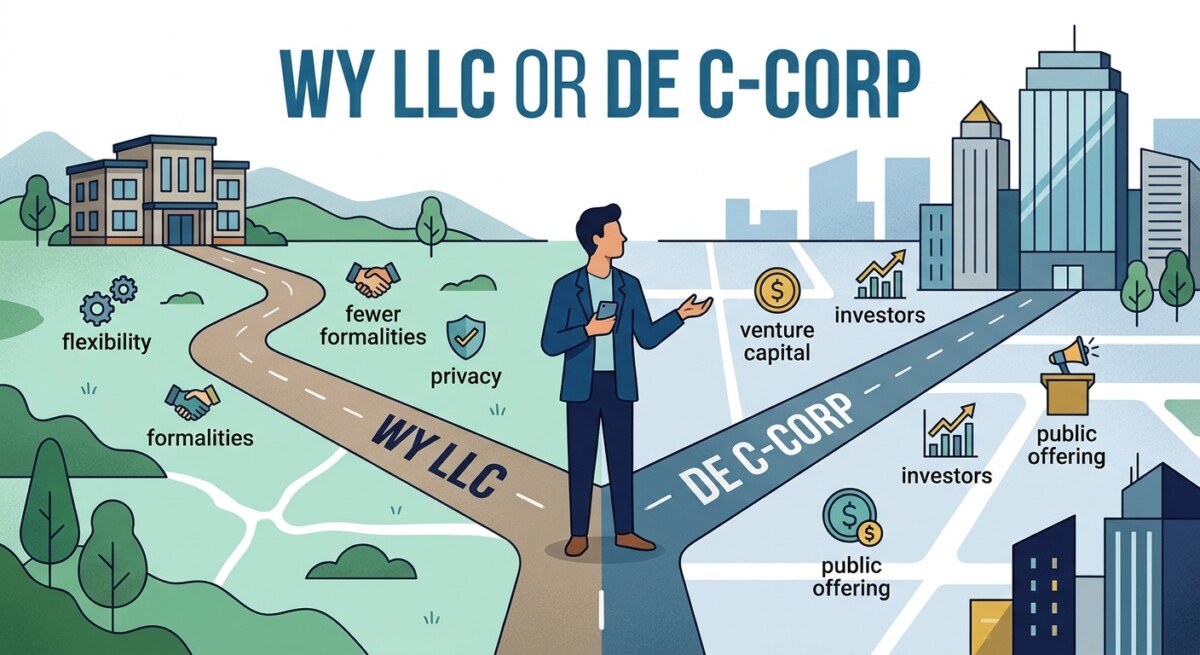
Should a solo founder form a wyoming llc vs delaware ccorp in 2026? If you plan to bootstrap, consult, or build a small operating business, a Wyoming LLC is almost always the right starting point. If you plan to raise priced-round venture capital from US funds and want the Section 1202 QSBS exclusion on your eventual exit, you should form a Delaware C-Corp from day one — converting later is possible but expensive and resets your QSBS clock.
You are one person with an idea, a laptop, and a strong preference not to light money on fire. Everyone tells you something different: a Y Combinator thread says “always Delaware C-Corp,” a Reddit post says “Wyoming is cheaper and more private,” a lawyer friend says “it depends.” Both camps are partly right, and the answer actually turns on a small number of concrete questions. In this guide — written for Korean-American founders and Korean entrepreneurs starting a US business — we walk through the wyoming llc vs delaware ccorp decision the way we work through it with clients in our LA practice, using current primary sources (IRS, Delaware Division of Corporations, Wyoming Secretary of State).
What is the real difference between a Wyoming LLC and a Delaware C-Corp? 🏛️
A Wyoming LLC is a flexible, pass-through entity formed under Wyoming law; a Delaware C-Corporation is a share-based entity formed under Delaware law and taxed as a separate corporation. The difference is not just “state A versus state B” — it is two legal shapes with two different default tax regimes.
Under the federal “check-the-box” rules, a single-member LLC is a disregarded entity by default (reported on your Schedule C, or Form 1040-NR if you are a nonresident), and a multi-member LLC is a partnership by default. The IRS overview of LLC classification and Form 8832 set the mechanics: you can elect to be taxed as a corporation at any time, but the default matters because it governs filings until you file an election.
A Delaware C-Corporation, by contrast, is always a separate taxpayer. It files Form 1120, pays corporate income tax at the flat 21% federal rate under Internal Revenue Code §11, and any distribution to you as a shareholder is a dividend — this is the “double taxation” everyone has heard about.
Choosing between them is really three nested choices: (1) what state law governs the entity, (2) what federal tax classification applies, and (3) what state tax regime applies to the entity itself. Many founders see only the first, and the price of that oversight can run into thousands per year.
Which structure matches your fundraising plan? 💰
If a US venture fund will ever lead a priced round in your company, you want a Delaware C-Corporation. If you are bootstrapping, taking revenue, or raising from friends and family only, a Wyoming LLC is cheaper and simpler.
US venture capital funds — especially those backing their limited partners, which include tax-exempt institutions and foreign LPs — strongly prefer Delaware C-Corporations for a stack of good reasons. Pass-through income from an LLC flows to the fund’s investors as unrelated business taxable income (UBTI) for tax-exempt LPs and as effectively connected income (ECI) for foreign LPs, triggering filings and withholding that the fund would rather avoid. A C-Corp blocks that. In our practice we have seen priced-round deals literally pause while the target LLC converts to a corporation; the conversion costs legal fees, triggers a tax event, and burns weeks.
The second fundraising concern is Qualified Small Business Stock (QSBS) under IRC §1202. QSBS can let a founder exclude a large portion of gain on the sale of stock held more than five years in a qualifying C-Corporation. It is one of the most valuable tax provisions in the Code for founders and early employees — and only C-Corporation stock qualifies. LLC interests, no matter how early you own them, do not. If you convert an LLC into a C-Corp later, the five-year clock generally starts at conversion, not at formation, so a founder who starts as an LLC and converts after three years has to wait another five years from the conversion date to pick up the benefit.
If none of that is your plan — you are a consultant, a solo SaaS, an Amazon seller, a creative studio — then the fundraising argument for Delaware disappears, and with it most of the case for the C-Corp overhead.
💡 Expert Insight (SW CPAS)
In our LA practice, roughly 7 out of 10 Korean-American solo founders who come in asking about Delaware C-Corp “because that is what everyone forms” do not actually have a near-term plan for institutional venture capital. For them, forming a C-Corp means they pay annual Delaware franchise tax and file Form 1120 — and get nothing fundraising-shaped in return. The honest first question is: “In the next 24 months, do you expect a priced round from a US venture fund, or an acquisition where QSBS matters?” If the answer is a clear no, Wyoming LLC is the quieter, cheaper default.
What do the two states actually cost each year? 💵
A Wyoming LLC in good standing typically costs about $60 per year in state fees plus a registered agent. A Delaware C-Corp typically costs at least $225 per year in state fees ($50 annual report + $175 minimum franchise tax under the authorized shares method) plus a registered agent, and that number scales up quickly if you authorize more than 5,000 shares.
The Delaware Division of Corporations franchise tax guidance explains the two methods a C-Corporation can use to compute the annual franchise tax: the authorized shares method (minimum $175, maximum $200,000 for most filers, and $250,000 for “large corporate filers”) and the assumed par value capital method (minimum $400). The annual report fee is $50 for domestic corporations. The common beginner mistake is to incorporate with a large authorized-share pool — say 10,000,000 shares at no par value — and discover a bill that uses the authorized shares method of several thousand dollars. The fix is to recompute under the assumed par value capital method, which is almost always lower for an early-stage company that owns few assets and has few issued shares.
Delaware LLCs are different: there is no franchise tax by that name, but a flat $300 annual tax is due to the state by June 1 each year.
On the Wyoming side, the Wyoming Secretary of State business filings page and the state’s annual report instructions set out the annual report license tax: a minimum of $60, calculated on the lower of total assets located in Wyoming or two-tenths of one mill on the dollar ($0.0002) of the value of assets within Wyoming. A pure holding or online business with no Wyoming assets just pays the $60 floor.
Both states require a registered agent with a physical address in the state. Registered agent fees are a competitive market, typically $50–$200 per year.
Side-by-side yearly cost (illustrative)
| Cost item | Wyoming LLC | Delaware C-Corp |
|---|---|---|
| Formation filing fee | $100 (online) | $89+ (fee schedule varies with authorized shares) |
| Annual report / license tax | $60 minimum | $50 annual report + $175 franchise tax (minimum, authorized shares method) |
| Registered agent | ~$50–$200 | ~$50–$200 |
| Federal return | Schedule C or Form 1065 (no separate corporate return) | Form 1120 (separate corporate return required) |
| Risk if authorized shares bloat | N/A (no shares) | Franchise tax jump to thousands of dollars |
Note that these are state entity-level costs. Your personal federal and state income tax is separate and discussed next. Note also that if the entity actually operates in another state (think California, New York), both of these structures will owe tax and filing fees in that operating state regardless of the state of formation — which is the subject of a separate SW CPAS post on US business formation cost.
How does the IRS tax each one at the federal level? 📋
The Wyoming LLC’s income flows to your personal return (or to your foreign parent if you are a Korean company), taxed once at individual rates. The Delaware C-Corp pays 21% federal corporate tax on its own income first, and then shareholders pay tax again on any dividend.
For a single-member Wyoming LLC owned by a US person, net profit lands on Schedule C of Form 1040. For an LLC that is a partnership, income passes through on a Schedule K-1 generated by the partnership’s Form 1065. In either case, the LLC itself does not pay US federal income tax; you do. Self-employment tax (15.3% on the first $168,600 of 2024 earnings per SSA, with the Medicare portion continuing above that) applies on top of regular income tax for most active-business LLC owners.
Many solo founders eventually make an S-Corporation election on top of the LLC using Form 2553, which — if you qualify (US-person owners, one class of stock, under 100 shareholders) — can reduce self-employment tax by paying yourself a reasonable salary and taking the rest as distributions. If you are a nonresident alien, you cannot be an S-Corporation shareholder, so this door is closed for Korean citizens living in Korea who form the US LLC personally.
A Delaware C-Corp follows a different arithmetic. The entity pays 21% on taxable income. If it distributes profit to you as a dividend, that dividend is taxable to you at qualified dividend rates (up to 20% federal, plus the 3.8% net investment income tax where applicable, per IRS Topic 559). You pay yourself a salary that is deductible to the corporation; wages are the main lever a solo C-Corp owner uses to pull cash out without creating double tax. The accumulated earnings tax and personal holding company rules are backstops the IRS uses when a C-Corp hoards earnings instead of paying dividends — a solo founder running a small services company should know these exist even if they rarely bite in practice.
⚠️ Warning — foreign-owned Wyoming LLC Form 5472
A single-member Wyoming LLC owned 25%+ by a foreign person is a disregarded entity that is nevertheless required to file Form 5472 (attached to a pro forma Form 1120) each year for any reportable transaction. The civil penalty for failure to file is $25,000 per form. Korean founders who form a US LLC from Seoul and treat it as “no filing because no income” learn about this rule the hard way — we have cleaned up several of these.
When is each the wrong answer? 🚫
Wyoming is the wrong answer when a US VC will not fund the entity, when your eventual exit depends on QSBS, or when the business will operate so heavily in another state (California, New York, Washington) that Wyoming is pure overhead. Delaware is the wrong answer when you have no fundraising plan and you authorize too many shares.
The common mismatch we see in our LA practice: a Korean parent company sets up a Wyoming LLC “to test the US market” because it is cheap, then signs a lease and hires a sales lead in Los Angeles. California, through the Franchise Tax Board, treats that entity as doing business in California — triggering the $800 minimum annual tax under California FTB Publication 1123, a California return, and (depending on the structure) the gross-receipts LLC fee. Wyoming “cheapness” evaporates because your real operating state is still charging you. The right question is never “which state is cheapest to form in” — it is “where do I actually do business, and which formation state helps me there.”
Conversely, the common Delaware mistake is the founder who incorporates a Delaware C-Corp with 10,000,000 authorized shares and no par value because an incorporation service default-sized it that way, then opens a franchise tax bill of $75,000+ computed under the authorized shares method. The fix is to amend the certificate (lowering authorized shares or giving the shares a par value) and refile under the assumed par value capital method, but the amendment itself costs filing fees and legal time.
A plain-English decision tree
- Do you expect a priced round from a US venture fund in the next 24 months? → Yes: Delaware C-Corp. No: continue.
- Do you expect to sell the business within ~5–10 years and want to use QSBS? → Yes: Delaware C-Corp. No: continue.
- Will the business actively operate in California, New York, or another high-fee state? → Form the LLC/corporation in that state, not Wyoming, to avoid dual registration and foreign-qualification fees.
- None of the above? → Wyoming LLC, with the right federal classification. Elect S-Corp on Form 2553 once self-employment income is comfortably above ~$80,000 if you are a US person.
Key takeaways
- For most solo founders without a near-term VC plan, a Wyoming LLC is the quieter, cheaper default — about $60/year in state tax, flow-through federal taxation, and no corporate return.
- Choose a Delaware C-Corporation when a US VC-led priced round, a tax-exempt or foreign LP, or Section 1202 QSBS is actually on the horizon.
- If you form a Delaware C-Corp, size authorized shares deliberately — the authorized-shares method of franchise tax can produce an eye-watering bill on bloated share counts.
- If a foreign person owns 25%+ of a US single-member LLC, Form 5472 applies and the $25,000-per-form penalty makes the “no income, no filing” assumption dangerous.
Frequently Asked Questions ❓
Q1. Can I start as a Wyoming LLC and convert to a Delaware C-Corp later?
Yes — most VC-backed companies that started as LLCs do exactly that. A statutory conversion or merger is possible, and the mechanics are well-trodden. The real cost is twofold: legal fees of several thousand dollars at the conversion, and resetting the five-year QSBS holding period to the conversion date. If you are confident you will fundraise, converting at a seed round is standard; if you are undecided, deferring the choice has value.
Q2. Does a Wyoming LLC give me privacy?
Wyoming does not list members or managers on the public business search by default, which is often marketed as “privacy.” But US beneficial ownership reporting under the Corporate Transparency Act applies regardless of state (with filings going to FinCEN under current rules), and banks, lenders, counterparties, and the IRS still see the full owner picture. Wyoming privacy is public-record privacy, not tax or AML privacy.
Q3. I live in Los Angeles. Should I form in California instead?
If your operations are entirely in California, forming the entity in California avoids the extra layer of foreign-qualification filings and dual registered-agent fees you incur by forming out of state and then registering back into California. California’s $800 minimum annual tax applies either way under FTB rules, so you rarely save money by forming elsewhere.
Q4. Can a Korean citizen living in Korea own a Wyoming LLC?
Yes. An LLC can be owned by a nonresident alien. You cannot, however, elect S-Corporation treatment, and you must file Form 5472 annually (plus a pro forma Form 1120) for the US-source reportable transactions of the disregarded entity. If the Wyoming LLC generates US effectively connected income, Form 1040-NR filings apply at the owner level.
Q5. Which structure is better for buying US rental real estate?
Almost always an LLC — a C-Corp holding appreciating real estate is one of the classic double-tax traps because gain on sale is corporate income first and then dividend second. For passive real estate held for appreciation, LLC (often one per property for liability isolation) is standard. The state of formation then typically follows the state the property is in.
Q6. How quickly can I actually form each one?
Both Delaware and Wyoming have online filing systems that typically complete in 1–3 business days, with expedited options available for additional fees per the respective Delaware and Wyoming fee schedules. Formation speed is rarely the deciding factor — the EIN, bank account, and operating agreement workflow afterward usually takes longer than the formation itself. We walk through state-by-state timing in a separate SW CPAS post on US LLC formation time.