2026 Retirement Plan Limits: 401(k), Catch-Up & Roth
If you sponsor a 401(k) or advise employees who contribute to one, the 2026 retirement plan limits are worth a close read. Contribution ceilings went up across the board, a new “super catch-up” rewards workers in their early 60s, and a SECURE 2.0 rule now forces high earners to route catch-up money into Roth — a change that surprises people who were counting on a pre-tax deduction.
At SW Accounting & Consulting Corp, we advise Los Angeles business owners and their employees on retirement plan design and payroll setup. Here are the new numbers, the rules behind them, and what plan sponsors need to fix before the first 2026 payroll run.
How much can employees contribute to a 401(k) in 2026? 💰
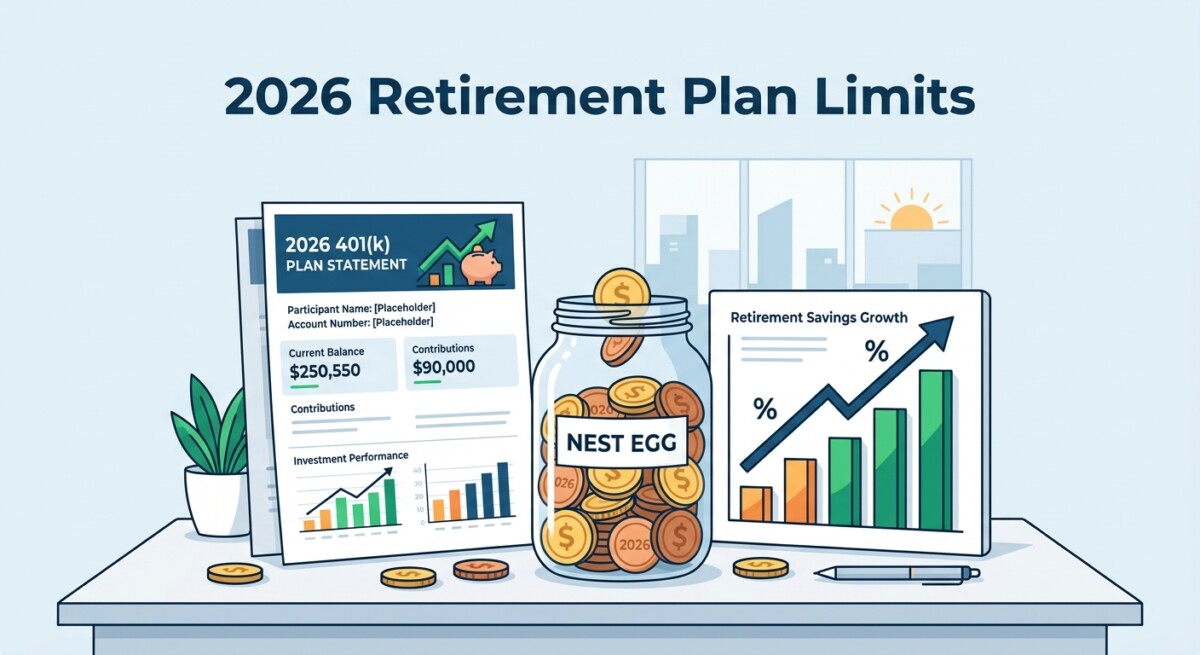
The 401(k) elective deferral limit is $24,500 for 2026, up from $23,500 in 2025.
The IRS announced the 2026 cost-of-living adjustments in Notice 2025-67. The headline figures:
- 401(k)/403(b)/457 elective deferral: $24,500 (up from $23,500).
- Age-50 catch-up: $8,000 (up from $7,500).
- “Super catch-up” for ages 60–63: an extra $11,250 instead of the standard $8,000, under SECURE 2.0.
- IRA limit: $7,500, with a $1,100 catch-up for those 50 and older.
A worker aged 60–63 in a 401(k) can therefore defer up to $35,750 in 2026 ($24,500 plus the $11,250 super catch-up) — a meaningful planning opportunity for owners and senior staff nearing retirement.
What is the “super catch-up” for ages 60 to 63? 🎯
SECURE 2.0 created a higher catch-up limit — $11,250 for 2026 — available only to employees who are 60, 61, 62, or 63 during the year.
This is not a permanent bump for everyone over 50. It is a specific four-year window. Once an employee turns 64, the catch-up drops back to the standard amount ($8,000). Plan sponsors need to confirm their payroll and recordkeeping systems can apply the correct catch-up based on the employee’s age during the plan year — a detail that trips up systems built only for the flat age-50 catch-up.
Do high earners have to make Roth catch-up contributions? 🔺
Yes. Starting in 2026, employees whose prior-year wages exceeded roughly $150,000 must make catch-up contributions as Roth (after-tax) rather than pre-tax.
This is the SECURE 2.0 change with the biggest payroll impact. If an employee earned more than about $150,000 in FICA wages in 2025 (an inflation-indexed threshold), any catch-up they make in 2026 must go into a Roth account. There is no more pre-tax catch-up deduction for these high earners.
The practical consequence: if your plan does not offer a Roth option, affected employees cannot make catch-up contributions at all. Plan sponsors must confirm the plan document permits Roth deferrals and that payroll can route catch-up dollars for high earners to the Roth source.
What other SECURE 2.0 features can employers offer? 🧩
Optional SECURE 2.0 provisions — student-loan matching and emergency savings accounts — let employers boost participation without raising cash compensation.
Two features many employers have not yet adopted:
- Student-loan matching: employers can make matching contributions to the 401(k) based on an employee’s qualified student-loan payments, so workers paying down debt still build retirement savings.
- Emergency savings accounts: plans can offer linked emergency-savings accounts for non-highly-compensated employees, giving staff a rainy-day fund tied to the plan.
Neither is mandatory, but in a tight labor market both are low-cost retention tools — especially for practices competing for hygienists, associates, and skilled hourly staff.
2026 retirement plan limits at a glance 📊
| Limit | 2025 | 2026 |
|---|---|---|
| 401(k)/403(b)/457 deferral | $23,500 | $24,500 |
| Catch-up (age 50+) | $7,500 | $8,000 |
| Super catch-up (age 60–63) | — | $11,250 |
| IRA contribution | $7,000 | $7,500 |
| IRA catch-up (age 50+) | $1,000 | $1,100 |
📌 Key Takeaways
- 401(k) deferral rises to $24,500; age-50 catch-up to $8,000.
- Ages 60–63 get a $11,250 super catch-up — a four-year window only.
- Earned over ~$150,000 in 2025? Your catch-up must be Roth in 2026.
- No Roth feature = affected high earners can’t catch up until the plan is amended.
Frequently Asked Questions ❓
Q. What is the 401(k) contribution limit for 2026?
The elective deferral limit is $24,500, up from $23,500 in 2025, per IRS Notice 2025-67. The age-50 catch-up is $8,000.
Q. Who qualifies for the $11,250 super catch-up?
Only employees who are 60, 61, 62, or 63 at any point during 2026. At age 64 the catch-up returns to the standard $8,000.
Q. Why do high earners have to use Roth for catch-up contributions?
SECURE 2.0 requires employees whose prior-year FICA wages exceeded an indexed threshold (about $150,000) to make catch-up contributions as Roth. This starts in 2026 and removes the pre-tax option for those catch-up dollars.
Q. What happens if my plan doesn’t offer Roth?
Affected high earners cannot make catch-up contributions until the plan is amended to permit Roth deferrals. Sponsors should update the plan document and payroll routing before 2026 contributions begin.
Q. How much is the 2026 IRA limit?
$7,500 for regular contributions, plus a $1,100 catch-up for those 50 and older.
Q. Is the student-loan match mandatory?
No. Student-loan matching and emergency savings accounts are optional SECURE 2.0 features. Employers can adopt them as retention tools but are not required to.
Getting the 2026 limits into payroll correctly — especially the super catch-up and the Roth catch-up rule — is where plans slip. If you would like a retirement plan and payroll review before the first 2026 contribution, contact SW Accounting & Consulting Corp. Primary sources: IRS Notice 2025-67 (COLA limits) and IRS retirement plans guidance on SECURE 2.0.