Life Events Tax Impact 2026: Marriage, Baby, Divorce & Death
The moments that reshape a family — a wedding, a new baby, a divorce decree, the loss of a spouse — also quietly reshape a tax return. Each of these events changes what you file, how you file, and how much the IRS expects to be withheld from every paycheck between now and April. Understanding the life events tax impact is the difference between a smooth filing season and a surprise balance due, a lost credit, or a mismatched Social Security record that delays a refund.
At SW Accounting & Consulting Corp in Los Angeles, we see the same pattern every spring: a client had a great year personally, but a name that no longer matches the Social Security Administration, a W-4 that still shows single, or a dependent on the wrong return. This guide walks through the four life events that most often reshape an individual return, what to update, and where the primary IRS guidance lives.
What is the life events tax impact, and why does it matter mid-year? 💍
Life events change filing status, withholding, and credit eligibility — often mid-year — so the fix belongs on your W-4 and personal records long before you file the return.
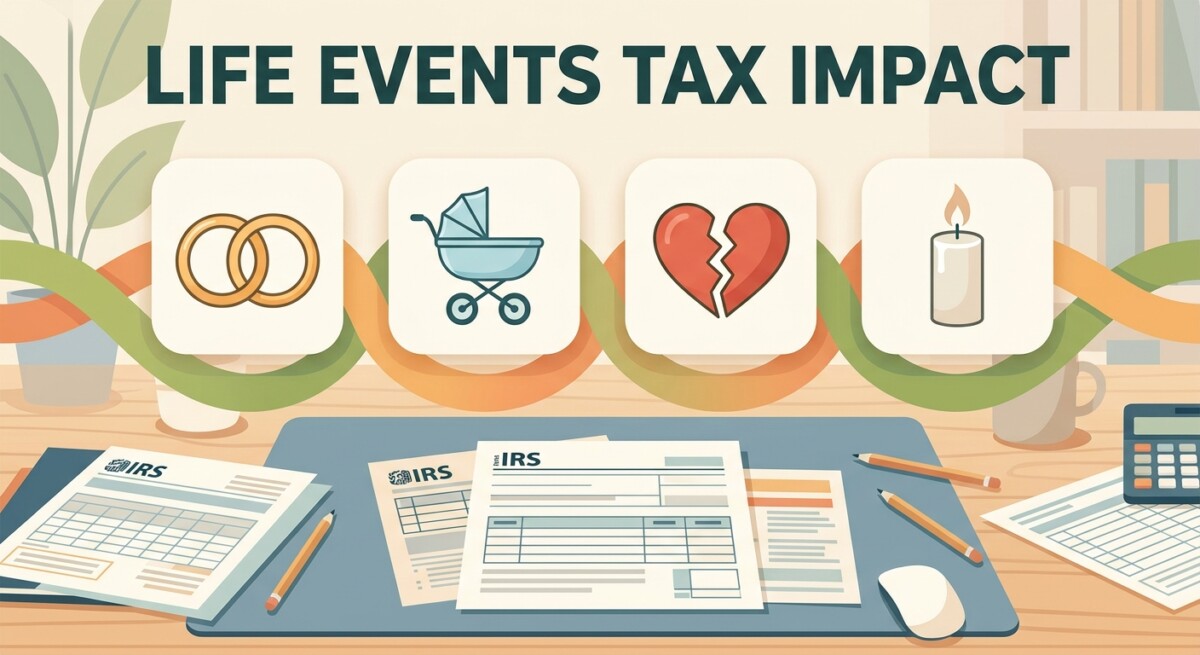
The IRS reminds taxpayers that several kinds of major life events affect filing requirements, tax benefits, and withholding: marriage, welcoming a new child, divorce or legal separation, and the death of a spouse or family member. Every one of those events touches at least one of three levers — your filing status, your W-4 withholding, and your credit eligibility — and the change usually happens in the middle of a tax year, not neatly on January 1.
Waiting until you sit down to file is the most expensive way to handle a life event. By then, the withholding damage is already done, dependents may have been claimed on the wrong return, and mismatched names or addresses can hold up refunds or notices.
How does marriage change my taxes? 💒
Marriage can change your filing status, your combined withholding, and your eligibility for several income-tested benefits — and both spouses need to update their records with SSA, the Postal Service, employers, and the IRS.
Newly married couples typically move from single to married filing jointly (or, less often, married filing separately). Two incomes stacked into one household can push into higher brackets or phase out certain credits, so the withholding that made sense as a single filer often no longer fits. The IRS advises newly married taxpayers to make several changes before the next filing season, including reviewing withholding and updating Form W-4 with each employer.
Two administrative steps are just as important as the tax math:
- Name change: report any name change to the Social Security Administration. A mismatch between the name on your return and the SSA record can delay processing.
- Address change: notify the U.S. Postal Service, your employers, and the IRS. The IRS uses Form 8822 to update your mailing address on file.
What tax benefits open up when we have or adopt a child? 👶
A new child can unlock the Child Tax Credit, the Adoption Credit, and the Child and Dependent Care Credit — each with its own eligibility rules and a valid Social Security number requirement.
Adding a child to the family is one of the largest single shifts in a personal tax picture. The IRS notes that a new child may make taxpayers eligible for several benefits, each with individual eligibility requirements, and that the parent (or taxpayer) and the child must generally have a valid Social Security number. The three most common credits:
- Child Tax Credit: a per-qualifying-child credit for taxpayers who meet the relationship, age, residency, and income tests.
- Adoption Credit: a credit for qualified adoption expenses tied to the adoption of an eligible child.
- Child and Dependent Care Credit: a credit for a portion of qualifying care expenses so you can work or look for work.
Practically, this also means requesting a Social Security number for the child promptly (needed to claim any of the above), and revisiting withholding. Adding a dependent usually reduces the tax owed on the same paycheck, and the W-4 should reflect that so you are not over-withholding for months.
How do divorce or legal separation change the return? ⚖️
Divorce and legal separation change your filing status, who can claim dependents, and eligibility for several credits — and almost always require a new W-4.
The IRS advises that filing taxes after divorce or separation can affect filing status, tax withholding, who can claim dependents, and eligibility for certain credits and deductions. Changes to income, withholding, and filing status may require taxpayers to update their Form W-4.
A few decisions typically drive the biggest tax swings:
- Filing status for the year the divorce becomes final — you are generally treated as unmarried for the entire year if the decree is final by December 31.
- Dependents — which parent claims the qualifying children (and which credits follow), and how the family reflects any Form 8332 release.
- Alimony and child support — federal tax treatment depends on the date of the divorce or separation instrument, so the year of the decree matters.
- Withholding — a fresh W-4 that matches the new filing status and dependent count prevents surprises next April.
What tax steps follow the death of a spouse or family member? 🕊️
A surviving family generally files a final individual return for the deceased in the same way they would have filed while alive — reporting all income up to the date of death and claiming any eligible credits or deductions.
The IRS explains on its deceased-person page that a final individual income tax return should be filed for the year of death, reporting all income up to that date and claiming any eligible credits or deductions. The specific mechanics — who signs, whether a Form 1310 is needed to claim a refund, whether a personal representative has been appointed — depend on the family’s situation.
Common follow-up items after a death in the family:
- Filing status for the surviving spouse: potentially married filing jointly for the year of death, then qualifying surviving spouse for up to two years thereafter if a qualifying child is in the home.
- W-4 update: withholding almost always needs to be re-set once income sources and household composition change.
- Estate income tax (Form 1041): income earned after the date of death typically belongs on an estate return, not the final individual return.
What should I do right after any major life event? ✅
Review your withholding, update your personal information with SSA, USPS, and the IRS, and preserve every document that supports next year’s return.
The IRS reminds taxpayers that after any major life event they should review their tax withholding, update personal information, and keep important records. A short punch list that works for any of the four events above:
- Update your W-4 at every employer and, if applicable, adjust estimated tax payments.
- Reconcile Social Security records — name change with SSA, address change with USPS, IRS, and employers.
- Refresh dependents — obtain Social Security numbers for new children and confirm claim rights after divorce.
- Keep the documentation — decree, birth or adoption certificate, marriage license, death certificate, Form 1310, Form 8332.
- Model the return early — even a rough projection catches under- or over-withholding while there is still time to fix it.
Life events tax impact at a glance 📊
| Life event | What changes | Do this now |
|---|---|---|
| Marriage | Filing status, withholding, benefit phase-outs | SSA name change; new W-4 for both spouses; Form 8822 |
| New child | CTC, Adoption Credit, Dependent Care Credit | Get child’s SSN; add dependent to W-4 |
| Divorce / separation | Filing status, dependent claims, credit eligibility | New W-4; agree on who claims each child; Form 8332 if needed |
| Death of a spouse | Final individual return; possible qualifying surviving spouse status | Gather income to date of death; consider Form 1310; assess estate 1041 |
📌 Key Takeaways
- Marriage, a new child, divorce, and death all change filing status, withholding, and credits.
- Update SSA, USPS, employers, and the IRS right after the event — not at filing time.
- A fresh Form W-4 after any life event usually prevents the biggest surprise at April.
- A new child needs a valid Social Security number to claim the Child Tax Credit and related credits.
Frequently Asked Questions ❓
Q. Do I have to change my W-4 after I get married?
The IRS advises newly married taxpayers to review their withholding and update Form W-4 with each employer if needed. Two paychecks that were both withheld as single often over- or under-withhold for the couple, so a fresh W-4 is usually worth the ten minutes.
Q. What is the life events tax impact of a new baby?
A new child may qualify a family for the Child Tax Credit, the Adoption Credit (if adopted), and the Child and Dependent Care Credit. Each credit has its own eligibility rules, and both the parent and child must generally have a valid Social Security number.
Q. If we divorce, who claims the kids?
Only one parent can claim a given qualifying child on their federal return. The IRS’s tie-breaker rules apply if both parents attempt to claim the same child, and Form 8332 can be used to release the exemption to the noncustodial parent when the parents have agreed to that arrangement.
Q. Who files the final tax return for someone who died?
A final individual income tax return is generally filed for the deceased in the same way it would have been filed while they were alive, reporting all income up to the date of death. The IRS’s deceased-person guidance covers who signs, when Form 1310 is used to claim a refund, and how a personal representative fits in.
Q. Do I need to tell the IRS if I move?
Yes — an address change should be reported to the U.S. Postal Service, your employers, and the IRS. The IRS uses Form 8822 to update the address on file for individual taxpayers.
Q. How do I change my last name for tax purposes?
The name on your tax return must match Social Security Administration records. Report the name change directly to the SSA before you file; a mismatch is one of the most common causes of refund delays.
Life events reshape a return more than most people expect, and the fix usually starts long before filing season. If you have had a major life change this year and want a proactive review before you file, contact SW Accounting & Consulting Corp. Primary sources: IRS, IRS Filing Taxes After Divorce or Separation, IRS Deceased Person, and Social Security Administration.