
California Business Tax 2026: SB 122, SB 180 & CCTC
If you own or advise a California business, the second half of 2026 is bringing a stack of changes that reach the state return, the annual franchise tax, and the credits you plan around. The California business tax 2026 updates now on the books — Senate Bill 122, Senate Bill 180, Franchise Tax Board Legal Ruling 2026-01, and a fresh California Competes Tax Credit (CCTC) allocation — are not incremental. They reshape when new entities start paying tax, how long the 70% credit cap will apply, and which trusts owe California tax on undistributed income.
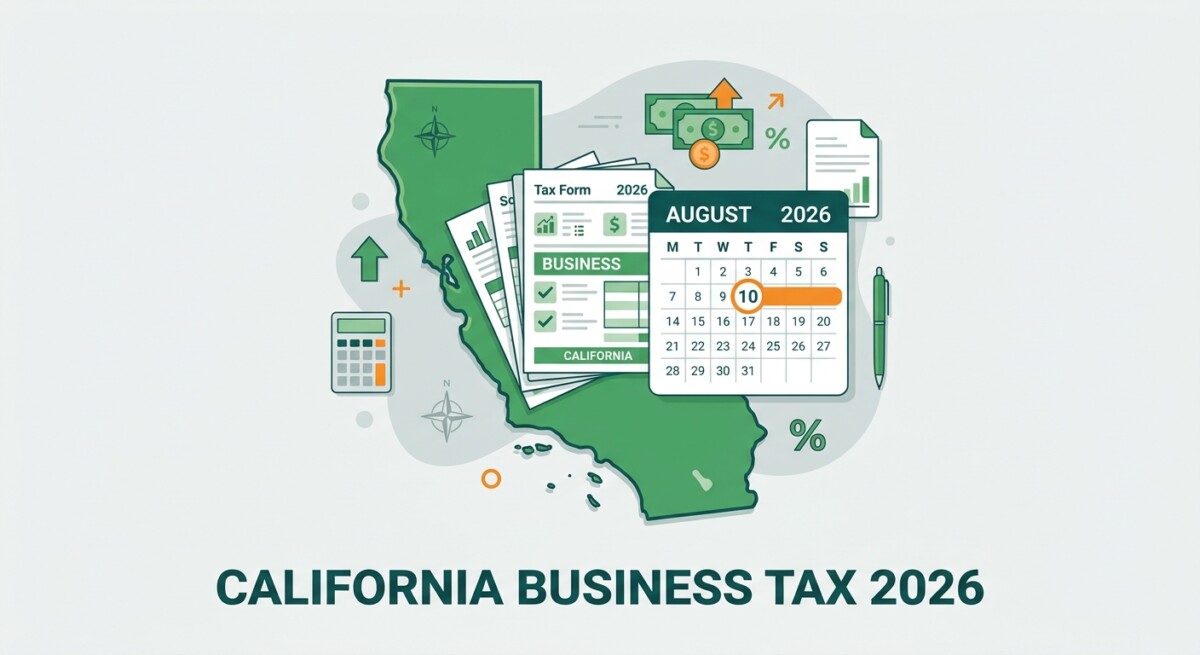
At SW Accounting & Consulting Corp we file California returns for Los Angeles restaurants, professional practices, and closely held companies every week. This post walks through what the new laws do, the near-term dates that matter (the CCTC window closes on August 10, 2026), and the practical planning moves for the rest of the year.
What do SB 122 and SB 180 change for California business tax 2026? 🧾
SB 122 and SB 180 are the fiscal-year budget trailer bills that touch the California Revenue and Taxation Code (RTC) — they extend the business credit limitation, cut the first-year annual tax for many entities, and align California with recent federal changes.
The two bills together push four changes into the Revenue and Taxation Code that Los Angeles business owners will feel first:
- Business credit limitation extended (temporary). The sunset for the business tax credit limitation and the annual refundable credit election is extended by three years, through taxable years beginning before January 1, 2030.
- Business credit limitation made permanent (from 2030). For taxable years beginning on or after January 1, 2030, specified tax credits can reduce a taxpayer’s tax by no more than 70% of tax (or net tax), or $5 million, whichever is greater. Credits blocked by the cap remain as a carryover.
- First-year annual tax cut to $400. For taxable years beginning on or after January 1, 2027 and before January 1, 2030, the annual tax on Limited Partnerships (LPs), non-corporate Limited Liability Companies (LLCs), and Limited Liability Partnerships (LLPs) drops from $800 to $400 for the first taxable year.
- ABLE Account conformity. California law is generally aligned with federal changes for IRC §530A Achieving a Better Life Experience (ABLE) accounts, which fund qualified disability expenses without triggering means-tested benefit cutoffs.
The bills also extend the California Competes Tax Credit five years through taxable years beginning before January 1, 2035, and impose a tax equal to 100% of any anti-weaponization settlement fund payment received during the year.
How does the business credit limitation actually work? 📉
The limitation caps how much California credit you can use in a single year, but the unused portion carries over rather than disappearing.
Under the original temporary rules, most California business credits (including the research credit and the CCTC in many cases) could reduce combined tax liability by no more than a fixed dollar cap each year. SB 122 stretches that temporary cap to taxable years beginning before January 1, 2030. Starting with taxable years beginning on or after January 1, 2030, a permanent version takes over: specified credits can offset no more than 70% of tax or net tax, or $5 million, whichever produces the larger deduction.
The practical consequences:
- Small and mid-size taxpayers whose California tax is under roughly $7 million are governed by the $5 million floor rather than the 70% ceiling — because $5M is greater than 70% of $7M.
- Large taxpayers lose access to more than 30% of tax each year, and the balance carries forward on the credit’s own carryover clock.
- Credit-heavy returns (R&D-heavy technology companies, entertainment production credits, film credits) should model the carryover schedule now — not at extension time — to project when credits will actually monetize.
When is the next California Competes Tax Credit deadline? ⏰
The first FY 2026/2027 California Competes Tax Credit application window is July 20, 2026 through August 10, 2026 — and $350 million in credits is available in this initial round.
The California Competes Tax Credit is an income tax credit negotiated by the Governor’s Office of Business and Economic Development (GO-Biz) and approved by the statutory CCTC Committee. It is designed for businesses that want to locate in California or stay and grow here. Awards can be significant — some California-based technology and manufacturing companies have received seven-figure allocations tied to hiring and capital investment commitments.
Three application windows apply for fiscal year 2026/2027:
- July 20, 2026 – August 10, 2026 (initial round, $350 million available)
- January 4, 2027 – January 25, 2027
- March 1, 2027 – March 15, 2027
Applications are filed at calcompetes.ca.gov. Because SB 122 and SB 180 extend the CCTC through January 1, 2035, businesses now have a much longer planning runway — but you still need to file inside a window to be considered.
What does FTB Legal Ruling 2026-01 mean for California trusts? ⚖️
Legal Ruling 2026-01 clarifies when a California resident beneficiary of a discretionary trust has a “contingent” versus “non-contingent” interest under R&TC section 17742 — a distinction that decides whether the trust owes California tax on accumulated income.
California R&TC section 17742 taxes the accumulated income of a trust on the entire taxable income of that trust when the fiduciary or beneficiary is a California resident — but only if the resident beneficiary’s interest is non-contingent. If the resident beneficiary’s interest is contingent, that beneficiary’s share does not pull accumulated trust income into California’s tax base.
Legal Ruling 2026-01 sets out three fact patterns involving distributions to a resident beneficiary of a discretionary trust and walks through how the Franchise Tax Board views “contingent” versus “non-contingent” interests in each scenario, along with the resulting tax consequences to the trust. If you or your clients have a family trust with California-resident beneficiaries and out-of-state trustees, this ruling should trigger a fresh look at the trust instrument and the current distribution pattern.
What other August 2026 California business tax items should I watch? 🔍
Two smaller items in the FTB’s August 2026 Tax News deserve attention: taxation of prediction-market income and voluntary administrative dissolution for dormant entities.
- Prediction market income. California residents must report all taxable income received through online prediction-market platforms, even when no Form 1099 is issued. Keep transaction-level records — the reporting burden is on the taxpayer.
- Voluntary administrative dissolution/cancelation. A qualified domestic corporation or domestic LLC that stopped operating (or never operated) can request voluntary administrative dissolution or cancelation using Form FTB 3715 PC (corporation) or FTB 3716 PC (LLC). The FTB may abate unpaid qualified taxes, penalties, fees, and interest on certification — but the entity must still file the proper dissolution/cancelation paperwork with the Secretary of State.
The dormant-entity path is genuinely useful for clients who registered an LLC or corporation years ago, never operated, and have been quietly accruing the $800 annual franchise tax and penalties. Cleaning it up now is far cheaper than another year of accrual.
California business tax 2026 at a glance 📊
| Change | Effective | Who it hits |
|---|---|---|
| Business credit limitation extended (temporary) | Through taxable years beginning before Jan 1, 2030 | Credit-heavy corporations and passthroughs |
| Permanent 70% / $5M credit cap | Taxable years beginning on/after Jan 1, 2030 | Large California taxpayers |
| $400 first-year annual tax | Jan 1, 2027 – before Jan 1, 2030 | New LPs, non-corporate LLCs, LLPs |
| CCTC extended to 2035 | Taxable years beginning before Jan 1, 2035 | Businesses locating or expanding in CA |
| FTB Legal Ruling 2026-01 | Published July 7, 2026 | Discretionary trusts with CA-resident beneficiaries |
| CCTC application window #1 | July 20 – August 10, 2026 | Any CA business planning growth |
📌 Key Takeaways
- The California business tax 2026 package is driven by SB 122 & SB 180.
- First-year annual tax drops to $400 for new LPs, LLCs, and LLPs starting Jan 1, 2027.
- A permanent 70% / $5M credit cap kicks in for tax years beginning on/after Jan 1, 2030.
- The next CCTC deadline is August 10, 2026 — $350M available in this round.
- FTB Legal Ruling 2026-01 reshapes California tax on discretionary trusts with resident beneficiaries.
Frequently Asked Questions ❓
Q. Do SB 122 and SB 180 affect my existing California LLC?
Yes, but not through the first-year annual tax cut. Existing LLCs continue paying the standard $800 annual tax. Where existing LLCs feel SB 122 and SB 180 is through the extended business credit limitation and the permanent 70% / $5 million cap that begins for taxable years beginning on or after January 1, 2030.
Q. Can my new LLC actually pay $400 instead of $800 in its first year?
Only if the entity’s first taxable year begins on or after January 1, 2027 and before January 1, 2030, and the entity is a Limited Partnership, a non-corporate Limited Liability Company, or a Limited Liability Partnership. Corporate LLCs are outside the cut. Confirm the entity’s first-taxable-year date with your CPA before relying on the reduction.
Q. When does the permanent 70% / $5 million credit cap start?
Taxable years beginning on or after January 1, 2030. Between now and then, the extended temporary limitation applies. Credit-heavy taxpayers should refresh their long-range utilization models to reflect the new endpoint.
Q. What is the next California Competes Tax Credit deadline?
The first fiscal year 2026/2027 application window closes on August 10, 2026, with $350 million in credits available. The next two windows are January 4 – 25, 2027 and March 1 – 15, 2027.
Q. How does FTB Legal Ruling 2026-01 change trust taxation?
The ruling clarifies how the Franchise Tax Board distinguishes between contingent and non-contingent interests of California-resident beneficiaries in discretionary trusts under R&TC section 17742. If a resident beneficiary’s interest is non-contingent, the trust’s accumulated income can be taxable to the trust in California; if the interest is contingent, it is not, in that fact pattern.
Q. I registered an LLC years ago and never operated. What do I owe?
A qualified domestic LLC that never conducted business, holds no assets, and is not actively conducting transactions for profit can request voluntary administrative cancelation on Form FTB 3716 PC. Corporations use Form FTB 3715 PC. Certification is under penalty of perjury, and the Secretary of State dissolution filing is still required — but the FTB may abate unpaid qualified taxes, penalties, fees, and interest.
If you would like a review of how the California business tax 2026 changes affect your entity structure, credit utilization, or trust planning, contact SW Accounting & Consulting Corp. Primary sources: California Legislative Information for Senate Bill 122 and Senate Bill 180, the Franchise Tax Board for Legal Ruling 2026-01 and the August 2026 Tax News, and the Governor’s Office of Business and Economic Development for the California Competes Tax Credit.