BTS Week sales spike: what changes in your books this month?
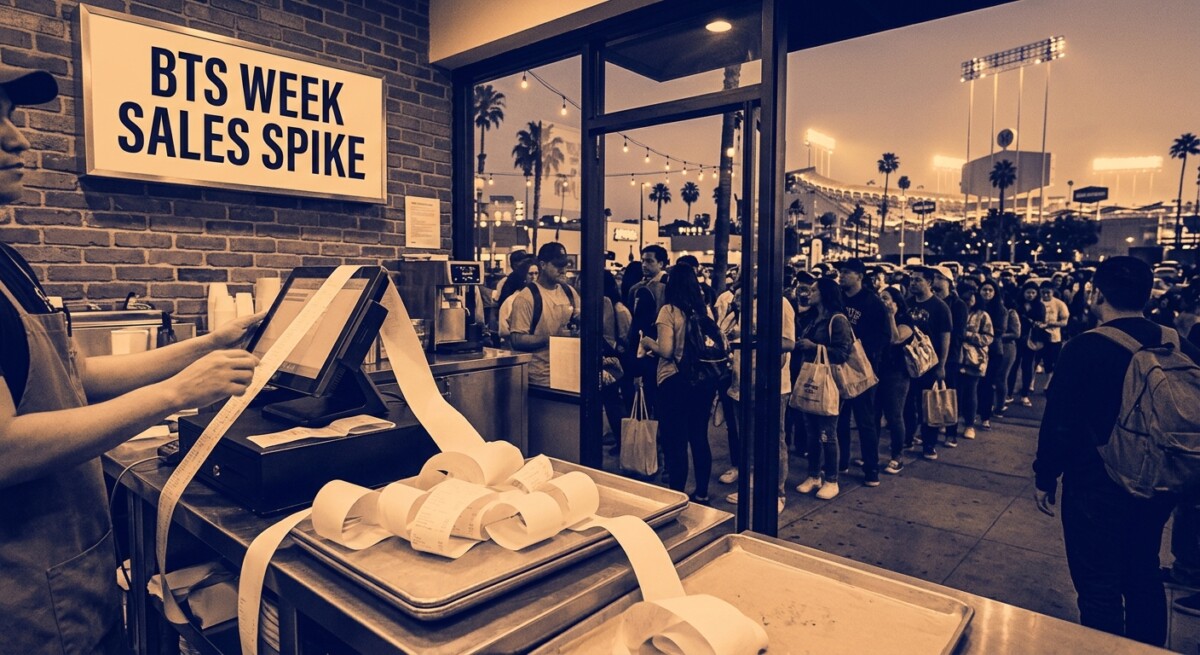
The City of Los Angeles proclaimed September 1 through 8, 2026 as BTS Week, and the group is playing four sold-out nights at SoFi Stadium on September 1, 2, 5, and 6. When the same tour stopped in Las Vegas in May, four shows were credited with several hundred million dollars of local spending. Inglewood, Koreatown, and the corridor between them are absorbing that now. If you own a restaurant, cafe, bakery, or retail shop in that zone, this is probably your best two weeks of the year. A BTS Week sales spike also moves four numbers that most owners never think about until April. Here is what a careful bookkeeper checks after a week like this.
Can a BTS Week sales spike change how often you file sales tax? 🧾
Yes. CDTFA assigns filing frequency based on reported taxable sales and can move you from quarterly to monthly, or require prepayments, after a period of higher volume.
California sales tax is administered by the California Department of Tax and Fee Administration (CDTFA). New accounts usually start on a quarterly schedule. As reported sales grow, CDTFA reassigns the account to monthly filing or to quarterly filing with monthly prepayments. The CDTFA filing-frequency rules describe the thresholds. The reassignment is not negotiated; it arrives as a notice in your CDTFA online account and by mail, and the new due dates apply from the period stated in the notice.
The practical risk is not the extra filing. It is missing the notice. Owners who have filed quarterly for years stop reading CDTFA mail. If the account was moved to monthly and the next return is late, the penalty is 10 percent of the tax plus interest, and the late-filing history follows the account. Log in to the CDTFA portal once before the end of September and read every notice dated after July.
The second sales tax issue is location. If you sold from anywhere other than your registered store, for example a booth, a truck, or a partner’s parking lot near the stadium, the district tax rate of that location applies. Under the CDTFA city and county rate table effective July 1, 2026, the City of Los Angeles is 9.75 percent, Inglewood is 10.25 percent, and Santa Monica and Culver City are 10.75 percent. A point-of-sale system set to your Koreatown address and used in Inglewood under-collects by half a percent on every sale, and the difference is yours to pay.
| Sale location | Combined rate (eff. 2026-07-01) |
|---|---|
| City of Los Angeles (Koreatown) | 9.75% |
| Inglewood (SoFi Stadium) | 10.25% |
| Santa Monica, Culver City | 10.75% |
Report the off-site sales on the same return, but allocate them to the correct district on Schedule A so the local share goes to the right city. CDTFA cross-checks district allocations against the addresses on your permit.
How does a big month affect tip reporting and the new tip deduction? 💵
Two ways. A sustained staffing increase can bring you under Form 8027, and the federal tip deduction only works for your employees if card and cash tips are recorded separately on the W-2.
Food and beverage establishments that normally employ more than 10 people on a typical business day must file Form 8027, the annual information return of tip income and allocated tips. The word that matters is “normally.” The IRS test looks at the whole year, so one busy week alone does not trigger the filing. If you added staff for the concerts and kept them through the holidays, run the test again in December.
The second issue is newer. Beginning with tax year 2025, employees can deduct qualified tips, up to $25,000 a year, on their federal return. The deduction depends entirely on what you report. Tips must appear on the W-2 in a way that identifies them as qualified tips, and that means your payroll records must separate credit card tips, cash tips reported by the employee, and any tip-pool distributions. A busy fortnight with tip pooling across temporary staff is exactly where those records get muddled.
Do not reconstruct tips in January
In our practice, the tip problems that cost the most are the ones discovered at W-2 time. Card tip totals from the processor rarely match the payroll tip totals once tip-outs and cash tips are added, and the gap has to be explained employee by employee. Reconcile weekly while the week is fresh.
Do temporary concert-night workers earn overtime after 8 hours in California? ⏰
Yes. California overtime is calculated daily and weekly, and the seventh consecutive day of work carries its own premium. Temporary or part-time status does not change any of that.
The California overtime rules are stricter than federal law. A non-exempt employee earns 1.5 times the regular rate for hours over 8 in a workday and for the first 8 hours on the seventh consecutive day of a workweek. Hours over 12 in a day, and hours over 8 on that seventh day, are paid at 2 times. A 14-hour concert-night shift therefore contains a double-time block whether or not the employee reached 40 hours that week.
BTS Week runs Tuesday through the following Tuesday. Many restaurants near the stadium stayed open long hours every day of it. If your workweek starts on Monday, an employee who worked every day from Tuesday September 1 through Monday September 7 hit a seventh consecutive day. Check the schedule against your defined workweek before running payroll.
- Daily overtime. Over 8 hours at 1.5x, over 12 hours at 2x, regardless of weekly total.
- Seventh consecutive day. First 8 hours at 1.5x, hours after 8 at 2x.
- Cash pay is allowed, missing stubs are not. The wage statement requirements under Labor Code section 226 apply to every wage payment. An itemized statement must show hours, rates, and deductions. Cash paid without a stub is hard to deduct and is the most common trigger for a Labor Commissioner wage claim.
- Meal and rest breaks. A missed meal break on a 14-hour shift owes one hour of premium pay per day. Long concert nights are where these accumulate.
Should the September 15 estimated tax payment go up? 📅
Usually not. Keep September on the safe harbor and raise the January payment once you know what the full year looks like.
Sole proprietors, S corporation shareholders, and partners pay estimated tax in four installments. The third installment for 2026 is due September 15, which lands before BTS Week revenue shows up in your monthly numbers. Under the IRS estimated tax rules, you avoid the underpayment penalty if your payments equal at least 100 percent of last year’s tax (110 percent if last year’s adjusted gross income exceeded $150,000), or 90 percent of this year’s tax.
One strong month rarely doubles a full year. If August was normal and September is up 100 percent, the annual increase is closer to 8 percent. Paying the safe-harbor amount in September and adding the extra to the January 15 installment keeps you penalty-free without guessing. The alternative, annualizing income each quarter on Form 2210 Schedule AI, lowers the April bill but requires quarter-by-quarter bookkeeping most small restaurants do not keep.
From our practice: the spike is not the risk, the unexplained spike is
When a client’s September stands out, the first question in any later examination is why. “Four SoFi Stadium shows plus a City of Los Angeles BTS Week proclamation” is a matter of public record. We drop a memo with the proclamation link and the show dates into the client’s accounting file. Three years later that memo answers the question before it is asked.
What about the emergency Costco runs and the food cost percentage? 🛒
Collect the card receipts now. Purchases without a vendor invoice fall out of the books, and a food cost percentage that suddenly drops reads to an auditor as unreported sales.
During a rush, owners buy from Costco, Restaurant Depot, Smart & Final, and the corner market on a card instead of from the usual distributor with an invoice. Those purchases have no bill to enter, so they are often coded as “supplies” or missed entirely. A card statement line does not tell your bookkeeper whether it was produce or paper goods.
The consequence is subtle. If September sales doubled but recorded food purchases rose only 30 percent, the food cost percentage for the month collapses. An IRS or CDTFA examiner who sees a restaurant’s cost of goods fall while sales rise does not conclude that you had a great week. They conclude that sales are understated in other months. Photograph every card receipt from the concert period, code it correctly, and file it with September.
BTS Week sales spike checklist for September 🗂️
Six items, all due before the end of the month.
| Item | Deadline |
|---|---|
| Read CDTFA account notices for a filing-frequency change | This month |
| Allocate off-site sales to the correct district rate | Next sales tax return |
| Overtime, seventh-day, and wage statements for temporary staff | Each payday |
| Third-quarter estimated tax at the safe-harbor amount | September 15 |
| Reconcile card tips, cash tips, and tip pools weekly | Weekly |
| Sort and code emergency card receipts | September 30 |
| Note the reason for the spike in your accounting file | This month |
Summary: what a BTS Week sales spike changes
- CDTFA can reassign you to monthly filing or prepayments after a high-volume period; read the notice.
- Off-site sales carry the rate of the sale location: Inglewood 10.25%, Los Angeles 9.75%, Santa Monica 10.75%.
- California overtime is daily (8 and 12 hours) and includes seventh-consecutive-day premiums for temp staff.
- Keep card and cash tips separate so employees can claim the federal tip deduction on their W-2.
- Pay the September 15 safe harbor; raise the January 15 installment instead of guessing.
- Document the reason for the spike so a later examiner sees a concert, not unreported sales.
Frequently asked questions about the BTS Week sales spike ❓
Q. Will one huge month change how often I file California sales tax?
It can. CDTFA sets filing frequency from your reported taxable sales and can move an account from quarterly to monthly, or add quarterly prepayments, after a period of higher sales. The change arrives as a notice in your CDTFA online account and by mail. Log in this month and confirm nothing has changed before assuming your next return is still quarterly.
Q. I sold from a booth near SoFi Stadium. Which sales tax rate applies?
The rate of the city where the customer took possession, not your home store’s rate. Inglewood is 10.25 percent under the CDTFA table effective July 1, 2026, while the City of Los Angeles is 9.75 percent and some nearby cities are 10.75 percent. If your point-of-sale applied your home rate, the shortfall comes out of your margin.
Q. Does a busy week push me into Form 8027 tip reporting?
Not by itself. Form 8027 applies to food and beverage establishments that normally employ more than 10 people on a typical business day, judged across the year. A single busy week does not change that, but if you staffed up and kept the extra staff, revisit the test at year end.
Q. Do I have to pay temporary concert-night workers overtime after 8 hours?
Yes. California overtime is daily as well as weekly. Non-exempt employees earn 1.5 times their regular rate after 8 hours in a day and 2 times after 12 hours, plus seventh-consecutive-day premiums. Temporary status does not exempt anyone.
Q. Should I raise my September 15 estimated tax payment because of BTS Week revenue?
Usually not. Paying the safe-harbor amount based on last year’s tax avoids the underpayment penalty regardless of how this year turns out. One strong month rarely doubles annual income, so most owners keep September as planned and increase the January 15 payment instead.
Q. Is a sudden sales spike an audit risk?
An unexplained spike is. A documented one is not. Note the SoFi Stadium concert dates and the City of Los Angeles BTS Week proclamation in your accounting file so the reason for the September jump is on record if anyone asks in a later year.
This article is general information, not tax advice for your specific situation. If you run a restaurant or shop in Los Angeles and want a second set of eyes on this month, contact SW Accounting & Consulting Corp.