California tourist tax refund: does it exist? (2026)
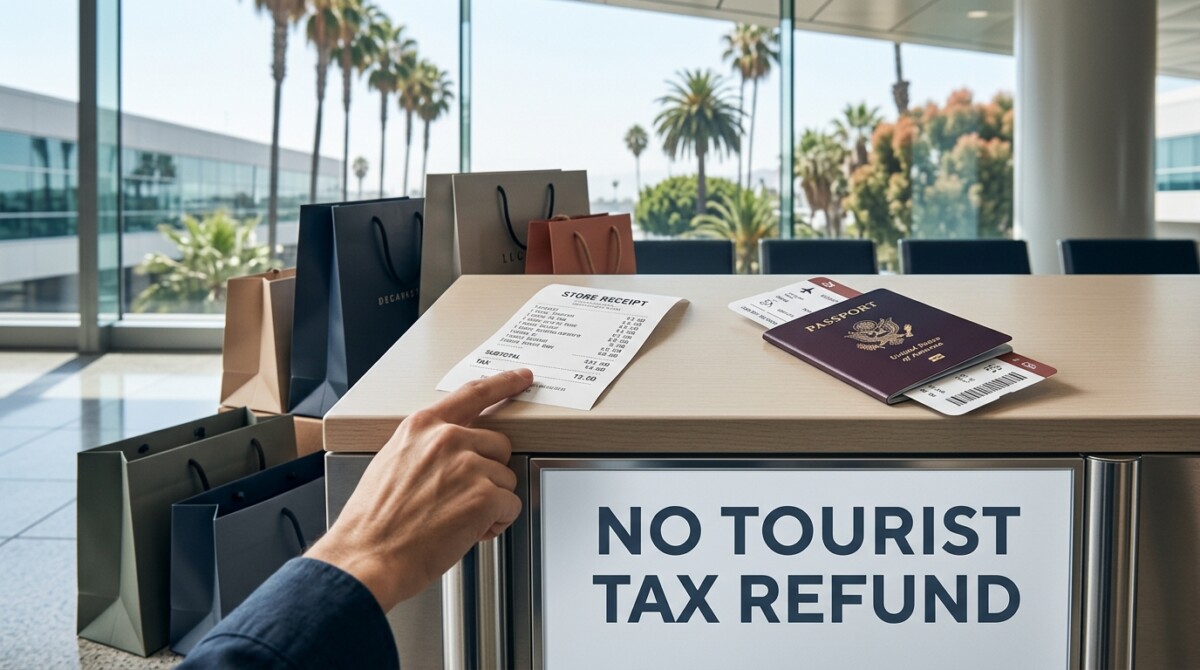
With Los Angeles in its official BTS Week and four sold-out SoFi Stadium shows, Koreatown and Inglewood retailers are seeing more international customers in a week than they usually see in a quarter. Many of those visitors come from countries where tourists reclaim VAT at the airport, and they are asking cashiers for a refund form. The question comes up often enough that it deserves a straight answer for both sides of the counter. This post explains why a California tourist tax refund does not exist, what the narrow exceptions elsewhere in the country actually are, what a Los Angeles retailer can and cannot do when a visitor asks, and what the visitor should plan for on the way home.
Why is there no California tourist tax refund? 🧾
Because U.S. sales tax is not a value-added tax. It is collected once, at the register, by the state and city where the sale happens, and there is no mechanism to unwind it when the goods leave the country.
Countries with tourist refund schemes run a national value-added tax. VAT is collected in stages along the supply chain, and because the government tracks the tax at each stage, it can refund the final consumer’s share when the goods are exported. The refund counter at Paris or Narita is the last step of that system.
The United States has no federal VAT. Instead, each state decides whether to levy a retail sales tax, and cities and counties add district taxes on top. The tax is paid once, by whoever is standing at the counter, and it is remitted to the state. There is no federal agency that collects it and therefore none that can refund it. California has never created a state-level tourist refund program, and nothing in the Revenue and Taxation Code treats a nonresident buyer differently from a resident one.
Under the CDTFA rate table effective July 1, 2026, the combined rate a visitor pays depends on the city where the purchase is made:
| Location | Combined rate |
|---|---|
| City of Los Angeles (Koreatown, Downtown) | 9.75% |
| Inglewood (SoFi Stadium) | 10.25% |
| Santa Monica, Culver City | 10.75% |
A visitor who spends $2,000 on merchandise, cosmetics, and clothing across Koreatown and Inglewood pays roughly $200 in sales tax that will not come back. Budget for it up front.
Which states do offer a tourist sales tax refund? 🗺️
Louisiana runs a statewide program, Texas allows private refund companies under conditions, and five states have no state sales tax at all. None of it helps a shopper in Los Angeles.
Retailers get this question with a follow-up: “But my friend got a refund in the U.S. last year.” That friend was probably in one of two states.
- Louisiana. The Louisiana Department of Revenue administers the Louisiana Tax Free Shopping program. International visitors who shop at participating merchants receive a voucher and claim a refund of the state sales tax at refund centers, including at the New Orleans airport. It is the only statewide program of its kind.
- Texas. The Texas Comptroller permits refunds of state sales tax on goods exported from the country. In practice, private refund companies operate at certain border crossings and airports and require the goods, receipts, and travel documents to be presented under specific conditions.
- No-sales-tax states. Oregon, Montana, New Hampshire, Delaware, and Alaska levy no state sales tax. There is nothing to refund because nothing was charged, though some Alaska municipalities have local taxes.
California is not on this list and has no pending program. A retailer who tells a customer “there might be a way at the airport” is sending them to a counter that does not exist.
What can a Los Angeles retailer legally do when a visitor asks? 🏪
Charge the tax. The only exemption that applies is a sale shipped directly out of California by common carrier, and it has to be a real shipment.
The retailer is the collector, not the taxpayer. If tax is not charged on a taxable sale, the California Department of Tax and Fee Administration holds the retailer liable for the uncollected amount on audit, with penalties and interest. A foreign passport, a tourist visa, or a promise to take the goods home does not create an exemption. CDTFA Publication 61 lists every exemption and exclusion in the sales and use tax law, and “nonresident buyer” is not among them.
- Do not waive or discount the tax. Discounting the price is your business decision. Not charging tax on a taxable sale is a liability you assume.
- Shipping out of state can be exempt. Under CDTFA Publication 101, a sale is generally not subject to California sales tax when the retailer ships the goods directly to the purchaser’s address outside the state by common carrier or the retailer’s own vehicle, and the purchaser does not take possession in California. Keep the bill of lading, the shipping label, and the customer’s foreign address in the sale record.
- “Mark it shipped” does not qualify. If the customer carries the bag out of the store, possession transferred in California and the sale is taxable, whatever the invoice says. Examiners look for carrier records that match the sale date and the destination.
- Duty-free is a different license. The duty-free shops at LAX operate under federal customs bond rules and sell only to departing international passengers at the gate. A regular retailer cannot offer duty-free or tax-free sales.
The expensive version of a friendly gesture
A Koreatown cosmetics shop that waived tax for visiting fans as a courtesy during a busy week would be liable for the full tax on every one of those sales at audit, plus a 10 percent penalty and interest, with no way to recover it from customers who have flown home. Kindness at the register is a discount off your price, not off the state’s tax.
What should the visitor plan for on the way home? ✈️
Budget about 10 percent on top of shelf prices, and check the customs allowance of the country you are flying back to. For Korea it is US$800 per person.
The U.S. side is simple. There is no refund, and there is no U.S. exit declaration for goods a tourist bought. U.S. Customs and Border Protection rules apply to what you bring into the United States, not what you take out. The home country’s rules are what matter on arrival.
For the many Korean fans in Los Angeles this week, the Korea Customs Service sets the allowance:
- Basic duty-free allowance: US$800 per person. It is per traveler, so a family of three has three allowances, but each person must actually carry their own goods.
- Separate allowances for alcohol (two bottles, up to 2 liters and US$400), tobacco (200 cigarettes), and perfume (100 ml).
- Over the limit? Declare voluntarily on arrival and the duty is reduced by 30 percent, up to a cap. Fail to declare and a 40 percent penalty applies, rising to 60 percent for repeat cases within two years.
- Buying to resell is not personal baggage. Multiple units of the same merchandise are treated as commercial goods, the allowance does not apply, and repeated resale creates income tax obligations at home.
Visitors from other countries should check their own customs authority. Japan, for example, has a different allowance structure, and the European Union applies a per-traveler threshold in euros. The common thread is that the California sales tax already paid is not creditable against any of it.
For the shop owner: the tax question that actually costs money this week 💡
Not the refund question. The district rate on your point-of-sale and your CDTFA filing frequency after a big quarter are where the real exposure is.
If you are a Koreatown or Inglewood retailer, the visitor refund question is a distraction you can answer in one sentence. The issues that move money this month are whether your point-of-sale applied the right district rate, especially if you sold from a temporary location near the stadium, whether giveaways and samples were logged for use tax, and whether CDTFA will move you to monthly filing after the spike. We covered those in BTS Week sales spike: what changes in your books and Pop-up shop sales tax in California.
From our practice: put the answer on a card by the register
In our practice, the retailers who handle this best print a two-line card in English, Korean, and Japanese: “California does not refund sales tax to visitors. We can ship purchases to your home address tax-free by carrier; ask us for a quote.” It ends the conversation, keeps the cashier out of an argument, and turns a refund request into a shipping sale that is actually exempt.
Summary: California tourist tax refund
- There is no California tourist tax refund and no federal one. Sales tax paid in Los Angeles stays paid.
- U.S. sales tax is a single-stage state and local tax, not a VAT, so there is nothing to unwind at the airport.
- Louisiana has a statewide program; Texas allows private refund companies; five states charge no state sales tax. California is none of these.
- Retailers cannot waive the tax. The only applicable exemption is a real shipment out of state by common carrier with records.
- Korean visitors have a US$800 per-person allowance at home; voluntary declaration cuts duty by 30 percent.
- For shop owners, the real exposure this week is district rates, giveaway use tax, and filing frequency.
Frequently asked questions about the California tourist tax refund ❓
Q. Does California refund sales tax to international tourists?
No. California has no tourist refund program and neither does the federal government. Sales tax paid at a California register stays paid, whether the buyer lives in Seoul, Tokyo, or San Diego.
Q. Why do European and Japanese visitors expect a refund at the airport?
Because their home countries run a national value-added tax that is collected in stages and can be unwound for goods leaving the country. The United States has no VAT. It has state and local retail sales taxes collected once at the point of sale, with no federal refund mechanism.
Q. Which U.S. states offer any tourist sales tax refund?
Louisiana runs a statewide Tax Free Shopping program through participating merchants and refund centers. Texas allows refunds through private refund companies at certain locations under conditions. Five states have no state sales tax at all: Oregon, Montana, New Hampshire, Delaware, and Alaska. None of that applies to a purchase made in Los Angeles.
Q. Can a Los Angeles store just not charge tax to a foreign customer?
No. The retailer is the collector. If tax is not charged on a taxable sale, CDTFA holds the retailer liable for it on audit, plus penalties and interest. A customer’s passport does not create an exemption.
Q. Is a sale exempt if the store ships the goods to Korea?
Generally yes, if the retailer ships directly to the customer’s address outside California by common carrier and the customer does not take possession in California. The retailer must keep the shipping documents. Handing the bag over the counter and marking the sale as shipped does not qualify.
Q. How much can a Korean visitor bring home duty free?
US$800 per person under Korea Customs Service rules, with separate allowances for alcohol, tobacco, and perfume. Over that amount, a voluntary declaration on arrival earns a 30 percent reduction on the duty, and failing to declare adds a 40 percent penalty.
This article is general information, not tax advice for your specific situation. Questions about sales tax on out-of-state or international shipments from a Los Angeles store? Contact SW Accounting & Consulting Corp.