How to keep QSBS treatment through a recap (2026)
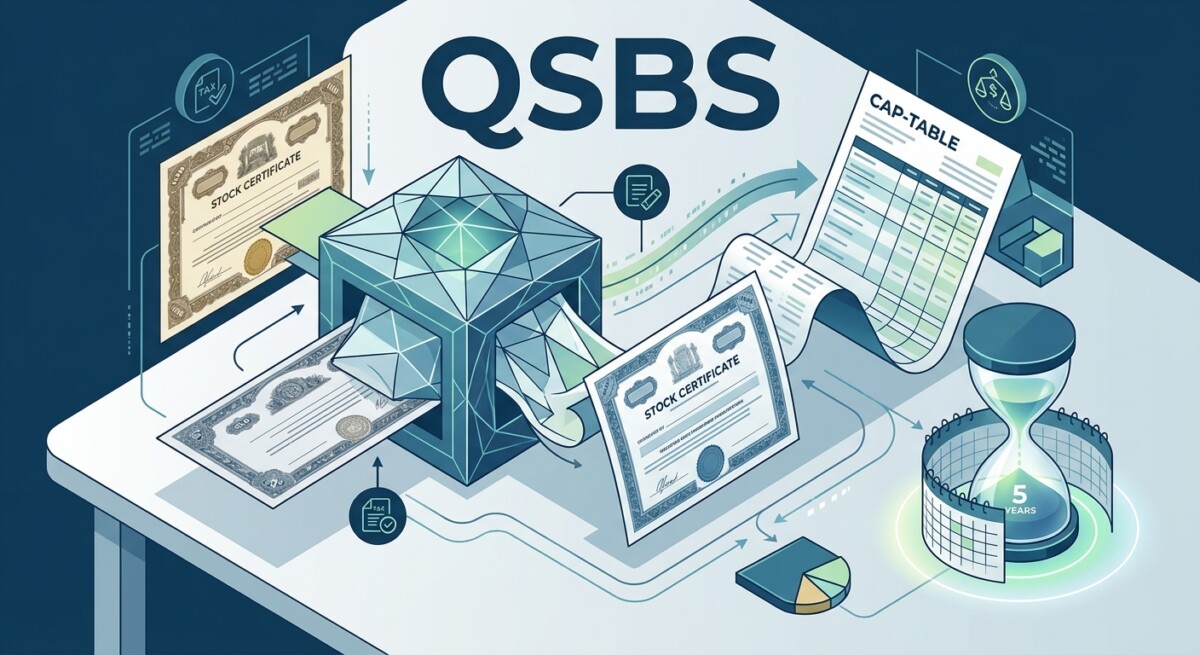
Many of our founder clients organize as C corporations for one big reason: the ability to sell their stock later and exclude most or all of the federal capital gain under Section 1202. That exclusion is what people mean when they say QSBS, or qualified small business stock. It is one of the most valuable planning tools in the Internal Revenue Code, and it is also one of the easiest to accidentally destroy. Any change to the terms of the stock, any new class of equity, or any restructuring can affect whether the exclusion still applies at exit. This post walks through how a tax-free recapitalization interacts with Section 1202, what the One Big Beautiful Bill Act changed in 2025, and where founders quietly lose QSBS status without noticing.
What does the QSBS exclusion under Section 1202 actually do? 💰
Section 1202 lets non-corporate shareholders exclude federal capital gain on the sale of qualified small business stock held more than five years, subject to a per-issuer cap that is now the greater of $15 million or 10 times basis.
The exclusion is defined in Internal Revenue Code Section 1202. At a high level, three things have to line up. First, the issuer must be a domestic C corporation, engaged in a qualified trade or business, with aggregate gross assets that never exceeded the applicable threshold at the time the stock was issued and immediately after. Second, the shareholder must have acquired the stock at original issuance in exchange for money, other property (not stock), or services. Third, the shareholder must hold the stock for more than five years before sale.
The One Big Beautiful Bill Act, enacted on July 4, 2025, materially expanded the exclusion for stock issued on or after July 5, 2025. The per-issuer cap increased from $10 million to $15 million (or 10 times basis, whichever is greater), and the aggregate gross assets threshold increased from $50 million to $75 million. Older QSBS remains under the prior rules. That means a single cap table can now include QSBS with two different sets of limits, and the analysis at exit has to distinguish stock issued before and after that date.
| Rule | Stock issued before July 5, 2025 | Stock issued on or after July 5, 2025 |
|---|---|---|
| Per-issuer gain exclusion cap | $10 million or 10x basis | $15 million or 10x basis |
| Aggregate gross assets threshold | $50 million | $75 million |
| Required holding period | More than 5 years | Partial exclusion after 3 and 4 years (tiered); 100% after 5+ years for post-OBBBA stock |
| Type of issuer | Domestic C corporation only | Domestic C corporation only |
Can a tax-free recap preserve QSBS treatment for founders? 🔁
Yes. Section 1202(h)(4)(A) treats stock received in a Section 368 tax-free reorganization as continuing QSBS, with the original holding period, so a properly structured Section 368(a)(1)(E) recap of QSBS does not, by itself, break the exclusion.
As companies grow, founders often want to change the rights attached to their common stock. Anti-dilution provisions, new liquidation preferences on a preferred round, or a clean-up of legacy share classes are common triggers. The mechanism is usually a Section 368(a)(1)(E) recapitalization, defined in Section 368 as a reshuffling of a corporation’s capital structure without a change in ownership at the entity level.
Section 1202(h)(4)(A) is the safe harbor. It provides that if QSBS is exchanged for other stock in a Section 368 reorganization, the new stock is treated as QSBS in the shareholder’s hands, and the original holding period tacks on. In other words, the five-year clock does not restart, and the new stock inherits the QSBS character of the old stock.
Section 1202(h)(4)(B) then adds a cap. If, at the time of the recap, the corporation no longer satisfies the aggregate gross assets test (that is, it has grown past the $75 million post-OBBBA threshold or the $50 million pre-OBBBA threshold), the excludable gain on the new stock is limited to the gain that would have been recognized if the recap had been taxable. This is often called the freezing rule: it locks in the QSBS-eligible value at the moment the company outgrew the size test, and any subsequent appreciation on the new stock is outside the exclusion.
How can Section 305 quietly turn a QSBS recap taxable? ⚠️
A recap that increases a shareholder’s proportionate interest in the corporation’s assets or earnings, or that adjusts preferred stock with dividends in arrears, can be treated as a deemed distribution under Section 305(c), taxable as a dividend under Section 301.
This is the least obvious way to lose QSBS. Section 305 and Treas. Reg. Section 1.305-7 treat certain stock distributions and stock rights as deemed distributions when they change the relative interests of shareholders. Two fact patterns are especially relevant to founder-led recapitalizations:
- Periodic proportionate-interest increases. If a recap is one step in a plan to periodically increase a shareholder’s proportionate interest in the corporation’s assets or earnings and profits, the regulations treat it as a taxable stock distribution.
- Preferred stock with arrearages. If a shareholder holding preferred stock with dividends in arrears exchanges that preferred for other stock and, as a result, increases his proportionate interest, the exchange can be treated as a Section 301 distribution.
If either applies, the recap is no longer purely tax-free. Any portion recharacterized as a Section 301 distribution is taxable to the extent of corporate earnings and profits (defined in Section 301). Because Section 1202(h)(4)(A) protects only stock received in a tax-free reorganization, a recap that becomes partially taxable this way carries the real risk that the resulting stock is no longer QSBS, or that the excludable gain shrinks.
Bona fide, isolated recaps are usually safe
Treas. Reg. Section 1.305-7 has long been read to permit isolated recapitalizations with a genuine business purpose that are not part of a periodic plan to shift ownership. Reasonable anti-dilution adjustments on convertible preferred stock are also carved out. The trouble comes when a recap looks like one step in a repeating pattern, or when preferred arrearages are cleaned up by shifting interests among shareholders. Both situations warrant a formal Section 305 analysis before closing.
What quietly breaks QSBS eligibility outside a recap? 🚫
Common eligibility killers include converting to an S corporation or LLC, letting the corporation’s aggregate gross assets ever exceed the threshold, engaging in a non-qualified trade or business, and certain redemptions that taint later issuances.
- Entity conversion. QSBS status requires a domestic C corporation. A check-the-box conversion to an LLC, or an S election, generally ends QSBS treatment for future gain unless the holding period is already met and the sale predates the change.
- Blowing the size test. The corporation must not have had aggregate gross assets exceeding the threshold ($75 million post-OBBBA, $50 million pre-OBBBA) at any time from August 10, 1993 through immediately after issuance of the stock in question. Once the threshold is exceeded, later-issued stock is disqualified forever, even if the balance sheet later shrinks.
- Wrong line of business. Section 1202 excludes health, law, engineering, architecture, accounting, actuarial science, performing arts, consulting, athletics, financial services, brokerage services, and hospitality. A significant pivot into an excluded field can strip QSBS status.
- Redemptions that taint issuance. Certain redemptions from the same shareholder within two years before or after the issuance, or significant redemptions from any shareholder within one year before or after, can disqualify the stock. These rules are unforgiving and easy to trip during buyouts or estate planning.
- Working capital and investment assets. The corporation must use at least 80% of its assets in the active conduct of a qualified trade or business during substantially all of the shareholder’s holding period. A cash-heavy balance sheet after a large financing can fall out of compliance without a plan to deploy the funds.
From our practice: the memo you write today saves the exit later
In our practice, most QSBS problems are documentation problems. Five years after issuance, memories fade, board minutes go missing, and the then-controller has moved on. When we onboard a C corporation with QSBS potential, we build a Section 1202 file at day one: a QSBS memo for each issuance, a running aggregate gross assets schedule tied to book value, a trade-or-business classification note, and cap-table snapshots at every round. That file is what turns an exit-year audit letter into a two-week response instead of a six-month reconstruction.
How should a QSBS company plan a recap? 🧭
Set the recap purpose in writing, confirm the aggregate gross assets position, screen for Section 305 issues, and time the closing to preserve as much post-recap exclusion as possible.
- Confirm the current QSBS profile. For each block of outstanding stock, verify issuance date, C corporation status at issuance and continuously, aggregate gross assets at issuance and immediately after, and whether the corporation is in a qualified trade or business.
- Test the size threshold as of closing. If the corporation is close to the $75 million (or $50 million pre-OBBBA) threshold, closing the recap before crossing it can be the difference between full exclusion and a frozen cap under Section 1202(h)(4)(B).
- Draft the business purpose. Board minutes and the closing memo should state, in plain language, why the recap is happening and why it is a one-off. A vague recital invites Section 305 questions.
- Screen for Section 305(c). Model the pre- and post-recap ownership percentages in assets and earnings, especially where preferred stock with arrearages is being converted or where a series of adjustments is underway. Where any shareholder’s proportionate interest goes up, apply the periodic-plan analysis carefully.
- Coordinate with 83(b), 409A, and estate planning. A recap that solves a capital-structure problem can create a compensation or valuation problem. Time it so the 409A refresh, any new 83(b) elections, and any founder gifting all move on a consistent set of facts.
Summary: QSBS and recapitalizations
- Section 1202 lets non-corporate holders of QSBS exclude a per-issuer capped amount of federal capital gain after a five-year hold — $15 million or 10x basis for post-July 4, 2025 stock, $10 million or 10x basis for older stock.
- A Section 368(a)(1)(E) tax-free recap can preserve QSBS under Section 1202(h)(4)(A), but Section 1202(h)(4)(B) can freeze the excludable gain if the corporation is above the aggregate gross assets threshold at closing.
- Section 305(c) and Treas. Reg. Section 1.305-7 can recharacterize a recap as a deemed distribution taxable under Section 301, which puts QSBS status at risk. Bona fide, isolated recaps with a real business purpose are usually safe.
- Common eligibility killers unrelated to the recap: converting to an S corporation or LLC, crossing the aggregate gross assets threshold, drifting into an excluded line of business, and problematic redemptions.
- Every QSBS-eligible C corporation should build the Section 1202 file at day one, not at the exit table.
Frequently asked questions about QSBS ❓
Q. What is the QSBS exclusion under Section 1202?
Section 1202 lets non-corporate shareholders who hold qualified small business stock (QSBS) for more than five years exclude a large portion of their federal capital gain when they sell. For stock issued on or after July 5, 2025, the per-issuer cap is generally the greater of $15 million or 10 times the taxpayer’s aggregate basis in the stock. For stock issued before that date, the cap is generally $10 million or 10 times basis. The corporation must have been a domestic C corporation, engaged in a qualified trade or business, with aggregate gross assets under the applicable threshold at the time the stock was issued.
Q. Which entities can issue QSBS?
Only a domestic C corporation. S corporations, partnerships, and LLCs taxed as partnerships cannot issue QSBS directly. If a partnership or S corporation owns QSBS, the Section 1202 exclusion can pass through, but the underlying stock must have been issued by a C corporation and satisfy every Section 1202 requirement at issuance.
Q. Does a tax-free recapitalization preserve QSBS treatment?
Usually, yes. Section 1202(h)(4)(A) treats stock received in a Section 368 tax-free reorganization as continuing to be QSBS, with its original holding period, so a Section 368(a)(1)(E) recapitalization can swap old QSBS for a new class of stock without breaking the exclusion. Section 1202(h)(4)(B) can still cap the excludable gain at the corporation’s value at recapitalization if the company no longer meets the aggregate gross assets threshold, so the timing of the recap matters.
Q. What is the Section 1202 aggregate gross assets threshold in 2026?
For stock issued on or after July 5, 2025, the corporation’s aggregate gross assets must not have exceeded $75 million at the time the stock was issued and immediately after. For stock issued before that date, the threshold is $50 million. Once assets ever exceed the threshold, later-issued stock cannot be QSBS, even if the assets later shrink.
Q. Can Section 305 make a recap taxable and threaten QSBS?
Yes. Under Section 305(c) and Treas. Reg. Section 1.305-7, a recapitalization that increases a shareholder’s proportionate interest in the corporation’s earnings and profits, or that adjusts preferred stock with dividends in arrears, can be treated as a deemed distribution taxable under Section 301. A recap that becomes taxable this way risks losing the safe harbor of Section 1202(h)(4)(A). The regulations do carve out bona fide, isolated, non-periodic recaps and reasonable anti-dilution adjustments on convertible preferred stock.
Q. What should founders document before any recap?
Founders should preserve a QSBS memo dated as of the stock issuance, corporate records showing aggregate gross assets and the qualified trade or business at each relevant date, cap-table snapshots before and after the recap, and a written business purpose for the transaction. If the recap is later challenged, the paper trail is the difference between a preserved exclusion and a lost one.
Q. Do state taxes follow the federal QSBS exclusion?
Not everywhere. California, for example, generally does not conform to the Section 1202 exclusion, so a sale that is federally tax-free can still be fully taxable at the California state level. Other states conform partially or fully. Founders and executives should model the state result alongside the federal result before assuming a Section 1202 outcome is a total exit.
This article is general information, not tax or legal advice for your situation. QSBS depends on the specific facts of each issuance and each transaction. If your company may qualify for Section 1202 treatment, or you are contemplating a recapitalization, contact SW Accounting & Consulting Corp for a confidential review.