Can a US startup get Korean TIPS through a reverse flip?
You incorporated in Delaware because every US investor asked for it, you parked a Korean sales office under the C-Corp as a wholly owned Ltd., and now a TIPS operator has told your co-founder the group can only receive the grant through a reverse flip Korea structure — a Korean HoldCo on top of the Delaware company. Before you sign anything, three parts of the US tax code have to be modeled: §367 (which taxes outbound stock transfers), §7874 (which can treat the new Korean parent as a US corporation anyway), and §1202 (which can quietly end your founders’ $10M QSBS gain exclusion). This guide walks through the US side of that decision using only primary sources — the Internal Revenue Code, Treasury Regulations, IRS forms, and the US–Korea Income Tax Convention.
In our practice, the founders who get hurt the most are not the ones who refused to flip — they are the ones who flipped first and modeled §367 and §7874 later. The US tax bill from an unplanned flip can easily exceed the TIPS grant it was meant to unlock. Everything below assumes you want to look at the numbers before you lose the choice.
What is Korean TIPS, and why does it need a Korean parent on top? 🇰🇷
Korean TIPS (Tech Incubator Program for Startup) is a Korean government matching grant run through private operators; the grant is paid to a Korean legal entity that the operator sponsors, so a US-top group has to put a Korean company on top to be the recipient.
The practical consequence for a Korean-American founding team is that the Korean entity cannot be a subsidiary of your Delaware C-Corp — it has to be the parent, or at minimum the sponsored company whose cap table TIPS reviews. That is why founders start asking about a reverse flip the moment the operator shortlists them. The question we address below is not whether to want the grant; it is what the IRS does on the day you convert a US-top startup into a Korean-top group.
How does a reverse flip Korea actually work on paper? 📑
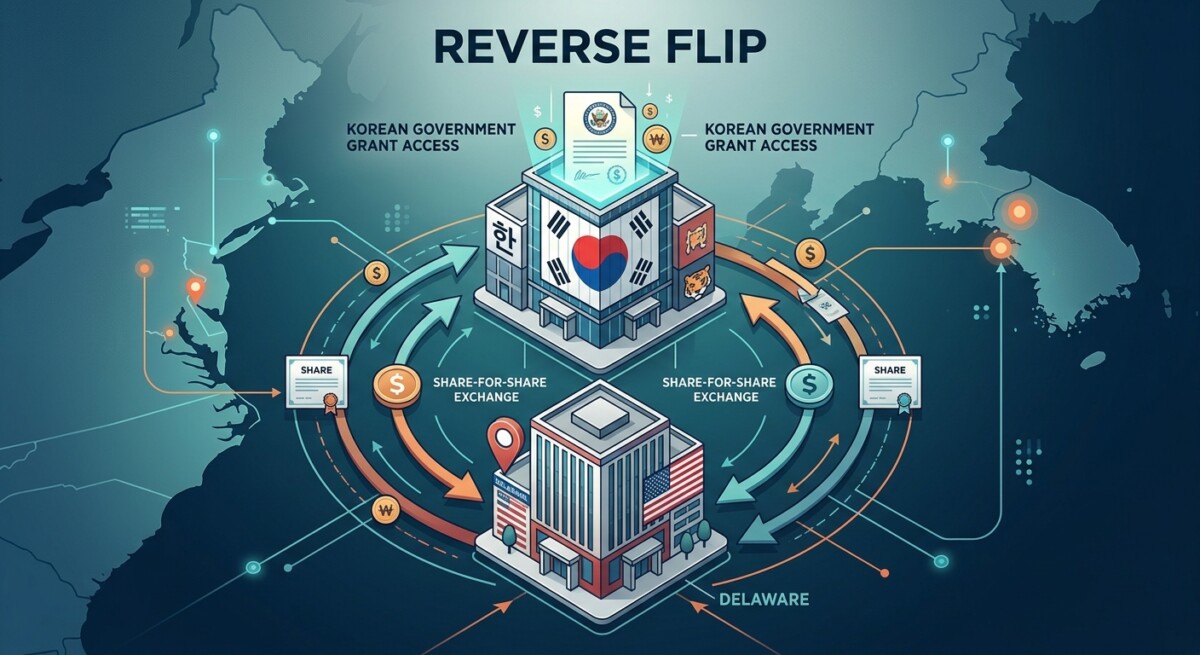
In a reverse flip, the Delaware C-Corp’s shareholders contribute their US stock to a newly formed Korean company (NewKoreaCo) in exchange for NewKoreaCo stock — turning the Delaware C-Corp into a wholly owned subsidiary of the Korean parent.
On the US side this is a share-for-share exchange that would normally qualify as a tax-free reorganization under IRC §368 or a §351 contribution. The problem is that the acquirer is a foreign corporation, which pulls the transaction into IRC §367. Section 367(a) overrides the usual non-recognition rules for US persons who transfer stock to a foreign corporation. Section 367(b) addresses the mirror-image case where a US corporation becomes the subsidiary of a foreign corporation and specific earnings and basis adjustments are required.
Treas. Reg. §1.367(a)-3 is the implementing regulation. It carves out an exception for a transfer that meets a long list of conditions, including a five-year holding requirement on the acquiring foreign stock, a basis cap, and the filing of a Gain Recognition Agreement (GRA) on Form 8838 to the IRS. Miss any one condition and the US shareholders recognize gain on the exchange as if they had sold the Delaware stock for the Korean stock’s fair market value.
What does §7874 do to a reverse flip Korea structure? ⚠️
If the former Delaware shareholders own 80% or more of the new Korean parent by vote or value right after the flip, IRC §7874 treats the Korean HoldCo as a US corporation for all federal tax purposes — so the “flip” buys the group nothing on the US side.
Section 7874 was written to stop inversions, and it does not care that the motive here is a Korean grant rather than a US tax saving. Two numbers matter:
- 80% ownership continuity: the new foreign parent is treated as a US corporation. You keep filing Form 1120, your worldwide income stays taxable, and the structure becomes a Korean-wrapper US corporation.
- 60% ownership continuity (but less than 80%): the new foreign parent is a “surrogate foreign corporation.” The former US company’s “inversion gain” is denied the use of credits and net operating losses for the ten years following the inversion.
Because an early-stage reverse flip almost always starts with the same founders holding more than 80% of the combined group — new Korean investors have not come in yet — the first bucket (full US-corporation treatment) is the realistic default unless the flip is sequenced after a dilutive Korean financing round that the IRS respects.
Will my founders lose QSBS gain exclusion in a reverse flip? 💸
Yes. IRC §1202 only applies to stock of a domestic C corporation; the moment your founders’ shares convert into Korean HoldCo stock, the five-year QSBS clock resets and the pre-flip gain window closes.
Section 1202 requires that the issuer be a domestic C corporation at every point from issuance through the shareholder’s sale. A reverse flip replaces the shareholder’s Delaware C-Corp stock with Korean company stock, which is not QSBS. For a founder who was eighteen months away from the five-year holding mark on $10 million of basis-zero QSBS, the arithmetic is a 23.8% federal gain on the next exit instead of 0%. In our practice, this single consequence is what turns most pre-seed founders away from a TIPS reverse flip once the full picture is on the whiteboard.
Is there a path to Korean TIPS without a reverse flip Korea? 🧭
For many Korean-American teams, the cleaner path is to incorporate the Korean operating company first, let it apply for TIPS directly, and only form the Delaware C-Corp later — before US investors come in — through a forward flip governed by Rev. Proc. 2003-48 style planning.
The sequencing matters because the US tax cost of putting a Korean company on top of an existing US C-Corp is dramatically higher than the US tax cost of putting a Delaware C-Corp on top of an existing Korean Ltd. A forward flip from Korea-top to US-top is governed by §367(b) and the §351 non-recognition rules, which are much more forgiving when the former shareholders of the foreign company receive stock of the new US parent. The §7874 anti-inversion rule does not run in that direction.
Where founders have already incorporated in Delaware, two interim options can preserve optionality:
- Keep the Delaware C-Corp on top and apply for a different Korean program that is not restricted to Korean-headed groups (R&D credits, local accelerators that match US-top companies).
- Delay the flip until the Korean side has raised an independent round large enough that §7874’s 80% / 60% ownership continuity test can plausibly be failed by design — and only after a full §367 model is signed off.
How does the US–Korea tax treaty interact with the flipped structure? 🌐
Once the group is Korean-top, dividends and royalties running from the Delaware subsidiary back up to the Korean parent are governed by the US–Korea Income Tax Convention, and the withholding at source steps down from the 30% statutory rate under IRC §881 to the treaty rate.
In practice this means the Delaware company deducts and withholds against each outbound dividend and files Form 1042-S with the IRS; the Korean parent collects a Form W-8BEN-E from the US side before any first payment, and the group lives with the branch profits tax under IRC §884 if any of the Delaware activity is run through a US branch rather than a subsidiary. None of this treaty mechanics applies while §7874 is treating the Korean parent as a US corporation — the IRS looks straight through it.
1. What is the current fair market value of the Delaware stock, and what is each founder’s basis? §367(a) recognition is on built-in gain; a seed-stage company with little appreciation is a very different conversation from a Series A-ready company.
2. Where is the ownership continuity line today, and where will it be after the next Korean round? If the group cannot credibly land below the §7874 80% / 60% thresholds, the Korean HoldCo buys nothing on the US side.
3. How much QSBS §1202 gain is each founder about to walk away from? On an eight-figure exit, the lost exclusion can be larger than the TIPS grant that triggered the flip in the first place.
How does keeping the US top compare side-by-side with a reverse flip? 📊
The decision is almost never between “flip” and “do not flip” in the abstract — it is between the ongoing US position of each structure for the next three to five years. The table below is the shortest version of that side-by-side.
| Item | Keep Delaware on top | Reverse flip to Korean top |
|---|---|---|
| Eligible for Korean TIPS as a group | No — operator cannot sponsor a US-parent group | Yes — Korean HoldCo can be the sponsored company |
| IRC §367(a) outbound-transfer tax | N/A | Triggered on built-in gain; exception requires GRA on Form 8838 |
| IRC §7874 anti-inversion | N/A | Likely 80%+ continuity at seed stage → Korean parent taxed as a US corporation |
| IRC §1202 QSBS gain exclusion | Available if domestic C-Corp requirements continue to be met | Lost on the exchange — Korean stock is not QSBS |
| Withholding on US → Korea dividends | N/A (no Korean parent) | US–Korea Income Tax Convention treaty rate via Form W-8BEN-E |
| Downstream US fundraising friction | Low — US VCs recognize Delaware stock | High — US VCs often require a second flip back |
What is the decision rule we use with founders? ✅
If the next round of real capital is expected from Korean investors and the TIPS grant is a meaningful share of the first twenty-four months of runway, the reverse flip can make sense — but only after a §367 and §7874 model is signed, every US shareholder files a GRA, and each founder has priced in the lost QSBS exclusion. Otherwise, keep the Delaware top and raise elsewhere.
The reason this question keeps coming back is that TIPS is loud and §1202 is quiet. Founders see the Korean grant on the news; they do not see the $2.4 million QSBS exclusion a flip quietly closes. A good decision here starts with putting both numbers on the same page.
- A Delaware-top startup cannot receive Korean TIPS directly — a Korean parent on top is required, which means a reverse flip Korea transaction.
- The flip is a §367 outbound stock transfer; the §1.367(a)-3 exception needs a Gain Recognition Agreement on Form 8838, filed by every US shareholder.
- IRC §7874 can treat the new Korean parent as a US corporation when the former Delaware shareholders own 80%+ of the combined group — common at seed stage.
- IRC §1202 QSBS treatment is lost on the exchange; the five-year clock does not carry over into Korean stock.
- The forward sequencing — Korea first, Delaware later — is usually cheaper on the US side than any post-hoc reverse flip.
Frequently asked questions ❓
Q1. Can a US-incorporated group receive TIPS by putting a Korean subsidiary under the Delaware C-Corp?
No. TIPS operators sponsor a Korean legal entity as the recipient, and the Korean HoldCo in a US-top group is a subsidiary, not the parent. The grant decision looks at who sits on top of the cap table.
Q2. Does the §367(a) gain apply even if nobody actually sold shares?
Yes. §367(a) treats the share-for-share exchange with a foreign acquirer as a taxable event unless the §1.367(a)-3 exception conditions are met and a Gain Recognition Agreement is filed. The absence of cash does not matter.
Q3. If I file the Gain Recognition Agreement and never sell within five years, is the exchange tax-free?
The GRA defers the recognition. If none of the triggering events listed in Treas. Reg. §1.367(a)-8 happen inside the five-year period and the annual certifications are filed, the deferred gain is extinguished. A disposition inside the period undoes the deferral.
Q4. Does §7874 look at voting stock or value for the 80% / 60% test?
Both. IRC §7874(a)(2)(B)(ii) applies the ownership test by vote or by value — whichever is higher. Founders who try to hit the test on votes alone with a dual-class structure usually fail on value.
Q5. Can the lost QSBS clock be restarted after a reverse flip?
No. §1202 requires continuous domestic C-Corp status at the issuer level. New QSBS shares could be issued in a future US entity, but each shareholder’s old five-year clock is lost on the exchange into Korean stock.
Q6. Does the US–Korea tax treaty reduce US withholding on the first dividend from Delaware to the Korean HoldCo?
Yes, provided the Korean parent qualifies for treaty benefits and timely delivers a Form W-8BEN-E to the Delaware subsidiary. Statutory withholding is 30% under IRC §881; the treaty rate under the US–Korea Income Tax Convention is lower.