How do I get an EIN without an SSN? (Foreign founder guide, 2026)
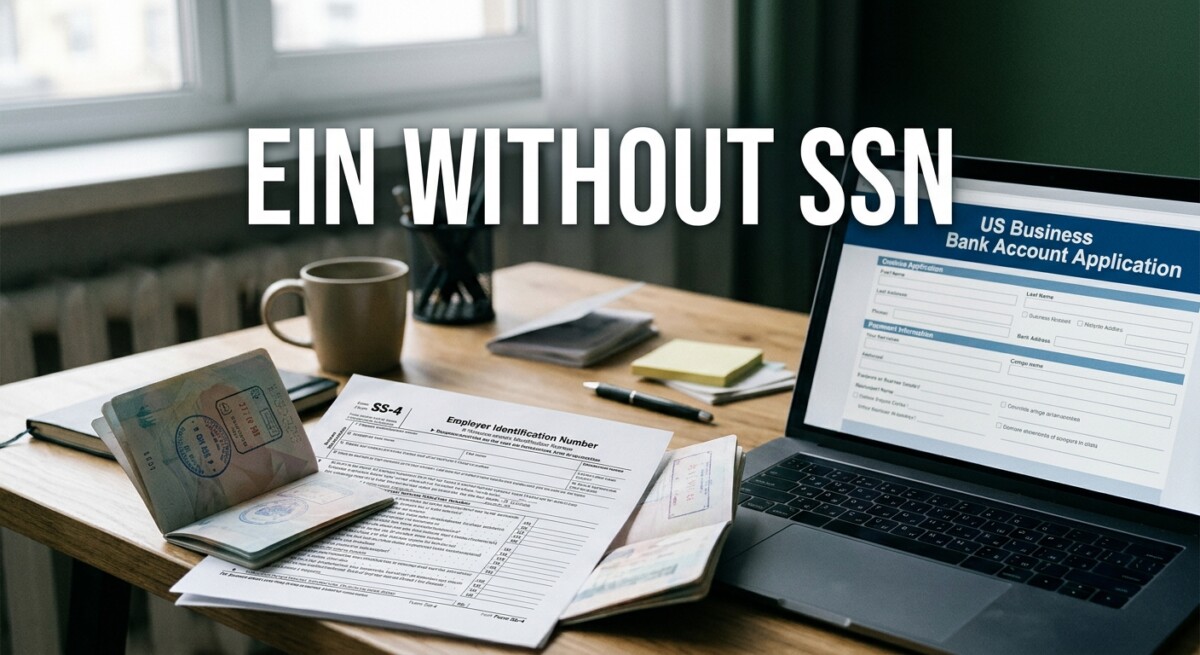
You incorporated a Delaware C-Corp or a Wyoming LLC from Seoul, paid the state fee, and now your registered agent is asking for an EIN without SSN so payroll, Stripe, and your business bank account can be set up. If you already have an Individual Taxpayer Identification Number (ITIN) you can apply online in about fifteen minutes. If you have neither an SSN nor an ITIN — the situation for almost every Korean founder who is not a US resident — the IRS online form will reject you and you have to take the paper or phone route. This guide walks through exactly what the IRS wants, which lines on Form SS-4 trip people up, and what to do the moment the CP 575 confirmation letter arrives.
The intended reader here is a Korean-American entrepreneur or a Korean parent company that has just set up a US entity. We are not writing this for accounting practitioners — we assume you have never seen an SS-4 before.
Who needs an EIN — and what does “without an SSN” mean? 🧾
Any US entity that has employees, files an excise or employment tax return, or is otherwise required to file a US federal tax return needs an EIN. In practice, every US-facing LLC or C-Corp needs one before it can open a bank account or run payroll.
The Employer Identification Number (EIN) is a nine-digit federal tax ID the Internal Revenue Service uses to identify a business, similar to how the Social Security Number identifies an individual. Per the IRS, the entity’s “responsible party” — the natural person who ultimately controls, manages, or directs the entity and the disposition of its funds and assets — must sign the application. See the IRS page Responsible Parties and Nominees for the current definition. The application asks for the responsible party’s Taxpayer Identification Number on line 7b, and this is where most of the confusion begins.
Two things about line 7b that trip founders up:
- The IRS prefers that the responsible party is a natural person with an SSN or ITIN, but does not require it. Foreign individuals with neither can write “Foreign” on line 7b and still receive an EIN.
- If your entity’s responsible party is another entity — for example, a Korean parent company that owns 100% of the new US subsidiary — the IRS wants that entity’s own EIN on line 7b. A Korean business registration number (사업자등록번호) is not accepted here.
What is the exact 2026 process to get an ein without ssn? 📮
Complete Form SS-4 in blue or black ink, sign it, and either fax it to the current numbers listed on the IRS EIN page or call the International EIN line at +1-267-941-1099 between 6 a.m. and 11 p.m. Eastern time.
The IRS publishes the current fax numbers and phone hours on Apply for an Employer Identification Number (EIN) Online. Two rules on that page catch first-time applicants:
- One EIN per responsible party per day. If you are the responsible party for two new US entities, you must apply on two separate business days.
- The online application is US-only. The online SS-4 requires the responsible party to have an SSN, ITIN, or existing EIN. From Seoul, the online path will reject you at the identity-verification step.
The paper and phone timing runs roughly as follows in our practice:
| Route | IRS fee | Typical turnaround (2026) | Written confirmation |
|---|---|---|---|
| Phone (International EIN line) | Free (own long-distance charges) | Same call — EIN issued verbally | CP 575 letter mailed within 4–5 weeks |
| Fax | Free | 4–6 business weeks | Faxed confirmation if a return-fax number is provided |
| Free | 4–8 weeks | CP 575 letter by USPS to the address on line 4 |
Turnaround times shifted from a few business days in 2019 to several weeks after pandemic-era backlogs. The IRS has not published a firm 2026 service standard for foreign SS-4 processing, so plan for the longer end. The National Taxpayer Advocate discusses paper-processing timelines each year in its Annual Reports to Congress.
Which lines on Form SS-4 trip up most foreign founders? ✍️
Lines 7a/7b, 8a–8c, and 9a are the three areas where a mistake makes the application come back rejected — and a rejected SS-4 sends you back to the multi-week queue.
The IRS overview of the form is on the page About Form SS-4, and the current instructions are at iss4.pdf. The traps we see repeatedly in our practice:
- Line 7b (Responsible party’s TIN). Write “Foreign” if the individual has neither an SSN nor an ITIN. Do not write a Korean resident registration number (주민등록번호) — the IRS system cannot validate a 13-digit foreign ID and the application will bounce.
- Line 8a (Is this application for a limited liability company?). Check “Yes” for any LLC, even a single-member LLC. Check “No” for C-Corps.
- Line 8b (Number of LLC members). For a single-member LLC owned by one non-resident individual, write “1”. Line 8c will then be “No”, and the entity is disregarded for federal income tax until it files Form 8832 to elect corporate treatment.
- Line 9a (Type of entity). A foreign-owned single-member LLC that has not elected corporate treatment should check “Other” and write “Foreign-owned U.S. DE” (disregarded entity). Checking “Corporation” here creates a taxpayer profile you cannot easily undo.
- Line 10 (Reason for applying). The most common correct answer is “Started new business” with a short description of what you sell (e.g., “SaaS payroll software”).
- Line 18 (Prior EIN). If the responsible party has ever obtained an EIN, prior EIN must be listed. This is the field the IRS uses to enforce the one-EIN-per-day rule.
How do you open a US business bank account after the EIN arrives? 🏦
A US bank or fintech will ask for the CP 575 (or a matching 147C letter), the state formation certificate, an operating agreement or bylaws, and government-issued ID for every beneficial owner holding 25% or more.
US financial institutions run a customer identification program required by 31 CFR §1020.220, the Bank Secrecy Act implementing regulation published by the Treasury Department. See the current text at the Legal Information Institute copy of 31 CFR §1020.220. Under that rule the bank cannot open the account until it has positively identified the beneficial owners. That is why “come to a branch in person” is often the fastest path with a traditional bank — and why fintechs designed for remote onboarding matter to founders who are still in Seoul.
US fintech and neobank options in 2026 typically require:
- The EIN confirmation letter (CP 575) — a fax copy is not always accepted; keep the original.
- A state formation document (Certificate of Formation, Articles of Organization) dated within the last 12 months.
- Passport-quality government ID for every beneficial owner and for the authorized signer.
- A US mailing address (not a P.O. box) — usually the registered agent’s business address.
- A short description of the business, including expected monthly transaction volume and countries you will send or receive payments from.
Fintechs such as Mercury, Brex, and Relay are private companies and are not endorsed by the IRS or the US Treasury. We list them here only because founders ask about them by name; compare terms and eligibility on each provider’s site before applying. From a tax standpoint, what matters is that the underlying deposit account sits at a US-chartered bank, so the balance is a US-situs asset and any interest is reported on Form 1099-INT to your entity’s EIN.
What compliance filings does a foreign-owned US entity still owe? 📅
Getting the EIN is the beginning, not the finish. A foreign-owned US entity has at least three annual filings independent of income: Form 5472 with a pro-forma Form 1120, the state annual report or franchise tax return, and, where applicable, the FinCEN BOI report.
A single-member LLC owned by a non-resident individual has an unusual filing pattern that surprises Korean founders in year one:
- Form 5472 with a pro-forma Form 1120. Even though the LLC is disregarded for federal income tax, the regulations at Treas. Reg. §1.6038A-1 (and the underlying statute at 26 U.S.C. §6038A) require the entity to file Form 5472 to report reportable transactions with the foreign owner. The IRS overview is on the About Form 5472 page. The base penalty for failure to file is $25,000 per form.
- State annual report or franchise tax. Delaware franchise tax is due March 1 for LLCs ($300 flat) and March 1 for corporations (variable — the “assumed par value capital” method usually beats the “authorized shares” method if you have many authorized shares). Wyoming’s annual report fee is a minimum of $60. California charges an $800 minimum franchise tax on any LLC or corporation registered there, regardless of income. Confirm the current fees directly on your state’s Secretary of State or franchise tax board site.
- FinCEN BOI report. As noted in the warning box above, foreign entities that register in a US state remain subject to BOI under FinCEN’s current rule.
- Owner-side FBAR (if applicable). If the responsible party is a US person and the US entity ends up with signature authority over foreign accounts, FBAR reporting sits at the owner level. See the FinCEN FBAR overview.
The IRS communicates by US mail. Foreign founders regularly miss deficiency notices because their registered agent forwards mail slowly. In our practice we require every foreign-owned entity we take on to designate a US Third Party Designee on Form SS-4 line 15 — usually the CPA firm — so that a duplicate copy of every IRS notice reaches a professional who reads it within 48 hours.
Key takeaways for foreign founders
- Get an EIN without SSN by filing SS-4 by fax or by calling +1-267-941-1099. The online form will reject you.
- Write “Foreign” on line 7b if the responsible party has no SSN or ITIN — never write a Korean resident registration number.
- Choose line 9a carefully. “Corporation” and “Foreign-owned U.S. DE” have very different lifetime consequences.
- Plan on 4–8 weeks from a signed SS-4 to a working US business bank account.
- Form 5472, state franchise tax, and FinCEN BOI each fire on their own calendar — set reminders on the day the EIN arrives.
FAQ
Q1. Can a filing service sign SS-4 on my behalf?
Only if the person signing is an authorized officer, partner, or LLC member of the entity. A pure filing service is not a “responsible party” under the IRS definition and cannot sign the taxpayer declaration line.
Q2. Does the IRS ever email an EIN?
No. The IRS does not send EIN confirmations by email. An emailed “CP 575” is a scam. See the IRS Tax Scams / Consumer Alerts page.
Q3. What if I already applied and never received the CP 575?
Call the Business & Specialty Tax Line at +1-800-829-4933 (US) or the International EIN line at +1-267-941-1099 and request a 147C letter. This is the IRS duplicate confirmation of the assigned EIN, and banks accept it in place of the original CP 575.
Q4. Does the responsible party have to be a US person?
No. Since the IRS clarified the definition in 2018 the responsible party must be a natural person who ultimately controls the entity; nationality is irrelevant to eligibility. That said, having a US-resident officer often smooths the bank account step because the bank’s KYC officer can meet them.
Q5. Do I need an ITIN before I apply for the EIN?
No. An ITIN is an individual-level TIN used for personal filings (Form 1040-NR, treaty claims, etc.). The EIN is entity-level. Many foreign founders never obtain an ITIN because they never file a personal US return. Get the EIN first and decide on the ITIN once you know whether you will have US-source income in your own name.