IFRS 15 vs ASC 606: Where does revenue still diverge?
The joint issuance of IFRS 15 Revenue from Contracts with Customers by the IASB and FASB Topic 606 by the FASB was supposed to end the story on revenue. For most transactions it did. For dual reporters and for anyone benchmarking a US filer against an IFRS filer, the story is not over. The five-step model is the same. The wording around each step is not, and the elections available under one framework are not always available under the other. IFRS 15 vs ASC 606 comparisons matter most at three moments: writing a new contract, closing the books each quarter, and preparing consolidation entries for a group that reports in both frameworks. This post walks through where the two standards genuinely diverge, why the divergence matters in a real ledger, and how a Los Angeles CPA firm approaches the reconciliation at year-end.
Why does IFRS 15 vs ASC 606 still matter for dual reporters? 🌐
Because differences in collectibility, scope, licenses, and disclosures change when revenue is recognized and how much of it flows through the income statement in a given period — even for two entities selling the same product on the same day.
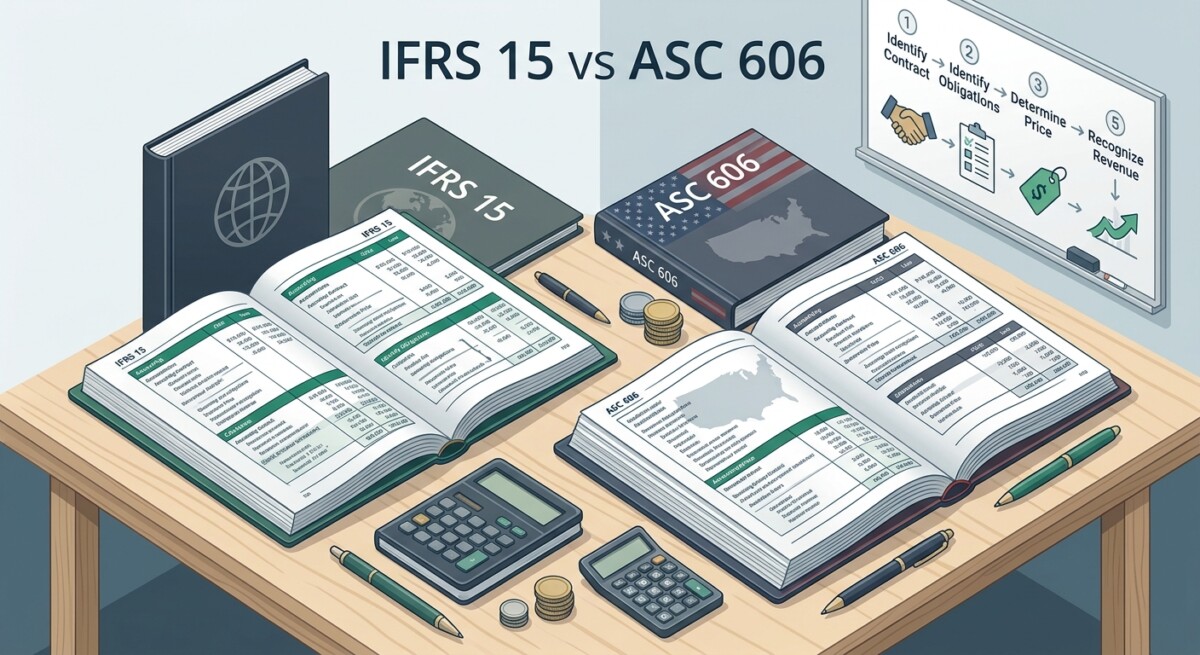
The IASB issued IFRS 15 and the FASB issued ASC Topic 606 as substantially converged standards, both effective for annual periods beginning on or after 1 January 2018 for public entities. Convergence at the model level is real: the five-step framework — identify the contract, identify the performance obligations, determine the transaction price, allocate the transaction price, recognize revenue when a performance obligation is satisfied — is worded almost identically in both standards. Convergence at the paragraph level is not. A dozen years of amendments, policy elections, and scoping decisions have opened seams that dual reporters have to reconcile every quarter.
Three categories of user feel this most directly: multinational groups that consolidate US subsidiaries into an IFRS parent (or the reverse), foreign private issuers that file in the US, and equity analysts building peer comparables across the same industry in both frameworks. For each of them, a difference in the transaction price or the timing of a performance obligation translates into a difference in reported revenue, gross margin, and the pattern of deferred revenue on the balance sheet.
What are the collectibility and scope differences between IFRS 15 vs ASC 606? 🎯
IFRS 15 uses a lower collectibility threshold to admit a contract into the revenue model, and its scope exceptions differ from ASC 606 in insurance, credit-card fees, and loyalty programs.
Step 1 of both models asks whether it is probable that the entity will collect the consideration to which it will be entitled. The word is the same; the meaning is not. Under IFRS 15, probable means more likely than not — greater than 50%. Under ASC 606, probable is the US GAAP threshold generally understood as approximately 75–80% or higher, and the entity must expect to collect substantially all of the consideration. A customer with a weakened credit profile, or a contract with extended payment terms, can clear the IFRS 15 hurdle and fail the ASC 606 hurdle. When the ASC 606 threshold is not met, consideration received cannot yet be recognized as revenue; the payment sits on the balance sheet as a deposit-like liability until the collectibility criteria are met, the contract is terminated, or the consideration is nonrefundable and the entity has no remaining performance obligation.
Scope also splits. IFRS 15 excludes insurance contracts within the scope of IFRS 17 Insurance Contracts, regardless of the type of entity that issues them, and has no specific guidance on credit-card fees and loyalty programs — the general IFRS 15 principles apply. ASC 606 excludes contracts issued by insurance companies within ASC Topic 944, and has specific US GAAP guidance for credit-card fees that entitle the cardholder to use the credit card; that guidance keeps the fees, and the goods and services covered by them, outside of ASC 606. Loyalty programs tied to credit cards may also fall outside ASC 606 on the facts. A transaction in the scope of IFRS 15 will not always be in the scope of ASC 606, which matters most for financial-services groups and any entity that bundles credit or insurance features into a customer offering.
| Topic | IFRS 15 | ASC Topic 606 |
|---|---|---|
| Collectibility (‘probable’) | > 50% (more likely than not) | ≈ 75–80% or higher; ‘substantially all’ of the consideration |
| Insurance contracts | Excluded under IFRS 17 for any issuer | Excluded under Topic 944 only for insurance companies |
| Credit-card fees | No specific guidance; general IFRS 15 applies | Specific US GAAP guidance scopes them out |
| Shipping and handling after transfer of control | Assess whether distinct; if distinct, separate performance obligation | Policy election: treat as a fulfillment activity, all revenue at transfer of control |
| Sales and similar taxes | Included in transaction price if the entity is primarily obligated | Policy election to exclude all such taxes from the transaction price |
In our practice: collectibility is where dual-reporter surprises begin
When a US subsidiary onboards a customer with a marginal credit score, the IFRS parent often books revenue that the US ledger will not. The reverse is rarer but just as jarring at consolidation. The fix is not a workaround; it is a documented policy at contract inception that describes what the credit assessment shows and which framework thresholds it clears. Trying to reconcile this at year-end without that memo turns a five-minute conversation into a week of contract re-reads.
How do licenses, taxes, and noncash consideration create IFRS 15 vs ASC 606 gaps? 📜
Licenses of intellectual property, sales-tax presentation, noncash consideration, and equity-based instruments granted to customers each have specific ASC 606 rules that IFRS 15 does not mirror, and the differences change the transaction price and the timing of revenue.
For licenses of intellectual property, ASC 606 requires the entity to classify the underlying IP as either functional (conveying a right to use the IP as it exists at the point in time the license is granted) or symbolic (conveying a right to access the IP over the license period). That classification drives point-in-time versus over-time recognition. IFRS 15 uses different criteria — over-time recognition is permitted only when specific conditions are met, and IFRS 15 does not draw the functional/symbolic distinction. Outcomes often converge for straightforward software or media licenses; they diverge for licenses with usage restrictions, renewal options, or bundled services. IFRS 15 also does not address the distinction between an additional license and a mere attribute of an existing license, so IFRS reporters exercise judgment where US filers apply a bright-line rule.
Sales-tax presentation is a policy election under ASC 606: an entity may exclude from the transaction price all taxes assessed by a governmental authority that are both imposed on and concurrent with the specific revenue-producing transaction. IFRS 15 has no such election. Whether sales, use, value-added, or excise taxes flow through revenue under IFRS 15 depends on a substantive analysis of whether the entity is primarily obligated for the tax under local law or is merely acting as a collecting agent. For the same underlying transaction, an IFRS reporter can show taxes inside the transaction price while a US reporter has elected them out — a difference in top-line revenue that is invisible below the line.
Noncash consideration and equity-based instruments granted to customers are two more specific fault lines. ASC 606 requires noncash consideration to be measured at fair value at contract inception and provides guidance for consideration whose fair value varies for both form-related and other reasons; the variable-consideration constraint applies only to the non-form-related variability. IFRS 15 requires fair value measurement but does not specify the measurement date — the entity applies judgment. For equity-based instruments granted to a customer alongside a sale of goods or services, ASC 606 sends the analysis to ASC Topic 718 (share-based payment), with the grant-date fair value ultimately recorded as a reduction of revenue when it is a reduction of the transaction price; subsequent remeasurement of a liability-classified award is recorded elsewhere in income. IFRS 15 has no specific guidance on these instruments — the entity applies the noncash-consideration and consideration-payable provisions in IFRS 15, and then the relevant financial-instruments standard (for example, IFRS 9) for subsequent measurement.
What about contract costs and onerous contracts under IFRS 15 vs ASC 606? 📉
Both standards capitalize incremental costs to obtain and costs to fulfill a customer contract, but the impairment rules and the treatment of onerous contracts differ in ways that affect gross margin.
ASC Topic 340-40 and IFRS 15 both provide guidance on capitalizing incremental costs to obtain a contract and costs to fulfill a contract that meet specified criteria, unless those costs fall under another standard (for example, inventory). US GAAP retained legacy cost guidance after the adoption of ASC 606 — including pre-production costs and hook-up costs for cable companies — which can create differences in accounting for similar costs under IFRS 15. Both frameworks require the resulting contract cost asset to be tested for impairment. IFRS 15 allows the impairment loss to be reversed when the conditions that caused the impairment improve, capped at the amortized carrying amount that would have existed with no impairment. US GAAP does not permit that reversal. For long-running professional-services contracts and multi-year subscription arrangements, that single rule can meaningfully change the gross-margin pattern reported under IFRS 15 versus ASC 606.
There is no onerous customer contract concept under ASC 606
Under IAS 37 Provisions, Contingent Liabilities and Contingent Assets, IFRS reporters recognize a provision for an onerous customer contract when the unavoidable costs of fulfilling the contract exceed the expected economic benefits, measured at the lesser of the cost to fulfill and the cost to exit. Unavoidable costs include both incremental costs and directly-related allocated costs such as depreciation. US GAAP has no comparable general concept for customer contracts — losses may be captured under narrower guidance for specific contract types. A dual reporter that has already recognized an onerous-contract provision under IFRS should not assume that a matching liability shows up under US GAAP.
How do IFRS 15 vs ASC 606 disclosures differ? 📊
IFRS 15 applies one disclosure standard to all IFRS reporters, while ASC 606 permits simplified disclosure for nonpublic entities and requires more extensive interim disclosures for public business entities.
Under IFRS 15, disclosure requirements — including the transaction price allocated to remaining performance obligations, subject to practical expedients such as a one-year contract term or a right-to-invoice practical expedient — apply equally to all reporters. Interim disclosure under IFRS is narrower: information about disaggregated revenue and its relationship with segment revenue, without the fuller contract-balance and remaining-performance-obligation disclosures. ASC 606 permits nonpublic entities to provide simplified disclosures compared to public business entities, includes additional optional exemptions for the remaining-performance-obligation disclosure (for example, sales- or usage-based royalties from licenses of IP), and requires public business entities to disclose contract balances and performance obligations at each interim period, similar to the annual disclosures.
For a group that reports quarterly in the US and semi-annually in an IFRS jurisdiction, the practical consequence is that the US interim filings will always contain more revenue-recognition detail than the IFRS interim filings, even when the underlying contracts have not changed. The disclosures do not diverge because the accounting diverges — they diverge because the standards themselves ask for different levels of interim detail.
| Disclosure area | IFRS 15 | ASC Topic 606 |
|---|---|---|
| Applicability of full disclosure package | All IFRS reporters | Simplified path available for nonpublic entities |
| Interim disclosures | Disaggregated revenue and segment relationship only | Public business entities: extensive contract balance and RPO disclosures |
| Remaining performance obligation exemptions | Contract term ≤ 1 year; right-to-invoice practical expedient | Same, plus specific exemptions (e.g. certain royalties from IP licenses) |
| Contract cost asset — impairment reversal | Permitted under IFRS 15 | Prohibited under ASC 340-40 |
| Onerous customer contracts | IAS 37 provision recognized | No general onerous-contract concept under US GAAP |
How should CPAs approach IFRS 15 vs ASC 606 at year-end close? 🧾
Identify the differences by contract type at inception, keep a policy memo that lists each ASC 606 election and its IFRS 15 counterpart, and reconcile the effect on revenue, contract-cost assets, and onerous-contract provisions each period.
- Map the contract portfolio to the difference list. Not every customer contract triggers an IFRS 15 vs ASC 606 issue. Long-term service contracts, IP licenses, arrangements with material variable consideration, and contracts with elevated credit risk are the ones that usually do.
- Write the ASC 606 elections down, once. Shipping and handling as a fulfillment activity, exclusion of sales and similar taxes from the transaction price, the portfolio approach, and the incremental cost practical expedient are all election-driven. A one-page memo that records the elections, the reasoning, and the date each was adopted is the fastest audit trail we know.
- Reconcile the collectibility calls. For each new customer that fell close to the credit threshold, note whether the contract cleared the ASC 606 hurdle. This is the single most common source of a US-vs-IFRS revenue timing gap in our practice.
- Track contract-cost assets separately. The impairment reversal under IFRS 15 will not exist under ASC 340-40, so the carrying amounts diverge over time. Keep the reversal history as its own reconciling item.
- Review onerous contracts under IAS 37. Contracts with committed costs that now exceed expected benefits need an IFRS provision; the equivalent US GAAP entry may not exist. Consolidation entries and note disclosures both change as a result.
- Disclose new IFRSs in issue but not yet effective. IAS 8 requires this in the period the entity applies the new standard. Building the tracking into the year-end checklist avoids a scramble in the following period.
From our practice: reconciliation, not translation
The best-run dual-reporter closes we see treat IFRS 15 vs ASC 606 as an ongoing reconciliation exercise, not a year-end translation. Contracts are tagged when signed, elections are recorded when made, and the differences are quantified each quarter. When an SEC comment or an auditor inquiry lands, the working paper is already there. The alternative — reconstructing the reasoning from contracts and emails after the fact — is where the days disappear.
Summary: IFRS 15 vs ASC 606 differences that still matter
- IFRS 15 uses a lower collectibility threshold than ASC 606 — a customer that clears IFRS may fail US GAAP.
- ASC 606 gives US filers policy elections (shipping and handling as fulfillment; excluding sales-type taxes from the transaction price) that IFRS 15 does not offer.
- Licenses of intellectual property, noncash consideration, and equity-based instruments granted to customers each have specific ASC 606 rules that IFRS 15 does not mirror.
- IFRS 15 permits reversal of impairment on contract cost assets; ASC 340-40 does not.
- IAS 37 requires an onerous customer-contract provision under IFRS; US GAAP has no equivalent general concept.
- IFRS 15 interim disclosures are narrower; ASC 606 requires extensive contract-balance and remaining-performance-obligation disclosures for public business entities.
Frequently asked questions about IFRS 15 vs ASC 606 ❓
Q. What is the core principle of IFRS 15 and ASC 606?
Both standards recognize revenue when a company transfers control of promised goods or services to a customer, in an amount that reflects the consideration the company expects to be entitled to. Both use the same five-step model: identify the contract, identify the performance obligations, determine the transaction price, allocate the price to the obligations, and recognize revenue as each obligation is satisfied. IFRS 15 is issued by the IASB; ASC 606 is issued by the FASB.
Q. If IFRS 15 and ASC 606 use the same five-step model, why do differences still matter?
Because the details around each step differ, and small definitional differences change when and how much revenue is booked. Examples include a lower collectibility threshold under IFRS 15 (probable = greater than 50%) versus ASC 606 (probable = highly likely, generally understood as 75–80%), an ASC 606 policy election for shipping and handling as a fulfillment activity, an ASC 606 election to exclude sales taxes from the transaction price, and different rules on licenses of intellectual property, noncash consideration, and equity-based instruments granted to customers.
Q. Are there onerous contract provisions under ASC 606?
No. There is no general onerous-contract concept under US GAAP for customer contracts. Under IFRS, IAS 37 requires a provision for an onerous customer contract when the unavoidable costs of fulfilling the contract exceed the expected economic benefits. Dual reporters can therefore recognize a provision under IFRS while showing no equivalent liability under US GAAP.
Q. Can contract cost assets be impaired and later reversed under IFRS 15 vs ASC 606?
Both frameworks require an impairment assessment of the asset recognized for costs incurred to obtain or fulfill a customer contract. IFRS 15 permits a reversal of the impairment loss when the conditions that caused the impairment improve, up to the carrying amount that would have existed net of amortization if no impairment had been recognized. US GAAP (ASC Topic 340-40) does not permit reversal of a previously recognized impairment loss on those contract cost assets.
Q. Are collectibility criteria really different for IFRS 15 vs ASC 606?
Yes. Under IFRS 15, probable means more likely than not (greater than 50%). Under ASC 606, probable is a higher bar generally understood in practice as 75–80% or higher, and the assessment specifically asks whether the company will collect substantially all of the consideration to which it is entitled. A customer credit profile that clears the IFRS 15 threshold can fail the ASC 606 threshold, delaying revenue and forcing the company to recognize consideration received as a liability until the threshold is met.
Q. How should a dual reporter document the IFRS 15 vs ASC 606 differences?
Identify the differences by contract type at inception, keep a policy memo that lists each elected option under ASC 606 (shipping and handling, sales taxes, portfolio approach, incremental cost practical expedient) and the reasoning under IFRS 15, and reconcile the resulting revenue, contract-cost asset, and onerous-contract provision figures between the two ledgers each period. Under IAS 8, disclose the effect of any new IFRSs in issue but not yet effective in the period they are applied.
This article is general information about the standards issued by the IASB and the FASB. It is not accounting or legal advice for your specific situation. Reporting choices turn on facts, the terms of individual contracts, and the elections a company has made. Contact SW Accounting & Consulting Corp for a confidential review of a specific revenue-recognition question.