
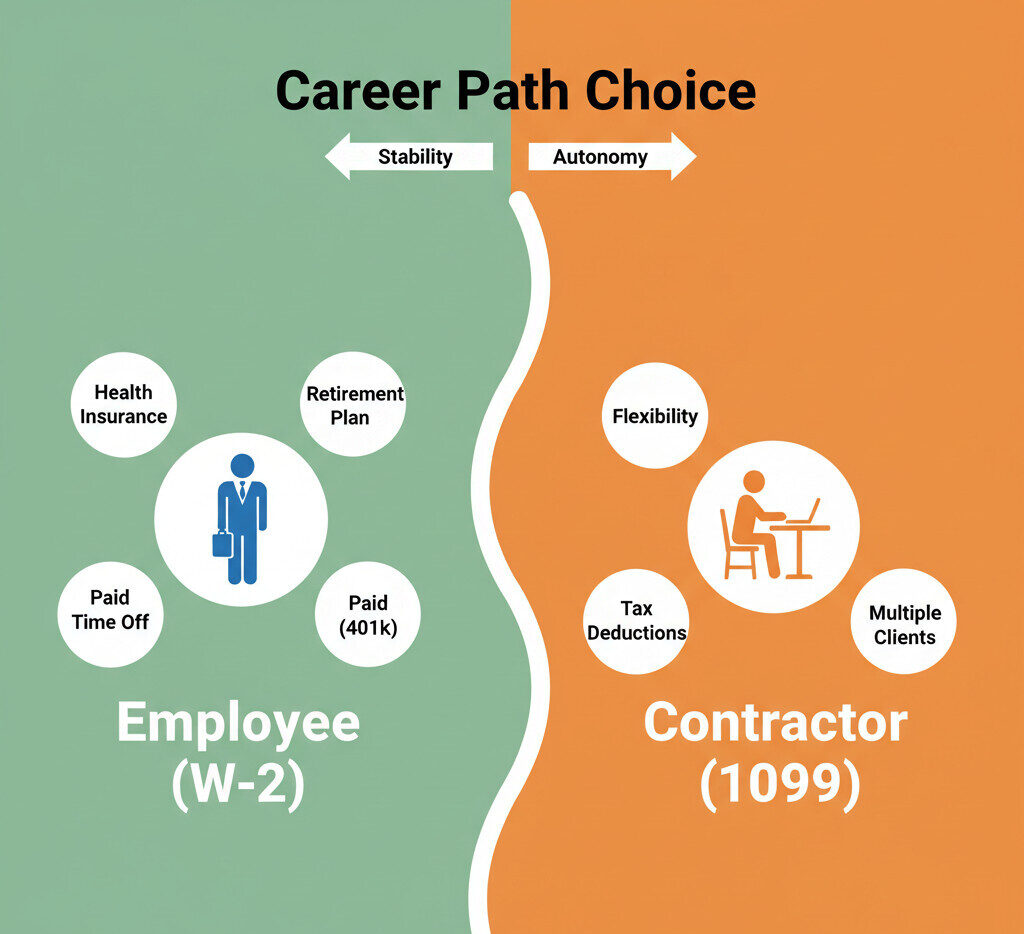
Employee vs Independent Contractor: The 3-Part Test Every Business Owner Must Know
Have you ever been in this situation? You’re a small business owner ready to hire someone, and they ask, “Can you make me an independent contractor instead of an employee?” It’s a common scenario, but it can be confusing. Usually, we hear about employers *preferring* contractor status to save on costs, and workers wanting the security of being an employee. So when the tables are turned, it can feel like a red flag. Is it okay to agree? What’s the risk? This is a classic, complex issue, but don’t worry, we’re going to clear it up! 😊
Why This Distinction is So Important 🤔
First, let’s understand the stakes. The line between an employee and an independent contractor (IC) is a bright one, legally speaking. Misclassifying a worker can lead to significant penalties, back taxes, and lawsuits. Here’s why each party usually has a preference.
Why Employers Often Prefer Independent Contractors
From a business owner’s perspective, classifying a worker as an IC is often preferred for purely financial and administrative reasons. The list of responsibilities you *avoid* is long:
- Taxes: You don’t have to pay the employer’s half of Social Security and Medicare taxes (7.65% of their wages). This is a major cost saving.
- Insurance: You generally aren’t required to provide workers’ compensation insurance for ICs.
- Wage & Hour Laws: Rules about minimum wage, overtime pay, and mandatory meal/rest breaks typically don’t apply.
- Expense Reimbursement: You’re not typically required to reimburse business-related expenses.
- Labor Laws: You have much less exposure to labor law claims, like wrongful termination.
Why Workers Usually Prefer Being Employees
For workers, the benefits are essentially the mirror opposite. They *get* all the protections and benefits the employer saves on. They receive workers’ comp coverage, are guaranteed minimum wage and overtime, get paid breaks, and their employer pays half of their payroll taxes. Plus, labor departments are often seen as being “employee-friendly,” offering a stronger safety net if disputes arise.
So, Why Would a Worker *Want* to Be a Contractor? 📊
This brings us back to the original question. If employee status is so great, why would someone ask to be an IC? It usually comes down to two things: taxes and flexibility.
The single biggest reason is the potential for **aggressive tax deductions**. We’ve all heard the term “glass wallet” for regular employees—it’s hard to deduct expenses, and most of your income is taxed.
An independent contractor, on the other hand, is legally a sole proprietor—a business of one. This status “opens up the breathing room” for tax planning. They can deduct a wide range of business expenses that an employee cannot, such as:
- A portion of their rent/mortgage via the **home office deduction**.
- Business-related vehicle mileage, software, supplies, and equipment.
- Portions of their phone and internet bills.
Another key benefit for ICs is **flexibility**. They might already have a full-time job and need a flexible arrangement for this “side work” that doesn’t conflict. Or, they may value the freedom to set their own hours and work location, which is a hallmark of the IC relationship.
The 3-Part Legal Test: How to Tell the Difference ⚖️
Here’s the most important part: It doesn’t matter what you *call* the person or what your *contract says* if it doesn’t match reality. The IRS and labor departments use a set of tests to determine the worker’s true status. While specifics vary, they generally look at three main categories.
| Category | Looks like an EMPLOYEE (High Control) | Looks like a CONTRACTOR (Low Control) |
|---|---|---|
| 1. Behavioral Control | Company provides detailed instructions, training, and supervision. Sets specific hours and work location. Provides tools and equipment. | Worker has freedom in *how*, *when*, and *where* they work. Uses their own tools. Is not trained or supervised. |
| 2. Financial Control | Paid a regular wage (hourly, salary) on a set schedule. Receives benefits like health insurance. Business reimburses expenses. | Paid a flat fee per project. Submits invoices for payment. Covers their own business expenses and benefits. |
| 3. Type of Relationship | Work is a *key part* of the company’s core business. The relationship is ongoing and permanent. Worker cannot work for others (exclusive). | Work is temporary or project-based. It’s an auxiliary function (e.g., a plumber for a law firm). Worker is free to have other clients. |
How to Protect Your Business: Practical Steps 👩💼👨💻
Okay, so how do you minimize your risk as a business owner? Just wanting someone to be an IC isn’t enough. You need to structure the relationship correctly from the start.
Be extremely cautious about reclassifying a current employee as an IC. This is a major red flag for auditors unless their job duties and level of control change *dramatically*. Also, avoid hiring ICs to perform the core function of your business (e.g., hiring an “IC” writer for your writing agency).
Here are the most important actions you can take:
- Use a Solid Contract: This is non-negotiable. Have a lawyer draft a proper “Independent Contractor Agreement” or “Service Agreement” that clearly defines the relationship.
- Define the Scope: The contract should be “by the project,” with a defined scope and end date, not an ongoing, indefinite role.
- Pay by the Project: Do not pay an hourly wage or a weekly salary. Pay a flat fee for the completed project, based on an invoice they send you.
- Enforce Boundaries: The worker *must* use their own tools, work from their own location, and set their own hours. Do not provide them with a company laptop, office, or detailed “how-to” training.
- Document Everything: The contract is just Step 1. Your *actual practice* must match the contract. Keep records of invoices, project milestones, and communications that show you are *not* controlling them like an employee.
A Final Thought: The “Hidden” Upside for Workers 🧮
While the employee safety net is valuable, don’t overlook the powerful financial tools available to independent contractors. For workers who are disciplined and good at planning, the IC route can be very strategic.
💡 Advanced Planning for Independent Contractors
As a business owner, an IC has access to powerful tax and retirement planning strategies unavailable to W-2 employees:
- Aggressive Deductions: As mentioned, writing off legitimate business expenses (home office, car, supplies) can significantly lower taxable income.
- Hiring Family: An IC can (legitimately) hire their family members for business tasks, which can be an effective tax planning tool.
- Superior Retirement Plans: This is a big one. An IC can set up their *own* retirement plans, like a SEP IRA or a Solo 401(k), and contribute far more tax-deferred money than a standard IRA allows.
Conclusion: Key Summary 📝
The “Employee vs. Independent Contractor” question isn’t just paperwork—it’s a fundamental legal and financial distinction. There’s no single, easy answer. The “right” classification depends entirely on the *level of control* you have over the worker’s behavior, finances, and the nature of your relationship.
For business owners, the key is to be honest about the relationship. If you need to control the “how,” “when,” and “where,” they are an employee. If you’re just buying a “what” (a finished project), they are likely a contractor. No matter what, get a strong contract and make sure your daily practices match it.
Contractor vs. Employee Summary
Frequently Asked Questions ❓
This is a complex area of law, and the rules can vary by state (with states like California having even stricter tests). This post is for informational purposes only. If you have any doubts, I strongly recommend consulting with a business attorney or a tax professional to review your specific situation. If you have any other questions, feel free to ask in the comments~ 😊