No Tax on Overtime: OBBBA Overtime and Tips Tax Deduction Guide 2025-2028
If you or your employees received overtime pay or tips in 2025, there is a powerful new federal tax break you need to understand. The overtime tax deduction — created under the One, Big, Beautiful Bill Act (OBBBA) — allows qualifying workers to subtract a portion of their overtime and tip income directly from federal taxable income. But the rules are more nuanced than most headlines suggest, especially for California businesses where state overtime laws differ sharply from federal FLSA standards.
At SW Accounting & Consulting Corp, our Los Angeles CPA team has been closely analyzing the IRS guidance and advising clients on how to properly apply — and track — these new deductions. This comprehensive guide walks you through everything: eligibility, calculation, payroll system setup, and the California trap that catches most employers off guard.
What Is the OBBBA Overtime Tax Deduction and Who Qualifies? 💼
The overtime tax deduction under OBBBA allows individual taxpayers to deduct up to $12,500 ($25,000 married filing jointly) of qualifying overtime compensation from federal taxable income for tax years 2025 through 2028.
Here is the critical definition: only overtime pay that is required under the Fair Labor Standards Act (FLSA) counts as “qualified overtime.” The FLSA mandates overtime pay (at 1.5× the regular rate) only when an employee works more than 40 hours in a single workweek. Overtime paid beyond what FLSA requires — including overtime mandated by a collective bargaining agreement, a state law, or company policy — does not qualify for the federal deduction.
Furthermore, the deduction applies only to the premium portion of overtime — the extra 0.5× premium above the regular rate. If an employee earns $20/hour and receives $30/hour for FLSA overtime, only the $10/hour premium is deductible. The base $20 straight-time rate is not.
Income phase-out thresholds: The deduction begins phasing out when modified adjusted gross income (MAGI) exceeds $150,000 (single filers) or $300,000 (married filing jointly).
In our practice, we are seeing significant confusion among restaurant and retail clients in California. Many assumed all overtime on their payroll reports qualifies for this deduction. Under OBBBA, only FLSA-triggered overtime (weekly 40+ hours) counts. California’s daily overtime (8+ hours per day) does not qualify unless the employee also exceeded 40 hours total that week. This distinction can drastically reduce the actual deductible amount.
What About the “No Tax on Tips” Deduction? 🍽️
Workers in qualifying tip industries can deduct up to $25,000 of “qualified tips” from their federal income — but mandatory service charges do not count, no matter how large.
The OBBBA also introduced a “no tax on tips” deduction for individuals in industries where tips are “customarily and regularly” received. Qualifying sectors include:
- Hospitality and food service (restaurants, cafes, bars, hotels)
- Gambling establishments
- Grooming and personal services (hair salons, barbers, nail salons, spas)
- Other service sectors where tipping is customary per IRS guidance
Critical exclusion: Mandatory service charges automatically added to a bill — such as the automatic 18% or 20% gratuity added for large parties at many restaurants — are NOT treated as qualified tips. These charges flow through as employer revenue and wages, not as voluntary tips. Only genuine voluntary tips from customers qualify for the deduction.
The $25,000 tip deduction limit applies per individual filer. The same income phase-out thresholds ($150,000 single / $300,000 joint MAGI) apply here as well.
How Does California’s Overtime Law Create a Special Problem? 🌴
California requires overtime pay for daily hours over 8 and on the 7th consecutive workday — but none of this California-specific overtime qualifies for the federal OBBBA deduction unless it also triggers FLSA’s 40-hour weekly threshold.
This is the hidden trap for California employers and employees. The federal deduction is built around FLSA only. California layered its own more protective overtime rules on top, but federal tax law does not recognize those additional protections for deduction purposes.
Consider a restaurant employee who works 10 hours per day for 3 days and then is off the rest of the week — totaling 30 hours. Under California law, the employer must pay overtime for the hours beyond 8 each day (6 hours total at 1.5×). But because the employee never worked more than 40 hours in the workweek, FLSA does not require any overtime. Therefore, none of that overtime premium is deductible under OBBBA.
| Work Schedule | CA OT Required? | FLSA OT Triggered? | OBBBA Deductible? |
|---|---|---|---|
| 10 hrs/day × 3 days = 30 hrs/wk | Yes (daily 8+ rule) | No | NO |
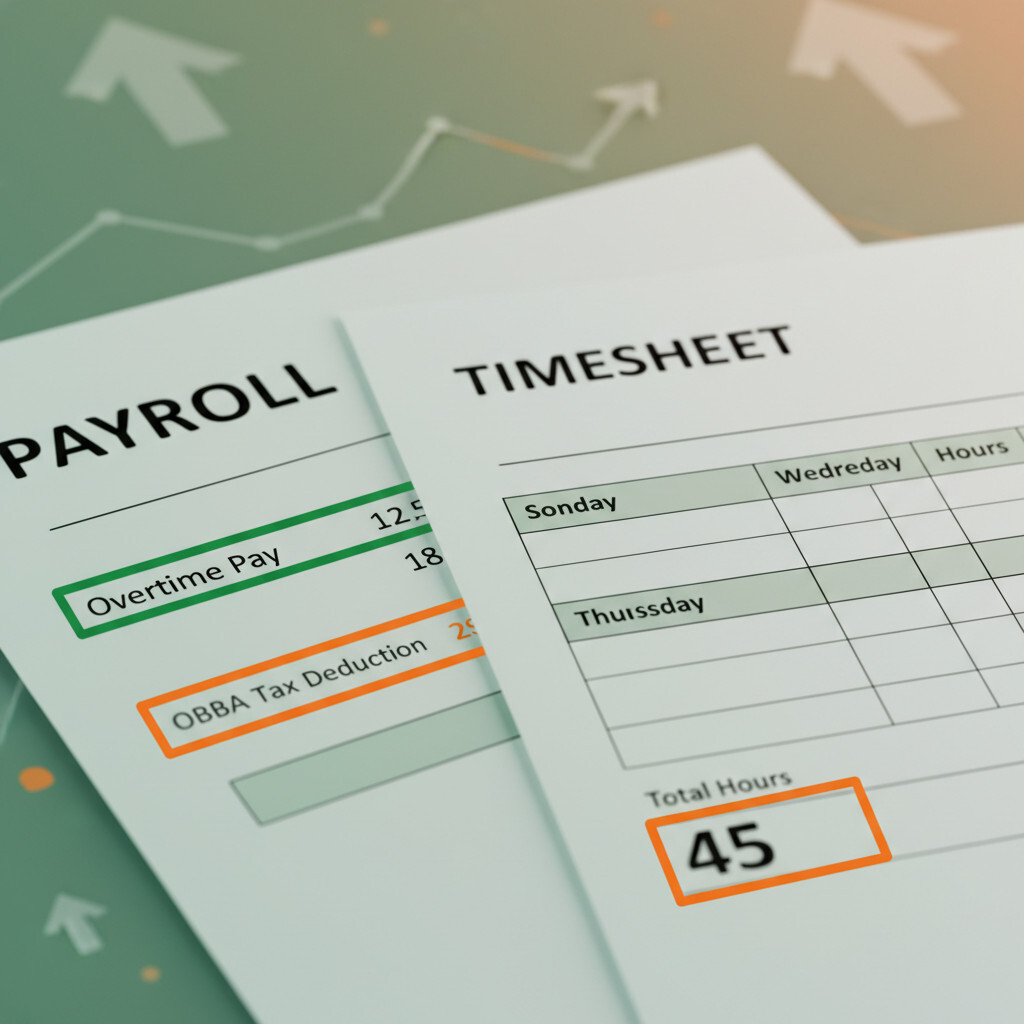
| 9 hrs/day × 5 days = 45 hrs/wk | Yes | Yes (5 hrs over 40) | YES (5 hrs premium) |
| 8 hrs/day × 6 days = 48 hrs/wk | Yes (6th/7th day) | Yes (8 hrs over 40) | YES (8 hrs premium) |
Payroll platforms like Gusto, ADP, and Paychex often aggregate all overtime as a single line item labeled “Overtime.” For OBBBA compliance, you must configure your payroll system to separately track and code: (1) FLSA overtime — weekly 40+ hours, deductible under OBBBA; and (2) California-only overtime — daily 8+ hours, 7th day rules, NOT deductible. Failure to segregate these in 2025 will create serious problems when preparing 2025 and 2026 Form W-2s.
What Are the New W-2 Reporting Requirements Starting in 2026? 📋
Beginning with tax year 2026, employers must report qualifying deductible overtime and tip amounts in new dedicated boxes on Form W-2. Tax year 2025 had a special transition grace period.
The IRS confirmed that the 2025 Form W-2 did not yet contain the new reporting boxes for OBBBA-deductible overtime and tips. The IRS issued the following transitional guidance for 2025:
- Employers were encouraged (but not required) to voluntarily report qualifying amounts in Box 14 of the 2025 W-2
- Employers could alternatively provide a supplemental payroll statement showing the deductible overtime and tip amounts
- For 2026 and future years, new mandatory reporting fields on Form W-2 will be required — and the amounts must reflect only the truly deductible portion
The challenge: payroll systems in 2025 often were not configured to track only FLSA-qualifying overtime separately from California-specific overtime. Many employers now face the task of reconstructing or approximating those amounts for 2025 tax filings. We strongly advise configuring payroll systems properly in 2026 before the mandatory reporting takes effect.
A multi-location restaurant group we work with employs over 40 hourly workers. After analyzing their 2025 payroll data, we found that approximately 60% of their overtime was California-only daily overtime that does not meet FLSA’s weekly 40-hour threshold. Only the remaining 40% actually qualified for the OBBBA deduction. We assisted them in implementing separate payroll tracking codes for 2026 and estimated their employees would collectively save roughly $14,000 in federal income tax annually through properly claimed deductions.
How Do I Claim the Overtime or Tips Deduction on My Tax Return? 📄
The overtime and tips deductions are claimed as above-the-line deductions on Form 1040, reducing adjusted gross income without requiring itemization.
This is a major advantage: these deductions do not require Schedule A itemization. They are available to all qualifying taxpayers who claim the standard deduction — which is most Americans. Here is the process:
- Obtain your 2025 W-2 and any supplemental payroll statements documenting deductible FLSA overtime and qualifying tips
- Calculate the premium portion only of your qualifying FLSA overtime (the 0.5× extra, not the base rate)
- Total your qualifying voluntary tips from tip-customary industries (do not include mandatory service charges)
- Confirm whether your MAGI triggers any phase-out (over $150,000 single / $300,000 joint)
- Report the deductible amounts on the designated line of your 2025 Form 1040 per IRS instructions
- Retain all supporting payroll documentation for at least 3 years in case of audit
For the latest official guidance, visit the IRS One, Big, Beautiful Bill Provisions page on IRS.gov.
- Effective years: 2025–2028
- Overtime deduction cap: $12,500 single / $25,000 joint
- Tips deduction cap: $25,000 (qualifying industries)
- Phase-out begins: $150,000 single / $300,000 joint MAGI
- Qualifying overtime: FLSA-required only — weekly 40+ hours premium (0.5×) only
- Qualifying tips: Voluntary tips in tip-customary industries
- Does NOT include: CBA overtime, CA-only daily OT (under 40/wk), mandatory service charges
- Deduction type: Above-the-line (no itemizing required)