
Do I still need to file a FinCEN BOI report? (2026)
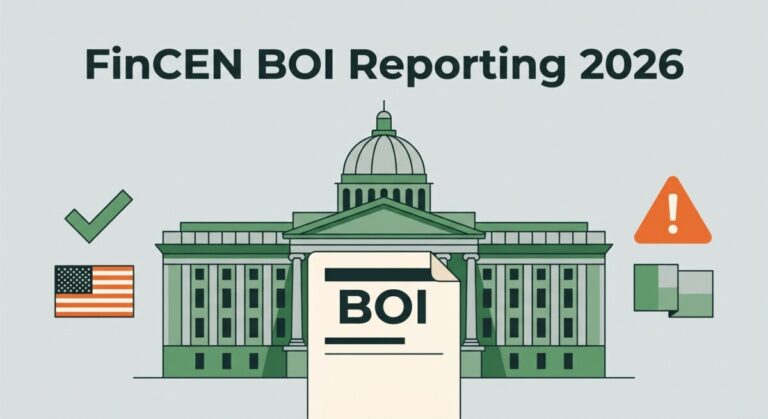
If you own a U.S. LLC or corporation, you have probably lost track of what happened to the Corporate Transparency Act’s beneficial ownership reporting rule after a year of court fights, deadline extensions, and interim rules. The FinCEN BOI final rule, published in the Federal Register on August 14, 2026 (Vol. 91, No. 156) and effective the same day, has now made the situation official. And for the vast majority of small U.S. businesses, the answer is simpler than the twelve months of headlines suggested.
At SW Accounting & Consulting Corp, we advise Los Angeles LLCs, S corporations, and closely held businesses on the compliance calendars that quietly become penalty magnets when the rules change mid-year. This post walks through what the FinCEN final rule actually does, who is now off the hook, who still has a filing obligation, and what to do about any information you already submitted.
What did the FinCEN BOI final rule actually change? 📜
It adopts, as final and with only limited changes, the March 26, 2025 interim final rule that pulled U.S. companies and U.S. beneficial owners out of the BOI reporting system.
The Corporate Transparency Act (CTA) was enacted January 1, 2021 as part of the Anti-Money Laundering Act of 2020, and it added a new section 5336 to the Bank Secrecy Act requiring many corporations, LLCs, and similar entities to disclose their beneficial owners to the Financial Crimes Enforcement Network (FinCEN). The original Reporting Rule went into effect on January 1, 2024 and required most pre-2024 entities to file initial BOI reports by January 1, 2025. Litigation in the Eastern District of Texas and elsewhere then upended those deadlines, and in March 2025 FinCEN issued an interim final rule (IFR) that sharply narrowed the reporting universe.
The August 14, 2026 final rule keeps the IFR’s core structure — no BOI reporting by domestic companies, no BOI reporting on U.S. person beneficial owners — and adds one small but useful change: U.S. persons who obtained a FinCEN identifier (FinCEN ID) no longer have to update the information they submitted to get it, whether they gave that information as a beneficial owner or as a company applicant. In plain English, if you are a U.S. person with a FinCEN ID sitting in the system, you can stop worrying about updating it every time you move or change your ID number.
Who is exempted under the FinCEN BOI final rule? ✅
Domestic reporting companies, U.S. person beneficial owners of any reporting company, U.S. person company applicants, and U.S. persons with an existing FinCEN ID are all outside the reporting net.
- Domestic reporting companies: every entity created by filing a document with a U.S. state or Indian tribe — corporation, LLC, LP, or similar — is exempt from filing an initial BOI report and from updating or correcting any previously filed BOI report. This is the bulk of small business America.
- U.S. person beneficial owners: even for foreign-formed entities that are still reporting companies, U.S. person beneficial owners do not have to provide their BOI, and reporting companies do not have to report it about them.
- U.S. person company applicants: the final rule extends the exemption to company applicants who are U.S. persons — the attorneys, formation agents, or organizers who filed the entity’s paperwork. Reporting companies no longer submit that information, and the applicants themselves have no BOI obligation.
- FinCEN ID updates by U.S. persons: a U.S. person who already obtained a FinCEN ID has no ongoing duty to update or correct the information provided to get it.
Who still has to file BOI reports? 🌍
Foreign reporting companies — foreign-formed entities registered to do business in a U.S. state or tribal jurisdiction — still file BOI on their foreign beneficial owners.
FinCEN explains the policy this way: the reporting rule is aimed at the money-laundering, terrorism-financing, and sanctions-evasion risks that Treasury and the intelligence community associate with foreign ownership channeled through U.S. entities. Domestic-only ownership of domestic entities does not carry the same profile, so the agency withdrew the reporting requirement for that class. What remains is a narrower rule aimed squarely at cross-border structures.
If you operate through a foreign LLC or corporation registered as a foreign entity in California — or any other U.S. state — the reporting obligation still applies to any beneficial owner who is not a U.S. person. Practical examples: a Cayman holding company registered to do business in Delaware, a Korean corporation registered to do business in California, or a BVI entity qualified to do business in New York. The company’s foreign beneficial owners must be reported; its U.S. beneficial owners do not.
What happens to information already submitted to FinCEN? 🗂️
Prior BOI reports remain in FinCEN’s system, but reporting companies have no ongoing duty to update, correct, or supplement them under the final rule.
Millions of reporting companies filed BOI to FinCEN in 2024 and early 2025 under the original Reporting Rule, and many U.S. individuals also obtained FinCEN IDs. Commenters on the interim final rule asked FinCEN to either delete that data or provide a mechanism for U.S. persons to have it removed. In the final rule FinCEN declined to build a bulk deletion tool, but the practical relief for private filers is the same: no updates, no corrections, no re-filings are required for information that the new rule no longer requires. In addition, the final rule now expressly exempts U.S. persons from updating the information provided to obtain a FinCEN ID.
For a small business owner who filed a BOI report or obtained a FinCEN ID in 2024, the answer today is essentially: leave it alone. The obligation to keep that record current has been withdrawn to the extent it covers U.S. persons and domestic entities.
What should business owners do now? ✏️
Confirm whether every entity in your group is domestic or foreign, map beneficial owners by U.S. or non-U.S. status, and keep a short internal memo documenting the exemption you rely on.
- List each entity you own or manage and mark it “domestic” (formed in a U.S. state or tribe) or “foreign” (formed under the law of another country and registered here).
- Identify every beneficial owner — the individuals who own or control at least 25% of the entity, plus anyone who exercises substantial control — and mark each as a U.S. person or a foreign person under the CTA definitions.
- For each foreign entity registered in a U.S. state, confirm whether it has any non-U.S. beneficial owners. If yes, it must file (and keep filing) BOI on those foreign owners.
- For each domestic entity, document that it qualifies as a domestic reporting company and is exempt under the FinCEN BOI final rule. A one-page memo in your governance file is cheap insurance if the rule changes again.
- Do nothing to previously filed BOI reports. There is no obligation to correct, update, or withdraw a prior filing that the current rule no longer requires.
FinCEN BOI final rule at a glance 📊
| Situation | BOI filing required? | Notes |
|---|---|---|
| Domestic LLC or corp with U.S. owners | No | Domestic reporting companies are exempt in full |
| Domestic LLC with a foreign owner | No | The entity itself is domestic — no filing under the final rule |
| Foreign entity registered in a U.S. state, only U.S. owners | No BOI on the owners | U.S. person owners are individually exempt |
| Foreign entity registered in a U.S. state, one or more foreign owners | Yes — on the foreign owners | Report only the non-U.S. beneficial owners; U.S. owners omitted |
| U.S. person with existing FinCEN ID | No updates required | Final rule expressly relieves U.S. persons of the update duty |
📌 Key Takeaways
- The FinCEN BOI final rule is effective August 14, 2026 and locks in the narrower March 2025 interim rule.
- Every domestic reporting company and every U.S. person beneficial owner is exempt from BOI reporting.
- Only foreign entities registered in a U.S. state still file BOI — and only on their foreign beneficial owners.
- U.S. persons with a FinCEN ID no longer have to update the information they submitted for it.
Frequently Asked Questions ❓
Q. Is BOI reporting cancelled entirely?
No. The Corporate Transparency Act itself is still on the books. What the FinCEN BOI final rule does is exempt every domestic reporting company and every U.S. person beneficial owner from reporting. Foreign entities registered here still file on their foreign owners.
Q. When did the FinCEN BOI final rule take effect?
August 14, 2026, the date it was published in the Federal Register. It adopts, with limited changes, the interim final rule FinCEN issued on March 26, 2025.
Q. My LLC filed a BOI report in early 2024. Do I need to do anything now?
Under the current rule, no. Domestic reporting companies are exempt from filing initial BOI reports and from updating or correcting previously filed reports. Your prior submission remains in FinCEN’s system; you have no ongoing update duty.
Q. I got a FinCEN identifier. Do I still have to keep it current?
Not if you are a U.S. person. The final rule expressly exempts U.S. persons from updating or correcting the information they provided to obtain a FinCEN ID.
Q. I run a California LLC owned by a foreign parent. Do I file?
The California LLC is a domestic reporting company and is exempt. If the foreign parent itself is registered to do business in California or another U.S. state, that registration makes it a foreign reporting company, and it must file BOI on its foreign beneficial owners.
Q. Where can I read the primary source?
The final rule appears at 91 Federal Register 52,508 (August 14, 2026). The statute is at 31 U.S.C. § 5336, and current filing guidance is on the FinCEN BOI page.
If your ownership chart includes any foreign entity registered in a U.S. state — or you are unsure whether an entity in your group crosses the line — contact SW Accounting & Consulting Corp for a beneficial-ownership review. Primary sources for this article: the FinCEN Beneficial Ownership Information Reporting Requirement Revision final rule at the Federal Register, the FinCEN BOI page, and the Corporate Transparency Act codified at 31 U.S.C. § 5336.