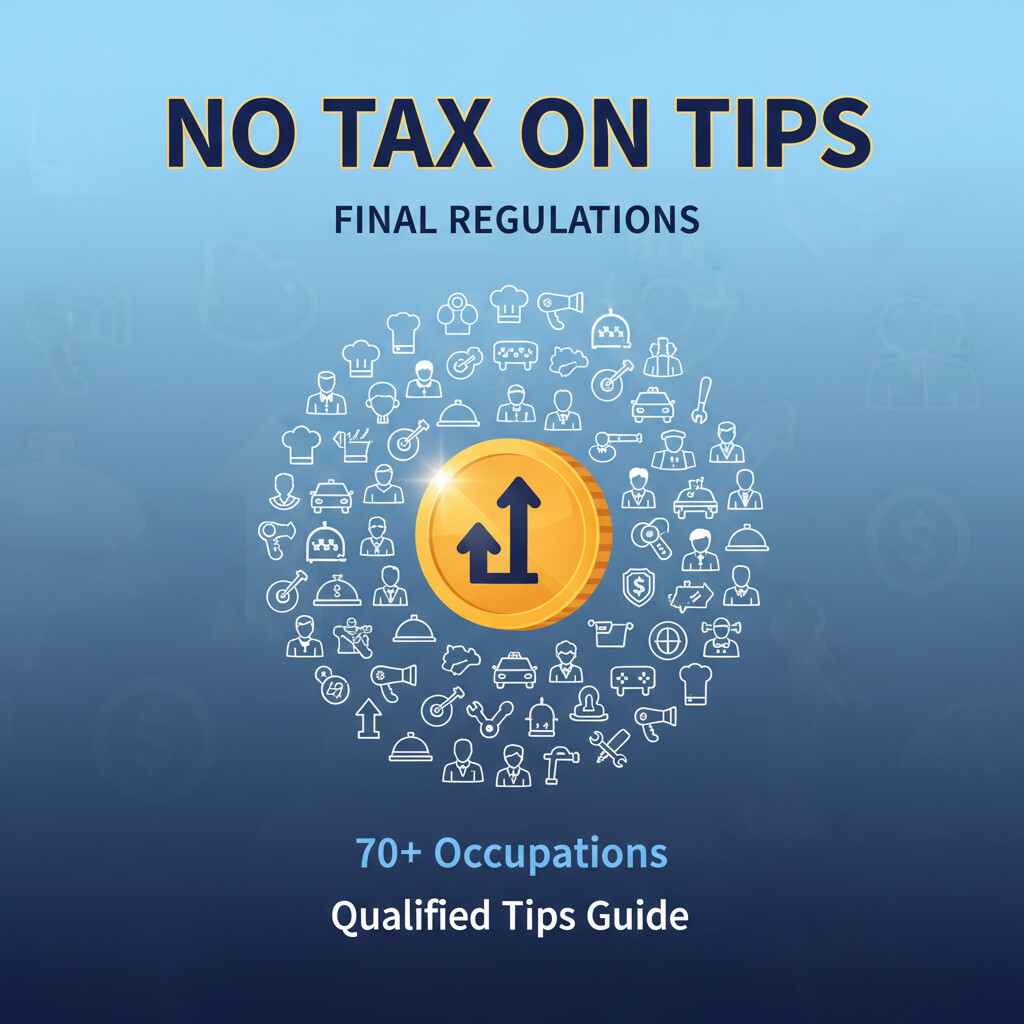
No Tax on Tips Final Regulations: 70+ Occupations, Qualified Tips Guide
After receiving over 300 comments on the proposed regulations and holding a public hearing on October 23, 2025, Treasury and the IRS issued final regulations implementing the OBBBA’s No Tax on Tips final regulations. Refunds are already going out to eligible workers — the practical compliance burden falls on employers and tax preparers to identify qualifying occupations, distinguish qualified tips from non-qualifying service charges, and report correctly.
At SW Accounting & Consulting Corp, we advise LA-area restaurants, hospitality groups, salons, and service businesses on payroll tax compliance. Below: what the final regulations changed from the proposed version, the 8-category occupation list, the qualified-tip definition, and the practical issues we’re seeing for employers.
What did the final regulations change from the proposed version? 📜
The April 10, 2026 final regulations expand the list of tipped occupations and clarify what counts as a “qualified tip” — but they do not change the underlying statutory framework: the deduction applies only to workers in occupations on the Treasury Tipped Occupation Code (TTOC) list, only for tips that satisfy the qualified-tip definition, and only when reported on the correct information return.
Key changes vs. the proposed regulations:
- Expanded list — added visual artists and floral designers (Personal Services category) and gas pump attendants (Transportation and Delivery category).
- Service charges clarified — mandatory service charges (e.g., 18% auto-gratuity on large parties added with no customer option to disregard or modify) are NOT qualified tips, even when distributed to workers.
- Information return requirement reinforced — qualified tips must be included on Form W-2, 1099-NEC, 1099-MISC, 1099-K, or reported by the worker on Form 4137 (Social Security and Medicare Tax on Unreported Tip Income).
- Self-employed net income cap — gig workers and self-employed individuals can qualify if their occupation is on the TTOC list, but the deduction is capped at the individual’s net income from the business.
Which occupations qualify? 👨🍳
The Treasury Tipped Occupation Code (TTOC) system uses a three-digit code grouping occupations into eight categories. A worker’s occupation must be on the TTOC list for any tip income to qualify for the deduction.
| TTOC Code | Category | Typical Occupations |
|---|---|---|
| 100s | Beverage and Food Service | Bartenders, servers, bussers, baristas, food runners |
| 200s | Entertainment and Events | Wedding/event staff, performers, entertainers |
| 300s | Hospitality and Guest Services | Hotel concierges, bellhops, housekeepers, valets |
| 400s | Home Services | Home repair, cleaning, lawn care workers |
| 500s | Personal Services (expanded) | Visual artists*, floral designers*, tour guides |
| 600s | Personal Appearance and Wellness | Hairstylists, nail technicians, massage therapists, estheticians |
| 700s | Recreation and Instruction | Fitness instructors, golf caddies, tour leaders |
| 800s | Transportation and Delivery (expanded) | Taxi/rideshare drivers, delivery workers, water taxi operators, gas pump attendants* |
*Added in the final regulations from the proposed list.
A worker performs multiple roles — a host who also bartends — qualifies only for tips earned in the qualifying occupation. If your payroll system doesn’t separately track tip allocation by job code, you’ll have data gaps when the IRS asks for substantiation. Update your POS time-clock setup before year-end 2026.
What counts as a “qualified tip”? 💰
A qualified tip must be received by a worker in a TTOC-listed occupation AND meet four core requirements set by the final regulations and the underlying statute.
- 1. Voluntary — the customer determined the amount and was free to give nothing.
- 2. Not a mandatory charge — auto-gratuities and mandatory service charges (no customer option to modify or remove) are NOT qualified tips, even when distributed to workers.
- 3. Reported on the correct return — must appear on Form W-2 (wages), Form 1099-NEC/MISC (independent contractors), Form 1099-K (third-party network), or Form 4137 (employee self-reporting).
- 4. Worker is in a listed occupation — the deduction is capped if the worker’s occupation isn’t on the TTOC list.
What should employers do now? 🛠
The deduction is claimed by the worker — but employers carry the documentation and reporting burden. Three actions for 2026 year-end:
| Action | Detail |
|---|---|
| Map your roles to TTOC codes | For each tipped role, assign a TTOC three-digit code. Document mappings for borderline cases. |
| Reconfigure POS / payroll to separate tips from service charges | Auto-gratuities flow through wages, not tips. Get this right at the POS — fixing it on W-2 is messy. |
| Train staff on Form 4137 | Workers who receive unreported tips (cash) need Form 4137 to qualify. Make this a hire-day discussion. |
Frequently asked questions
No. If a restaurant adds an 18% service charge for parties of six or more with no customer option to remove or adjust it, that amount flows through wages — even when distributed to staff. It does not qualify for the No Tax on Tips deduction.
Yes, if their occupation is on the TTOC list (Transportation and Delivery — 800s) and other requirements are met. Self-employed deduction is capped at net income from the activity.
You cannot claim the deduction. The final regulations limit eligibility to listed occupations; the IRS may update the list through future rulemaking, but workers cannot self-classify into eligibility.
On the federal income tax return, as a deduction against qualified tip income that was already reported on Form W-2/1099/4137. The IRS is already issuing refunds to eligible workers who filed in early 2026.
How can SW Accounting help? 💼
At SW Accounting & Consulting Corp, we advise LA restaurants, hospitality groups, salons, and gig-economy clients on No Tax on Tips compliance — TTOC mapping, POS reconfiguration for service-charge vs. tip separation, Form 4137 training, and individual return positioning.
📩 Schedule a No Tax on Tips compliance review
Disclaimer: This article is for informational purposes only and is not legal or tax advice. Always consult a qualified professional regarding your specific facts. Primary source: IRS News Release IR-2026-49 (April 10, 2026); Treasury and IRS final regulations under the One, Big, Beautiful Bill Act.