Section 1031 Exchange: Defer Tax on Investment Real Estate
For real estate investors, few tools are as powerful as a like-kind exchange. Done correctly, a Section 1031 exchange rolls your gain into the next property instead of triggering a tax bill today. Done carelessly, it falls apart and the whole gain becomes taxable. This guide explains the rules, the deadlines, and the traps.
At SW Accounting & Consulting Corp, we help Los Angeles real estate investors structure 1031 exchanges and report them correctly. Below: what qualifies, the real-property-only rule, the 45- and 180-day clocks, the role of the qualified intermediary, and how “boot” is taxed.
What is a Section 1031 exchange? 🔁
Under Internal Revenue Code § 1031, no gain or loss is recognized when real property held for productive use in a trade or business or for investment is exchanged for like-kind real property to be held for the same purpose.
The key word is deferral, not elimination. You are not paying tax now; you are carrying your old basis forward into the replacement property. “Like-kind” is interpreted broadly for real estate — for example, raw land can be exchanged for a rental building, or an apartment complex for commercial space. What matters is that both the relinquished and replacement properties are real property held for business or investment.
Does 1031 still apply to equipment or personal property? 🏢
No. Since 2018, Section 1031 applies only to real property. Exchanges of personal property — equipment, vehicles, machinery — no longer qualify.
The Tax Cuts and Jobs Act limited like-kind exchanges to real property for exchanges completed after 2017. It also does not apply to property held primarily for sale (such as a dealer’s inventory) or to your personal residence. The classic use case today is investment and business real estate.
What are the 45-day and 180-day deadlines? 🗓️
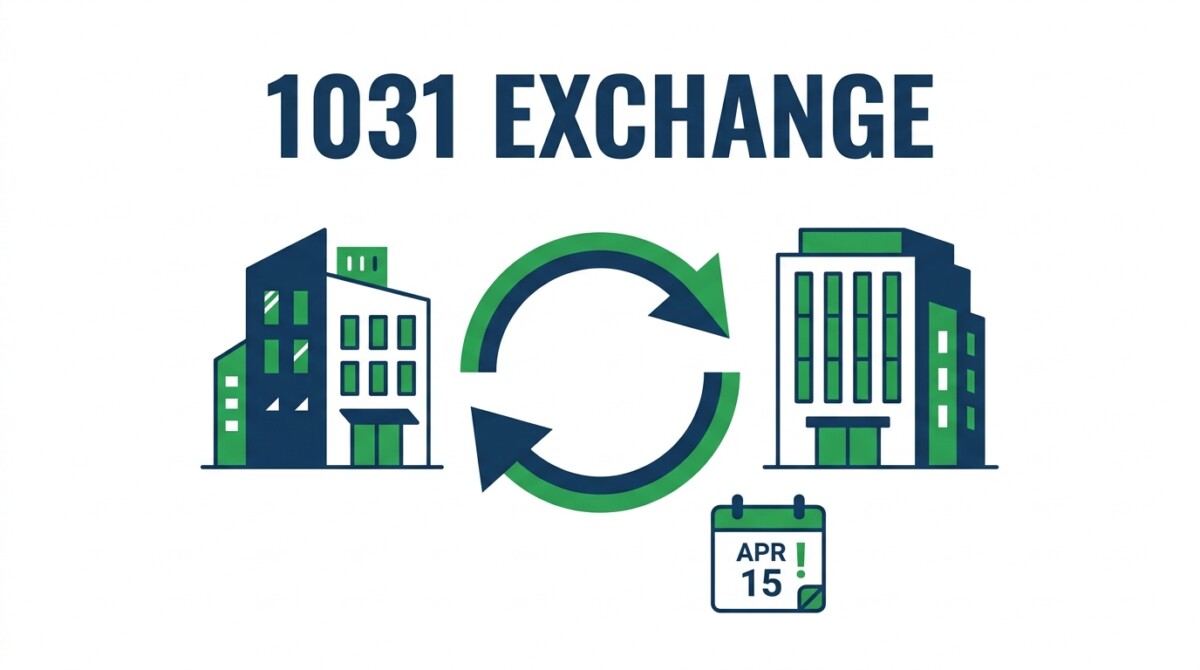
You must identify replacement property within 45 days of selling the relinquished property, and you must complete the purchase within 180 days (or by your tax return due date, including extensions, if earlier).
These clocks run at the same time and are strict — there is no general extension for missing them. The day count starts when you transfer the relinquished property. Because the timeline is unforgiving, most investors line up potential replacement properties before they close on the sale, not after.
| Rule | What it means |
|---|---|
| Like-kind, real property only | Both properties must be real property held for business or investment (since 2018). |
| 45-day identification | Identify replacement property in writing within 45 days of the sale. |
| 180-day exchange | Close on the replacement within 180 days (or your return due date, if earlier). |
| Qualified intermediary | A QI holds the sale proceeds; you cannot take constructive receipt of the cash. |
| Report on Form 8824 | Each like-kind exchange is reported to the IRS on Form 8824. |
The two failures we see most are touching the cash and missing the 45-day window. We help clients engage a qualified intermediary before closing the sale, document the identification in writing on time, and model whether any boot will be taxable — so the deferral holds up.
What is “boot,” and is it taxable? 💵
Boot is any non-like-kind value you receive in the exchange — cash, or net relief from debt. Boot is generally taxable up to the amount of your realized gain, even in an otherwise valid 1031 exchange.
If you trade down — buying a cheaper property or pulling cash out — that value is treated as boot and can trigger tax. To defer the full gain, investors generally reinvest all the proceeds and acquire property of equal or greater value and debt. A partial exchange still works; you simply pay tax on the boot.
Three common ways it fails: (1) taking constructive receipt of the sale proceeds instead of using a qualified intermediary; (2) missing the 45-day identification deadline; and (3) trying to exchange a personal residence or property held for sale. Set up the structure before you sell — not after.
- Section 1031 defers — not eliminates — gain when you exchange like-kind real property held for business or investment.
- Since 2018, only real property qualifies; personal property and your home do not.
- Strict clocks: 45 days to identify, 180 days to close; a qualified intermediary must hold the proceeds.
- Boot (cash or debt relief) is generally taxable; report the exchange on Form 8824.
Frequently asked questions
No. It defers the gain by carrying your basis into the replacement property. Tax can come due later when you sell without another exchange.
You must identify replacement property within 45 days of the sale and close within 180 days (or by your tax return due date, including extensions, if earlier).
No. Section 1031 applies to real property held for business or investment, not a personal residence or property held primarily for sale.
Each like-kind exchange is reported to the IRS on Form 8824, which calculates any recognized gain and your basis in the replacement property.
How can SW Accounting help? 💼
At SW Accounting & Consulting Corp, we help LA-area real estate investors plan and report 1031 exchanges — coordinating the qualified intermediary, tracking the 45- and 180-day deadlines, modeling boot and depreciation recapture, and filing Form 8824 correctly. If you are selling investment property, talk to us before you close so the deferral is there when you need it.
Disclaimer: This article is for informational purposes only and is not tax or legal advice. Consult a qualified professional about your specific situation. Primary sources: 26 U.S.C. § 1031 (exchange of real property held for productive use or investment); Treasury Regulations § 1.1031; IRS Form 8824 and its instructions.