
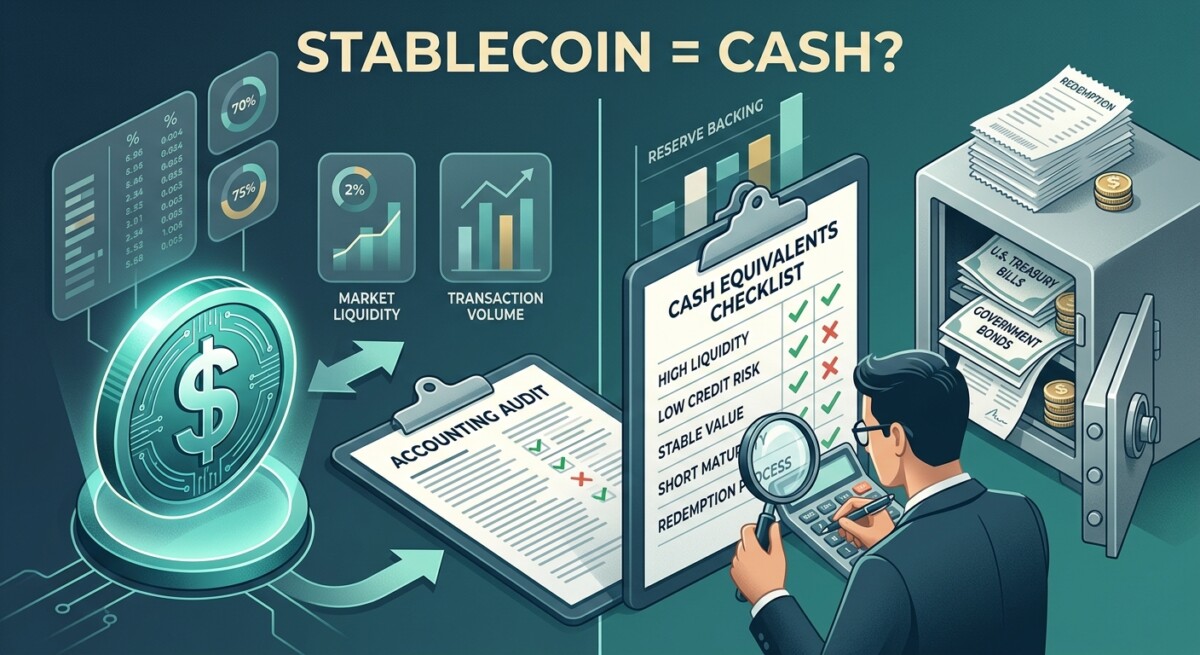
Can stablecoin cash equivalents pass FASB’s test?
A controller at a technology company holds a seven-figure balance in USDC and USDT and reports it on the balance sheet as cash equivalents, on the view that the tokens are redeemable one-for-one and backed by short-term Treasuries. The auditor flags it. A peer company, holding the same tokens, has concluded the opposite and reports them as other current assets. Both companies are reading the same Master Glossary definition and reaching different answers. That diversity in practice is why the Financial Accounting Standards Board (FASB) voted unanimously on August 13, 2026 to issue a proposal, and on August 18, 2026 released it for comment. The proposal does not rewrite the definition. It gives preparers and auditors something they have not had: a worked set of examples that show when the existing cash equivalents definition in ASC Topic 230, Statement of Cash Flows actually applies to a digital asset, and when it does not. This post walks through what the Proposed ASU, Statement of Cash Flows (Topic 230); Cash Equivalents and Certain Digital Assets says, which stablecoins would and would not qualify, and what every company that reports cash equivalents — crypto or not — needs to prepare for before the November 19 comment deadline.
What exactly did FASB propose on August 18, 2026? 📄
A proposed Accounting Standards Update, filed as 2026-ED400 under Topic 230, that adds illustrative examples for evaluating when certain digital assets meet the existing cash equivalents definition, and that adds a new annual disclosure of the significant components of cash equivalents.
The proposal is amendments to ASC Topic 230, Statement of Cash Flows — not a new standard, and not a new definition. Instead, FASB took the diversity in practice around stablecoins and attacked it in two ways. First, the proposal adds illustrative examples under Topic 230 showing the attributes a digital asset would need to meet the Master Glossary definition of a cash equivalent. Second, the proposal adds a new annual disclosure requirement — a new paragraph 230-10-50-1A — that applies to every entity that presents cash equivalents, regardless of what those cash equivalents actually are. The scope is deliberately broader than crypto, because the diversity it addresses is broader than crypto.
The vote was unanimous across all seven board members. Comments on the proposal are due by November 19, 2026. The proposed effective date and transition provisions are open for comment, which is where most of the useful preparer feedback is likely to focus.
The classification remains elective
Reading the examples, a digital asset that satisfies the three attributes could be classified as a cash equivalent — but it does not have to be. Topic 230 has always treated cash-equivalent classification as an accounting policy choice. The proposal preserves that choice. An entity that meets the attributes but prefers to report stablecoin holdings on a separate line can continue to do so, as long as the policy is applied consistently.
What is a cash equivalent under current US GAAP? 💵
A short-term, highly liquid investment that is readily convertible to a known amount of cash and so near its maturity that it presents insignificant risk of changes in value because of changes in interest rates. In practice, that has long meant original maturities of three months or less.
The Master Glossary definition in ASC Topic 230, Statement of Cash Flows has been largely unchanged for decades. It turns on three ideas: short term, known amount of cash, and insignificant risk from interest-rate movements. Historical examples are Treasury bills, commercial paper, money market funds, and federal funds sold. Nothing in the definition contemplates a token traded on a blockchain. That silence is the source of the current diversity: well-advised companies have reached opposite conclusions on identical stablecoin holdings because the standard was written for a world that did not yet exist.
The proposal does not change that definition. It instead layers illustrative examples on top of it, so that preparers can see how the same three tests apply to a token issued by a stablecoin sponsor and backed by segregated short-term reserves.
Which three attributes make a stablecoin a cash equivalent? 🧪
An on-demand contractual redemption right, a direct claim against the issuer for a known cash amount, and segregated reserves held at no less than a one-to-one ratio in short-term, highly liquid assets. All three have to be present at the same time.
The illustrative examples pull apart what has, until now, been a general sense that “a stablecoin pegged one-for-one to the dollar must be close to cash.” The examples say: close is not enough; the right has to be contractual, direct, and backed. Each attribute carries weight on its own.
| Attribute | What it means in practice | Why it matters |
|---|---|---|
| On-demand contractual redemption right | The holder can demand cash from the issuer at any time under the terms of the token’s governing agreement — not a secondary-market sale, not a best-efforts window. | Removes any gating or discretionary limit on redemption; converts the token to cash on known terms. |
| Direct claim against the issuer for a known amount of cash | The holder’s redemption counterparty is the issuer itself, and the amount paid is known in advance (for example, 1 USD per token, less any disclosed fee). | Eliminates reliance on an exchange or market maker to realize the stated value. |
| Reserves at ≥ 1:1 in short-term, highly liquid assets | The issuer holds reserves segregated from its operating assets, at a ratio of at least one unit of reserves per token outstanding, in instruments that themselves would qualify as cash or cash equivalents. | Ensures the economic backing matches the redemption promise and preserves the “insignificant risk” test. |
A token that trades near one dollar but lacks any one of these — because the issuer has discretion to pause redemption, because reserves are held partly in longer-dated or riskier assets, or because the only exit is to sell on an exchange — would not qualify as a cash equivalent under the examples, even if its market price is stable.
Secondary-market liquidity is not a substitute for a redemption right
An actively traded token can look like cash on a trading screen while failing the Topic 230 test. The examples draw a hard line: a holder must be able to redeem the token with the issuer for a known cash amount, not merely sell it to another buyer. For auditors, that is the single most important diagnostic in the proposal.
What is the new disclosure every company must consider? 📋
A new annual disclosure of the significant components of cash equivalents, in a new paragraph 230-10-50-1A. It applies to every entity that presents cash equivalents, whether or not any of them are digital.
This is the quietly broader piece of the proposal. For years, companies have aggregated money market funds, Treasury bills, commercial paper, and (increasingly) stablecoins into a single cash-equivalents line, with little or no footnote detail. The new disclosure would require entities to describe the significant components of that balance and the related amounts, on an annual basis. The intent is to give users visibility into what actually sits inside the line — and, in the stablecoin era, which pieces carry which kind of credit, redemption, or operational exposure.
The disclosure is not framed as a crypto rule. A company that holds no digital assets at all would still have to describe the significant components of its cash equivalents line. In our experience advising middle-market CFOs, this is the piece that will produce the most line-item disclosure work — because almost every company is in scope and almost no company currently discloses the components of cash equivalents at this level of detail.
How does the proposal interact with the FASB’s 2023 crypto accounting rule? 🪙
The 2023 fair value model under Subtopic 350-60 covers crypto assets that do not qualify as cash equivalents. The new proposal defines, through examples, when a token leaves that model and enters cash-equivalent treatment under Topic 230.
FASB’s prior crypto accounting standard required certain crypto assets to be measured at fair value through net income, replacing the earlier impairment-only model. That standard was aimed at assets that are held and used as crypto — Bitcoin, Ether, and similar — not at stablecoins intended to behave like dollars. The question of whether a particular stablecoin fell into the fair-value model or into the cash equivalents line was left to each preparer’s judgment.
The new proposal does not displace the 2023 standard. It draws the line between the two regimes: a token that meets the three attributes can be classified as a cash equivalent under Topic 230 and reported on the cash-equivalents line, outside the fair-value crypto model. A token that does not meet the attributes stays in the earlier model. The classification is still an elective policy, but it is a policy that can now be documented against a specific set of criteria.
For audit workpapers, the three attributes become the control
Audit teams that have been inheriting management conclusions on stablecoin classification without a framework now have one. In our audit support work, we are already rebuilding workpapers around the three attributes: contractual redemption terms (reviewed against the token’s governing agreement), reserve composition (reviewed against the issuer’s attestations and any available examination reports), and segregation (reviewed against legal opinions and custody arrangements). A stablecoin classification memo without those three sections is now a review finding.
What should CFOs and auditors do before November 19, 2026? 🗓️
Map existing cash equivalents against the three attributes, decide whether to submit a comment letter, draft the significant-components disclosure, and align internal controls and audit workpapers to the proposed examples — all before the comment period closes.
- Inventory what is in cash equivalents today. Pull the general-ledger composition of the cash equivalents line. Separate stablecoins, money market funds, commercial paper, Treasury bills, and any other components. This exercise feeds both the comment letter and the new disclosure.
- Test each stablecoin against the three attributes. Read the token’s governing agreement for the on-demand contractual redemption right. Confirm that the counterparty is the issuer itself, not a market maker or exchange. Review the issuer’s reserve attestations for the 1:1 segregated-reserves attribute. Document each conclusion.
- Draft the significant-components disclosure. Even if the final rule changes, building the first draft under the proposal reveals which components are actually significant and which internal reporting systems can produce the disclosure.
- Decide on a comment letter. The transition and effective-date language, the level of specificity in the examples, and the scope of the disclosure are all open. A short, concrete comment letter from an operating company is more valuable to the Board than a generic endorsement.
- Align audit workpapers now. Build the three-attribute analysis into the stablecoin classification memo and the cash equivalents walkthrough. Even before the ASU is finalized, that structure is the one auditors will be asked to defend.
One practical point from recent engagements: the hardest attribute to document is usually the reserves attribute. Attestations and audit reports from the issuer’s own auditors vary in scope, frequency, and specificity. Companies that have been relying on marketing materials rather than underlying attestations are going to find the three-attribute analysis uncomfortable. That is the point of the proposal.
Summary: FASB’s stablecoin cash equivalents proposal
- FASB’s August 18, 2026 Proposed ASU under Topic 230 adds illustrative examples for when a stablecoin meets the existing cash equivalents definition. The Master Glossary definition is not changed.
- Three attributes must all be present: an on-demand contractual redemption right, a direct claim against the issuer for a known cash amount, and segregated reserves at ≥ 1:1 in short-term, highly liquid assets. Secondary-market liquidity is not a substitute.
- A new annual disclosure (paragraph 230-10-50-1A) requires every entity with cash equivalents — digital or not — to describe the significant components and related amounts.
- Classification remains an elective accounting policy — meeting the attributes allows cash-equivalent treatment, it does not require it.
- Comments are due November 19, 2026. CFOs and auditors should inventory existing cash equivalents, test each stablecoin against the three attributes, draft the disclosure, and align workpapers before then.
Frequently asked questions about stablecoin cash equivalents ❓
Q. What did FASB actually propose on stablecoin cash equivalents in August 2026?
On August 18, 2026, FASB issued Proposed ASU, Statement of Cash Flows (Topic 230); Cash Equivalents and Certain Digital Assets (File Reference No. 2026-ED400). The proposal adds illustrative examples showing when a digital asset — principally a stablecoin — can meet the existing cash equivalents definition, and adds a new annual disclosure of the significant components of cash equivalents. The Master Glossary definition of cash equivalents itself would not change. The comment period runs until November 19, 2026.
Q. Does the proposal change the definition of cash equivalents?
No. The Master Glossary definition of cash equivalents in ASC Topic 230 would not change. FASB is proposing to add illustrative examples, not to rewrite the standard. A short-term, highly liquid investment still has to be readily convertible to a known amount of cash and so near its maturity that it presents insignificant risk of changes in value from interest-rate movements. The examples show how those tests apply to stablecoins and other digital assets, not whether to apply them.
Q. What three attributes make a stablecoin a cash equivalent under the proposal?
Based on the illustrative examples, three attributes have to be present at the same time. The holder must have an on-demand contractual right to redeem the token for cash. That right must be a direct claim against the issuer for a known amount of cash, not merely the ability to sell the token on a secondary market. And the issuer must hold segregated reserves at no less than a one-to-one ratio in short-term, highly liquid assets. If any one of those is missing, the token is not a cash equivalent under the examples.
Q. Is secondary-market liquidity enough to make a stablecoin a cash equivalent?
No. The ability to sell a token on an exchange, even an active one, is not the same as a direct contractual redemption right against the issuer. FASB’s examples treat secondary-market liquidity as insufficient on its own. The holder has to be able to go to the issuer and demand cash on known terms. That is the distinction that separates a stablecoin from a crypto asset that merely trades at a stable price.
Q. Who has to think about the new cash equivalents disclosure, even without crypto?
Every entity that presents assets as cash equivalents on its balance sheet. The proposed disclosure of the significant components of cash equivalents (new paragraph 230-10-50-1A) applies regardless of whether any of those assets are digital. Companies that only hold money market funds, Treasury bills, or commercial paper will still need to describe what sits inside the cash equivalents line. The disclosure is annual and sits with the statement of cash flows.
Q. What is the comment deadline and what should preparers do before then?
Comments on the proposed ASU are due November 19, 2026. Before that date, companies that hold stablecoins or that may want to classify them as cash equivalents should map their holdings against the three attributes, document the redemption terms and reserve arrangements, and decide whether to submit a comment letter. Auditors should begin aligning working papers and classification memos with the proposed examples. The classification would remain an elective accounting policy — meeting the attributes allows cash-equivalent treatment, it does not require it.
This article is general information, not accounting or legal advice for your situation. Classification of a specific digital asset turns on its own terms. If your company holds stablecoins or is preparing a comment letter, contact SW Accounting & Consulting Corp for a confidential review.