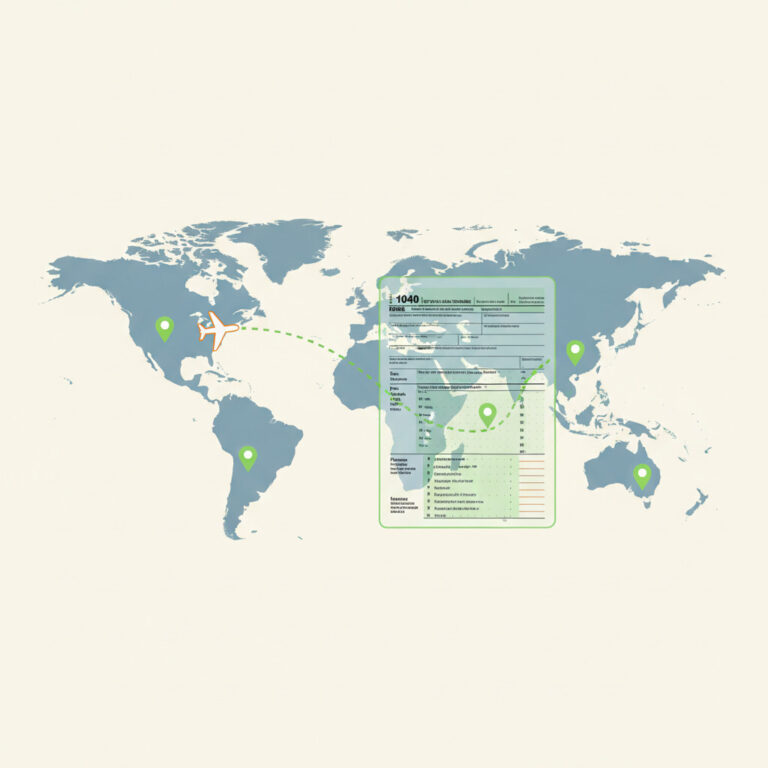
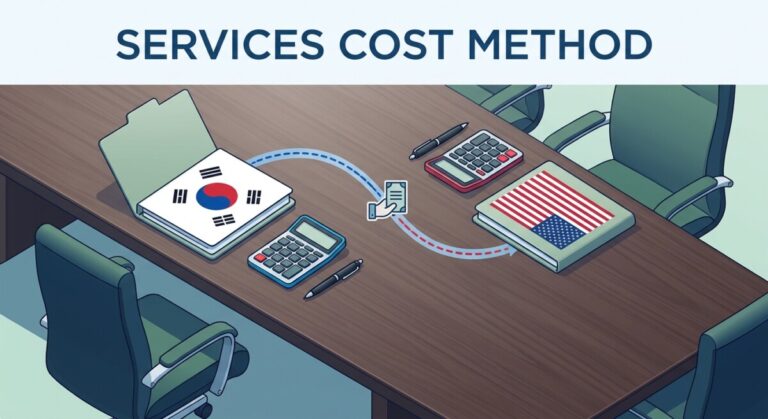
A corporate boardroom table with two folders representing a Korean parent and a US subsidiary connected by an intercompany services invoice line.
|

Can my Korean parent use the services cost method?

Can my Korean parent charge my US subsidiary at cost for shared back-office work? Yes — if the service fits the services cost method (SCM) safe harbor in Treasury Regulation §1.482-9(b). SCM lets a Korean parent bill routine support services (bookkeeping, HR administration, payroll, IT help desk, legal admin) to a US sub at pure…


Diagram concept of a reverse flip Korea reorganization: a US Delaware C-Corp becoming a subsidiary of a new Korean holding company.
|

Can a US startup get Korean TIPS through a reverse flip?

Our US-incorporated startup wants Korean TIPS funding — can we just drop a Korean subsidiary under our Delaware C-Corp, or do we actually need to reverse flip to a Korean top? Dropping a Korean subsidiary does not qualify the group for Korean TIPS: the Korea Technology Finance Corporation and the operator programs run the grant…

Business owner reviewing international tax developments on a tablet world map

International tax developments October 11, 2026

International tax moved in four places business owners should flag this week: the OECD put out a refreshed Model Tax Convention with a new remote-work permanent establishment framework, France filed its 2027 budget bill, South Africa opened consultation on a digital VAT architecture, and Singapore extended its innovation incentive to artificial intelligence adoption. What changed…

Side-by-side depiction of a US representative office and a US branch, contrasting the two US presence options a Korean parent company must choose between.
|

US representative office vs branch: what should a Korean parent set up?

If my Korean parent only wants to watch the US market, is a representative office enough — or do I already need a branch? A US representative office that limits itself to market research, information gathering, and liaison work typically falls outside the US “trade or business” definition under IRC §864(b), so it files no…

Crypto international tax: structuring a global digital asset group under IRS and §482 rules
|

How do I plan crypto international tax for a global group?

How does crypto international tax structuring work for a global group? A US-founded crypto business has to align entity classification, controlled-foreign-corporation rules, transfer pricing, IP ownership, and digital-asset reporting with how it actually operates. Crypto international tax is not a jurisdiction search; it is a documentation discipline. A protocol launches with founders in Los Angeles,…

US-Korea tax treaty royalty withholding — illustration of cross-border software royalty payment and reduced treaty rate.
|

What is the US-Korea tax treaty royalty rate, and how do I claim it?

Does the US-Korea tax treaty actually reduce the 30% default withholding on a software royalty paid to a Korean licensor? Yes — a US payer must generally withhold 30% on a US-source royalty, but the Korea tax treaty royalty article can cut the rate to 10% or 15% depending on the royalty type, provided the…

Editorial illustration of a globe with pins for an international tax update

International tax update — Sept 27, 2026

This international tax update covers three moves that reach owners of US businesses with any cross-border footprint. Australia has released an exposure draft that would reshape its Research and Development Tax Incentive from mid-2028; Hong Kong has unveiled tax-related measures in the 2026 Policy Address; and the OECD has published its 2026 report on tax…

A Korean phone banking screen beside a US Treasury form on a wooden desk, showing FBAR reporting for Korean-American families.

Do I need to report my Korean bank accounts on FBAR? (Toss & KakaoBank)

Do my Korean bank accounts really need to be reported on FBAR? Yes — any U.S. person whose foreign financial accounts (including Toss, KakaoBank, KEB Hana, Kookmin, or a Korean brokerage) together exceed $10,000 at any point during the calendar year must file FinCEN Form 114. The $10,000 test is measured across all accounts combined,…

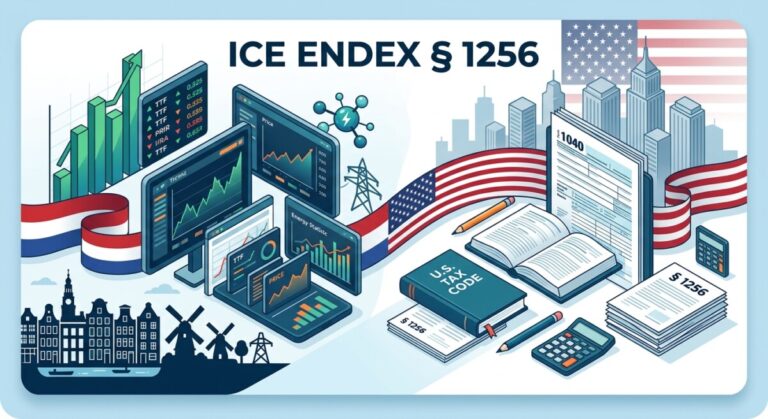
ICE Endex Section 1256: Netherlands futures exchange now qualified for U.S. mark-to-market
|

Are ICE Endex futures Section 1256 contracts? (2026)

Are ICE Endex futures Section 1256 contracts now? Yes — for contracts entered into on or after September 1, 2026. In Rev. Rul. 2026-16, the IRS determined that ICE Endex, a Netherlands regulated exchange, is a qualified board or exchange under § 1256(g)(7)(C), so its futures and futures options get mark-to-market and 60/40 capital-gain treatment…

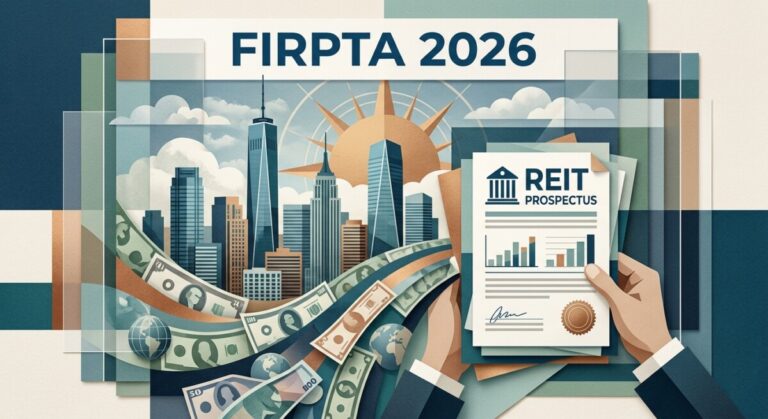
FIRPTA 2026 changes: DC REIT lookthrough rule repealed and Sec. 892 rules finalized
|

What changed for FIRPTA 2026 and foreign investors?

What changed for FIRPTA in 2026 for foreign investors in U.S. real estate? Two Treasury releases moved the ground under cross-border deals — the 2025 proposed regulations on domestically controlled REITs repeal the lookthrough rule for U.S. corporate shareholders, and the 2025 final FIRPTA-adjacent Sec. 892 regulations give foreign governments a workable path to hold…

Global tax changes in 2026 linking cross-border filing deadlines and registration portals to a single company
|

Which Global Tax Changes in 2026 Affect My U.S. Business?

Which global tax changes in 2026 affect my U.S. business? If you have a foreign parent, a foreign subsidiary or cross-border intragroup payments, four do: proposed U.S. foreign tax credit rules with a September 17 comment deadline, Pillar Two registration deadlines arriving jurisdiction by jurisdiction, spreading e-invoicing mandates, and sharply increased transfer pricing scrutiny. International…

Illustration of the Coca-Cola v. IRS transfer pricing case — courthouse column, cola bottle silhouette, and Treasury seal
|

Coca-Cola v. IRS: Transfer Pricing Case at the 11th Circuit

What is the Coca-Cola transfer pricing case, and why should other US companies care? The Coca-Cola transfer pricing case is a dispute over how a US parent must price transactions with its foreign affiliates under IRC §482. The Tax Court sided with the IRS in 2020 and the appeal is now before the Eleventh Circuit…

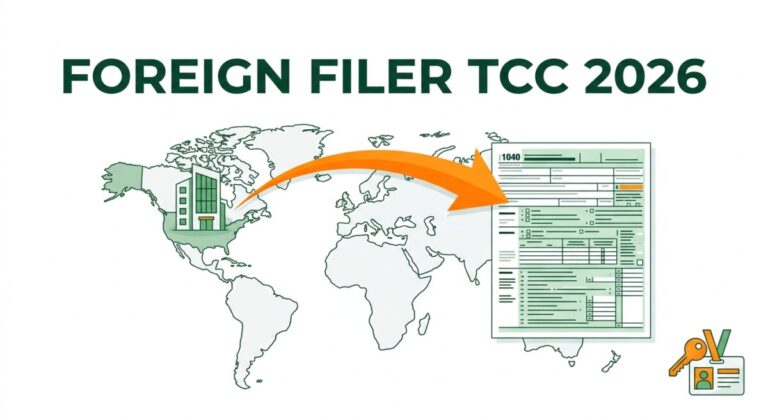
Illustration of Foreign Filer TCC 2026 — a world map with an arrow flowing from an overseas building into a U.S. tax form
|

Foreign Filer TCC 2026: IRS Path as FIRE Retires

How do foreign entities e-file 1042-S and 1099 forms after FIRE is retired? Through the new IRS Foreign Filer TCC Registration System. It gives foreign filers whose authorized users have no U.S. SSN or ITIN a way to obtain a Transmitter Control Code and transmit information returns electronically through IDES. The way U.S. information returns…

Illustration of a June 2026 international tax roundup — OECD Pillar Two global minimum tax, EU Court of Justice rulings, and country-level corporate rate changes
|

International Tax Roundup June 2026: Pillar Two, EU, Rates

What were the key international tax developments in early-to-mid June 2026? The OECD pushed forward on the global minimum tax (Pillar Two) — releasing practical fixes to the GloBE Information Return (GIR) XML schema for first filings, an updated 2026 consolidated commentary, and new transfer-pricing guidance on intragroup services. In the EU, the Court of…

Illustration of 2026 FIFA World Cup income sourcing — IRS, Canada Revenue Agency, and Mexico SAT consensus allocating team compensation by games played across three host countries
|

2026 World Cup Taxes: IRS/CRA/SAT Income Sourcing Consensus

How is income from the 2026 FIFA World Cup taxed across the U.S., Canada, and Mexico? The 2026 FIFA World Cup is co-hosted by three countries, which raises a thorny question: when a national team earns prize money and other compensation, how is that income sourced among the United States, Canada, and Mexico? To avoid…

Foreign earned income exclusion relief 2026 featured
|

Foreign Earned Income Exclusion Relief: Rev. Proc. 2026-16 Countries

What is the foreign earned income exclusion relief under Rev. Proc. 2026-16? The IRS waives the section 911 residency and presence tests for 2025 for qualified individuals who had to leave seven specified countries due to war, civil unrest, or similar adverse conditions. If you’re a US citizen or resident who was living abroad and…