Coca-Cola v. IRS: Transfer Pricing Case at the 11th Circuit
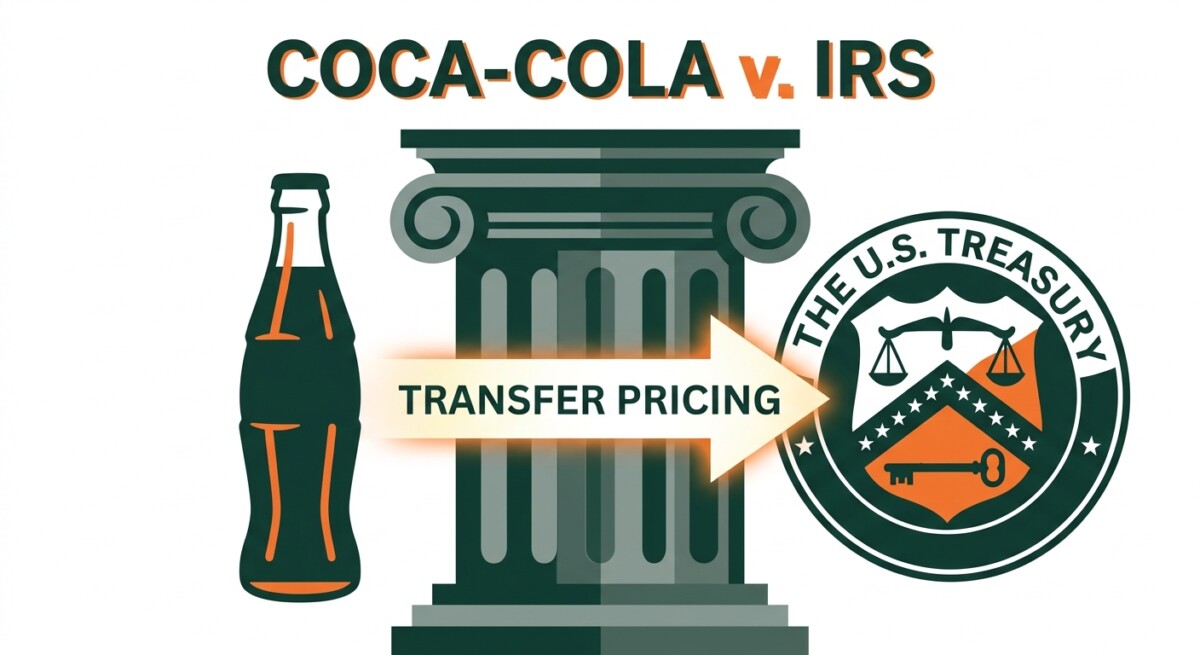
If you have ever wondered why the IRS cares so much about the price a US parent charges its own overseas subsidiary, the Coca-Cola transfer pricing case is the answer. It is the highest-profile Internal Revenue Code §482 fight in a generation, it has already produced a $6 billion payment while the appeal proceeds, and its outcome at the U.S. Court of Appeals for the Eleventh Circuit will reshape how every US multinational prices intercompany royalties, licenses, and profit splits.
At SW Accounting & Consulting Corp, we advise US-based companies with operations in Korea, Latin America, and Europe. Transfer pricing is the single largest cross-border compliance exposure most of them carry — and the Coca-Cola litigation is now the case the IRS is using to reset the rules. Here is what happened, what is on appeal, and what your finance team should be doing now.
What is transfer pricing under IRC §482? 📚
IRC §482 lets the IRS reallocate income between related entities so that intercompany transactions produce results consistent with what unrelated parties would agree to — the arm’s-length standard.
When a US parent licenses its brand, formulas, or intangibles to a foreign subsidiary, or the subsidiary manufactures product that the US parent then sells, someone has to decide how much of the resulting profit belongs in the US and how much belongs abroad. If the US parent under-charges the foreign affiliate, US taxable income drops and foreign income (often taxed at lower rates) rises. Section 482 of the Internal Revenue Code, together with the Treasury regulations under 26 C.F.R. §1.482, gives the IRS the authority to reallocate that income — and to add penalties and interest — when intercompany pricing does not reflect arm’s-length results.
The statute itself is short. The text of 26 U.S.C. §482 simply says the Treasury Secretary may distribute, apportion, or allocate gross income, deductions, credits, or allowances between related organizations “if he determines that such distribution, apportionment, or allocation is necessary in order to prevent evasion of taxes or clearly to reflect the income” of the taxpayers. The battleground is the regulations under it — and the specific pricing methods (comparable uncontrolled transaction, comparable profits method, profit split, and others) the IRS may apply.
What did the U.S. Tax Court actually decide in the Coca-Cola transfer pricing case? ⚖️
In 2020 the U.S. Tax Court sustained the IRS’s use of the comparable profits method to reallocate billions of dollars of income from Coca-Cola’s foreign supply-point affiliates back to the US parent for 2007–2009.
The IRS challenged how Coca-Cola priced the intangibles — brand, formulas, trademarks — that its foreign supply-point affiliates in Ireland, Brazil, Chile, Mexico, Costa Rica, Egypt, and Eswatini used to manufacture concentrate. Under Coca-Cola’s long-standing 1996 approach, the foreign affiliates kept a share of profits far larger than what the IRS believed was consistent with the functions those affiliates actually performed.
Two aspects of the U.S. Tax Court’s ruling matter most for other multinationals:
- The IRS was allowed to pick a different method. The Tax Court accepted the IRS’s use of the comparable profits method (CPM) to benchmark the supply-point affiliates against independent contract manufacturers — producing a large upward reallocation of income to the US parent.
- A prior closing agreement did not lock in the future. Coca-Cola argued that a 1996 settlement of an earlier audit created a binding methodology it could keep using. The court disagreed — the closing agreement resolved earlier tax years and did not bind the IRS’s transfer pricing determinations for 2007–2009.
The result: an upward reallocation of income totaling several billion dollars per year across 2007–2009, and a large federal tax deficiency once corresponding adjustments were made. The full opinion sits with the United States Tax Court.
What is on appeal at the Eleventh Circuit — and why is the Coca-Cola transfer pricing case worth roughly $20 billion? 💰
Coca-Cola has appealed the Tax Court decision to the U.S. Court of Appeals for the Eleventh Circuit, arguing the IRS misapplied §482 and its regulations. Combined tax, interest, and later-year exposure has been estimated at roughly $20 billion.
Coca-Cola’s appeal to the U.S. Court of Appeals for the Eleventh Circuit attacks the case on several fronts — the choice of the best pricing method under the §482 regulations, the treatment of the 1996 closing agreement, and the reallocation of profits attributable to the foreign affiliates’ own intangibles and functions. The company has publicly said it has already paid several billion dollars in tax and interest while the appeal is pending, in order to stop interest from accruing on the disputed amount — but continues to seek reversal.
The dollar figure most often reported — on the order of $20 billion — is not just the 2007–2009 deficiency. It reflects those years plus interest, plus follow-on adjustments for later years using the same methodology. That is why the case is now watched not only by tax lawyers but by every US-headquartered group with meaningful offshore profits.
What does the Coca-Cola transfer pricing case mean for my company? 🌐
If you are a US parent with foreign manufacturing, distribution, licensing, or IP-holding affiliates, the case tells you exactly where the IRS is focusing its resources — and how it will litigate.
Historically, the IRS lost or settled most of its high-profile transfer pricing cases. Coca-Cola is the clearest recent win for the government. If the Eleventh Circuit affirms, expect the IRS to lean harder on:
- Comparable profits method (CPM) attacks on foreign supply-point or distribution affiliates that report unusually high margins.
- Refusal to honor “historical” methodologies that have not been re-documented under the current §482 regulations.
- Aggressive assertion of routine returns for foreign affiliates that perform mainly manufacturing or distribution functions, leaving the residual (non-routine) profits with the US owner of the intangibles.
What should CFOs and controllers do right now? ✅
Refresh transfer pricing documentation, pressure-test the best-method analysis, and quantify the downside of an IRS reallocation before your next audit cycle.
Practical steps for a US-headquartered group with foreign affiliates:
- Refresh contemporaneous documentation. IRC §6662(e) penalties are avoided only if you have written documentation prepared by the due date of the return that supports your method under the §482 regulations.
- Re-run the best-method analysis. Coca-Cola lost in part because the IRS’s CPM was accepted as more reliable than the taxpayer’s method. Ask whether your chosen method would still win that comparison today.
- Stress-test foreign-affiliate margins. If a foreign manufacturing or distribution affiliate is consistently earning far more than comparable third-party companies, that gap is the exact fact pattern the IRS is now willing to litigate.
- Model the downside. Compute the incremental US tax, interest, and potential penalty if the IRS reallocated foreign profit back to the US at, say, the median margin of independent comparables. This is the number your audit committee should see.
- Consider an Advance Pricing Agreement (APA). For material intercompany flows, an APA with the IRS’s Advance Pricing and Mutual Agreement (APMA) program can lock in an agreed method prospectively.
Coca-Cola transfer pricing case at a glance 📊
| Item | Where it stands |
|---|---|
| Statute | IRC §482 (26 U.S.C. §482); regulations at 26 C.F.R. §1.482 |
| Tax years at issue | 2007, 2008, 2009 (original notice of deficiency) |
| Foreign affiliates | Supply-point companies in Ireland, Brazil, Chile, Mexico, Costa Rica, Egypt, Eswatini |
| Trial outcome (2020) | U.S. Tax Court sustained IRS’s CPM-based reallocation |
| Current stage | Appeal to the U.S. Court of Appeals for the Eleventh Circuit |
| Reported total exposure | Approximately $20 billion (deficiency + interest + follow-on years) |
📌 Key Takeaways
- IRC §482 lets the IRS reallocate income between related parties to enforce the arm’s-length standard.
- The 2020 Tax Court decision sustained the IRS’s CPM-based reallocation of Coca-Cola’s foreign supply-point profits.
- A prior closing agreement did not bind the IRS’s determination for later years.
- The Eleventh Circuit appeal will shape how every US multinational documents intercompany pricing.
- Refresh §482 documentation and model the downside before your next audit cycle.
Frequently Asked Questions ❓
Q. What is the Coca-Cola transfer pricing case in one sentence?
It is a long-running IRC §482 dispute in which the U.S. Tax Court in 2020 sustained the IRS’s reallocation of billions of dollars of income from Coca-Cola’s foreign supply-point affiliates back to the US parent for 2007–2009; the case is now on appeal to the U.S. Court of Appeals for the Eleventh Circuit.
Q. Why is the exposure often reported as around $20 billion?
The reported figure reflects the original 2007–2009 tax deficiency plus interest and follow-on adjustments for later years using the same transfer pricing methodology. Coca-Cola has publicly disclosed that it has already paid several billion dollars while the appeal is pending, but continues to challenge the assessment.
Q. Did the IRS win the case outright?
The U.S. Tax Court sustained the IRS’s application of the comparable profits method in 2020. The decision is now on appeal at the U.S. Court of Appeals for the Eleventh Circuit, which will review whether the Tax Court correctly applied IRC §482 and the §1.482 regulations.
Q. What is the comparable profits method (CPM)?
CPM is one of the transfer pricing methods allowed under 26 C.F.R. §1.482-5. It benchmarks the operating profits earned by a controlled party against the profits of uncontrolled comparable companies performing similar functions and bearing similar risks. If a foreign affiliate consistently reports profits much higher than comparable independent companies, CPM can be used to reallocate the excess back to the related US party.
Q. Can I rely on a prior IRS audit or closing agreement to protect me today?
Only for the specific tax years covered. In the Coca-Cola litigation, the U.S. Tax Court expressly declined to let a 1996 closing agreement determine transfer pricing for 2007–2009. Each open tax year is evaluated on its own facts and against the current §482 regulations.
Q. What is the fastest way for a mid-sized US multinational to reduce risk?
Refresh your contemporaneous IRC §482 documentation, re-run the best-method analysis under the current 26 C.F.R. §1.482 regulations, quantify the downside of an IRS reallocation, and, for material intercompany flows, consider an Advance Pricing Agreement (APA) with the IRS’s APMA program.
Transfer pricing is not just a form to file — after Coca-Cola, it is a live litigation exposure. If you would like a §482 review of your intercompany arrangements before your next audit cycle, contact SW Accounting & Consulting Corp. Primary sources: IRC §482 (26 U.S.C. §482), 26 C.F.R. §1.482, the United States Tax Court, and the U.S. Court of Appeals for the Eleventh Circuit.