W-8BEN vs W-9 at a Korean bank: which one do I file?
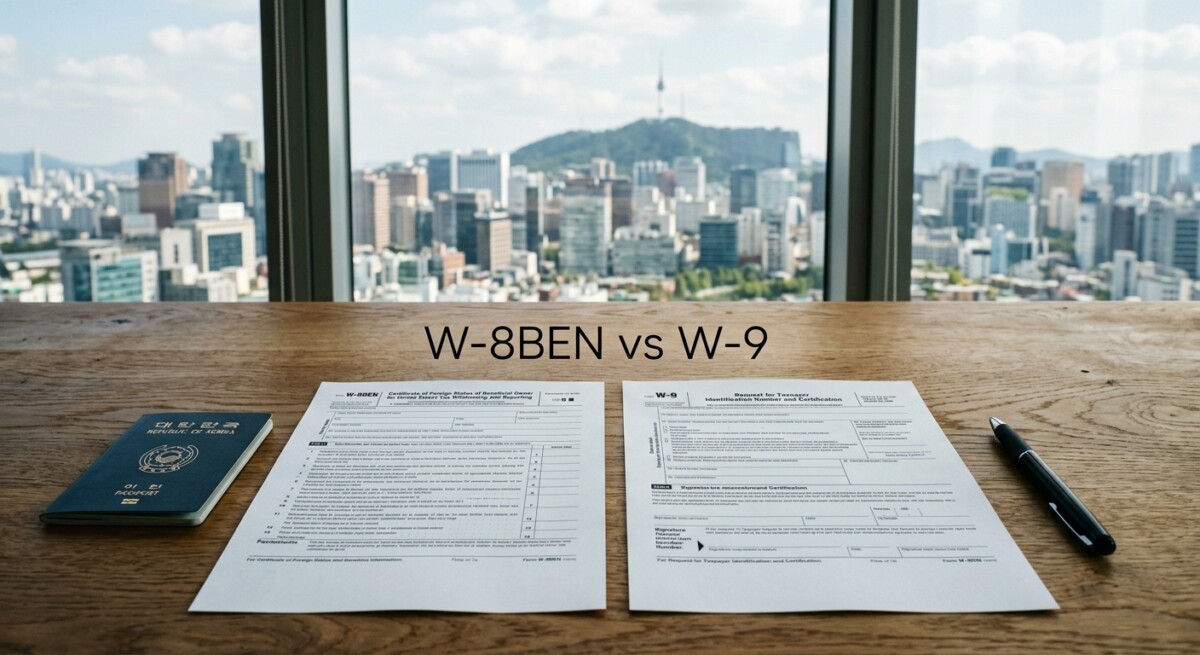
W-8BEN vs W-9 at a Korean bank — which form do I file? If you are a US citizen or green-card holder, you file W-9; if you are a non-US Korean national with the account, you file W-8BEN. The form proves your US tax status under FATCA and lets Korean brokers apply the right US withholding rate on US-source dividends and interest.
If you have ever walked into a KakaoBank, Toss, Kiwoom Securities, or Mirae Asset branch and been handed a one-page form in English asking you to tick “U.S. person” or “foreign person,” the question of w8ben vs w9 suddenly becomes very practical. Pick wrong and the Korean financial institution reports you to the IRS as something you are not; refuse to sign and the account can be frozen or hit with a 30% withholding haircut on every US dividend. This guide walks through who should file which form, how to complete each line for a Korean account, and how to claim the US-Korea tax treaty rate on US stocks held through a Korean broker.
The questions below come up in our practice almost every week — most often from Korean-American business owners who kept their Korean bank from before they naturalized, and from Korean parent companies whose US subsidiaries received payments routed through a Korean trust account.
What is W-8BEN vs W-9 and why is my Korean bank asking? 🏦
Both forms certify your US tax status to a financial institution, but w8ben vs w9 is really a yes/no question: are you a US person for tax purposes? Yes = W-9. No = W-8BEN.
The IRS defines a “US person” to include US citizens, lawful permanent residents (green-card holders), and anyone who meets the Substantial Presence Test under Internal Revenue Code §7701(b). US corporations, partnerships, trusts, and estates are also US persons. Everyone else — most notably a Korean citizen who has never held a green card — is a “foreign person” and uses one of the W-8 series forms. For individuals, that form is Form W-8BEN.
Korean banks are not asking out of curiosity. Under the Foreign Account Tax Compliance Act (FATCA) and the US-Korea intergovernmental agreement that implements it, every Korean financial institution must identify which of its account holders are US persons and report those accounts annually to the Korean National Tax Service, which then forwards the data to the IRS. The W-9 or W-8BEN is the documentation that lets the bank classify you. No form on file means the bank must either close the account or treat you as a “recalcitrant account holder” subject to 30% withholding on US-source payments.
If I am a US citizen or green-card holder, do I file W-9 or W-8BEN? 📋
You file W-9. A green-card holder living in Seoul is still a US tax resident until the card is formally surrendered, and filing W-8BEN in that situation is a false certification that FATCA cross-matching will almost certainly flag.
Under IRC §7701(b)(1)(A)(i), you are a resident alien of the United States from the first day of the calendar year in which you receive a green card and remain a resident until the card is abandoned, revoked, or determined to be abandoned. The IRS Green Card Test is categorical: physical location in Korea is irrelevant. If you still carry an unexpired green card, you file W-9 even if you have not set foot in the US for three years.
The common trap is the Korean-American who moved back to Korea years ago, stopped filing US returns, and now assumes a W-8BEN is appropriate because “I live in Korea.” A W-8BEN signed by a current green-card holder is a false IRS form. When the bank’s FATCA report later shows you as a “foreign account holder” while your green card remains active in USCIS records, the mismatch creates an audit flag — one that typically arrives together with a reminder that FBAR (FinCEN Form 114) was due and that Form 8938 may also have been missed.
CPA Insight: In our practice, by far the most common quiet error we clean up is a long-term green-card holder in Korea who ticked “non-US person” on a W-8BEN at a Korean bank years ago. The usual fix is not just a corrected W-9 going forward — it is also delinquent FBARs and often a Streamlined Foreign Offshore submission to come into compliance without the willful FBAR penalty, which can reach 50% of the account balance.
If you are genuinely done with the US tax system, the path is to surrender the green card by filing Form I-407 with USCIS and then — if you held it in at least 8 of the prior 15 tax years — run through the covered-expatriate rules under IRC §877A before you switch forms.
What goes on each line of the W-9 for a Korean bank account? ✍️
A W-9 for a Korean brokerage or deposit account is just the standard IRS Form W-9 (Rev. March 2024). The address can be your Korean residential address — the IRS cares about the TIN, not where you receive mail.
| Line | What to enter | Common mistake |
|---|---|---|
| Line 1 — Name | Your full legal name as it appears on your SSN card, matching the Social Security Administration’s record exactly. | Writing your Korean legal name instead of the English name on the SSN card. |
| Line 3a — Federal tax classification | “Individual/sole proprietor or single-member LLC” for a personal account. | Checking “C corporation” because the account is held through a Korean 법인 — the W-9 classification is a US tax classification, not a Korean one. |
| Lines 5–6 — Address | Your current residence. A Korean address is fully acceptable. | Using a US relative’s address “because the form is a US form” — mismatched address and 1099 reporting creates its own problems. |
| Part I — TIN | Your SSN (nine digits). If you were never issued one, your ITIN. | Writing your 주민등록번호 (Korean resident registration number). The W-9 requires a US-issued TIN only. |
| Part II — Certification | Signature and date. Perjury statement attached — read it before signing. | Leaving backup-withholding box unchecked when you have actually received an IRS underreporting notice. |
⚠ Security warning — do not email your W-9 as a plain attachment. Your SSN is on it. The IRS has published repeated reminders that SSNs sent over unencrypted email are the single most common entry point for return-season identity theft. Deliver the completed W-9 at the branch, through the bank’s encrypted document portal, or by registered mail.
The second trap is forgetting that filing a W-9 at a Korean broker does not substitute for filing your US return. The 1099-INT or 1099-DIV reported by the Korean institution flows to the IRS; you still need to report that same interest and dividend income on your Form 1040, and you still need to meet the FBAR threshold test (aggregate foreign accounts over $10,000 at any point in the year) and the Form 8938 threshold (varies by filing status and residency) on your own.
How does a Korean national claim the US-Korea tax treaty on W-8BEN? 🇰🇷🇺🇸
You claim it in Part II of the Form W-8BEN. The treaty cuts US dividend withholding from a default 30% to 15%, and US interest withholding from 30% to 12%, if you provide a Korean foreign TIN and the correct treaty article.
Without a W-8BEN, Korean brokers that give you access to US-listed stocks are required under IRC §1441 and §1442 to withhold 30% on every dividend from Apple, Microsoft, or any other US issuer, and on US-source interest, before crediting your account. The United States–Korea Income Tax Convention lowers that rate once you certify, in writing, that you are a Korean resident entitled to treaty benefits.
| Income type | Default US withholding | Treaty rate | Treaty reference |
|---|---|---|---|
| Dividends | 30% | 15% | US-Korea Treaty Article 12 |
| Interest | 30% | 12% | US-Korea Treaty Article 13 |
| Royalties (patents, copyrights, software) | 30% | 10% or 15% | US-Korea Treaty Article 14 |
Three lines on the W-8BEN decide whether the treaty rate actually applies:
- Line 2 — country of citizenship. For most readers of this post, “Korea” or “Republic of Korea.” Writing “United States” voids the form and triggers backup withholding.
- Line 3 — permanent residence address. Must be a physical Korean address. A US address, a P.O. box, or the Korean broker’s own office address makes the form invalid under Treas. Reg. §1.1441-1(e)(2). If your mailing address is different, put it on Line 4.
- Line 6a — foreign TIN. Enter your Korean resident registration number (주민등록번호) or business registration number for a Korean entity. Without the foreign TIN, the US withholding agent is instructed under §1.1441-1(e)(4)(vii) to apply the statutory 30% rate.
- Part II — treaty claim. Fill in “Korea,” the article number, the rate, and the type of income. For example: Korea / Article 12 / 15% / dividends.
A W-8BEN is not permanent. Under Treas. Reg. §1.1441-1(e)(4)(ii), the form stays valid from the date it is signed until the last day of the third succeeding calendar year — a form signed in May of year 1 expires December 31 of year 4. It also becomes invalid immediately upon a change in circumstances that affects the claim (for example, you obtain US permanent residency). The treaty rate drops back to 30% the first business day the broker’s system flags the form as expired, and recovering the over-withheld amount later requires filing Form 1040-NR with the IRS, which the broker will not do for you.
What happens if I refuse to file, or file the wrong form? 🚫
Under FATCA, a Korean financial institution has only three choices for an undocumented account: close it, apply the 30% penalty withholding rate, or classify you as a “recalcitrant account holder” and report the account to the Korean National Tax Service for forwarding to the IRS anyway.
The Korea-US FATCA intergovernmental agreement, in force since 2016, requires every Korean bank, securities firm, and insurer to identify “US indicia” on each account — a US place of birth, a US phone number, a US address, standing instructions to transfer funds to a US account, or a power of attorney granted to someone with a US address. If any indicium is present and the account holder refuses to produce a W-9 (if a US person) or a W-8BEN (if not), the institution must still report the account; it has no option to simply leave the box blank.
Filing the wrong form is worse than filing nothing. A W-9 signed by a non-US person carries a false TIN; a W-8BEN signed by a US person is a certification of foreign status under penalties of perjury. Both expose you to IRC §6701 penalties for aiding and abetting an understatement of tax liability, in addition to the civil fraud penalty under §6663. In practice, the IRS enforcement path is less dramatic — most matches surface during the FATCA reconciliation and lead to a request for a corrected form and the past-due returns — but the available penalty is severe enough that the correct answer is always to file the right form on the first try.
Dual-status years need special care. If you obtained your green card mid-year or surrendered it mid-year, part of that calendar year you were a resident alien and part of it you were a nonresident alien. The Korean broker will often ask for both forms, or for a single form with a change-of-status attachment. Pair the correct form for each period with a Form 8833 treaty-based return position disclosure on your US return if you are using the US-Korea treaty tiebreaker (Article 4) to be treated as a Korean resident for part of the year. The treaty tiebreaker is a last resort, not a planning tool — if you still spend substantial time in the US, it is likely to fail.
Summary — the four points to take away
- US person = W-9. Everyone else = W-8BEN. Physical location in Korea does not change your US tax status.
- Green-card holders in Korea still file W-9. A W-8BEN signed by a green-card holder is a false IRS form that FATCA cross-matching will catch.
- Korean nationals use W-8BEN Part II and a Korean TIN to cut US dividend withholding from 30% to the 15% US-Korea treaty rate (12% for interest).
- Refusing to file leads to account closure or 30% backup withholding. The Korean institution has no “do nothing” option under FATCA.
Frequently asked questions 💬
Do I need an ITIN before I can sign a W-9 for a Korean broker?
No — only if you do not have an SSN. If you are a US citizen or green-card holder you already have an SSN, and that is the TIN that goes on Part I of the W-9. ITINs are only for US-tax-filing individuals who are ineligible for an SSN (typically dependents on a nonresident return).
I had a green card but let it expire ten years ago without filing I-407 — am I still a US tax resident?
Likely yes, until you formally abandon it. Under IRC §7701(b)(6), lawful permanent resident status for US tax purposes ends only when the card is formally revoked or administratively or judicially determined to have been abandoned. Letting the card lapse at the border does not, by itself, end US tax residency. Talk to an immigration attorney and a CPA before switching to W-8BEN.
What is the difference between W-8BEN and W-8BEN-E?
W-8BEN is for individuals; W-8BEN-E is for entities. A Korean 법인 that opens a brokerage account for a US-listed ETF investment uses W-8BEN-E and claims treaty benefits by specifying the entity’s status (for example, “corporation” meeting the limitation-on-benefits article).
Does filing W-9 at my Korean bank increase the US tax I owe?
The form itself does not create tax. It only confirms that the Korean institution should report your interest, dividends, and account balances to the IRS. If you are a US citizen or green-card holder you were already required to report that income on Form 1040 and the account on FBAR; the W-9 just makes sure the IRS sees the same numbers you report.
Can my Korean 세무사 (tax accountant) sign the W-8BEN on my behalf?
Only with a specific written authorization. Part III of the W-8BEN requires the signature of the beneficial owner or a person authorized to sign for the beneficial owner. A general power of attorney is usually not sufficient — most US withholding agents require a Form 2848 or an equivalent IRS-recognized authorization.
Where do I actually get the forms?
Download the current revision directly from the IRS: Form W-9 and Form W-8BEN. Many Korean brokers also provide a pre-populated version through the mobile app, but check that the revision date matches the IRS version — using an old revision is a common reason banks reject the paperwork.