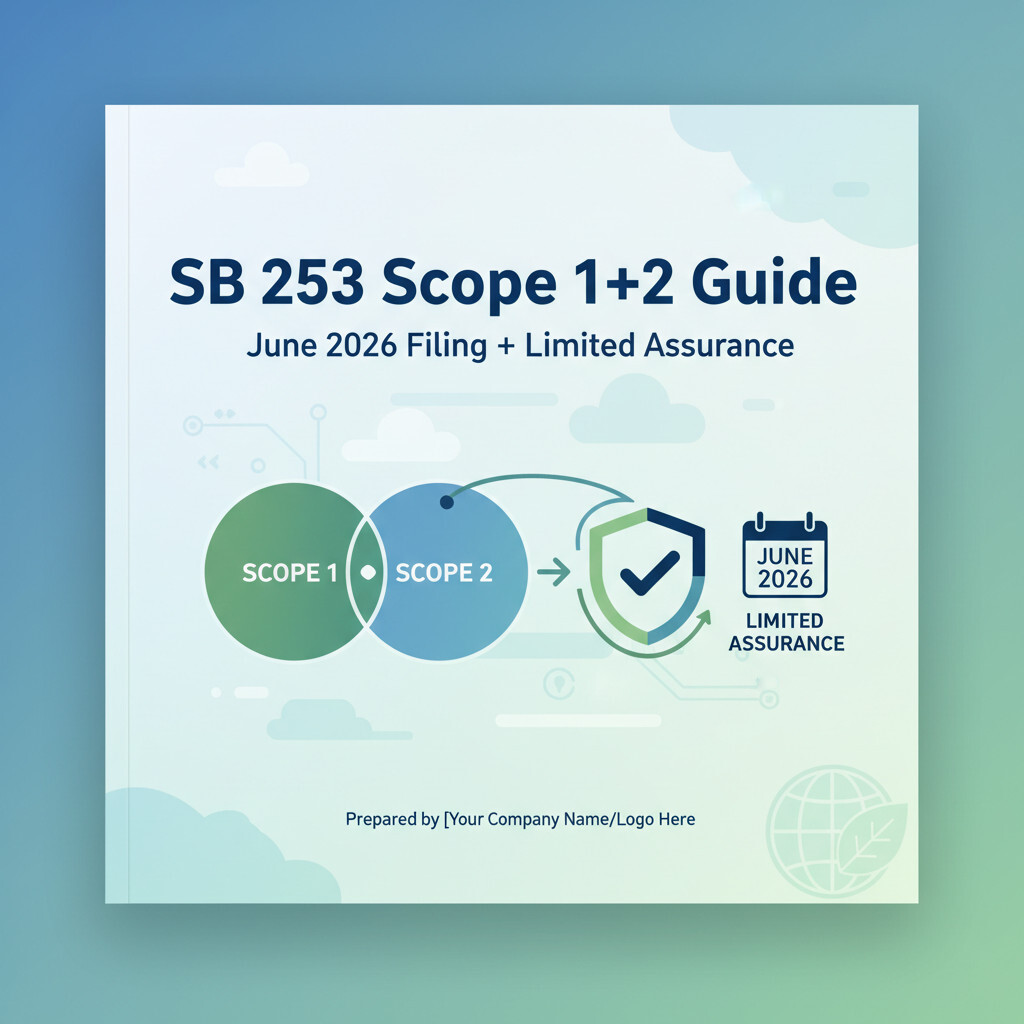
SB 253 Scope 1+2 Guide: June 2026 Filing + Limited Assurance
SB 253’s first reporting deadline lands in seven months — and unlike Scope 3 (which gets a year of buffer and lighter assurance), SB 253 Scope 1 and Scope 2 measurement ships with LIMITED ASSURANCE from day one. That changes the standard of evidence companies need to bring. Spreadsheet-based emissions accounting that worked for voluntary CDP submissions will not pass independent assurance review.
At SW Accounting & Consulting Corp, we work with Los Angeles area finance and sustainability teams preparing their first-cycle SB 253 filings. Below: what the GHG Protocol actually requires for Scope 1 and 2, the location-based vs. market-based dual reporting requirement, the limited assurance standard, and the 5-month preparation sequence we use with clients filing in June 2026.
What is Scope 1? 🏭
Scope 1 covers direct GHG emissions from sources owned or controlled by the reporting entity — primarily combustion of fuels (natural gas, propane, diesel, gasoline) in facilities, fleet vehicles, and on-site equipment, plus refrigerant losses and process emissions.
Typical Scope 1 categories:
- Stationary combustion — natural gas, propane, fuel oil burned for heating, hot water, on-site generators, manufacturing processes.
- Mobile combustion — gasoline, diesel, jet fuel in owned/leased fleet vehicles, forklifts, company aircraft.
- Fugitive emissions — HFC and other refrigerant leakage from HVAC, chillers, refrigeration; SF6 from electrical switchgear; CH4 leakage at gas-handling facilities.
- Process emissions — chemical reactions in cement production, chemicals manufacturing, semiconductors (e.g., CO2 released during cement clinker calcination).
Measurement is straightforward conceptually — activity data (gallons of fuel, kWh of equipment runtime, kg of refrigerant) times an emission factor (kg CO2e per unit) — but the auditor will look at the underlying records: fuel purchase invoices, fleet odometer readings, refrigerant maintenance logs, calibration records of meters used.
What is Scope 2? ⚡
Scope 2 covers indirect GHG emissions from purchased electricity, heat, steam, and cooling consumed by the reporting entity. For most non-industrial companies, Scope 2 = purchased electricity. The GHG Protocol’s Scope 2 Guidance (2015 amendment) requires BOTH location-based and market-based methods to be reported.
| Method | What it measures | Emission factor |
|---|---|---|
| Location-based | Average emissions intensity of the grid where you draw electricity | eGRID subregion average (U.S.), residual mix, or national average |
| Market-based | Emissions attributable to electricity you specifically procured (green tariffs, RECs, PPAs) | Contract-specific (PPA, REC) → supplier-specific → residual mix |
Why both: location-based shows your physical impact on the grid; market-based shows your procurement choices. A data center with 100% renewable PPA can have a near-zero market-based Scope 2 while still drawing from a fossil-heavy local grid (location-based remains high).
For data center and AI-heavy operations, Scope 2 often exceeds Scope 1 by 10× or more. Hourly time-matched renewable procurement (24/7 carbon-free energy) is becoming the new standard regulators and investors look at — annual REC averaging is increasingly viewed as a weak claim. Plan procurement strategy now, not at filing time.
What does “limited assurance” require? 🔍
Limited assurance (under ISAE 3000 / AICPA SSAE 18 / ISAE 3410 for GHG) is a lower bar than the “reasonable assurance” required for audited financial statements — but it is still independent third-party verification. The assurance provider expresses a conclusion in the form “nothing came to our attention that indicates the GHG inventory is not, in all material respects, in accordance with the criteria.” Compare with reasonable assurance: “the inventory is fairly stated.”
What an assurance team will sample:
- Organizational boundary documentation — which entities, which sites are included; equity vs. operational control consolidation method.
- Activity data source records — utility bills, fuel invoices, refrigerant logs traced from totals back to original document.
- Emission factor library — versions used (EPA Emission Factors Hub, IEA, eGRID subregion factor with vintage year), application logic.
- Calculation workpapers — formulas, unit conversions, sample re-performance.
- Internal controls — who approves the inventory, segregation of duties, evidence of management review.
What is the 5-month prep sequence to June 30, 2026? 📅
For companies filing first-cycle SB 253 Scope 1+2 in June 2026, here is the minimum-viable sequence. This assumes fiscal year 2025 data as the reporting period — adjust if your fiscal year differs.
| Month | Milestone |
|---|---|
| Jan 2026 | Confirm in-scope. Document organizational boundary (equity vs. control). Engage assurance provider. |
| Feb 2026 | Inventory all Scope 1 sources (stationary, mobile, fugitive, process). Build site-by-site activity-data inventory. |
| Mar 2026 | Collect activity data: fuel invoices, fleet records, refrigerant logs, utility bills. Lock emission factor library (EPA Hub, eGRID 2024 vintage). |
| Apr 2026 | Calculate Scope 1 + Scope 2 location-based AND market-based. Assemble market-based instrument evidence (PPAs, RECs, green tariffs). |
| May 2026 | Assurance fieldwork: assurance team samples records, re-performs calculations, tests internal controls. |
| Jun 2026 | Resolve audit findings. Publish report by June 30 with limited assurance opinion. File via CARB digital platform. |
The most common audit finding in first-cycle GHG inventories: emission factors from inconsistent vintage years (e.g., 2021 eGRID for some grid regions, 2024 for others). Lock a single vintage at the start of the reporting period and document the choice. The assurance team will not let you “average” across factor releases.
Frequently asked questions about SB 253 Scope 1+2 measurement
The GHG Protocol allows equity share OR operational control OR financial control. Most U.S. SB 253 filers use operational control for consistency with management reporting and to match financial statement consolidation. Document the choice in your methodology memo — auditors will ask.
Only for the MARKET-BASED method, and only if the RECs are unbundled, retired in the reporting period, sourced from the same market as your consumption, and meet GHG Protocol Scope 2 Quality Criteria. Location-based Scope 2 ignores RECs by design.
Use the residual mix factor for your subregion (eGRID for U.S.) for the market-based method when no contractual instruments apply. Document the fallback in your methodology log.
SB 253 Scope 3 disclosures begin in 2027 (for fiscal year 2026 data). Limited assurance for Scope 3 begins in 2030. Different deadline, different assurance schedule — see our prior post on Scope 3 supplier engagement.
How can SW Accounting help? 💼
At SW Accounting & Consulting Corp, we help LA-area finance and sustainability teams build first-cycle SB 253 Scope 1+2 inventories — organizational boundary memos, activity data collection, emission factor library curation, location-based AND market-based Scope 2 dual reporting, methodology documentation packs ready for limited assurance review, and audit support during the assurance fieldwork window.
📩 Schedule an SB 253 Scope 1+2 readiness consultation
Disclaimer: This article is for informational purposes only and is not legal or tax advice. Always consult a qualified professional regarding your specific facts. Primary sources: California Health & Safety Code §38532 (SB 253), CARB rulemaking and enforcement notices, GHG Protocol Corporate Accounting and Reporting Standard, GHG Protocol Scope 2 Guidance (2015), EPA Emission Factors Hub, eGRID.
Need help with SB 253 or climate disclosure? SW Accounting provides framework advisory, vendor data readiness, and formal CPA assurance (SSAE AT-C 210 / ISAE 3410). Explore our ESG & Climate Disclosure services →