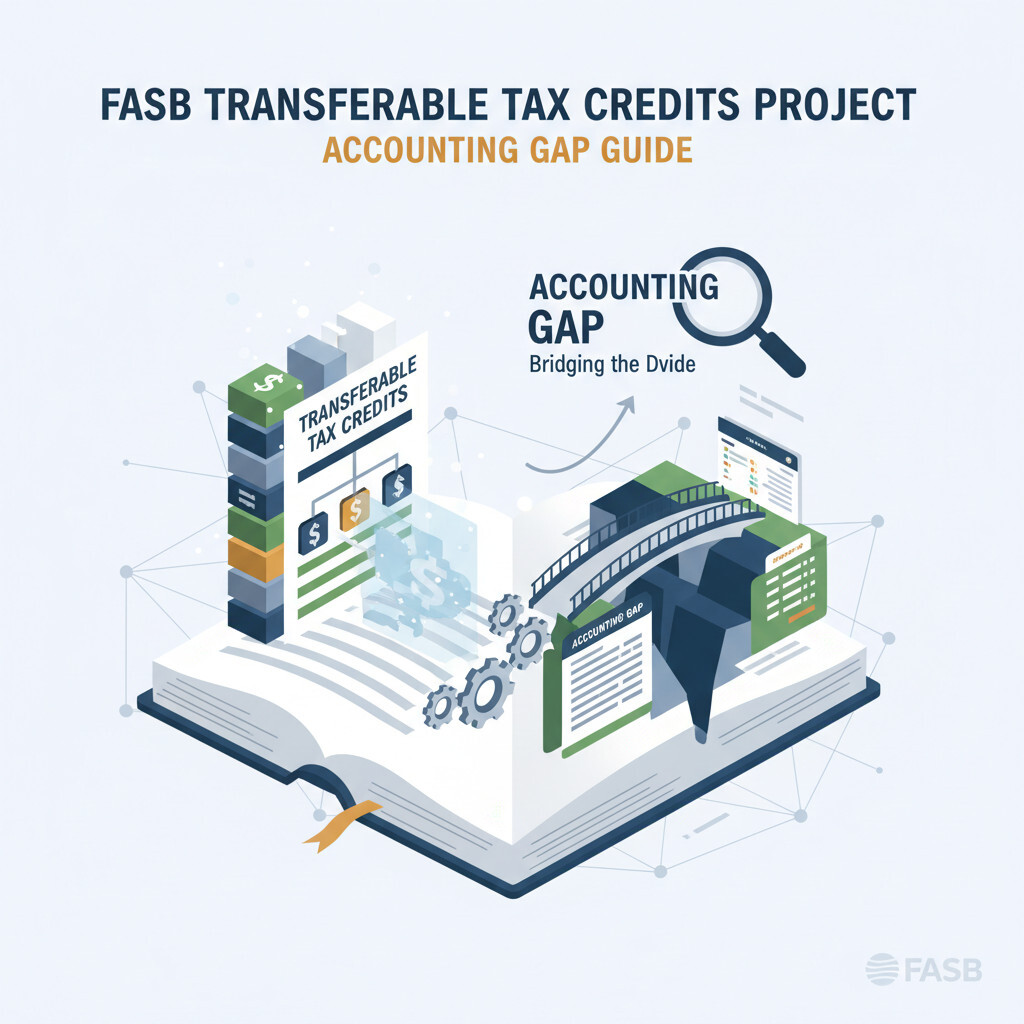
FASB Transferable Tax Credits Project: Accounting Gap Guide
The volume of transferable tax credits entering U.S. financial reporting since 2022 is unprecedented. The CHIPS and Science Act, Inflation Reduction Act (IRA), and One Big Beautiful Bill Act (OBBBA) of 2025 each introduced new categories of credits — many designed explicitly to be transferable so smaller renewable developers can monetize credits to large taxpayers with offsetting income. Current U.S. GAAP was not written for this, and diversity in practice has emerged.
At SW Accounting & Consulting Corp, we work with corporate finance teams holding or acquiring transferable credits — from solar developers monetizing ITCs to manufacturers claiming semiconductor credits to fund managers transacting in credit markets. Below: what the FASB voted to do, the current GAAP gap, the analogies in play, and what the eventual standard is likely to address.
What did the FASB vote on? 🗳
In May 2026, the FASB voted to ADD a project to its technical agenda specifically on the accounting treatment of nonrefundable transferable tax credits. The project will produce an ASU; FASB Chair Rich Jones and Board Member Hillary Salo both spoke in favor. The vote does not yet specify recognition rules — that is what the project will decide.
Key questions the project will address:
- What IS a transferable tax credit? Asset or financial instrument? The classification cascades into all other accounting questions (recognition, measurement, presentation, impairment).
- When does the credit become recognizable? When earned (project placed in service)? When certified by Treasury? When a transferee buyer is identified?
- How is gain or loss on transfer presented? Above the income tax line (as a tax-related item) or below (operating income)? Stakeholders have asked specifically for clarity here.
- How does the valuation allowance guidance apply? Jones suggested the project look at this — relevant for credits the holder might NOT use (and might therefore want to sell).
- How does this interact with new government grant guidance (ASC 832)? The board considered transferable credits during its government grants project — that work informs this project.
What’s the current U.S. GAAP gap? 📏
U.S. GAAP today recognizes investment tax credits (ITCs) under either the deferral method or the flow-through method (ASC 740). But these models pre-date transferability. A tax credit you cannot sell is unambiguously an offset against income tax liability. A tax credit you CAN sell starts to behave like an asset — and possibly a financial instrument with a market value that can fluctuate.
| Analogy | When it’s used | Limitation |
|---|---|---|
| ASC 740 (Income taxes) | Credit holder plans to use the credit to offset own tax | Doesn’t address sale to a third party or pre-sale fair value |
| ASC 832 (Government assistance) | Treats the credit as a government grant (disclosure-only, not recognition) | ASC 832 explicitly scopes out transactions in scope of ASC 740 — boundary disputed |
| ASC 470 (Debt) or 825 (Financial instruments) | Pre-sale credits with active markets and observable pricing | No clear authoritative basis — analog only |
| IFRS IAS 20 (proxy) | Some U.S. preparers reference IAS 20 government grants for analogous fact patterns | Not U.S. GAAP — disclosure required if relied on |
With no authoritative U.S. GAAP guidance, two companies receiving identical IRA credits can legitimately apply different accounting models and arrive at different financial statement presentations. Auditors are scrutinizing the methodology choice and disclosure — companies should document the analogy, the policy election, and the consistency of application year-over-year.
What credits are affected? ⚡
Transferability under IRC §6418 covers most IRA-era clean energy credits, plus CHIPS and OBBBA additions. Each has different mechanics around transfer timing, IRS notification, and recapture risk.
| Credit | Statute | Transferable? |
|---|---|---|
| Investment Tax Credit (ITC) — solar, storage, geothermal | IRC §48 / §48E | Yes (§6418) |
| Production Tax Credit (PTC) — wind, solar, nuclear | IRC §45 / §45Y | Yes (§6418) |
| Advanced Manufacturing PTC — solar, wind, battery components | IRC §45X | Yes (§6418) |
| Advanced Manufacturing Investment Credit — semiconductors (CHIPS) | IRC §48D | Refundable election (similar mechanics) |
| Carbon Capture (45Q) | IRC §45Q | Yes (§6418) |
| Clean Hydrogen (45V) | IRC §45V | Yes (§6418) |
What should preparers do NOW (before the new ASU)? 📋
Until the FASB issues final guidance (likely 2027 at earliest), companies holding or trading transferable credits should establish defensible policy elections and disclosure now — both because financial statement audit cycles will not wait, and because consistency-of-application becomes a transition issue when the new ASU lands.
- Policy memo — document the analogy chosen (ASC 740, ASC 832, etc.), the rationale, and the consistency commitment.
- Recognition trigger — define the point at which the credit is recognized: project placed in service, IRS Form 7700-series filing, transferee identified.
- Measurement basis — face value, fair value, or net realizable value if you intend to sell; document the basis and the inputs.
- Income statement classification — above-the-line (revenue, operating) or below-the-line (income tax expense / benefit). Get this right early — restating later is messy.
- Disclosure — provide robust footnote disclosure of the policy election, accounting analogy, and amounts recognized or transferred. Auditors will request this.
Frequently asked questions about transferable tax credits
The board just added the project in May 2026. Typical FASB project timeline (research → exposure draft → comment period → final ASU) is 18–30 months. Final ASU likely 2027–2028 with an effective date 12–24 months later.
IFRS preparers typically apply IAS 20 (Government Assistance) and IAS 12 (Income Taxes). Neither was written for the transferability mechanic, so IFRS has comparable diversity. IASB has not opened a parallel project.
CHIPS §48D uses a refundability election (the taxpayer can elect to receive the credit as a direct payment from Treasury) rather than the §6418 transferability mechanism. Mechanically similar effect but different statutory provision — and different accounting questions about timing of recognition.
IRA credits carry recapture risk if the underlying property ceases to qualify (e.g., facility shutdown within 5 years for §45). Both the original holder and the transferee buyer face recapture exposure. Document recapture provisions in the transfer agreement and disclose recapture risk in financial statements.
How can SW Accounting help? 💼
At SW Accounting & Consulting Corp, we advise LA-area corporate finance teams on transferable tax credit accounting — policy memo drafting under existing GAAP, recognition trigger analysis, gain/loss presentation, audit support during interim and annual reviews, and transition planning for the eventual FASB ASU. Whether you are a generator selling IRA credits, a buyer using them to offset income, or a fund transacting in credit markets, we help you set defensible policies now.
📩 Schedule a transferable tax credit accounting consultation
Disclaimer: This article is for informational purposes only and is not legal, tax, or accounting advice. Always consult a qualified professional regarding your specific facts. Primary sources: FASB May 2026 board meeting materials; Internal Revenue Code §6418 (transferability), §45, §48, §45X, §45Q, §45V, §48D; Inflation Reduction Act (P.L. 117-169), CHIPS and Science Act (P.L. 117-167), One Big Beautiful Bill Act of 2025; ASC 740, ASC 832, ASC 470.