ISSB Global Baseline: IFRS S1/S2 Sustainability Disclosure Guide
Sustainability reporting spent a decade fragmented across competing voluntary frameworks. That era is closing. The ISSB global baseline — IFRS S1 and IFRS S2 — has moved from concept to cornerstone, and by 2026 governments and capital markets increasingly treat it as the reference point for climate- and sustainability-related financial disclosure. The frameworks differ in legal form jurisdiction by jurisdiction, but the direction of travel is unmistakable: standardized, decision-useful, investor-grade sustainability data embedded in mainstream corporate reporting.
At SW Accounting & Consulting Corp, we advise Los Angeles area companies — many with cross-border operations or global investors — on building a coherent sustainability reporting architecture. Below: what the ISSB baseline is, how IFRS S1 and S2 are structured, how China and the Philippines are converging, where the U.S. fits, and what to build now.
What are IFRS S1 and IFRS S2? 🌍
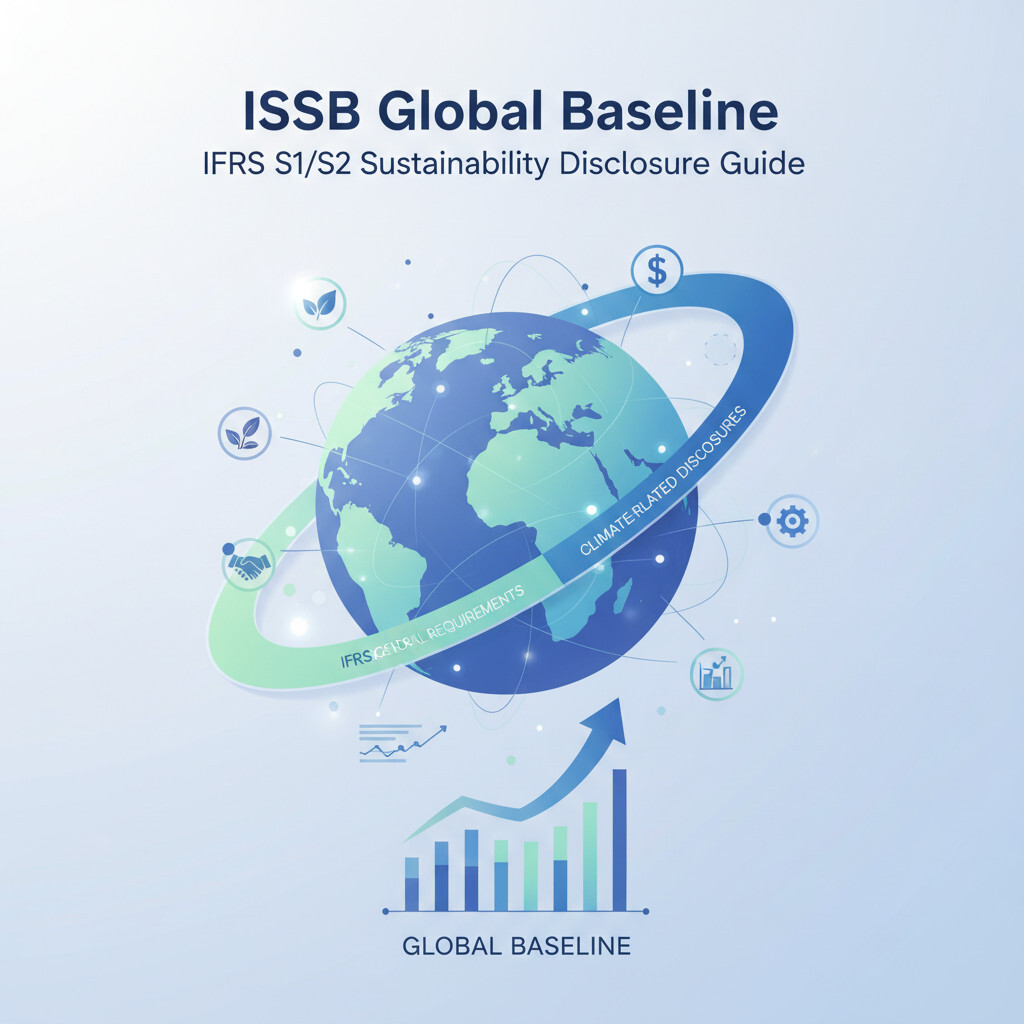
IFRS S1 and IFRS S2 are the two inaugural ISSB standards. IFRS S1 sets the general requirements for disclosing sustainability-related financial information; IFRS S2 sets the specific climate-related disclosure requirements. Both are built on the same four-pillar architecture inherited from the TCFD framework.
| Standard | What it covers |
|---|---|
| IFRS S1 | General requirements — disclose material sustainability-related risks and opportunities that could reasonably affect a company’s cash flows, access to finance, or cost of capital over the short, medium, and long term. |
| IFRS S2 | Climate-specific — physical and transition risks, greenhouse gas emissions (Scope 1, 2, and 3), climate resilience and scenario analysis. Designed to be applied alongside IFRS S1. |
The four pillars both standards share:
- Governance — the board and management’s oversight of sustainability risks and opportunities.
- Strategy — how those risks/opportunities affect the business model, strategy, and financial planning.
- Risk management — how the company identifies, assesses, and manages them.
- Metrics & targets — the measures and goals used to track performance.
ISSB is explicitly designed as a baseline, not a ceiling. Jurisdictions can adopt IFRS S1/S2 as-is or add requirements on top (“building blocks” approach). For a company, that means an ISSB-aligned report satisfies the core of most regimes; you then bolt on the local extras (EU CSRD’s double materiality, California’s specific filing mechanics) rather than rebuilding from scratch.
How are major economies converging? 🗺
Jurisdictions are taking different legal paths to the same destination. The common thread: governance, strategy, risk management, and metrics anchored to the ISSB pillars.
| Jurisdiction | Approach |
|---|---|
| China (CSDS) | China’s Sustainability Disclosure Standards introduce double materiality (impact + financial) into national sustainability reporting — a major signal given the scale of Chinese capital markets. |
| Philippines | Aligning national disclosure frameworks toward ISSB principles, illustrating adoption beyond the largest economies. |
| European Union (CSRD) | The Corporate Sustainability Reporting Directive — one of the most comprehensive regimes globally — requires standardized climate, environmental, and social disclosures with governance oversight and assurance. Interoperability with ISSB is a stated goal. |
| United States | No single federal mandatory framework; political resistance has slowed nationwide action. States have moved instead — California’s SB 253 (GHG emissions) and SB 261 (climate financial risk) are the landmark examples. |
ISSB (IFRS S1/S2) uses financial materiality: disclose what affects enterprise value. EU CSRD and China’s CSDS use double materiality: also disclose the company’s impact on people and planet, regardless of financial effect. A company subject to both must capture the wider double-materiality data set — an ISSB-only report will not be sufficient for EU or Chinese requirements.
Where does the U.S. company fit? 🇺🇸
Even without a federal mandate, U.S. companies are pulled into the ISSB orbit through three channels: global investors who expect ISSB-comparable data, EU/Asian customers and parents subject to mandatory regimes, and state laws like California’s that impose their own disclosure obligations.
Practical exposure paths for a U.S. company:
- You do business in California over the revenue thresholds — SB 253 ($1B revenue, GHG emissions) and/or SB 261 ($500M revenue, climate financial risk) apply directly.
- You supply to or are owned by an EU-regulated company — CSRD value-chain reach pulls you into the data request.
- You raise capital from global investors — institutional investors increasingly expect ISSB-comparable disclosures as a condition of access.
- You operate in a jurisdiction adopting ISSB — subsidiaries in Asia/Latin America may face local ISSB-aligned mandates.
What should you build now? 🛠
Build one ISSB-aligned reporting backbone and layer jurisdiction-specific requirements on top. This avoids maintaining duplicative frameworks and positions you for whichever regime reaches you first.
- Map your exposure — list every jurisdiction and customer/investor relationship that could trigger a disclosure obligation. Identify the earliest binding deadline.
- Adopt the four-pillar structure — organize governance, strategy, risk management, metrics & targets now, even for a voluntary first report.
- Stand up GHG accounting — IFRS S2 (and California SB 253) require Scope 1, 2, and eventually 3 emissions under the GHG Protocol. Build the inventory early.
- Decide your materiality lens — financial only (ISSB) vs. double (CSRD/China). Capture the wider data set if any double-materiality regime applies to you.
- Prepare for assurance — investor-grade data must withstand independent verification. Document methodology and source records from day one.
Frequently asked questions about the ISSB global baseline
No. There is currently no single mandatory federal sustainability disclosure framework in the U.S. Action has come from states — most prominently California’s SB 253 and SB 261 — and from market/investor expectations rather than a federal ISSB mandate.
ISSB’s IFRS S2 is built on the TCFD’s four-pillar structure (governance, strategy, risk management, metrics & targets) and effectively consolidates and succeeds TCFD reporting. Companies that already reported under TCFD have a head start on IFRS S2.
ISSB uses financial materiality (what affects enterprise value); the EU’s CSRD uses double materiality (financial impact AND the company’s impact on people and planet). CSRD is also broader in social/environmental scope. The two are designed to be interoperable but are not identical.
Directly, usually not yet — but indirectly, increasingly yes. If you supply to a large company subject to CSRD or California’s laws, you may receive data requests. Building basic GHG and governance data now reduces scramble later.
How can SW Accounting help? 💼
At SW Accounting & Consulting Corp, we help LA-area companies build ISSB-aligned sustainability reporting architectures — exposure mapping across jurisdictions, four-pillar report structuring, GHG inventory setup under the GHG Protocol, materiality-lens determination (financial vs. double), and assurance-readiness documentation. We help you build once and report many times, instead of rebuilding for every regime.
📩 Schedule an ISSB readiness consultation
Disclaimer: This article is for informational purposes only and is not legal, tax, or accounting advice. Always consult a qualified professional regarding your specific facts. Primary sources: IFRS Foundation / International Sustainability Standards Board (ISSB) — IFRS S1 General Requirements and IFRS S2 Climate-related Disclosures; EU Corporate Sustainability Reporting Directive (CSRD); China Sustainability Disclosure Standards (CSDS); California Health & Safety Code §38532 (SB 253) and §38533 (SB 261); GHG Protocol.
Need help with SB 253 or climate disclosure? SW Accounting provides framework advisory, vendor data readiness, and formal CPA assurance (SSAE AT-C 210 / ISAE 3410). Explore our ESG & Climate Disclosure services →