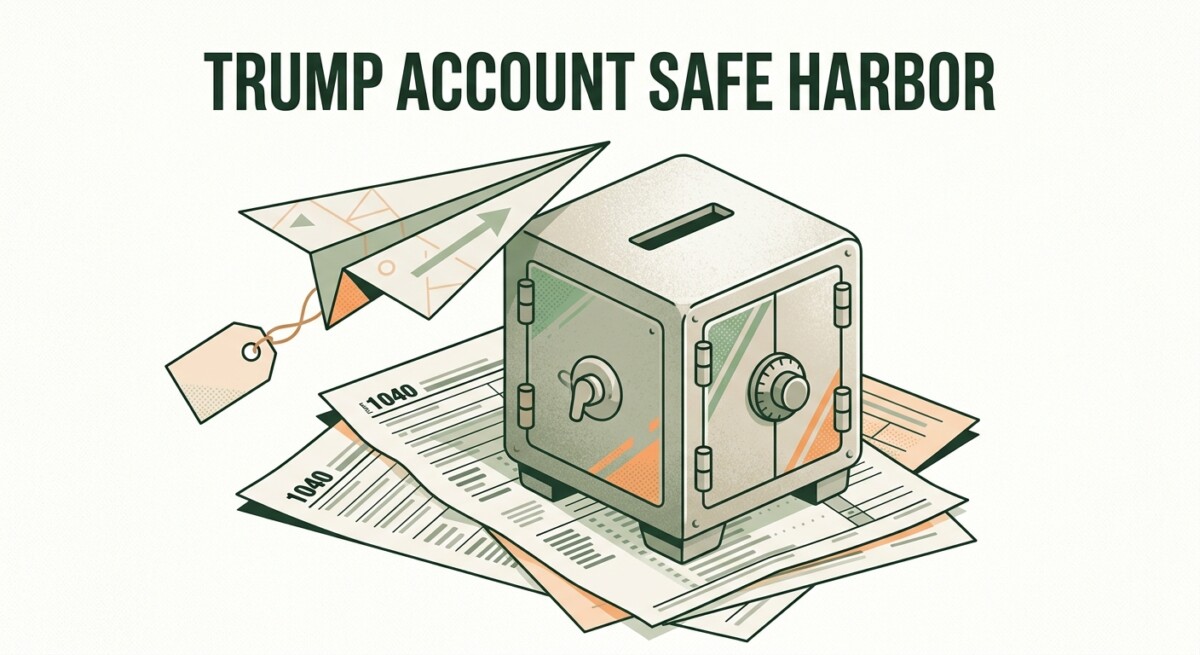
Trump Account Gift Tax Safe Harbor (Rev. Proc. 2026-25)
The launch of the new Section 530A “Trump Accounts” on July 4, 2026 came with a technical wrinkle that surprised a lot of families: because the money is locked up until the child turns 18, contributions look like “future interest” gifts under the tax code — the kind that normally trigger a Form 709 gift tax return. That is the Trump Account gift tax puzzle that IRS Revenue Procedure 2026-25 was released to solve.
At SW Accounting & Consulting Corp, we already have Los Angeles families asking whether every $1,000 birthday check to a niece’s Trump Account is a filing event. Below is what the new safe harbor actually does, who qualifies, and where a Form 709 is still on the table.
What is a Trump Account, and why does the gift tax even come up? 🎁
A Trump Account is a new tax-favored investment account for U.S. children under Internal Revenue Code §530A, and contributions are technically taxable gifts to the child.
Congress created Section 530A as part of the One Big Beautiful Bill Act (P.L. 119-21), officially the Working Families Tax Cuts, and the accounts became active investment accounts on July 4, 2026. Eligible children can receive a $1,000 federal seed contribution, and family members can add cash on top up to an annual per-account cap.
Here is the wrinkle. The contributed funds are inaccessible until the beneficiary turns 18, which — statutorily — makes each contribution a “future interest” gift. Future interest gifts do not qualify for the $19,000 (2026) annual gift tax exclusion under IRC §2503(b), and they generally require a Form 709 filing. Left unaddressed, that treatment would have pushed millions of families into gift tax paperwork they have never touched before.
How does Rev. Proc. 2026-25 fix the Trump Account gift tax problem? 🛡️
It provides a safe harbor that treats qualifying cash Trump Account contributions as completed present-interest gifts, so they are covered by the annual exclusion and no Form 709 is required.
The IRS announcement — “Treasury, IRS provide safe harbor for certain contributions to Trump Accounts” — introduces Revenue Procedure 2026-25. Inside the safe harbor, a contribution is recharacterized as a current-interest gift for gift and generation-skipping transfer (GST) tax purposes, meaning:
- Each contribution can be sheltered by the donor’s $19,000 (2026) annual exclusion per beneficiary under IRC §2503(b).
- No gift tax or GST tax is owed on those contributions, provided the donor has enough applicable credit or GST exemption remaining.
- If the safe harbor applies and the donor has no other reason to file, Form 709 is not required.
The IRS structured this as administrative relief, not a rewrite of the statute — the underlying §530A language still classifies these gifts as future interest gifts. A permanent fix would require a technical correction from Congress.
Who qualifies for the Trump Account gift tax safe harbor? ✅
Rev. Proc. 2026-25’s safe harbor applies only when three tests are all met for the tax year.
Simplified, the safe harbor is available to an individual donor for a calendar year when:
- Only-Trump-Account gifts: the donor’s only otherwise-taxable gifts for the year are cash contributions to one or more Trump Accounts, and those contributions do not exceed the annual exclusion amount per beneficiary.
- No net gift or GST liability: after applying the donor’s remaining applicable credit against the gift tax and any remaining GST exemption, no gift tax or generation-skipping transfer tax is due.
- No other Form 709 trigger: disregarding the Trump Account contributions above, no gift tax return would otherwise be required (for example, no larger family gifts, no split-gift election with a spouse).
Miss any one of these and the safe harbor is gone — the contributions revert to future interest treatment and a Form 709 becomes the default position.
When is a Form 709 still required despite Rev. Proc. 2026-25? 📄
Anytime the donor breaks one of the three safe harbor conditions, or the contribution mechanism doesn’t fit the revenue procedure.
Common situations where the safe harbor will not apply:
- Over the annual exclusion: total 2026 gifts to any single beneficiary (Trump Account plus other cash or property) exceed $19,000.
- Non-cash contributions: the safe harbor is written for cash. In-kind or securities contributions to a Trump Account fall outside its plain terms.
- Split-gift election: a married couple electing to split gifts under IRC §2513 files Form 709 regardless.
- Concurrent large family gifts: tuition paid directly to the school and medical bills paid directly to the provider under IRC §2503(e) are exclusion-free — but a big graduation check to the same child is not, and requires a return.
- GST considerations: if the donor is contributing to a grandchild’s account and has GST issues, the safe harbor may still leave a return obligation depending on remaining exemption.
Trump Account gift tax safe harbor at a glance 📊
| Situation | Safe harbor? | Form 709? |
|---|---|---|
| Parent puts $1,000 cash in each of two kids’ Trump Accounts; no other gifts | Yes | No |
| Grandparent contributes $20,000 cash to one grandchild’s Trump Account | No (over $19,000) | Yes |
| Aunt contributes appreciated stock to a niece’s Trump Account | No (non-cash) | Yes |
| Married couple splits a $30,000 gift under §2513, plus $500 to a Trump Account | No (split-gift election) | Yes |
| Parent contributes $2,500 cash to a child’s Trump Account; also gives $25,000 to an adult child | No (other 709 required) | Yes |
What should families and CPAs do now? 🧭
Document the safe harbor test annually, keep Trump Account contributions in cash, and coordinate with the rest of the family’s gift plan.
Practical steps for the 2026 year and beyond:
- Track contributions by donor and beneficiary. The exclusion is per donor per donee — split family contributions to the same child so no single donor breaks $19,000.
- Keep contributions in cash. A non-cash contribution can knock the entire year’s Trump Account activity out of the safe harbor.
- Coordinate other gifts. Before December, verify no separate gift for the year triggers Form 709 — a single large check can drag the Trump Account piece back into filing territory.
- Consider the full §2503(e) picture. Direct tuition and medical payments do not consume the exclusion and do not force a Form 709 — they are the cleanest way to add value on top of a Trump Account contribution.
- Watch for a technical correction. Congress may amend §530A directly to make the fix permanent and broader; the safe harbor is administrative and could be narrowed by later guidance.
📌 Key Takeaways
- Trump Account contributions look like future-interest gifts, which would normally require Form 709.
- IRS Rev. Proc. 2026-25 creates a safe harbor treating qualifying cash contributions as current-interest gifts.
- Three tests must all pass: only-Trump-Account gifts, no net gift/GST liability, no other Form 709 trigger.
- Non-cash contributions, split-gift elections, and unrelated large gifts break the safe harbor.
Frequently Asked Questions ❓
Q. Do I have to file a gift tax return for a $1,000 Trump Account contribution?
Not if the Rev. Proc. 2026-25 safe harbor applies. If your only otherwise-taxable gifts for the year are cash contributions to one or more Trump Accounts within the $19,000 (2026) annual exclusion, and no other event forces you to file, Form 709 is not required.
Q. What is the 2026 annual gift tax exclusion?
$19,000 per donee under IRC §2503(b). A donor can give up to that amount to each recipient in 2026 without using any of their lifetime exemption, and the safe harbor lines up with this limit for Trump Account contributions.
Q. Does the safe harbor cover non-cash contributions?
No. Rev. Proc. 2026-25 addresses cash contributions to Trump Accounts. Contributions of stock, mutual fund shares, or other property fall outside its terms and revert to future-interest treatment, likely requiring Form 709.
Q. What about grandparents contributing to a grandchild’s Trump Account?
The safe harbor treats the contribution as a current-interest gift for both gift and generation-skipping transfer tax purposes, so a normal grandparent-to-grandchild contribution within the annual exclusion is covered — but the analysis is more delicate if the grandparent has already exhausted GST exemption.
Q. Is the Trump Account gift tax safe harbor permanent?
It is an IRS revenue procedure, not a statutory fix. The safe harbor stands until the IRS modifies or supersedes it, or until Congress amends IRC §530A directly to reclassify these contributions across the board.
Q. My spouse and I want to split gifts this year. Are we still in the safe harbor?
No. A split-gift election under IRC §2513 requires Form 709 in itself, which breaks the “no other Form 709 trigger” prong of the safe harbor. Trump Account contributions are still shielded from gift and GST tax within the exclusion, but the return still has to be filed.
Trump Account planning is quickly becoming a family-wealth conversation, not just a savings choice. If you would like a review of your 2026 gift picture — Trump Accounts, direct tuition, and larger family transfers — contact SW Accounting & Consulting Corp. Primary sources: IRS Newsroom — Rev. Proc. 2026-25 announcement, IRS Form 709 guidance, IRS gift tax FAQs, and the Working Families Tax Cuts (P.L. 119-21).