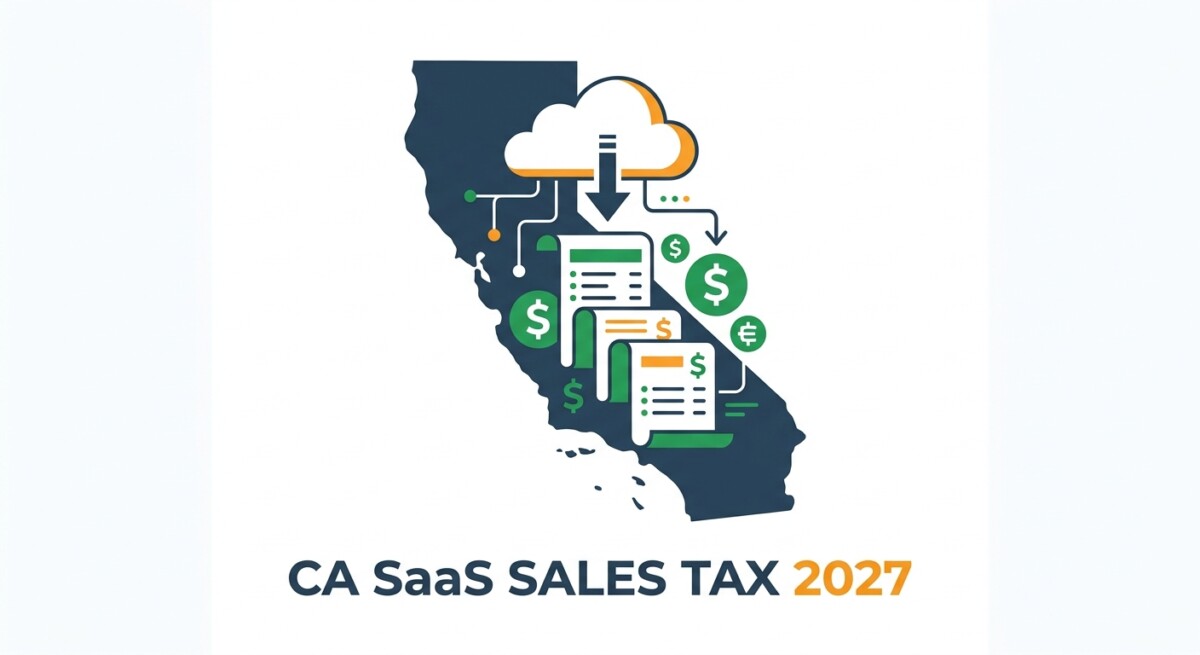
California SaaS Sales Tax 2027: SB/AB 122 Guide
Update — September 26, 2026: SB 122 was signed on June 29, 2026 (Stats. 2026, ch. 23), and the California Department of Tax and Fee Administration (CDTFA) confirmed in Special Notice L-1036 (September 2026) that sales and use tax applies to digital products, including SaaS, beginning January 1, 2027. The original article below, published July 10, 2026, describes the legislation in proposal terms. The points below reflect the CDTFA’s published guidance.
- Covered: prewritten software transferred on tangible storage media, transferred electronically, or accessed remotely, including SaaS used through a web browser or a program interface.
- Not digital products: digital assets, digital audio and audiovisual works, digital books, digital infrastructure such as IaaS and PaaS, video games played for entertainment, and digital visual works.
- Exempt: custom software, digital products representing a service (SaaS does not qualify), rights to reproduce for distribution, and products purchased solely for use outside California.
- Out-of-state sellers: a seller engaged in business in California must register for a Certificate of Registration – Use Tax. That includes a seller whose California sales, combined with related companies, exceed $500,000 in the current or preceding calendar year (Revenue and Taxation Code section 6203(c)(4)).
- Large purchasers: when one retailer’s electronic or remote sales to the same purchaser exceed $5 million in 2027, the purchaser reports use tax directly on the transaction that crosses the threshold.
For the enacted rules in full, see our guide to California’s digital products sales tax and the CDTFA Tax Guide for Retailers and Purchasers of Digital Products.
If your company buys software subscriptions, cloud tools, or remotely accessed applications from a California billing address, the California SaaS sales tax proposed in SB/AB 122 will change how much you pay — and when you have to remit it yourself. The bill, part of California’s 2026–27 budget package, would rewrite the state’s sales and use tax base to reach a broad class of digital transactions that have historically been treated as nontaxable, and it pairs the sales-tax expansion with a longer runway on the business credit utilization cap.
At SW Accounting & Consulting Corp, we work with Los Angeles businesses that live on SaaS — restaurant POS platforms, medical practice management systems, dental imaging suites, ERP subscriptions, and creative agency tool stacks. Almost every one of them would see a new cost line if this proposal is enacted. Here is what SB/AB 122 would actually do, how the tax would be sourced, and what buyers and sellers should be modeling now.
What is SB/AB 122 and why does the California SaaS sales tax matter now? 📜
SB/AB 122 is the operative tax trailer bill in California’s 2026–27 budget package. As drafted, it would extend the state’s sales and use tax to prewritten software and SaaS and would restructure the state’s business credit limitation rules.
Trailer bills carry the tax and fee provisions that make a California budget deal work. SB/AB 122 became the principal vehicle for two related items: a broad new sales-tax base for digital software, and a longer, phased extension of the existing business credit utilization cap. Together, the two changes would materially expand California’s revenue base while narrowing the offsets that many California taxpayers rely on. The bill’s status has been widely reported as part of a consensus revenue agreement among legislative leaders and the Governor. The California Legislative Information portal is the authoritative source for the current bill text and status; taxpayers should track any updates there rather than relying on early summaries.
For CFOs and controllers, the practical takeaway is simple: California is on the path to being one of the largest states to reach SaaS with sales tax. Whether you sell software into California, or buy it from a California billing address, this is a 2027 planning issue that has to be modeled now — not in December 2026.
What software and SaaS would become taxable? 💾
The proposal would expand the definitions of “sale,” “purchase,” “digital product,” and “tangible personal property” in the California Revenue and Taxation Code to reach prewritten software delivered on any medium and SaaS accessed remotely.
Three definitional changes carry most of the weight:
- “Sale” and “purchase” would be amended to include “any permanent or temporary transfer of the right… to open, view, access, download, copy, update, possess, store, manipulate, or otherwise use a digital product transferred electronically or accessed remotely.”
- “Digital product” would be defined to include prewritten computer software transferred on tangible media, transferred electronically, or accessed remotely, including SaaS and cloud-accessed software.
- “Tangible personal property” would be amended to include digital products and any associated copyright or patent interests.
A new California Revenue and Taxation Code § 6009.5 would clarify that merely holding a license, without action by the purchaser “to use the digital product to perform a task for which it was designed,” is not a taxable “use.” Practically, though, that carve-out is narrow: nearly any perpetual license, subscription, term license, or remote-access arrangement would produce a taxable use as soon as the buyer actually uses the software for its intended purpose.
What the bill would not reach is equally important. As drafted, the new tax base would center on prewritten software and SaaS. It would not extend to several categories many other states have brought into their sales-tax bases — including cryptocurrency and other digital assets, digital audiovisual works, digital audio works, digital books, infrastructure-as-a-service (IaaS), video games, and digital visual works. Custom software would remain exempt, but a modification to prewritten software would be treated as custom software only to the extent of the modification.
How would the California SaaS sales tax be sourced across state lines? 🌐
Transactions not delivered on tangible media would be sourced to the purchaser’s California address using a fixed priority: (i) billing address; (ii) shipping or delivery address; (iii) mailing address associated with the payment instrument; and (iv) any other mailing address.
For a purely in-state buyer, that rule is straightforward. But for multistate and multinational operators, the mechanic can create a structural mismatch. A single California billing address — often the corporate headquarters — would drive the tax treatment of the entire transaction, regardless of where the software is actually used. A Los Angeles parent company buying a nationwide SaaS subscription for its offices in Texas, Nevada, and Arizona could be paying California sales tax on the whole subscription simply because the invoice lands in California.
The bill would not incorporate a Multiple Points of Use (MPU) certificate familiar from other taxing states. Instead, it would provide two narrower relief mechanisms:
- A large-purchaser self-remittance rule for purchases from a single retailer exceeding $5 million per year. The seller would be relieved of collection, and the purchaser would self-remit use tax directly to the California Department of Tax and Fee Administration (CDTFA). The $5 million threshold would be indexed for inflation beginning in 2031. Note: this is not an exemption — it only shifts the remittance obligation to the buyer.
- An interstate commerce exemption for digital products purchased solely for out-of-state, interstate, or foreign-commerce use. The seller would be relieved of collection on a good-faith certificate, and the CDTFA would be authorized to permit an “alternative method” that “fairly reflects” the in-state use.
For transactions that fall below the $5 million single-retailer threshold and don’t qualify for the interstate exemption, the billing-address rule would effectively determine the whole tax treatment. Multistate buyers should expect that most day-to-day SaaS spend will be sourced to their California billing address by default.
What about the business credit utilization cap? 💰
SB/AB 122 would replace the Governor’s proposal for an immediate permanent credit limitation with a phased structure: the existing $5 million cap would extend through tax years 2027, 2028, and 2029, and beginning in 2030 business credits would be permanently limited to the greater of $5 million or 70% of the taxpayer’s tax liability.
The 70% floor is more taxpayer-favorable than the May Revision’s 50% floor, but it still extends material limitations on credit utilization beyond the current temporary regime. Net operating losses would not be affected, and the proposal would not appear to alter the 2024 budget deal relating to refundable tax credits.
Businesses most exposed to this side of SB/AB 122 include those with large research and development credit balances, film and production credits, hiring credits, and other California-specific incentives. Even generous credits are worth less when a floor stops you from using them against tax. Taxpayers may want to revisit their California return filings, including apportionment positions that previously mattered less because business credits fully offset liability. For guidance on California return mechanics and credits, the California Franchise Tax Board maintains the operative forms and instructions.
What other tax items ride along with SB/AB 122? 🧾
Beyond the SaaS tax and credit cap, the bill would prohibit local-tax diversion agreements, grant the CDTFA two-year emergency regulatory authority, temporarily reduce the annual LP/LLP/LLC tax, and impose a 100% tax on payments from a federal “Anti-Weaponization Fund.”
Several narrower provisions matter for planning:
- Local Bradley-Burns tax protection. The bill would prohibit agreements between purchasers and retailers of digital products that divert local sales-tax revenue and would authorize the CDTFA to redistribute misallocated local revenue.
- Emergency regulatory authority. The CDTFA would receive two-year emergency regulatory authority, signaling that key operational detail — including the outer boundary of the “digital product” definition and any “alternative method” for allocating tax under § 6372(d)(3) — may be developed through rulemaking rather than statute.
- Reduced entity tax for new formations. The annual LP, LLP, and LLC tax would be temporarily reduced from $800 to $400 for the first taxable year during 2027 through 2029.
- Anti-Weaponization Fund tax. A 100% tax would apply to payments received from the federal Anti-Weaponization Fund or successor funds for 2026 through 2029, with no offsetting deductions or credits.
The bill is also silent on several recurring software-taxability questions, including the line between custom and prewritten software, bundled transactions, and how Technology Transfer Agreement (TTA) principles would apply to digital licensing. Historically, California appellate decisions such as Nortel Networks Inc. v. State Board of Equalization and Lucent Technologies, Inc. v. State Board of Equalization excluded from the taxable “sales price” amounts charged for intangible personal property transferred with tangible personal property under a TTA. SB/AB 122’s broadened definition of “tangible personal property” to include digital products may limit the future reach of those rulings. For the case histories, see the California Courts published-opinion database.
California SaaS sales tax at a glance 📊
| Item | Current California treatment | Proposed under SB/AB 122 |
|---|---|---|
| Prewritten software (electronic delivery) | Generally not taxable | Taxable at 7.25% + district |
| SaaS / cloud-accessed software | Generally not taxable | Taxable at 7.25% + district |
| Custom software | Generally not taxable | Remains not taxable (except for modification portion) |
| Sourcing rule | Delivery / possession-based | Billing address → shipping → payment → mailing |
| Multiple Points of Use certificate | N/A | Not adopted; narrow $5M self-remit + interstate exemption only |
| Business credit cap | $5M cap (temporary) | Extended through 2029; 2030+ = greater of $5M or 70% of liability |
What should California businesses do right now? ✅
Inventory your SaaS spend by vendor and billing address, model the additional cost at the combined state and district rate, and revisit your California credit position under the extended cap.
Practical steps for the next two quarters:
- Build a SaaS register. List every recurring software or cloud subscription, the vendor, contract term, renewal date, billing address, and users by location. Group by whether custom or prewritten, and whether accessed remotely.
- Model the incremental tax cost. Apply the applicable district rate for the billing address on prewritten and SaaS purchases; net that into 2027 budget forecasts.
- Confirm collection responsibility. Talk to vendors before year-end 2026: will they begin collecting California tax on January 1, 2027, or does the buyer need to accrue use tax?
- Evaluate the $5M self-remit threshold. Large-vendor spend should be reviewed for whether the buyer will need to self-remit directly to CDTFA on a recurring basis.
- Revisit credit strategy. If you carry material R&D or hiring credits, model 2030-and-later utilization under the 70%-of-liability floor and re-examine California apportionment.
- Track the bill and rulemaking. Follow SB/AB 122 on the California Legislative Information portal and watch for CDTFA emergency regulations under the two-year rulemaking authority.
📌 Key Takeaways
- SB/AB 122 would extend California’s 7.25%+ sales and use tax to prewritten software and SaaS starting Jan. 1, 2027.
- Sourcing would default to the buyer’s California billing address — no MPU certificate.
- Relief is narrow: a $5M/year single-retailer self-remit rule and an interstate commerce exemption.
- Business credits would be limited to the greater of $5M or 70% of liability permanently from 2030.
- Custom software stays exempt (only the modification portion of a prewritten mod is treated as custom).
Frequently Asked Questions ❓
Q. When would the California SaaS sales tax take effect?
If SB/AB 122 is enacted as drafted, the new sales and use tax on prewritten software and SaaS would take effect January 1, 2027.
Q. What rate would apply?
The full California state and local sales and use tax rate would apply — currently 7.25% at the state level plus applicable district taxes, which push the combined rate higher in many jurisdictions.
Q. Would custom software be taxed?
No. Custom software would remain exempt. If prewritten software is modified for a specific buyer, only the modification portion is treated as custom; the underlying prewritten product remains taxable.
Q. How would multistate buyers avoid paying California tax on subscriptions used in other states?
Relief is narrow. The bill does not include a Multiple Points of Use certificate. A large-purchaser self-remittance rule applies to single-vendor spend above $5 million per year, and an interstate commerce exemption applies to purchases solely for use outside California. Otherwise, sourcing defaults to the California billing address.
Q. Does SB/AB 122 change my business credit utilization?
Yes. The bill would extend the existing $5 million business credit cap through 2027, 2028, and 2029, and beginning in 2030 would permanently limit business credits to the greater of $5 million or 70% of the taxpayer’s California tax liability.
Q. Where can I track the bill?
Follow SB 122 and AB 122 on the California Legislative Information portal for current bill text and status. Guidance on any newly enacted sales and use tax provisions will be issued by the California Department of Tax and Fee Administration under its two-year emergency regulatory authority.
The California SaaS sales tax proposed in SB/AB 122 would fundamentally change how California companies price, procure, and account for software. If you would like a review of your SaaS register, sourcing exposure, and 2027 forecast under the new law, contact SW Accounting & Consulting Corp. Primary sources: California Legislative Information (SB/AB 122), CDTFA, California FTB, and California Courts.