OBBBA nonprofit tax: What changed for your 501(c)(3)?
The One Big Beautiful Bill Act (OBBBA, P.L. 119-21) is best known as an individual and business tax bill. But buried inside it are provisions that reshape almost every corner of the nonprofit sector — who gets a deduction for donating, how much high-earners can write off, and how much excise tax exempt organizations owe on executive pay and endowments. The OBBBA nonprofit tax changes will directly affect 501(c)(3) fundraising strategy, executive-comp design, and endowment management starting with the 2026 tax year.
At SW Accounting & Consulting Corp, we work with Los Angeles nonprofits — charities, foundations, private schools, and religious organizations — that need to translate the statute into a concrete plan. Here is what changed, what it means in dollars, and what nonprofit boards should do before the next filing.
What is the OBBBA, and why do 501(c)(3)s care? 🏛️
The OBBBA is a broad federal tax law enacted in July 2025 that rewrote several Internal Revenue Code provisions touching charitable giving, tax-exempt executive compensation, and private-college endowments.
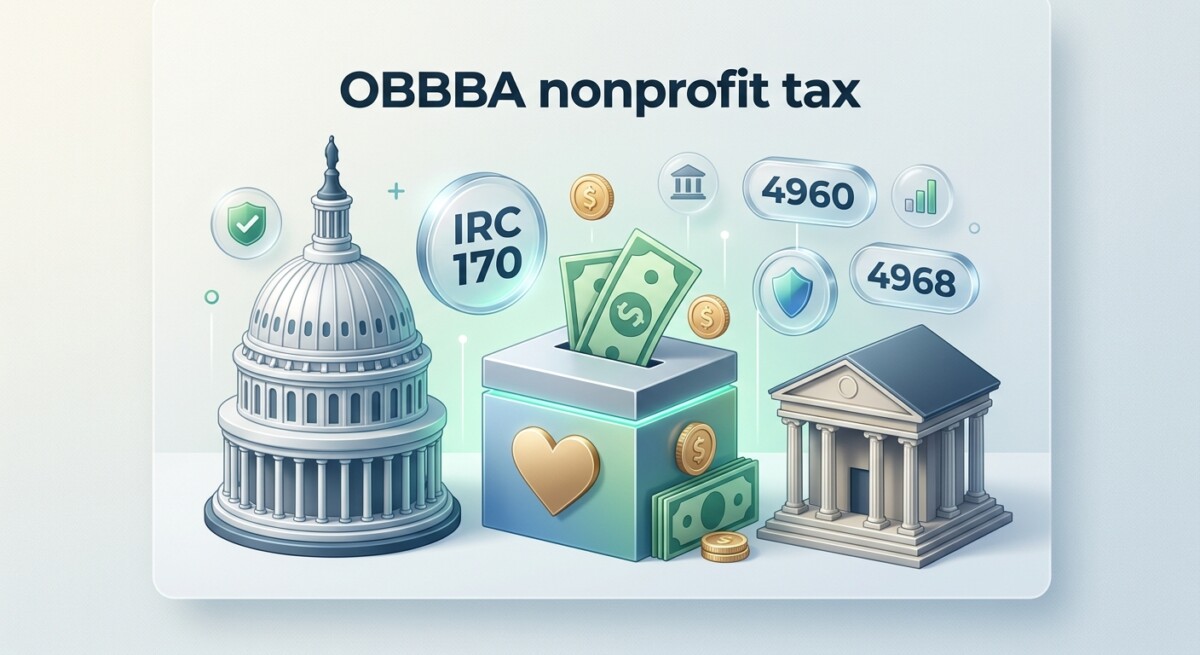
The law is codified in the U.S. Code as amendments to Title 26 (the Internal Revenue Code). Nonprofit leaders should focus on four buckets: (1) donor-side changes to the charitable deduction under IRC §170, (2) the new Federal Scholarship Tax Credit for donations to Scholarship Granting Organizations, (3) the expanded §4960 excise tax on compensation over $1 million, and (4) the tiered §4968 excise tax on net investment income of large private colleges and universities. Every one of them will show up on someone’s Form 990 or on a donor’s return in 2026 and beyond.
How did the OBBBA nonprofit tax rules change charitable giving? 💝
The OBBBA gives non-itemizers a new cash-donation deduction but adds an AGI floor and a rate cap that shrink the deduction for high-income and corporate donors.
- Non-itemizer deduction (post-2025): Individual filers who take the standard deduction can now deduct up to $1,000 of cash contributions to qualified public charities; joint filers, up to $2,000. Gifts to private foundations or donor-advised funds do not qualify.
- 0.5% AGI floor for itemized charitable deductions (starting 2026): Only the portion of a donor’s itemized charitable gifts above 0.5% of AGI is deductible.
- 35% cap on top-bracket donors: Deductions for donors in the 37% bracket are capped at 35%, so the last dollar of a large gift is worth less than the donor’s marginal rate.
- 1% of taxable-income floor for corporate donors: Corporate charitable deductions kick in only after the corporation has given more than 1% of taxable income.
The numbers get real fast. Consider a single donor with $650,000 of AGI who gives $5,000 in cash in 2026. The 0.5% AGI floor absorbs the first $3,250, so only $1,750 is deductible — and at the 35% cap that is roughly $613 in federal tax savings. Before the OBBBA the same $5,000 gift produced about $1,850 in savings. That is a real change in the after-tax cost of giving, and major-gift teams need to walk their top donors through the math before year-end.
What is the Federal Scholarship Tax Credit — and why is it a fundraising opportunity? 🎓
Starting January 2027 the OBBBA creates a dollar-for-dollar federal tax credit of up to $1,700 for individuals who donate to eligible Scholarship Granting Organizations (SGOs), with a five-year carryforward for unused credit.
An SGO is a 501(c)(3) whose primary mission is providing K–12 scholarships to students in households below 300% of area median gross income. To qualify, the SGO must direct at least 90% of income to scholarships and operate in a state that has opted into the federal program. Participating states have until the end of 2026 to submit their list of eligible SGOs to the federal government. See official information at the Internal Revenue Service.
A dollar-for-dollar credit is a far stronger fundraising incentive than a deduction — the donor is not lowering taxable income, they are offsetting tax owed. Nonprofits considering SGO status should evaluate eligibility now: verify the 90% scholarship spend, confirm the family-income limits, and watch for the state opt-in list. Qualifying educational expenses under the credit are broad and include tuition, fees, transportation, uniforms, special-needs services, and other classroom costs.
How does OBBBA reshape the §4960 excise tax on executive pay? 🧑💼
The OBBBA widens the §4960 21% excise tax on compensation above $1 million to reach any current or former employee going back to January 1, 2017 — not just the top-five covered employees.
IRC §4960 already imposed a 21% excise tax on remuneration over $1 million paid by an applicable tax-exempt organization to a “covered employee.” Before the OBBBA, that class was narrow — essentially the top five highest-paid employees for the year. Under the new rule the definition of covered employee is expanded to include any current or former employee with a lookback all the way to January 1, 2017. That means deferred compensation, retirement packages, and executive-transition payouts can trigger the excise tax for individuals who left the organization years ago. Compensation paid for medical services performed by a physician remains excluded from the §4960 calculation.
How does the new tiered private-college endowment excise tax work? 🏫
For private colleges with at least 3,000 tuition-paying students, the flat 1.4% endowment excise tax is replaced by a three-tier structure based on the institution’s Student Adjusted Endowment (SAE) — the largest tier is 8%.
SAE is calculated as total assets (excluding assets used directly in carrying out the institution’s exempt purpose) divided by the number of eligible students. The tiers are:
| Student Adjusted Endowment (SAE) | Excise-tax rate on net investment income |
|---|---|
| $500,000 – $750,000 | 1.4% |
| $750,000 – $2,000,000 | 4% |
| Above $2,000,000 | 8% |
Related-organization assets can be included in the SAE calculation under specific aggregation rules, so the tier a college lands in may not be obvious from its published endowment figure. Affected institutions should model each tier, revisit spending policy, and consider how the tax interacts with existing endowment-management assumptions before the next fiscal year’s budget is set.
What should nonprofit boards and finance teams do now? ✅
Model the donor impact, review executive-comp exposure, and stress-test the endowment tax before you set the next budget.
- Build a non-itemizer campaign: Communicate the $1,000 / $2,000 deduction to mid-level and small-dollar donors who never itemized before — a genuine expansion of your donor pool.
- Run the numbers for major donors: Show top-bracket individuals and corporate donors exactly how the 0.5% AGI floor, the 35% cap, and the 1% corporate floor change their after-tax cost of giving.
- Audit §4960 exposure since 2017: Pull compensation records for every current or former employee paid above $1 million and flag anyone whose future payouts could trigger the 21% excise.
- Model the endowment tier if you are a large private college: Recompute SAE with aggregation rules and match spending policy to the resulting excise rate.
- SGO applicants — move now: Confirm program eligibility and get on your state’s opt-in list before the end of 2026.
📌 Key Takeaways
- The OBBBA nonprofit tax rules add a $1K / $2K non-itemizer deduction and a 0.5% AGI floor for itemized gifts.
- A 35% cap for top-bracket donors and a 1% corporate floor shrink deductions for large donors.
- The Federal Scholarship Tax Credit (up to $1,700, dollar-for-dollar) is a real fundraising lever for eligible SGOs starting 2027.
- §4960 excise now reaches any current or former employee paid $1M+ since 2017; §4968 endowment tax is tiered up to 8%.
Frequently Asked Questions ❓
Q. Can I deduct a charitable donation if I take the standard deduction in 2026?
Yes. Under the OBBBA nonprofit tax rules, non-itemizers can deduct up to $1,000 (single) or $2,000 (joint) of cash gifts to qualified public charities. Gifts to private foundations and donor-advised funds are excluded.
Q. What is the 0.5% AGI floor on itemized charitable deductions?
Starting in 2026, itemizing donors can deduct only the portion of their charitable contributions that exceeds 0.5% of adjusted gross income. A donor with $650,000 of AGI must give more than $3,250 before any of the gift is deductible.
Q. Does the §4960 excise tax now apply to former employees?
Yes. The OBBBA expanded the covered-employee definition to include any current or former employee, with a lookback to January 1, 2017. Deferred compensation and severance for people who left the organization can now trigger the 21% excise on amounts above $1 million.
Q. What is the Federal Scholarship Tax Credit?
A dollar-for-dollar federal tax credit of up to $1,700 for individual donations to eligible Scholarship Granting Organizations (SGOs), effective January 2027. Unused credit carries forward up to five years. SGOs must direct at least 90% of income to scholarships for K–12 students in households below 300% of area median income.
Q. How does the new private-college endowment tax work?
For private colleges with at least 3,000 tuition-paying students, the §4968 excise tax on net investment income moves from a flat 1.4% to a three-tier structure — 1.4%, 4%, or 8% — depending on Student Adjusted Endowment (SAE), which is total assets divided by eligible students.
Q. Do these OBBBA nonprofit tax changes apply in California?
The OBBBA changes are federal. California conformity is separate — state-level charitable deductions and state excise treatment may differ. Multi-state nonprofits and California donors should model federal and state results separately before making a large gift or filing.
Nonprofit tax rules moved a lot in 2025–2026, and the impact reaches donors, executives, and endowments together. If you would like a review of how the OBBBA nonprofit tax changes affect your fundraising plan, compensation policy, or endowment, contact SW Accounting & Consulting Corp. Primary sources: the One Big Beautiful Bill Act (H.R. 1 / P.L. 119-21) and guidance from the Internal Revenue Service.