Can my Korean parent use the services cost method?
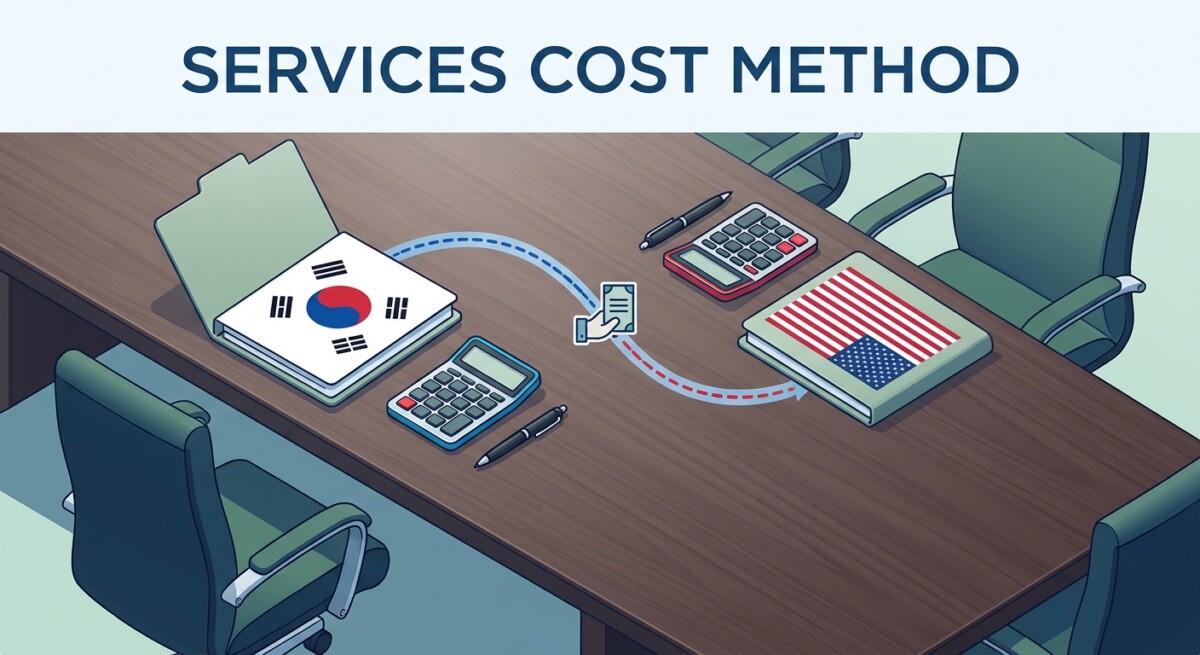
Can my Korean parent charge my US subsidiary at cost for shared back-office work? Yes — if the service fits the services cost method (SCM) safe harbor in Treasury Regulation §1.482-9(b). SCM lets a Korean parent bill routine support services (bookkeeping, HR administration, payroll, IT help desk, legal admin) to a US sub at pure total cost with no markup, as long as the activity is on the IRS’s covered list, is not an excluded core activity, and clears the business judgment rule.
Founders running a Korean parent and a US subsidiary almost always route the first-year back office through Seoul. The founder in Seoul books QuickBooks for the Delaware entity, the Seoul admin team runs payroll in Gusto, Seoul’s lawyer drafts US customer contracts. Then the US bookkeeper asks the awkward question: how much should the US sub pay Seoul for all that work, and does the IRS believe the number? That is a transfer pricing question, and the cheapest, lowest-audit-risk answer for routine support is the services cost method. Used properly, SCM takes the entire category of boring intercompany services off the audit table — but it has a specific list of services it covers, a specific list of activities it will not cover, and a documentation standard the US sub has to meet before Form 5472 is filed.
This guide walks a Korean-American founder through SCM the way we explain it on an onboarding call: when it applies, when it does not, and the paperwork a Form 5472 preparer will ask for every year.
What is the services cost method, and who can use it?
The services cost method is a transfer pricing safe harbor in Treasury Regulation §1.482-9(b) that lets related parties — including a Korean parent and its US subsidiary — bill intercompany services at total cost with no markup, if the activity is on the IRS’s list of covered services and clears the business judgment rule.
Section 482 of the Internal Revenue Code gives the IRS authority to reallocate income between related parties if intercompany prices do not reflect what unrelated parties would pay. For services, the default is arm’s-length pricing — the Korean parent should charge a profit markup it could defend if an outside firm did the same work. The services cost method is the exception. If a service is clerical, administrative, or genuinely routine, the regulation accepts total services cost with zero markup as the arm’s-length price. See the regulation text at Legal Information Institute — 26 CFR §1.482-9 and the underlying statute at 26 U.S.C. §482.
For most early-stage Korean-US groups this is a straight dollars-and-cents win. If the Korean parent spends $120,000 of staff time running the US sub’s bookkeeping, the US sub reimburses $120,000, period. There is no required 5–10% profit element to defend. The founder keeps the economic cost in the US entity where the service is actually consumed, and the Korean parent is not forced to recognize phantom profit in Seoul.
Which services qualify for services cost method treatment?
Two groups: Specified Covered Services (SCS) listed by the IRS in Revenue Procedure 2007-13, and Low Margin Covered Services (LMCS) where the median comparable arm’s-length markup is 7% or less.
The Specified Covered Services list in Rev. Proc. 2007-13 is the easier of the two paths. It names routine functions by category: payroll, accounts payable, accounts receivable, general ledger accounting, treasury administration, tax compliance, human resources administration, employee benefits administration, data processing, legal administration, public relations, government relations, procurement, and similar back-office activities. If the Korean parent is doing something that fits one of those labels, no comparability study is needed — the IRS has already decided the service is low-value and low-margin by category.
Low Margin Covered Services is the fallback for activities not on the SCS list. Under Treas. Reg. §1.482-9(b)(4), a service qualifies if the median arm’s-length markup on total services cost would be 7% or less. This path requires a benchmarking study, so it is more expensive to document than SCS, but it extends SCM to borderline activities the Korean parent might not have expected to fit — for example, certain back-office functions specific to a Korean industry sector.
What activities are excluded from SCM entirely?
Treas. Reg. §1.482-9(b)(2)(ii) names a hard-stop exclusion list — these activities cannot use SCM no matter how routine they feel inside the group:
- Manufacturing
- Production
- Extraction, exploration, or processing of natural resources
- Construction
- Reselling, distribution, acting as a sales or purchasing agent, or acting under a commission or similar arrangement
- Research, development, or experimentation
- Engineering or scientific services
- Financial transactions, including guarantees
- Insurance or reinsurance
If the Korean parent’s engineers are helping design the US sub’s product, that is R&D or engineering — not SCM. If the Korean parent is sourcing components the US sub resells, that is purchasing-agent activity — not SCM. The exclusion list is not negotiable; it is a bright line in the regulation.
💡 In our practice
The exclusion that catches Korean-US groups the most is the sales/distribution one. A Korean parent that places its US product manager in Seoul and has that manager co-sign US sales deals, negotiate pricing, and process US orders is almost always running sales activity under the regulation — even when the founder describes it internally as “coordination.” Sales support like that cannot ride SCM. It has to be priced arm’s-length under one of the §1.482-9 markup methods, which usually means a cost-plus somewhere between 5% and 10% depending on functions and risk.
How does the business judgment rule apply to the services cost method?
Even if a service is on the SCS list, SCM is only available if the taxpayer reasonably concludes that the service does not contribute significantly to key competitive advantages, core capabilities, or fundamental risks of success or failure of the business.
This is the business judgment rule in Treas. Reg. §1.482-9(b)(5). It exists to stop groups from stuffing high-value, strategy-critical work into an SCS label. Payroll administration is on the SCS list — but if the Korean parent’s “payroll admin” team is actually designing executive compensation plans that drive key hires in Silicon Valley, that is not SCM-eligible, because the activity is strategic.
The test is written to be forgiving. The taxpayer makes the judgment, not the IRS, and the regulation says the conclusion only has to be reasonable. But the US sub has to be able to show it made the judgment — contemporaneously, in writing, before Form 5472 was filed. In practice that is a one-page memo per intercompany service line, naming the service, pointing to the SCS or LMCS basis, and stating the conclusion that the service is not a key competitive advantage. A memo is cheap; recreating the analysis in audit three years later is not.
How does the services cost method interact with Form 5472?
SCM changes the price (cost with no markup), not the disclosure obligation. The US sub still files Form 5472 every year to report every intercompany transaction with the Korean parent, including SCM-priced service charges.
A 25%-or-more foreign-owned US corporation files Form 5472 — Information Return of a 25% Foreign-Owned U.S. Corporation as an attachment to its Form 1120 each year. A foreign-owned, disregarded single-member LLC files a pro-forma 1120 plus the 5472 even though it has no US income tax liability. Each 5472 reports the related party, the type of transaction, and the dollar amount of transactions during the year.
The IRS treats non-filing severely. Under IRC §6038A, the baseline penalty for failing to file Form 5472 — or filing a substantially incomplete one — is $25,000 per form per year, with continuing penalties if the failure persists after notice. SCM does not reduce the risk of a 5472 penalty; it only reduces the transfer pricing adjustment risk. The two have to be managed together.
⚠️ Common mistake: paying Seoul but booking no intercompany charge
The most frequent SCM failure we see is not an SCM failure at all — it is the US sub never charging itself for services the Korean parent plainly provides. If Seoul books the US sub’s accounting and the US sub pays nothing for it, that is a §482 understatement of US sub income (the US sub overstated profit by not deducting its true costs — or the Korean parent overstated profit by absorbing them, depending on who had the opposite error). SCM only works when the intercompany charge is actually run through the books, invoiced, and settled in cash on a reasonable schedule. “We’ll trueup at year-end” is not the IRS’s preferred cadence; quarterly settlement with written service agreements is.
What documentation does my US subsidiary need every year?
Four files, every year the Korean parent provides services: a written intercompany services agreement, a business judgment memo per service line, a cost build-up schedule proving the charge equals total services cost, and the Form 5472 that discloses the transaction.
Treas. Reg. §1.482-9(b)(6) lists the specific documentation SCM requires. The elements the US sub needs on file by the time the Form 1120 is filed are:
- Intercompany services agreement. A short written contract naming the services, the pricing method (SCM — cost with no markup), the settlement cadence, and the controlling law.
- Business judgment memo. Per service category, the conclusion that the service does not contribute significantly to key competitive advantages. One page is enough, dated before the Form 1120 is filed.
- Total services cost build-up. A schedule showing the direct and indirect costs the Korean parent incurred in providing each service — personnel costs, allocable overhead, allocation drivers (headcount, floor space, software seats). Total services cost under Treas. Reg. §1.482-9(j) is defined broadly and includes stewardship-type overhead.
- Form 5472. One per 25%-or-more foreign shareholder, reporting the intercompany service charge in Part IV.
SCM vs cost-plus vs arm’s-length comparables — which should I use?
For routine back-office activity use SCM; for mixed support that includes marketing, product, or sales elements use cost-plus with a documented markup; for revenue-generating activity between related parties use the comparable profits method or another §1.482-9 specified method.
The table below is how we describe the three options to Korean-American founders on an initial call:
| Method | When to use | Markup | Documentation effort |
|---|---|---|---|
| Services Cost Method | Routine back office on the SCS list (payroll, HR, bookkeeping, legal admin, IT support) | 0% | Low — service agreement, business judgment memo, cost build-up |
| Cost-Plus | Mixed support (parent provides engineering help, product input, or sales coordination) | Typically 5–10%, benchmarked | Medium — add a comparables study |
| Comparable Profits Method | Core revenue activity (sales, distribution, manufacturing) between related parties | Set to hit a target operating margin | High — full benchmarking study, often outside TP firm |
The main mistake is picking SCM for a mixed function and hoping the IRS will not notice the product-input part. If the Korean parent’s team spends 60% of its time on true back office and 40% on US product strategy, SCM covers the 60% only. The 40% has to be carved out, priced cost-plus with a markup, and documented separately. Trying to run the whole 100% through SCM is the kind of position that invites a §482 adjustment later.
What is the audit risk if the services cost method is applied incorrectly?
If the IRS rejects SCM, it imposes an arm’s-length markup — commonly 5–10% on total services cost — and assesses tax, interest, and transfer pricing penalties under IRC §6662(e), which can be 20% or 40% of the resulting underpayment.
The transfer pricing penalty under 26 U.S.C. §6662(e) runs 20% for a “substantial valuation misstatement” and 40% for a “gross valuation misstatement” of transfer prices. The penalty is defended by having contemporaneous transfer pricing documentation on file — which, for SCM, is the four-document set listed above. Without the SCM documentation, a US sub that applied zero markup is defenseless if the IRS pushes a 7% imputed markup, and the resulting liability runs through the penalty gates.
💡 Scaling note
SCM is also the pricing method that scales best when a Korean group spins up multiple US entities (a Delaware C-corp for sales, a California LLC for a hiring vehicle, a Nevada LLC for warehousing). The same intercompany services agreement template, business judgment memo, and cost build-up can be adapted entity-by-entity. Groups that start with ad-hoc transfer pricing in year one almost always rebuild on SCM by year three — easier to maintain and lower audit exposure for a given level of staff attention.
Key takeaways on the services cost method
- SCM lets a Korean parent charge a US sub for routine back-office services at cost with no markup, provided the service is on the Specified Covered Services list or meets Low Margin Covered Services criteria.
- Excluded activities — manufacturing, R&D, engineering, sales/distribution, financial, insurance — cannot use SCM, no matter how routine the Korean team believes the work is.
- The business judgment rule requires the US sub to conclude in writing that the service does not drive key competitive advantages before Form 1120 is filed.
- SCM reduces transfer pricing adjustment risk but does not reduce Form 5472 obligations — the $25,000-per-form penalty under IRC §6038A applies independently.
Frequently asked questions on the services cost method
Can the services cost method be used for a Korean parent that lends money to its US subsidiary?
No. Financial transactions, including intercompany loans and guarantees, are on the SCM exclusion list in Treas. Reg. §1.482-9(b)(2)(ii). Intercompany loans are priced under the separate loan pricing rules in Treas. Reg. §1.482-2(a), which generally require an arm’s-length interest rate benchmarked to comparable third-party debt.
What happens if my Korean parent provides free services and the US sub never books an intercompany charge?
The IRS can impute an arm’s-length charge under IRC §482, assess tax on the Korean parent for the deemed income, and apply §6662(e) transfer pricing penalties. SCM is only a safe harbor on how much to charge — it does not excuse charging nothing. Even an at-cost intercompany invoice is better than silence.
Does the US-Korea tax treaty change the services cost method rules?
No. The services cost method is a US domestic transfer pricing regulation; it applies the same way to a Korean parent as it does to any other foreign parent. Treaty relief under Article 7 (Business Profits) and Article 9 (Associated Enterprises) can address double taxation if Korea’s National Tax Service assesses a different transfer price, but the US-side pricing analysis is a §482 question regardless.
If the Korean parent uses the services cost method, does the US subsidiary still deduct the full cost?
Yes. SCM is the arm’s-length price for US tax purposes under §482. The US subsidiary deducts the full SCM charge as an ordinary business expense under IRC §162, assuming the service is ordinary and necessary and otherwise deductible. The lack of a markup does not reduce deductibility — it only means the markup element is zero.
Is a formal transfer pricing study required to use the services cost method?
A full benchmarking study is not required if the service is on the Specified Covered Services list in Rev. Proc. 2007-13 — the IRS has pre-approved those categories. A study is needed for Low Margin Covered Services, because the 7% median markup test has to be documented with comparables. For most Korean-US back-office activity, the SCS path avoids a study entirely.
Can an SCM charge create a US permanent establishment risk for the Korean parent?
Charging a US sub for services performed in Korea does not, by itself, create a US permanent establishment under the US-Korea Tax Treaty. PE risk arises when the Korean parent’s personnel are physically in the US for extended periods or exercise contracting authority on US soil. SCM pricing is a separate question from PE threshold — but if PE exists, service income may become US-taxable regardless of the intercompany label.