Is student loan forgiveness tax free in 2026?
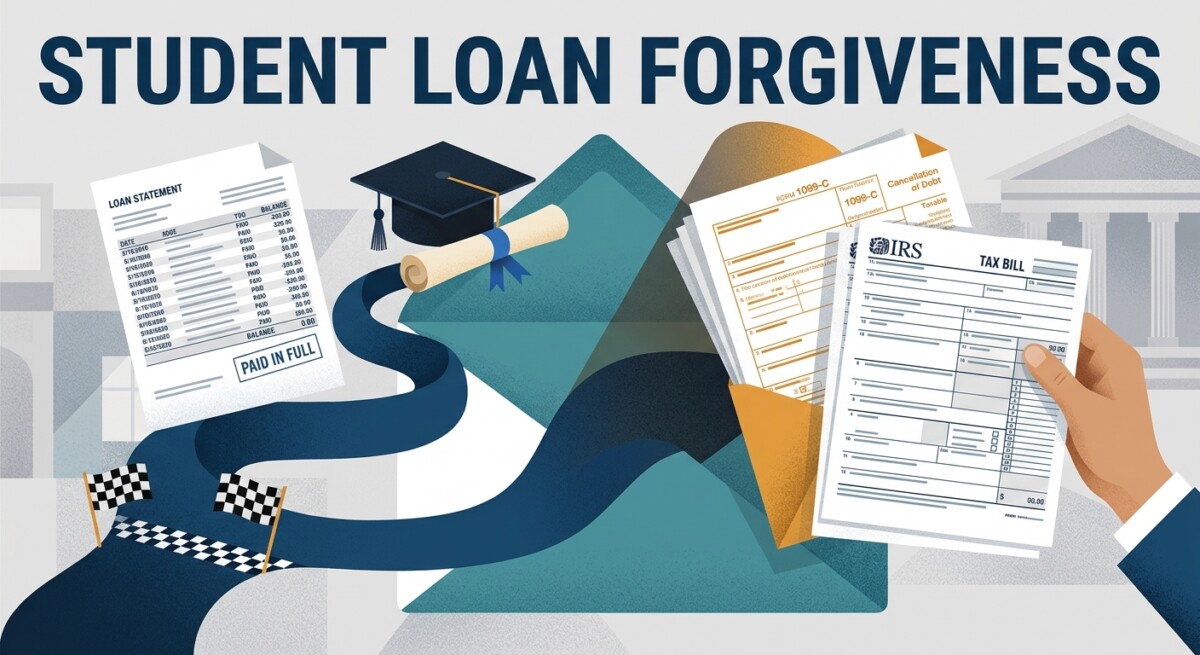
Every October our Los Angeles practice fields the same call. A borrower who has been on an income-driven repayment plan for twenty years just received a cancellation notice from the loan servicer, and the next thing in the mail is a Form 1099-C. Three years ago the same discharge would have come with no federal tax at all. In 2026 the answer is different, and the gap between the two years is one line in the Internal Revenue Code. This post walks through the student loan forgiveness tax rules that apply after the 2025 sunset: what the statute now says, which cancellations are still excluded, how to size the bill, and the steps that keep a surprise cancellation from becoming a surprise collection notice.
What exactly changed about the student loan forgiveness tax rules? 📖
The temporary exclusion for discharged student loans in §108(f)(5) applied only to discharges after December 31, 2020 and before January 1, 2026. For discharges in 2026 and later, that specific exclusion is no longer available.
Under Internal Revenue Code §108, gross income normally includes income from the discharge of indebtedness. Section 108 then lists exclusions and reductions. One of those exclusions, §108(f)(5), was added to broadly exempt discharged federal and most private student loans. Its text is specific to a window of discharges — “after December 31, 2020, and before January 1, 2026.” Nothing in current law extended that window. For a 2026 cancellation, the broad shield is gone; what remains are the narrower, longstanding exclusions in §108(a), §108(f)(1), and a handful of program-specific provisions.
The practical effect is that an income-driven repayment (IDR) cancellation — the twenty- or twenty-five-year discharge granted after the required number of qualifying payments — is treated like any other cancellation of debt. The loan servicer typically issues a Form 1099-C showing the amount discharged, the IRS matches it to the return, and the amount flows into taxable income unless a different exclusion applies. See IRS Topic 431 for the general rule and Publication 4681 for the worked-example walkthrough the IRS publishes for borrowers in this position.
Which student loan cancellations are still excluded from income? 🛡️
Public Service Loan Forgiveness, the National Health Service Corps and certain state loan repayment programs, bankruptcy, insolvency, and a short list of discharge categories tied to death, disability, and closed-school situations continue to be excluded under separate rules.
Several exclusions sit outside §108(f)(5) and were untouched by its sunset. These are the exclusions a 2026 borrower will typically test when the Form 1099-C arrives:
| Exclusion | Statute or program | What it covers |
|---|---|---|
| Public Service Loan Forgiveness | §108(f)(1) with Federal Student Aid’s PSLF program | Direct Loan balances discharged after 120 qualifying payments while working full-time for a qualifying public-service employer. Federally tax free; the sunset did not touch this exclusion. |
| National Health Service Corps / state repayment | §108(f)(4) and the HRSA National Health Service Corps Loan Repayment Program | Loan repayment or forgiveness under programs tied to work in a health-professional shortage area, or similar state loan repayment programs. Federally tax free. |
| Bankruptcy or insolvency | §108(a)(1)(A) and (B), reported on Form 982 | Discharge in a Title 11 case, or discharge while insolvent to the extent of insolvency. Tax attributes are reduced in order under §108(b). |
| Death or total and permanent disability | §108(f)(5) remnants and program rules | A separate pre-2021 federal rule excludes discharge on death or TPD and remains in effect for the narrower set of loans Congress carved out. |
The point of running down this list is not that most borrowers will land on one of these exclusions — most will not. The point is that “my 2026 discharge is taxable” is a default, not a conclusion. The right answer depends on which program forgave the loan and the borrower’s financial position on the day of the discharge.
How do I size the student loan forgiveness tax hit? 💲
Take the discharged balance from the Form 1099-C, add it to the borrower’s other income, and compute federal and state tax on the resulting total. The additional tax is not a flat rate on the forgiven amount — it is the difference between the total tax with and without the cancellation in income.
A worked example makes the math concrete. Consider a single borrower in California with $75,000 of wage income who receives an IDR discharge of $90,000 in 2026.
- Baseline federal tax. On $75,000 of wages, after the 2026 standard deduction, the borrower is firmly in the 22% federal bracket with a tax of roughly $8,500 depending on inflation adjustments.
- With the cancellation. Adding $90,000 of discharge income pushes taxable income into the 24% bracket for most of the cancellation. Federal tax rises by roughly $19,000 – $22,000, and credits that phase out with income (the saver’s credit, portions of education credits, parts of the earned income credit for families) can fall away.
- California. California generally conforms to federal cancellation-of-debt principles but has its own history of student-loan-specific exclusions. The practical step is to check the state’s current conformity rules before preparing the return and not to assume alignment with federal.
- No withholding. Cancellation of debt income is not reported on a Form W-2. If the borrower did not make estimated payments or did not raise W-2 withholding during the year, the liability is paid in full with the return — together with a possible underpayment penalty.
From our practice: the number people miss is the state line
In our practice the federal exposure is the one borrowers Google. The state exposure is the one that doubles the surprise. California has its own history of carving out student loan forgiveness, and other states track or decouple from federal rules in their own patterns. Before writing a check, run the state return side by side and look at the state conformity statute by its date — state law can change by legislative session, and the right answer in April is not always the right answer the following October.
What if I cannot pay the student loan forgiveness tax bill? 💸
The IRS has installment agreements and other collection alternatives, and the application process is online. The faster question is whether a bankruptcy or insolvency exclusion applies first — that lowers the taxable amount before any collection discussion begins.
Walk through the exclusions before the collection alternatives. Under §108(a), cancellation income is excluded to the extent the discharge occurs in bankruptcy, or the borrower is insolvent immediately before the discharge. Insolvency is measured by the excess of total liabilities over the fair market value of total assets, which includes retirement balances and the borrower’s share of jointly held property. The excluded amount is reported on Form 982, and certain tax attributes (net operating losses, credit carryforwards, basis of property) are reduced in order under §108(b).
Where exclusions do not cover the full amount, IRS payment plans describe the available plans. A short-term plan pays the balance within 180 days with no setup fee. A long-term installment agreement can run up to 72 months with a setup fee that varies by application channel and payment method. In both cases, interest continues to accrue, and the failure-to-pay penalty continues at a reduced rate while the plan is in effect. Taxpayers in genuine hardship can request currently-not-collectible status, which pauses collection without erasing the liability. An Offer in Compromise is available where the facts support one, though the eligibility screens are narrower than many borrowers assume.
Form 1099-C silence is not the same as nontaxable
A loan holder generally issues Form 1099-C only for discharges of $600 or more and sometimes misses the deadline, sends to a bad address, or issues a form with the wrong year. The absence of the form does not make the amount nontaxable. Borrowers who know a cancellation occurred should request the servicer’s discharge statement, report the amount in the correct year, and keep a copy of the servicer’s letter with the return in case the Form 1099-C arrives later with a different year or amount.
What should borrowers do before year-end to control the student loan forgiveness tax? 🛠️
Confirm the discharge paperwork, estimate the tax now, test the exclusions, set aside funds, and get the state answer in writing. Any one of those steps is cheap. Finding out in April is not.
- Get the discharge letter from the servicer. The letter shows the amount discharged and the date, both of which drive which year’s return the income lands on and which state’s rules apply if the borrower moved during the year.
- Check whether an exclusion already covers the discharge. PSLF, NHSC, state repayment programs, bankruptcy, and insolvency are the common ones. The Federal Student Aid’s income-driven repayment page and Federal Student Aid’s PSLF program describe the eligibility screens for the discharge itself; the tax exclusions ride on top of those.
- Estimate the combined federal and state tax now, not in April. Run the discharge through a projection with the borrower’s actual year-to-date income. The number is often large enough that an estimated payment before January 15 is cheaper than the underpayment penalty.
- Document insolvency if it applies. Pull together a balance sheet dated immediately before the discharge: total liabilities, fair market value of total assets, and the net. If the borrower is insolvent, Form 982 and a worksheet in Publication 4681 drive how much to exclude and which attributes to reduce.
- Keep the servicer paperwork with the return. If the Form 1099-C never shows up, the servicer letter and account statement are the primary records. If the Form 1099-C does show up with the wrong amount, those records are what support a corrected return.
The National Taxpayer Advocate 2024 Annual Report to Congress identified tax and financial literacy as one of the ten most serious problems facing US taxpayers, with large shares of surveyed taxpayers unsure about basic filing concepts. Cancellation of debt is a classic example of the kind of income that catches people by surprise — no withholding, no paycheck line item, and a tax bill in the next filing season for an event that felt like good news. Walking through the five steps above moves the conversation out of April and into a window where options still exist.
Summary: student loan forgiveness tax in 2026
- The temporary §108(f)(5) exclusion covered discharges only through December 31, 2025. A 2026 IDR cancellation is generally federal taxable income.
- Public Service Loan Forgiveness, the NHSC program, state loan repayment programs, bankruptcy, and insolvency remain available exclusions and are tested before any collection discussion.
- Size the tax on the full forgiven amount at the borrower’s marginal rate and run the state return side by side — the state answer is not automatic.
- If the full amount cannot be paid, the IRS payment plans cover short-term and long-term installments; the failure-to-pay penalty continues at a reduced rate during a plan.
- Document the discharge, request the servicer letter, and keep records in case the Form 1099-C arrives late or with the wrong year.
Frequently asked questions about the student loan forgiveness tax ❓
Q. Is student loan forgiveness tax free in 2026?
At the federal level, no, for most borrowers. The exclusion in Internal Revenue Code §108(f)(5) that treated discharged student debt as nontaxable applied only to discharges from 2021 through the end of 2025. For federal income tax purposes, cancellations in 2026 generally fall back under the ordinary cancellation-of-debt rules, which include the forgiven balance in gross income unless a different exclusion applies. State treatment varies and must be checked separately.
Q. Does Public Service Loan Forgiveness still avoid tax?
Yes. Public Service Loan Forgiveness is excluded from gross income under a different, longstanding provision of §108(f) tied to a work requirement in a public-interest profession. That exclusion did not sunset at the end of 2025. PSLF discharges under the program described by Federal Student Aid remain federally tax free in 2026.
Q. How does the IRS find out about my cancellation?
The loan holder generally reports a discharge of $600 or more to the IRS and the borrower on Form 1099-C, Cancellation of Debt. The amount shows up in the IRS’s income-matching systems. If a borrower omits the amount from their return, the IRS normally issues a CP2000 notice proposing additional tax. The absence of a Form 1099-C does not by itself make the amount nontaxable.
Q. What if I cannot pay the tax on my student loan forgiveness tax bill?
The IRS offers short-term plans (balance paid within 180 days) and long-term installment agreements described on the IRS payment plans page. Interest and the failure-to-pay penalty continue to accrue during a plan, though at reduced rates once a plan is in place. Taxpayers who cannot meet basic living expenses may also request currently-not-collectible status or, in some cases, an Offer in Compromise.
Q. Does bankruptcy or insolvency change the answer?
Yes. §108(a) excludes cancellation-of-debt income to the extent the discharge occurs in a Title 11 bankruptcy case or the taxpayer is insolvent immediately before the discharge. Insolvency is measured by the excess of total liabilities over the fair market value of total assets. The excluded amount is calculated and reported on Form 982, and certain tax attributes are reduced in order under the statute.
Q. Will states tax a forgiven federal student loan?
It depends on the state. States that conform to current federal law pick up what Congress leaves in place. States that decoupled from the federal §108(f)(5) exclusion, or that affirmatively exempted student loan forgiveness under their own law for specified years, follow their own rules. The practical step is to check the state’s conformity statute and any state-specific exclusion before preparing the state return, not to assume federal and state treatment match.
Q. What should borrowers do before December 31, 2026?
Pull together the loan servicer’s statements showing the discharge event and date, confirm whether a Form 1099-C has been or will be issued, estimate the federal and state tax hit on the forgiven amount, and set aside funds now rather than at filing. If an insolvency or bankruptcy exclusion looks available, gather the asset and liability information needed to document it on Form 982. Borrowers in PSLF or the NHSC Loan Repayment Program should keep their program-eligibility paperwork to support the separate exclusion.
This article is general information, not tax or legal advice for your situation. Student loan cancellations turn on the loan program, the state of residence, and the borrower’s financial position on the day of discharge. If you received or expect to receive a discharge in 2026, contact SW Accounting & Consulting Corp for a confidential review before year-end.