
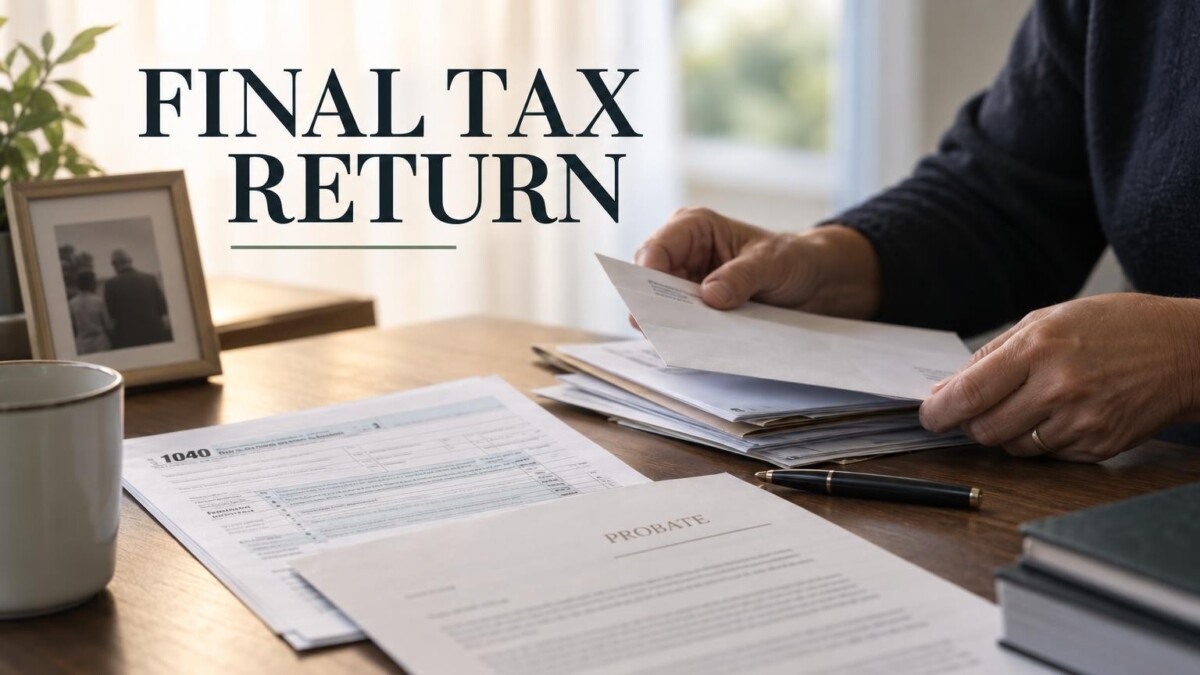
Who files the final tax return after a death?
A parent dies in May. Two weeks later, a bank statement arrives in the mail and a 1099 from a brokerage follows in January. The family asks the same question we hear every spring: who signs the check, which return gets filed, and by when? This post is a plain walk-through of the IRS rules for the final tax return of a deceased family member — which return goes where, who has the authority to sign, which forms unlock IRS records, and the deadlines that quietly decide whether a refund is lost or kept. Everything below is based on IRS guidance; nothing here is a substitute for advice on a specific estate.
Which tax returns get filed after a family member dies? 📋
Usually three different returns can come into play — the decedent’s final Form 1040, the estate’s Form 1041, and, for larger estates, Form 706. Most families only ever file the first two.
The IRS separates the decedent, the estate, and any beneficiaries. Each one is a different taxpayer, and each has its own return. The IRS hub on managing a deceased person’s tax responsibilities explains that the individual tax return for the deceased and the estate’s income tax return are independent filings. Beneficiaries then report income passed through from the estate on their own personal returns.
| Return | What it covers | When it is required |
|---|---|---|
| Form 1040 | The decedent’s income from January 1 through the date of death. Reported on the usual Form 1040, with ‘Deceased,’ the decedent’s name, and the date of death written at the top. | If the decedent met the normal filing thresholds for the year of death, or to claim a refund, a recovery rebate, or a withholding credit. |
| Form 1041 | Income earned by the estate after the date of death — typically interest, dividends, capital gains, or rental income received while the estate is in administration. | Required if the estate has $600 or more of gross income for the tax year, or any beneficiary who is a nonresident alien. |
| Form 706 | The federal estate tax return. Covers the gross estate at death — real property, securities, business interests, insurance, lifetime gifts, and more. | Required only when the gross estate plus adjusted taxable gifts exceeds the basic exclusion amount — $13.99 million in 2025 and $15 million in 2026. |
Two notes that trip families up. First, Form 706 is not the same as a state inheritance or estate tax return. A handful of states (not California) impose their own estate tax at much lower thresholds, and that is a separate filing. Second, the estate tax on Form 706 is paid out of the estate; it does not land on an heir’s personal return. What beneficiaries do see on their own returns is distributable net income flowing through Form 1041 via Schedule K-1 — that is income tax, not estate tax.
Who signs the final tax return, and what gives them authority? ✍️
The personal representative appointed by the probate court — the executor named in the will or the administrator appointed where there is no will. A surviving spouse can sign a joint return. If no one has been appointed yet, the person in actual charge of the decedent’s property files and signs.
The IRS term is ‘personal representative,’ and it covers executors, administrators, and anyone else legally responsible for managing the decedent’s property. They sign the final Form 1040 with their own name and title (for example, ‘Personal Representative’ or ‘Executor’). Where there is a surviving spouse filing jointly, the spouse signs for both and writes ‘filing as surviving spouse’ next to the decedent’s signature line.
Before the IRS will talk to a representative about the decedent’s prior returns, balances, or notices, the agency needs proof the representative actually has authority. Three forms do most of the work:
- Form 56, Notice Concerning Fiduciary Relationship — tells the IRS that a fiduciary (executor, administrator, or trustee) is now responsible for the decedent’s tax matters. File it as soon as the appointment is in hand so IRS correspondence is routed correctly.
- Form 2848, Power of Attorney — authorizes a named CPA, EA, or attorney to speak with the IRS on behalf of the decedent or the estate. It is narrower than Form 56; it lets a professional help, not a family member act as fiduciary.
- Form 8822, Change of Address — redirects IRS mail for the decedent and the estate to the representative’s address so refunds, notices, and transcripts actually arrive.
From our practice: the fiduciary filings come before everything else
In our Los Angeles practice, the single step that saves the most time is filing Form 56 and Form 8822 the week the representative is appointed. Until those are on record, the IRS will not release transcripts, will not reroute notices, and will often return refund checks. Families who wait until the April deadline to deal with authority almost always miss something.
When is the final tax return due, and what if we need more time? ⏰
The final Form 1040 is due on the decedent’s usual filing date for the year of death — generally April 15 of the following year. A six-month extension is available on Form 4868, but any tax owed is still due by the original date.
Deadlines are the same as if the decedent had lived, which surprises families who assume death triggers a delay. It does not. The year of death is treated as a short year — January 1 through the date of death — but the April 15 deadline for that short year does not move. A surviving spouse who files a joint return follows the normal joint-return calendar; a personal representative who files for the decedent alone follows the same.
The estate’s Form 1041 is a different calendar. The estate can choose a calendar year (January 1 through December 31) or a fiscal year ending the last day of any month within twelve months after the date of death. Form 1041 is then due on the 15th day of the fourth month after the chosen year-end. Form 7004 extends the Form 1041 due date; IRS guidance on filing Form 1041 walks through the mechanics.
Form 706 — when required — is due nine months after the date of death, with an automatic six-month extension available on Form 4768. Portability elections for a deceased spouse’s unused exclusion are claimed on a timely-filed Form 706 even when no tax is owed; miss the window and the surviving spouse may lose millions of exclusion.
Refund claims die with the clock
A refund on the decedent’s final Form 1040 can only be claimed within the normal refund statute — generally three years from the return’s due date, or two years from the date the tax was paid. Families who find old W-2s and 1099s years after a death often cannot recover the withholding. Pull transcripts early — a free Form 4506-T request puts the complete income record in your hands in weeks.
How do I pull the decedent’s past IRS records? 🔎
Submit Form 4506 for a full copy of a filed return (a fee applies) or Form 4506-T for a free transcript, and attach proof you are the personal representative — usually the letters testamentary plus Form 56.
The practical difference between the two forms matters. Form 4506 returns a photocopy of the original return and attachments; it is slow and costs a per-return fee, but is what probate courts sometimes demand. Form 4506-T returns a transcript — the line items the IRS has on file, including wages, 1099 income, and estimated-tax payments — for free and in days. For most estates the transcript is what you actually need.
Along with either form, include a copy of the court appointment. The IRS will not release records on a decedent to someone whose authority is not on file. If Form 56 has not yet been processed, attach a copy of it to the Form 4506-T request and note the letters testamentary. Change-of-address filings on Form 8822, Change of Address make sure the records actually arrive at your office, not the decedent’s old mailbox.
What else does the personal representative need to handle? 🧰
Open an estate bank account under a new EIN, collect every 1099 and K-1, decide whether a joint return is still appropriate, and watch the Form 1310 refund rule.
- Get an EIN for the estate. The decedent’s Social Security number stops receiving income on the date of death; income earned afterward belongs to the estate, which needs its own tax ID. The EIN online application issues one in a single session.
- Decide on the filing status for the year of death. A surviving spouse who has not remarried by year-end may file a joint Form 1040 with the decedent. For the following two years, a qualifying surviving spouse with a dependent child keeps joint rates on their own return. These elections usually produce a lower combined tax than filing separately.
- Collect every information return. Brokerage 1099s, retirement 1099-Rs, W-2s for the short year, Schedule K-1s from partnerships or S corporations, and any state-level forms. A third-party-payer reconciliation often catches income the family did not know existed.
- File Form 1310 for refunds. Unless a surviving spouse is filing a joint return, a refund due the decedent is released only to a person who files Form 1310 and attaches a copy of the court appointment.
- Coordinate the final 1040 with the first 1041. Income received after the date of death belongs on the estate’s Form 1041, not on the decedent’s Form 1040. The split is based on when the income was received, not when the underlying activity happened. Payers often need to be notified so later 1099s are issued under the estate’s EIN.
Summary: filing a final tax return for a deceased family member
- The final tax return is the decedent’s Form 1040 for January 1 through the date of death, due on the usual April 15 date.
- Form 1041 reports estate income earned after death; Form 706 is required only for estates above the federal exclusion ($13.99M in 2025, $15M in 2026).
- File Form 56 to establish fiduciary authority and Form 8822 to redirect IRS mail — before anything else.
- Request a free Form 4506-T transcript to see every W-2 and 1099 the IRS already has.
- A refund due the decedent requires Form 1310 unless a surviving spouse files a joint return.
Frequently asked questions about a deceased family member’s tax returns ❓
Q. Who is responsible for filing the final tax return for a deceased person?
Whoever has been appointed to handle the estate: the court-appointed personal representative (executor or administrator), a surviving spouse filing a joint return, or, if no one has been appointed, any person in charge of the decedent’s property. The IRS calls this person the ‘personal representative’ and expects them to sign and file the final Form 1040 for the year of death.
Q. When is the final tax return for a deceased family member due?
The final Form 1040 covers the period from January 1 through the date of death and is due on the same date the decedent’s return would have been due had they lived — generally April 15 of the year following the death. A six-month automatic extension is available by filing Form 4868. State deadlines may differ; California generally follows the federal due date but has its own forms.
Q. What is the difference between Form 1040, Form 1041, and Form 706?
Form 1040 is the decedent’s individual income tax return for the final year of life. Form 1041 is the estate’s income tax return, filed when the estate earns income (for example, interest, dividends, or rental income) during administration. Form 706 is the federal estate tax return, required only when the gross estate plus adjusted taxable gifts exceeds the filing threshold ($13.99 million in 2025 and $15 million in 2026 for the basic exclusion amount).
Q. How do I get copies of the deceased person’s prior tax returns?
Submit Form 4506 to request a full copy of a prior return (a fee applies) or Form 4506-T for a free transcript. You must attach proof of your authority to act for the decedent — typically the letters testamentary or letters of administration issued by the probate court — and, if the IRS does not yet show you as the fiduciary, a Form 56.
Q. Can a surviving spouse still file a joint return for the year of death?
Yes. For the year the decedent died, a surviving spouse who has not remarried before year-end can still file a joint Form 1040 with the decedent. The surviving spouse signs for both spouses and writes ‘filing as surviving spouse’ next to the decedent’s signature line. If the decedent left a qualifying child, the surviving spouse may use the ‘qualifying surviving spouse’ filing status for the two years after the year of death.
Q. Does the estate need its own taxpayer ID?
Yes. Once a person dies, their Social Security number can no longer be used to report income earned by the estate. The personal representative applies for an Employer Identification Number (EIN) for the estate, which is then used on Form 1041 and on any accounts opened in the estate’s name.
Q. How is a refund claimed on a deceased person’s return?
A surviving spouse filing a joint return claims the refund as usual. In every other case, the personal representative files Form 1310, Statement of Person Claiming Refund Due a Deceased Taxpayer, together with a copy of the court appointment. Without Form 1310 or an appointment, the IRS will not release the check.
This article is general information, not tax or legal advice for your situation. Deadlines, filing thresholds, and portability elections turn on facts that vary by estate and by state. For help with a specific case, contact SW Accounting & Consulting Corp for a confidential review.