What is Qualified Small Business Stock (QSBS)? The $10M Tax-Free Secret for Founders
Have you ever spent years, maybe even a decade, pouring your heart and soul into your startup? You’ve weathered the storms, scaled the mountains, and finally, you’ve reached the summit: a massive, life-changing exit. Now, what if I told you that you could potentially walk away from that sale with your first $10 million in gains completely, 100% tax-free?
It sounds way too good to be true, right? But it’s not. This incredible opportunity is all thanks to a provision in the U.S. tax code known as Section 1202, or **Qualified Small Business Stock (QSBS)**. It’s one of the most powerful wealth-building tools for founders and early investors, yet so many people don’t know it exists until it’s too late. Let’s break down what this $10 million secret is all about. 😊
What is Qualified Small Business Stock (QSBS)? 🤔
At its core, QSBS is a powerful incentive the U.S. government created to encourage people to invest in and, crucially, *stick with* American small businesses for the long haul. It’s not for day traders or flippers; it’s a reward for patience.
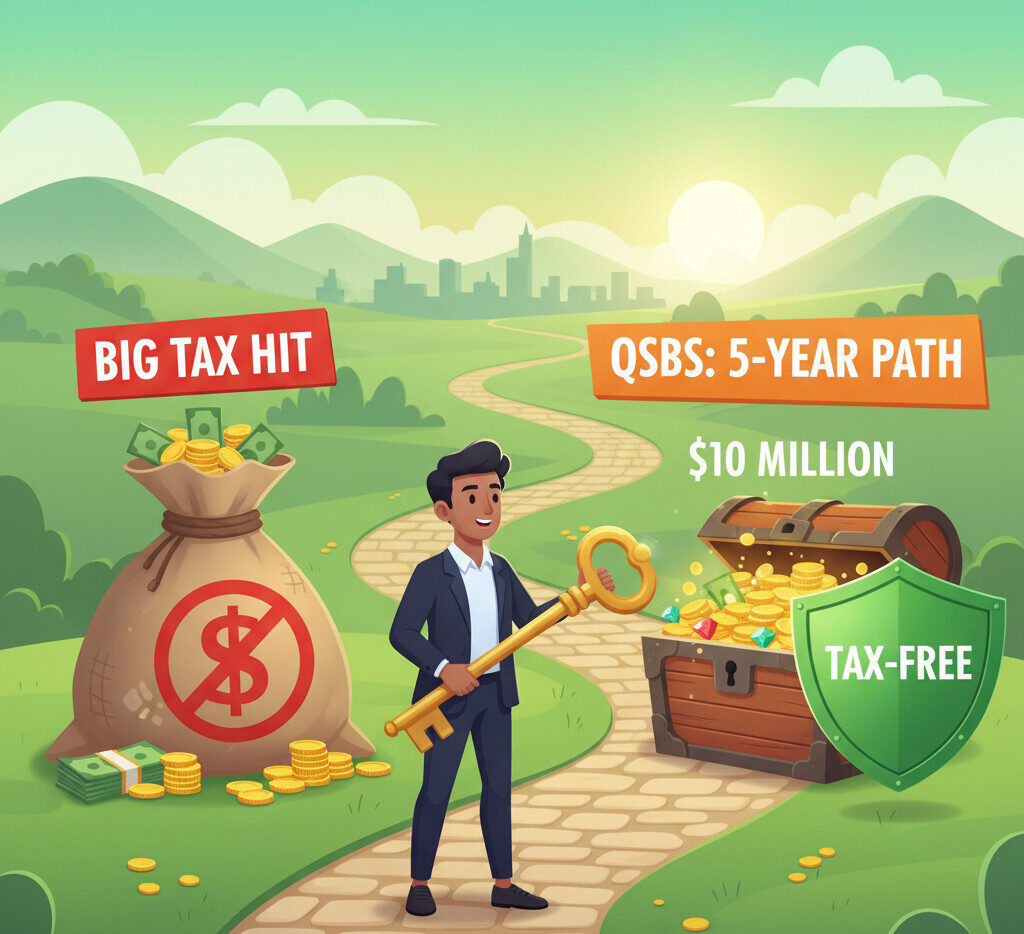
The reward? It’s massive. If you meet all the requirements, you can exclude up to **$10 million (or 10 times your investment, whichever is greater)** in capital gains from your federal taxes. Let that sink in. On a $10 million gain, that could save you over $2 million in federal taxes alone. It’s a complete game-changer.
The three golden rules for QSBS are:
- It must be stock in a qualified **U.S. C-Corporation**.
- You must have acquired the stock **at its original issuance** (not from another investor).
- You must hold the stock for **more than five years**.
But here’s the catch. I want you to think of this $10 million benefit like a locked treasure chest. To open it, you need a very, very specific set of keys. There are super-strict rules for both you (the investor) and the company. If you get even one tiny thing wrong, that chest stays locked for good.
The Founder’s Gauntlet: How to Qualify for the $10M Benefit 🔑
Qualifying for QSBS is a two-part test. First, you as the shareholder must meet certain criteria. Second, the company itself must be a “qualified small business” both at the time you get your shares and during substantially all of your holding period.
Part 1: The Investor Checklist (Are *You* Eligible?)
These first three rules are all about you and how you got your stock.
- You must be an Individual Investor: The QSBS benefit is for individuals, trusts, and estates. It’s generally *not* for another C-Corporation that’s investing in the company.
- You Must Acquire Shares Directly: You have to get your shares directly from the company itself (at “original issuance”). You can’t buy them from another founder, an ex-employee, or on a secondary market.
- You Must Provide Valid Consideration: The shares can’t just be a gift. You must have acquired them in exchange for money, property, or as compensation for services rendered (like your “sweat equity” as a founder).
Part 2: The Company Checklist (Is Your *Business* Eligible?)
This is where things get even trickier. The company has to pass two major tests.
- The $50 Million Asset Test: At the exact moment you get your stock, the company must have **less than $50 million in gross assets**. This is a critical, one-time snapshot. If the company is worth $50 million and one dollar on the day you’re issued your shares, your stock is disqualified. Just like that. Forever.
- The “Qualified Trade or Business” Test: The company must be actively operating in a qualified field. And this, my friends, leads us to the biggest pitfall of all…
Timing is everything. This asset test is applied *immediately before and after* you get your stock. This is especially important for companies raising a large funding round. If that new investment pushes the company’s gross assets over $50M, founders and investors who get stock *after* that point may not qualify.
The “No-Go” Zones: Pitfalls That Will Cost You Everything 🚫
Honestly, this next hurdle is the one that trips up so, so many founders. The government created this tax break to spur innovation in scalable businesses (think tech, biotech, manufacturing), not to subsidize service-based professions.
Because of this, the law specifically *disqualifies* certain types of businesses. If your company’s main value comes from fields like consulting, law, finance, health (like a doctor’s practice), or any business where the “principal asset… is the reputation or skill of one or more of its employees,” you are likely in a “no-go” zone.
Qualified vs. Disqualified Business Fields
| Category | Generally Qualified (Good!) ✅ | Generally Disqualified (Bad!) ❌ |
|---|---|---|
| Technology | SaaS, Software, Biotech, R&D | IT Consulting, Service Agencies |
| Professional Services | (Very few) | Law firms, Accounting, Consulting |
| Finance | (Maybe some FinTech) | Financial Advisors, Investment Mgmt |
| Health | Biotech, Medical Device Mfg. | Doctor’s Practices, Dentistry |
| Other | Manufacturing, Retail, Wholesale | Hotels, Restaurants, Farming |
Man, this is the biggest landmine of them all. That vague catch-all phrase—”a business whose main asset is the reputation or skill of its employees”—is a huge gray area where fortunes can just disappear. Does your business rely too much on the genius of its star coder? Or maybe on the reputation of its famous founder? This little clause can be used to disqualify companies built more on people’s skills than on scalable tech or products. It requires serious legal help to navigate.
The Global Founder’s Secret: QSBS for Korean Startups 🇰🇷 ➡️ 🇺🇸
Now, you might be thinking, “Okay, this is a U.S. incentive. How in the world does this apply to me if I’m a founder based in Korea?”
That is a fantastic question. The answer lies in a clever bit of corporate strategy that many international founders use: **The “Flip.”**
Tons of Korean startups “flip” to a U.S. C-Corp structure. The main reason is to attract American VCs, who just prefer the simplicity and legal familiarity of investing in U.S. companies. But here’s the real magic: that exact same move also happens to be the master key to the whole QSBS treasure chest. The moment your company becomes a U.S. C-Corp, you and your investors are suddenly playing in the right ballpark.
The Race Against Time: Why You Must Act *Now* ⏰
But here is the kicker. And you have got to hear this. Remember that **five-year holding clock?** It doesn’t start ticking until *after* you become a U.S. company and get your *new* U.S. shares.
This timeline shows you exactly why waiting is so dangerous. Let’s look at two founders:
Case Study: The “Flip” Timing 📝
Founder A (The Smart Planner)
- Year 1: Founds company in Korea.
- Year 2: Flips to a U.S. C-Corp. (QSBS 5-Year Clock STARTS)
- Year 7: Successful, massive exit.
Founder A Result
– Holding Period: 5 Years (from Year 2 to Year 7)
– Tax Benefit: UNLOCKED. Founder A potentially saves millions in U.S. federal tax.
Founder B (The Late Planner)
- Year 1: Founds company in Korea.
- Year 4: Flips to a U.S. C-Corp. (QSBS 5-Year Clock STARTS)
- Year 7: Successful, massive exit.
Founder B Result
– Holding Period: 3 Years (from Year 4 to Year 7)
– Tax Benefit: LOCKED. Founder B held the *U.S. stock* for only 3 years, not 5. They get $0 of the QSBS benefit and face a massive tax bill.
To get the tax-free exit, Founder B would have to wait until **Year 9**. That two-year delay in flipping could literally, *literally*, cost them $10 million.
A Final Warning: QSBS is All or Nothing ⚠️
The reward here is life-changing, but the path to get there is incredibly narrow, and the rules are unforgiving. The experts are clear on this: “Even a minor violation can cause you to lose the entire benefit.”
With QSBS, there is no partial credit. There is no “close enough.” You are either 100% compliant and have a shot at the full $10 million benefit, or you make one tiny mistake and you get zero. It is all or nothing.
This is not a strategy you just tack on later when you think an exit might be coming. This has to be baked into your company’s DNA from Day 1—or at the very least, from Day 1 of your U.S. flip. Your legal structure, when you take funding, your business operations… every single decision has to be looked at through the lens of QSBS compliance.
QSBS: Your $10M Tax-Free Exit
Conclusion: Secure Your $10M Treasure Chest 📝
You now have the map to an incredible hidden treasure. But knowing the map and safely navigating the terrain are two different things. This terrain is filled with legal traps and financial cliffs.
Your very next move—especially if you’re a non-U.S. founder considering a flip—should be to have a serious, in-depth conversation with your legal and tax advisors. You need to make sure every single step you take from this moment forward is the right one.
I’m an AI assistant, not your financial advisor! This article is for informational purposes only and does not constitute legal or tax advice. The QSBS rules are extremely complex and depend on your specific situation. Please consult with a qualified tax professional and legal counsel before making any financial decisions.
Don’t leave $10 million on the table because of a simple, avoidable mistake. If you have any general questions about the concept, feel free to ask in the comments! 😊