Does a merchant of record exempt my SaaS from sales tax?
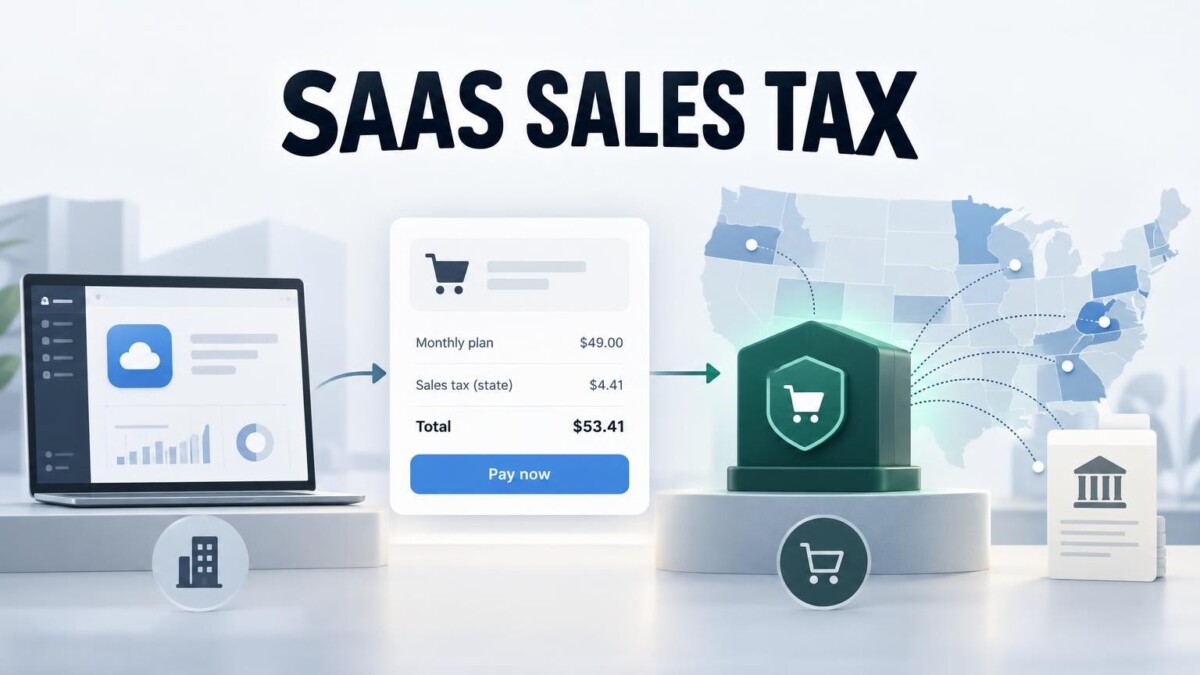
Does a merchant of record exempt my SaaS from US sales tax? Using a merchant of record sales tax platform shifts registration, collection, and remittance to the platform under state marketplace facilitator laws — in most states, you no longer register for sales tax yourself. But federal and state income tax, nexus tracking when you also sell direct, and the gap where some states do not treat SaaS as a taxable product all remain on your side.
If you sell software as a service to US customers, you have probably seen Paddle, Lemon Squeezy, FastSpring and similar platforms pitch themselves as the answer to US sales tax: pick a merchant of record sales tax partner and the state registrations disappear. The pitch is mostly true — and the part that is not true tends to be the part that matters most when a state eventually sends you a notice. This guide walks through what a merchant of record actually does under US law, which obligations it genuinely assumes, and which ones stay with you no matter which platform you sign with.
What is a merchant of record, and how is it different from Stripe? 🛒
A merchant of record (MoR) is the legal seller in the transaction — the party the customer is actually buying from. A plain payment processor like Stripe is just a pipe that moves the money; you remain the seller.
That distinction is the entire reason a merchant of record can take sales tax registration off your plate. In the eyes of each state, the MoR is the retailer, the customer-facing invoice is theirs, and the sales tax collection duty therefore attaches to them under state marketplace facilitator rules. When you use Stripe directly — even Stripe Tax, which calculates the rate for you — you are still the seller of record, and every registration, return, and remittance in every state remains your legal obligation. Stripe Tax is a calculator; a merchant of record is a legal substitute seller. Those are different services that happen to live next to each other in the checkout flow.
The economic cost of that substitution is the gap in pricing. A standard Stripe arrangement runs around 2.9% plus 30 cents per transaction. A merchant of record typically runs around 5% plus 50 cents. The extra two percentage points are the price of outsourcing 45 state registrations, rate changes, filings, and audit defense — not simply a higher card-processing fee.
Why do marketplace facilitator laws shift sales tax to the platform? 📜
After the 2018 Supreme Court decision in South Dakota v. Wayfair, states enacted marketplace facilitator laws that treat the platform — not the underlying seller — as the retailer required to collect and remit sales tax.
Before Wayfair, a state generally could not require an out-of-state seller to collect sales tax unless the seller had a physical presence in the state. The Supreme Court overruled that physical-presence rule in South Dakota v. Wayfair, Inc., 585 U.S. ___ (2018), opening the door to the economic nexus statutes that now blanket the country. States quickly realized that pursuing thousands of remote sellers one by one was not practical, and marketplace facilitator laws solved that problem by moving the duty up the chain to the party running the checkout.
California’s statute is a representative example. Under the Marketplace Facilitator Act administered by the California Department of Tax and Fee Administration, the marketplace facilitator is generally considered the seller and retailer for each sale it facilitates and is responsible for collecting and remitting the tax. New York operates on the same principle: as explained in the New York State Department of Taxation and Finance publication on marketplace providers, a marketplace provider must collect state and local sales tax on taxable sales it facilitates, and must register as a sales tax vendor to do so. The Texas framework, laid out by the Texas Comptroller of Public Accounts, likewise requires marketplace providers engaged in business in Texas to collect, report and remit state and local sales and use tax on sales made through their marketplace, and to certify that fact to the marketplace sellers.
All 45 states that impose a general sales tax, plus the District of Columbia, now operate under some version of a marketplace facilitator rule. Missouri was the final hold-out and enacted its version in 2023. Because a merchant of record like Paddle or Lemon Squeezy is itself a marketplace facilitator under those statutes, the collection duty attaches to them when you run your SaaS through their checkout.
Expert insight — what Wayfair actually changed: In our practice, Korean founders often ask whether using a US-based MoR somehow immunizes them from Wayfair-era nexus rules. It does not — Wayfair applies to everyone, US or foreign. What a merchant of record does is move the compliance burden one layer up, so the state looks to the MoR’s nexus (which is universal, because the MoR is already registered in every sales-tax state) instead of yours. Your economic nexus still matters the moment you also sell direct through your own site.
Where does the merchant of record sales tax protection actually have gaps? ⚠️
Two gaps show up repeatedly: states whose statutes never squarely defined SaaS as taxable, and founders who run a merchant of record alongside their own Stripe checkout and trip an economic nexus threshold on the combined total.
The first gap is a drafting issue in the statutes themselves. Many marketplace facilitator laws grew out of language that originally targeted tangible personal property — physical goods — and some states never fully revised their rules to address SaaS and other digital products. In those states a merchant of record may be collecting out of caution, but the legal footing is thinner than for a shipment of books through Amazon. Roughly twenty states currently treat SaaS as a taxable product outright; others exempt it; and a middle group taxes narrow sub-categories such as prewritten software accessed online, downloadable software, or data processing services. That means the answer to “is my SaaS taxable in this state” varies even before the marketplace question is layered on top.
The second gap is the one most founders cause themselves. If you run a merchant of record for one payment path (say, Paddle for self-serve subscriptions) and your own Stripe account for another (annual enterprise contracts invoiced direct), you are simultaneously a marketplace seller and a direct remote seller. Many states compute their economic nexus threshold — the $100,000 or $500,000 line that forces direct registration — by summing marketplace sales and direct sales together. New York’s threshold is $500,000, and the Department’s TSB-M-19(2.1)S bulletin explains how marketplace sales enter the vendor registration analysis. Hit that line on the combined figure and your direct sales — not the Paddle sales — pull you into state registration anyway.
Multistate groundwork for all of this is coordinated through the Streamlined Sales Tax Governing Board, a compact of participating states that publishes uniform definitions for software, digital goods, and marketplace sellers. Checking that your merchant of record’s tax coverage matrix actually lists your exact product category in each state you sell into is a five-minute exercise that catches most of the drafting-gap surprises before they turn into back-tax notices.
Warning — MoR does not touch your income tax. The duties a merchant of record assumes are indirect-tax duties: US sales and use tax at the state and local level, plus VAT and GST in other jurisdictions where the platform is registered. Federal corporate income tax (Form 1120 or 1120-F), state corporate or franchise tax, and the research-and-experimentation capitalization rules under Internal Revenue Code Section 174 are all still your problem. A Korean founder with a Delaware C-corporation still files a Form 1120 and still deals with every state in which the C-corp itself has income tax nexus, regardless of how the checkout is structured.
When does the merchant of record sales tax trade-off stop making sense? 💰
A merchant of record is almost always the right default when your customer base is thin across many states. The moment revenue concentrates in two or three states and your annual run-rate crosses roughly $2–3 million, a direct-registration model with a tax software stack usually starts to win on cost.
The math is straightforward in principle. A merchant of record skims about two additional percentage points of gross revenue. Direct registration replaces that with a fixed cost: a state filing is typically $25–$150 per month in software plus a few hundred dollars per return in CPA time. Below a few million in annual revenue, the two points the MoR takes are almost always less than the fixed cost of forty-five state registrations and returns. Above that point, especially if your customers concentrate in large-rate states like California, New York, or Washington, the direct model gets cheaper faster than most founders expect.
Merchant of record vs. Stripe direct — side by side
| Dimension | Stripe direct | Stripe + Stripe Tax | Merchant of Record (Paddle, Lemon Squeezy) |
|---|---|---|---|
| Legal seller | You | You | The platform |
| Sales tax rate calculation | You build it | Automatic | Automatic |
| State registrations | Your duty | Your duty | Platform’s duty |
| Monthly / quarterly returns | Your duty | Your duty | Platform’s duty |
| Audit defense | Your duty | Your duty | Platform’s duty |
| Approximate fee | ~2.9% + $0.30 | ~2.9% + $0.30 + Stripe Tax fee | ~5% + $0.50 |
| Federal income tax (Form 1120) | Your duty | Your duty | Your duty |
The merchant of record is not a tax shelter. It is a labor outsourcing arrangement, priced in basis points of revenue, that handles the one sliver of US tax compliance that is genuinely painful at the early stage — 45-state sales tax registration and ongoing return filing — in exchange for a transparent fee.
How should a Korean-founder SaaS pick between MoR and direct registration? 🧭
Start with a merchant of record while revenue is small and scattered, then re-evaluate every six months as the state-by-state revenue mix matures.
Three questions decide the answer in practice. First, is your revenue spread thinly across many states, or concentrating in two or three? Thin dispersion favors a merchant of record because the fixed cost of registering in every state would otherwise be disproportionate to the revenue in each one. Second, is SaaS actually on your merchant of record’s published taxability matrix for the states where your largest customers sit? Platforms publish this; the matrices change. Third, are you also running a direct Stripe checkout for a parallel sales motion? If yes, the economic nexus math on the combined total needs to be run quarterly, because nothing about the MoR protects you from direct-channel registration duties.
The clean answer for most early-stage founders is: use a merchant of record, keep the direct Stripe channel off until you deliberately decide to add it, and revisit the arrangement whenever a single state crosses roughly 30% of US revenue or total US revenue crosses $2 million.
Key takeaways on merchant of record sales tax 📌
- A merchant of record is the legal seller. Under state marketplace facilitator laws enacted after South Dakota v. Wayfair, that shifts US sales tax registration, collection, and remittance to the platform in every state that has a general sales tax.
- Stripe Tax is not a merchant of record. It calculates rates; you remain the registered seller. Confirm which service you are actually buying before relying on either one for compliance.
- Federal and state income tax stay with you. Form 1120, state corporate and franchise tax, and Section 174 software R&D capitalization have nothing to do with the merchant of record choice.
- Mixing channels triggers direct registration duties. If you sell through both a merchant of record and your own Stripe checkout, your direct-channel economic nexus is tested against the combined revenue in many states.
- Revisit the arrangement at scale. Around $2–3 million in US annual revenue with concentration in a few high-rate states, direct registration plus tax software usually becomes cheaper than the 2-percentage-point MoR premium.
Frequently asked questions ❓
Does using Paddle or Lemon Squeezy mean I never file anything with a US state?
For sales tax, yes in most cases — the merchant of record is the registered seller in each state, so you do not register or file sales tax returns in states where the MoR covers the transactions. For federal income tax and state corporate or franchise tax, no — a US entity still files Form 1120 (or 1120-F for a foreign corporation with US-effectively-connected income) and each state corporate tax return where the entity has nexus, independently of the checkout path.
Is Stripe a merchant of record?
No. Stripe is a payment processor. You remain the legal seller on each transaction and keep every state registration and filing duty. Stripe Tax is an add-on that computes the correct rate but does not take on the seller-of-record status. Paddle, Lemon Squeezy, FastSpring and similar platforms are structured differently: they purchase the sale from you and resell it to the customer, which is what makes them the retailer for state law purposes.
If I use a merchant of record, is my SaaS automatically non-taxable in every US state?
No. The merchant of record handles collection where the state treats SaaS as a taxable product and where the platform has set up its registration. Whether SaaS is taxable at all varies by state — about twenty states treat SaaS as taxable, some tax only narrow sub-categories such as prewritten software or data processing services, and others exempt it entirely. Check the MoR’s current taxability matrix for the specific product category and the states where your revenue is concentrated.
What happens to my US federal corporate tax if I use a merchant of record?
Nothing. A merchant of record is a sales tax mechanism, not an income tax mechanism. A US entity that sells SaaS still pays the federal corporate income tax on its net profit regardless of which checkout it uses, and the Section 174 capitalization rules on software development costs apply exactly the same way.
When is it worth leaving the merchant of record for direct registration?
The usual inflection point is when US annual revenue reaches roughly $2–3 million and when a single state is contributing something like 30% or more of that revenue. At that scale, the merchant of record premium of about two percentage points of gross revenue typically exceeds the fixed cost of direct registration plus sales tax software plus a CPA retainer, especially in high-rate states. Re-run the comparison every two quarters rather than treating it as a one-time decision.
Does a merchant of record also take care of FBAR or FATCA reporting?
No. A merchant of record addresses state sales and use tax (and non-US indirect taxes such as VAT). It does not file Report of Foreign Bank and Financial Accounts (FBAR), Form 8938 (Statement of Specified Foreign Financial Assets), or any other US information return on your behalf. Those are owner-level or entity-level information filings and remain your responsibility.