Section 351 ETF conversion: Rev. Rul. 2026-20
The pitch was simple enough that it moved real money this year. An investor sitting on a highly appreciated portfolio of individual stocks transfers that portfolio to a newly launched ETF in exchange for ETF shares, relying on IRC § 351. Within days, the ETF uses the just-received securities to redeem shares held by an authorized participant and swaps in a different, diversified portfolio. The investor walks out holding ETF shares backed by a very different basket than the one they contributed, with no capital-gains tax recognized. On October 1, 2026, the Internal Revenue Service released Rev. Rul. 2026-20 and said that version of the Section 351 ETF conversion does not work. The investor is treated as having engaged in a taxable exchange of the swapped-out securities with the authorized participant, with the ETF disregarded as a mere conduit. This post walks through what the ruling holds, who is in the crosshairs, and what — if anything — of the diversification playbook survives.
What is a Section 351 ETF conversion, in one page? 📘
A Section 351 ETF conversion is a planned contribution of appreciated securities to a newly formed ETF in exchange for ETF shares, structured so the transfer qualifies for nonrecognition under Section 351 and the investor ends up holding a diversified ETF instead of concentrated stock, without recognizing the built-in gain.
Section 351 is the Code’s workhorse for tax-free incorporations: no gain or loss is recognized when one or more persons transfer property to a corporation solely in exchange for stock, if immediately after the exchange the transferors are in control of the corporation. The regulations require the transferred portfolio to be diversified. Promoters of the ETF conversion read those two requirements together and marketed a package: contribute concentrated stock to a brand-new ETF, meet the diversification test, receive ETF shares at carryover basis, and defer tax.
The second half of the strategy relies on IRC § 852(b)(6), which turns off the usual rule in IRC § 311(b) that forces a corporation to recognize gain when it distributes appreciated property. For a regulated investment company, IRC § 852(b)(6) provides that in-kind redemptions do not trigger gain at the fund level. ETFs use this provision every trading day to redeem authorized participants with baskets of securities instead of cash — that is how the ETF ‘arbitrage’ mechanism keeps the market price close to NAV.
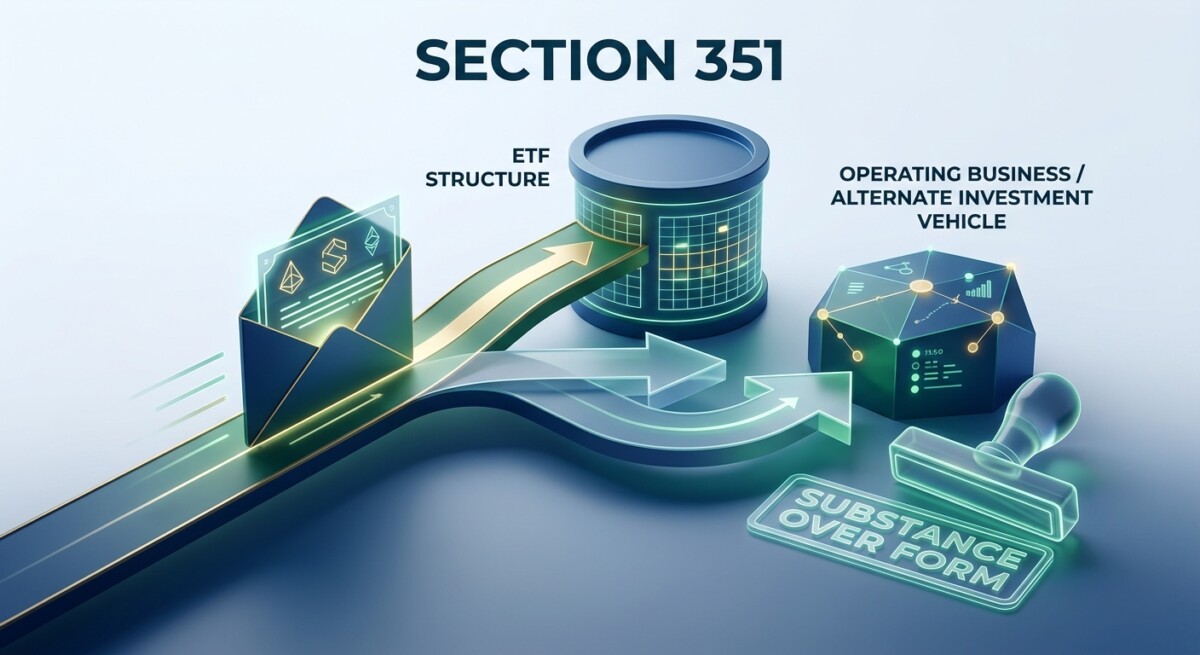
The promoted conversion stacks the two provisions. The investor’s Section 351 transfer brings appreciated securities into the ETF tax-free. A near-simultaneous Section 852(b)(6) redemption pushes those same securities out to an authorized participant, tax-free at the ETF level, in exchange for a different basket of securities. The investor is left with ETF shares backed by the new basket, carrying over the original low basis. Promoted as a ‘diversification without tax,’ the arrangement treats a sale as a reorganization.
What did Rev. Rul. 2026-20 actually hold? ⚖️
The ruling holds that when the plan includes both the Section 351 contribution and a Section 852(b)(6) redemption of the same securities to an authorized participant, the ETF’s transitory ownership is disregarded and the investor is treated as having engaged in a taxable Section 1001 exchange with the authorized participant for the securities that are swapped out.
The facts in the ruling are stylized but unmistakable. An investor transfers a diversified portfolio of appreciated securities to a newly formed ETF intending Section 351 treatment. Pursuant to the same plan, the ETF issues shares to an authorized participant for a different basket of securities (or cash the ETF will use to buy that basket), and shortly thereafter the ETF redeems the authorized participant’s shares under Section 852(b)(6) by handing over the investor’s contributed securities. The ETF ends up with the authorized participant’s basket; the investor ends up with ETF shares backed by that different basket.
The IRS applies two long-standing doctrines. First, substance over form: a transaction’s tax consequences follow its economic substance, not its labels. Second, the step transaction doctrine: pre-arranged steps are collapsed when they are integrated parts of a single plan. The ruling walks through the controlling precedents — Minnesota Tea Co. v. Helvering, 302 U.S. 609 (1938) on not letting a ‘devious path’ change a straight-path result, and Commissioner v. Court Holding Co., 324 U.S. 331 (1945) on refusing to let a corporation serve as a ‘conduit through which to pass title’ — and applies them to the ETF.
The holding is specific. The investor is treated as having disposed of the swapped-out securities in a Section 1001 exchange directly with the authorized participant for ‘other property differing materially in kind or extent.’ That is textbook recognition. The investor’s basis in the ETF shares is adjusted accordingly, and the tax deferral promised by the planned conversion disappears for the portion of the portfolio that walks out the back door.
From our practice: the ruling tells you where the IRS was always looking
In our Los Angeles practice, the first question we always ask on a promoted Section 351 ETF conversion is whether the client’s securities are the ones the ETF plans to redeem. That question has been the whole case all along. Rev. Rul. 2026-20 doesn’t invent new tax policy — it writes down what substance-over-form and the step transaction doctrine have required for eighty years. The surprise is that anyone ever expected a different answer.
Who is in the crosshairs — and who is not? 🎯
The ruling targets planned Section 351 contributions coupled with an authorized-participant redemption of the same contributed securities. ETFs that simply receive contributed securities and manage them within the stated strategy, without a planned swap-out, are not described in the fact pattern.
Read the ruling tightly and three categories fall out. The crosshair group is the one the IRS stylized: investors who contributed concentrated stock to a new ETF where the plan was always to swap it out to an authorized participant for the ETF’s target basket. Those investors face the recharacterization squarely, and they face it on the facts the IRS has already written down.
A second group is in a grayer zone: investors who contributed to an ETF that did not pre-commit to a swap-out but used Section 852(b)(6) redemptions in the ordinary course and ended up swapping the contributed securities out quickly in response to market demand. The ruling does not describe this fact pattern, but the step transaction and substance-over-form doctrines are doctrine-based, not fact-pattern-limited. Whether the IRS or a court applies them depends on how much of the swap-out was pre-arranged and documented, how long the ETF actually held the contributed securities, and whether the swap-out served the ETF’s investment thesis or the investor’s tax plan.
A third group is likely fine on these facts. An investor who contributes securities to an ETF that keeps and manages the contributed portfolio under its stated strategy — rebalancing over time, redeeming authorized participants from the fund’s ongoing operations rather than from the specific contribution — is in the Section 351 fact pattern the Code actually describes, with no pre-arranged exit. That is a different story than the one the IRS tells in Rev. Rul. 2026-20.
| Investor profile | Rev. Rul. 2026-20 exposure |
|---|---|
| Contributed to a new ETF with a planned swap-out to an authorized participant for the contributed securities | Direct hit. Section 1001 recognition on swapped-out positions; ETF disregarded as conduit. |
| Contributed to an ETF with no written plan, but ETF swapped out contributed securities quickly after launch | Fact-dependent. Risk turns on step-transaction evidence — plan documents, timing, holding periods, who initiated the redemption. |
| Contributed to an operating ETF that retained and managed the contributed portfolio under its stated strategy | Likely outside the ruling. Pattern not described; ordinary Section 351 and Section 852(b)(6) rules apply. |
Prior guidance does not provide cover
Rev. Rul. 2026-20 directly addresses the two older rulings most often cited by promoters. It distinguishes Rev. Rul. 75-447 and Rev. Rul. 88-32 — meaning they do not apply to the fact pattern described — and it amplifies Rev. Rul. 71-336, which recharacterized a pre-arranged contribution-and-redemption as a taxable stock-for-stock exchange among the shareholders. A memo relying on the older rulings to opine comfort on the new fact pattern is no longer defensible.
How does a Section 351 ETF conversion get recharacterized on the return? 📋
The IRS treats the investor as having engaged directly with the authorized participant in a Section 1001 exchange of the swapped-out securities for other property, meaning the authorized participant’s basket. Gain or loss is computed on that exchange, and basis in the ETF shares is adjusted.
Three mechanical consequences follow once the recharacterization is applied:
- Gain on the swapped-out positions. The investor recognizes gain or loss on the securities that leave the ETF under Section 852(b)(6), measured as fair market value received minus the investor’s historical basis in those positions. For a long-held, appreciated portfolio, this is the full built-in gain the conversion was designed to defer.
- Basis in the ETF shares. The ETF shares the investor retains carry a basis that reflects the recharacterization. The gain just recognized on the swapped-out securities is pulled into the investor’s basis story so the investor is not double-taxed on a later sale of the ETF shares, but the net result is that the deferral the plan sought simply does not happen.
- Holding period and character. The swapped-out positions produce long-term capital gain or loss based on the investor’s historical holding period in the contributed securities. That is often the only mitigating fact — long-held concentrated stock is usually long-term — but the preferential rate does not change the headline: tax is due now.
For a California resident in the top combined bracket, that math is unforgiving. Long-term capital gains are federally taxed at up to 20%, add the 3.8% net investment income tax, and add California’s top ordinary rate on gains, which treats capital gains as ordinary. A $5 million recharacterized exchange on highly appreciated stock can produce a combined tax liability north of $1.6 million. The conversion sold the client on exactly that savings.
What should advisors do between now and April? 🧭
Review every open-year conversion against the Rev. Rul. 2026-20 fact pattern, model the recharacterized tax, decide whether a protective amended return or a disclosure statement is warranted, and reset client expectations on anything in the pipeline.
- Inventory the universe. Pull every Section 351 ETF conversion the firm has documented for the last three to four tax years. Flag any transaction where the ETF redeemed an authorized participant in whole or in part with the client’s contributed securities within a short window after launch.
- Score each one against the ruling. Document the plan evidence, the timing, the identity of the authorized participant, and whether the contributed securities were swapped out. A conversion that cleanly stays outside the fact pattern should be papered that way; one that clearly falls inside should be modeled for recharacterized tax.
- Decide on protective filings. For prior years still within the statute of limitations, the choices are amended returns, Form 8275 disclosure statements with the original return as-filed, or no action with a reasoned memo in the file. The right answer depends on how clearly the facts match the ruling and on the client’s appetite for an audit fight.
- Pause the pipeline. Any Section 351 ETF conversion still in planning should be redesigned so the contributed securities stay in the fund or the deferral case should be abandoned. Diversification is still available through other paths; it just cannot be bought for free with this specific structure.
- Document client conversations. Clients who were sold the strategy on pre-ruling comfort letters need a written reset. The firm’s record of what it said and when it said it is the only defense against a later malpractice look-back.
What tax-free (or tax-light) diversification routes remain? 🪜
Several. Exchange funds under partnership rules, direct-indexed loss harvesting, qualified opportunity funds for a different kind of deferral, charitable remainder trusts for philanthropic clients, and plain-vanilla gradual selling with offsetting losses. Each has its own tax cost; none of them pretends to be free.
The usefulness of each path depends on the client’s wealth, time horizon, charitable intent, and tolerance for complexity. None of them matches the headline simplicity the Section 351 ETF conversion promised. That simplicity was always the warning sign. The structures that remain are structures the Code and regulations actually describe, which is why they continue to work.
Summary: Section 351 ETF conversion and Rev. Rul. 2026-20
- Rev. Rul. 2026-20 recharacterizes a planned Section 351 contribution plus Section 852(b)(6) redemption of the same securities to an authorized participant as a taxable Section 1001 exchange between the investor and the authorized participant.
- The ETF is treated as a mere conduit. The investor’s deferral on the swapped-out positions is lost; built-in gain is recognized now.
- Prior rulings cited in sales materials — Rev. Rul. 75-447 and Rev. Rul. 88-32 — are distinguished; Rev. Rul. 71-336 is amplified.
- Conversions where the ETF retains and manages the contributed portfolio under its stated strategy, without a planned swap-out, are not the fact pattern the ruling targets.
- Advisors should inventory open-year conversions, decide on protective filings, pause pipeline transactions, and reset client expectations in writing.
Frequently asked questions about Section 351 ETF conversions ❓
Q. What is a Section 351 ETF conversion?
It is a tax strategy in which an investor transfers an appreciated portfolio of securities to a newly formed exchange-traded fund in exchange for ETF shares, intending the transfer to qualify as a tax-free exchange under IRC Section 351. The investor ends up holding shares of a diversified ETF instead of the original stocks, with the built-in gain deferred rather than recognized.
Q. What did IRS Rev. Rul. 2026-20 decide about Section 351 ETF conversions?
The IRS ruled that when the same plan includes both the Section 351 transfer of securities to the ETF and a shortly following distribution of some or all of those same securities to an authorized participant under Section 852(b)(6), the transaction is recharacterized. The ETF is treated as a mere conduit, and the investor is treated as having engaged in a taxable Section 1001 exchange with the authorized participant for the securities swapped out.
Q. Does Rev. Rul. 2026-20 shut down every Section 351 ETF conversion?
No. The ruling targets a specific pattern: a planned Section 351 contribution combined with a Section 852(b)(6) redemption of the same contributed securities to an authorized participant, resulting in a materially different portfolio. A conversion in which the ETF simply holds the contributed securities and manages the portfolio normally — without a planned swap-out at inception — is not what the ruling recharacterizes.
Q. When is Rev. Rul. 2026-20 effective?
Revenue rulings generally apply to any open tax year unless the ruling itself specifies a prospective-only effective date. Rev. Rul. 2026-20 contains no prospective-only limitation. Investors who completed the targeted pattern in a prior year with an open statute of limitations should assume the IRS will apply the ruling and should discuss protective amended returns or disclosure with their advisor.
Q. How does the IRS justify recharacterizing the transfer?
The ruling applies long-standing judicial doctrines — substance over form and the step transaction doctrine — to look through the ETF’s transitory ownership of the swapped-out securities. The IRS cites Supreme Court decisions including Court Holding Co. (1945) and Minnesota Tea (1938), and Fifth Circuit precedent in Kuper v. Commissioner (1976), all of which support disregarding an intermediary when a single plan passes title through it to another party.
Q. What should advisors who recommended Section 351 ETF conversions do now?
Three steps. First, map any pending conversion to the fact pattern in Rev. Rul. 2026-20 — in particular whether the plan contemplates an authorized-participant redemption of the contributed securities. Second, revisit returns for closed conversions still within the statute of limitations and model the tax cost if the IRS applies the ruling. Third, do not rely on sales-pitch comparisons to older rulings; Rev. Rul. 2026-20 explicitly distinguishes Rev. Rul. 75-447 and Rev. Rul. 88-32 and amplifies Rev. Rul. 71-336.
This article is general information, not tax or legal advice for your situation. Section 351 ETF conversion facts turn on the plan documents, the timing of each step, and the identity of the authorized participant. If you or your firm has used this structure in the last three years, contact SW Accounting & Consulting Corp for a confidential review before the ruling drives the first notices. Background on IRS revenue rulings is on the IRS website.